
- A China plastic mold factory can reduce tooling and per-part costs while supporting OEM plastic manufacturing at scale.
- Good suppliers add value through DFM review, mold testing, material guidance, and export coordination, not just machining.
- For e-commerce, the best mold partner balances appearance, assembly tolerance, lead time, and repeatability.
- Quality control should be defined by measurable standards such as dimensional tolerance, gate quality, and cosmetic acceptance criteria.
- Choosing the right factory is a supply-chain decision, not only a purchasing decision.
For e-commerce sellers, the China plastic mold factory model matters because injection molding is built for repeatable, high-volume production, and many consumer products require tight fit, good surface finish, and stable assembly. In precision moldmaking, process accuracy is often managed around machine and mold capability standards such as ISO 230-1:2022, while part design is frequently judged against tolerance and fit requirements that can be verified before mass production. If your product includes housings, covers, clips, or decorative shells, the right OEM plastic manufacturing partner can reduce unit cost, improve consistency, and make cross-border fulfillment more predictable.
Why a China Plastic Mold Factory Fits E-Commerce Supply Chains
The main reason e-commerce sellers use a China plastic mold factory is simple: the model aligns with fast SKU growth and demand volatility.
Unlike low-volume fabrication, a mold is an asset that can produce thousands or millions of identical parts with controlled repeatability. That matters for online sellers, where one weak product batch can create returns, bad reviews, and ad spend waste. Injection molding also supports a wide material range, including PP, ABS, PC, PA, and TPE, so the same supplier can often serve different product families.
For sellers, the practical question is not whether plastic molding works, but whether the factory can support the full path from concept to shipment. A capable supplier should review CAD files, suggest wall-thickness changes, flag undercuts, recommend draft angles, and confirm material behavior before cutting steel.
That is where injection molds matter most: they are the bridge between an online product idea and a repeatable industrial process. If your product line includes accessories, enclosures, or home goods, a mature plastic parts workflow can lower sourcing friction and simplify replenishment planning.
What E-Commerce Sellers Actually Gain from OEM Plastic Manufacturing
The biggest advantage of OEM plastic manufacturing is control over the final product geometry, appearance, and cost structure.
When sellers source finished plastic items from trading layers, they often lose visibility into mold design, resin choice, and defect root causes. OEM work reverses that. It lets the buyer define the product around manufacturability instead of adapting the product to whatever the market already offers.
In practice, that means better fit between parts, fewer assembly failures, and more predictable cosmetic quality. It also makes private-label differentiation possible. A small change in texture, logo placement, clip geometry, or window thickness can create a distinct listing without reinventing the entire product.
For products such as electronics housings, appliances, and industrial accessories, structure and appearance are inseparable. Buyers often choose a plastic housing mold approach because the exterior surface is part of the product value, not just packaging around it.
Technical Reasons a Plastic Mold Improves Product Economics
A plastic mold improves economics because tooling cost is front-loaded while per-part cost falls sharply as volume rises.
That is the classic tradeoff in OEM plastic manufacturing. A mold may require significant upfront investment, but once qualified, each molded part usually costs far less than machining, manual assembly, or short-run fabrication. The exact break-even point depends on cavity count, resin price, cycle time, and annual volume, but the cost curve typically favors molding as demand stabilizes.
Cycle time is one of the most important variables. In industrial injection molding, total cycle time can range from under 20 seconds for simple parts to more than 60 seconds for thicker or more complex components, depending on part thickness, cooling design, and ejection behavior. Faster cycles raise throughput, but only if the tool maintains dimensional stability and avoids warpage.
Material choice also affects economics. PC is often selected for transparent or impact-resistant housings because it offers high toughness and good dimensional stability, while ABS is widely used for consumer product shells because it balances cost, surface quality, and processability. If the product needs premium clarity or impact resistance, PC plastic parts can be a strong fit for display windows, protective covers, and device enclosures.
| Decision Factor | Typical Range | Why It Matters for E-Commerce |
|---|---|---|
| Injection cycle time | 20-60 seconds | Directly affects unit cost and replenishment speed |
| Dimensional tolerance target | Often around ±0.05 mm to ±0.10 mm for well-controlled molded features | Influences fit, assembly, and return risk |
| Common tooling life | 100,000+ to 1,000,000+ shots depending on steel and maintenance | Impacts long-term supply continuity |
| Typical resin drying needs | 2-4 hours for hygroscopic materials such as PC or PA, depending on grade | Reduces splay, bubbles, and surface defects |
These values are not marketing claims; they are the operating realities that determine whether a product can scale profitably. For sellers with fast-moving listings, the best factory is the one that treats these variables as part of the quoting process, not as surprises after production starts.
When a China Plastic Mold Factory Is Better Than Local Sourcing
A China plastic mold factory is usually better when the project needs engineering support, tooling depth, and competitive export manufacturing in one place.
Local suppliers may be easier to visit, but they are not always the best fit for multi-SKU commerce, especially when the product roadmap includes repeated revisions. Chinese factories often have broader mold-shop capability, stronger access to subcontracted surface finishing, and more experience with export packaging and international documentation.
That advantage becomes more important when a seller needs both the mold and the finished parts. One-stop supply can cut handoff errors between moldmakers and part assemblers. It also reduces the chance that a separate molding vendor interprets the tool differently than the designer intended.
For products with high visual sensitivity, such as consumer electronics shells or home appliance covers, surface consistency matters as much as dimension control. A 3D mold strategy can help when the product has complex curves, asymmetrical geometry, or branding-driven design features that must look distinctive on a retail shelf.
| Supply Option | Strength | Common Risk | Best Use Case |
|---|---|---|---|
| China plastic mold factory | Tooling depth, OEM support, export readiness | Requires clear communication and specification control | Scaling e-commerce SKUs and private label products |
| Local small workshop | Easy site visits, short communication loop | Limited capacity and fewer finishing options | Simple prototypes or very low volume |
| Trading company only | Convenience and sourcing coordination | Less visibility into tool quality and root causes | Commodity sourcing with low technical complexity |
How to Evaluate a Plastic Mold Supplier Before You Place an Order
The best way to evaluate a plastic mold supplier is to test how they handle uncertainty before they ask for a deposit.
Strong suppliers do not just answer price questions. They ask for drawings, sample photos, target annual volume, resin requirements, surface finish expectations, and acceptable defect levels. That is the behavior you want because mold success depends on early decisions. If a factory can explain gate location, shrinkage risk, and parting line tradeoffs in plain English, your project is already in safer hands.
A mature supplier should also have clear trial-mold feedback. For example, they should be able to identify whether a short shot comes from insufficient venting, low injection pressure, or gate freeze. They should also know how to handle texture, polishing, and dimensional compensation during mold correction.
Some sellers prefer a partner that can provide both tooling and finished goods. In those cases, OEM/ODM service is useful because it aligns product development, mold building, and production planning under one workflow.
- Check whether the factory requests CAD, 2D drawings, resin spec, and target volume before quoting.
- Ask how they manage trial reports, dimensional inspection, and corrective actions after T0 or T1 sampling.
- Confirm whether they can support packaging, labeling, and export documentation for cross-border fulfillment.
- Verify whether they have experience with your product class, such as housings, home goods, toys, or industrial parts.
- Ask for a maintenance plan covering inserts, cooling channels, wear parts, and spare components.
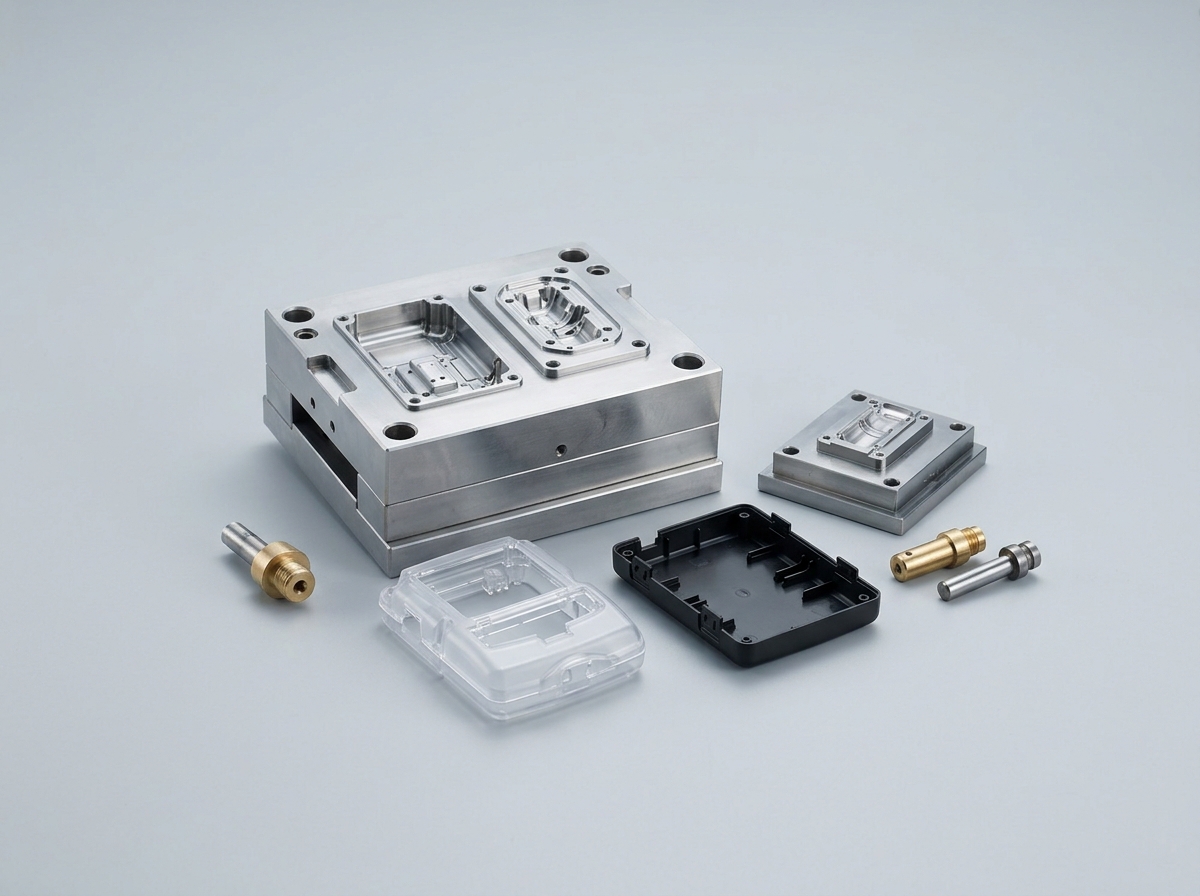
Plastic Housing Mold Projects: Why Appearance and Fit Drive Sales
Plastic housing mold projects are sales-critical because the shell is often the customer’s first and last physical impression.
For consumer electronics, smart devices, and small appliances, the enclosure must do more than cover internal parts. It has to align seams, protect components, manage snap-fit loading, and look consistent across the full batch. Small visible defects, such as sink marks, flow lines, or mismatch at the parting surface, can affect conversion rates and reviews even if the product functions correctly.
That is why many e-commerce brands treat housing development as a design-and-manufacturing project instead of a sourcing order. Material selection, wall thickness, draft angle, and rib design all influence the final result. A PC shell may be preferable when clarity and impact resistance matter, while ABS may be better for painted or textured consumer housings that need stable molding and cost control.
For sellers comparing options, a dedicated injection parts supplier can help match the product’s visual requirements to a production process that will actually scale.
| Housing Requirement | Typical Engineering Focus | Commercial Impact |
|---|---|---|
| Snap-fit retention | Boss geometry, rib support, material flexibility | Lower assembly labor and fewer returns |
| Cosmetic surface | Polish grade, texture, venting, melt flow control | Better listing photos and stronger brand perception |
| Assembly alignment | Parting line control, warpage management, tolerance stack-up | Reduced squeaks, gaps, and customer complaints |
| Impact resistance | Resin choice, wall uniformity, rib placement | Lower breakage in shipping and use |
Industry Standards and Data That Matter in Plastic Mold Buying
Standards matter because they give buyers a common language for quality, tolerance, and testing.
For molded parts, dimensional consistency is usually verified with calibrated measurement tools and controlled sampling plans. On the tooling side, mold inspection and process capability are often discussed using ISO-based quality systems, while product safety may require material or application-specific standards depending on the category. If your product falls into a regulated segment, the supplier should be able to cooperate with test reports, traceability, and material declarations.
The U.S. National Institute of Standards and Technology provides widely used metrology references that help manufacturers think about measurement uncertainty and calibration discipline; see NIST Physical Measurement Laboratory. For material and mechanical testing, ASTM standards are commonly used across the plastics industry; a useful starting point is ASTM plastics standards. When a factory can speak in those terms, it usually signals a more mature quality culture.
For buyers, the actionable point is this: ask how the factory measures critical features, how often it calibrates instruments, and what happens when a sample fails inspection. The answer is often more valuable than the lowest quote.
Common Mistakes E-Commerce Sellers Make with Plastic Mold Projects
The most expensive mistakes happen before the mold is even cut.
Many sellers underestimate shrinkage, ignore draft angles, or approve a concept drawing without checking wall thickness and gate position. Others specify appearance only and forget functional tolerances, which creates assembly problems during volume production. A third common mistake is comparing factories only by tooling price, while ignoring communication speed, engineering support, and after-sales maintenance.
For e-commerce, those mistakes create hidden costs: delayed launches, rework, air freight, refund pressure, and poor ratings. A lower tooling quote can become the most expensive option if the mold requires repeated corrections or if the supplier cannot maintain stable output over time.
To reduce risk, sellers should request a clear development path from prototype to trial to mass production. If the supplier offers mold design support, ask whether the design review includes draft, venting, shrinkage, and assembly checks rather than only visual comments.
- Do not approve a mold solely on appearance; confirm dimensions and assembly fit.
- Do not skip material testing when the product needs impact resistance or transparency.
- Do not ignore packaging design, especially for fragile or cosmetic parts.
- Do not rely on vague deadlines; ask for milestone-based sample and shipment dates.
How to Decide If a China Plastic Mold Factory Is the Right Partner
The right China plastic mold factory is the one that matches your product complexity, sales velocity, and communication needs.
If you sell simple commodity items, the key metric may be unit cost. If you sell premium consumer products, the key metric may be cosmetic stability. If you sell seasonal or viral products, the key metric may be lead time and responsiveness. The supplier must fit your business model, not just your technical drawing.
A good decision framework is to score the factory in five areas: engineering support, tooling quality, sampling speed, communication clarity, and production continuity. A factory that performs well across all five is often more valuable than one that wins only on price.
In e-commerce, time to market often determines margin. That is why a China plastic mold factory with one-stop OEM plastic manufacturing capability can be strategically useful: it helps sellers move from idea to market test to replenishment without rebuilding the supplier chain at every step.
| Evaluation Area | What to Ask | Strong Signal |
|---|---|---|
| Engineering support | Do you provide DFM and mold flow feedback? | Specific design changes with reasons |
| Sampling speed | How long to T0 and T1 samples? | Milestone-based schedule with risk notes |
| Quality control | How do you inspect critical dimensions? | Measured reports with calibration discipline |
| Production continuity | How are spare parts and maintenance handled? | Documented tool care and replacement plan |
| Export readiness | Can you support packaging and documentation? | Clear handling of labels, cartons, and shipping docs |
FAQ
Why do e-commerce sellers choose a China plastic mold factory?
They choose it because it usually combines tooling capability, OEM plastic manufacturing, and export support in one supply chain. That makes it easier to launch, revise, and scale products without managing multiple vendors.
Is a plastic mold worth the cost for online products?
Yes, if the product will be sold in repeat volume. A mold spreads its upfront cost across many units, which often lowers the long-term cost per part compared with short-run fabrication.
What products are best for plastic injection molding?
Products with repeatable geometry, such as housings, covers, clips, consumer accessories, appliance parts, and industrial shells, are usually strong candidates for injection molding.
How do I know if a supplier can handle OEM plastic manufacturing?
Look for DFM feedback, trial molding reports, measured samples, material recommendations, and a clear production plan. A good supplier should explain engineering decisions in practical terms.
What is the biggest risk when working with a plastic mold factory?
The biggest risk is unclear specifications. If the drawing, material, tolerance, or surface requirement is vague, the factory may deliver a mold that works technically but fails commercially.
Why is PC often used for plastic housing parts?
PC is often chosen because it offers strong impact resistance and good dimensional stability, which makes it suitable for transparent or protective housings in electronics and safety-related products.
What should I ask before approving a mold?
Ask about shrinkage, draft, venting, gate position, maintenance, critical dimensions, and sample approval criteria. Those questions reduce the chance of expensive corrections later.
Post time: Jul-14-2026