
- Medical device components need precision molding because fit, function, and safety depend on repeatability.
- Tool design, resin selection, and process validation matter as much as the molded part itself.
- Quality evidence such as traceability, inspections, and validation records is essential for regulated supply chains.
- Choosing a supplier with strong engineering support reduces launch risk, scrap, and rework.
High-quality injection molding is critical for medical device components because the smallest variation can affect assembly, sealing, sterility, and patient safety. In regulated production, dimensional capability, clean processing, and documented control matter as much as throughput. For context, medical plastic parts often need tolerances that are aligned with the process capability achieved through disciplined toolmaking and control plans, and ISO 13485:2016 sets the quality management framework most buyers expect from suppliers in this space. If you are evaluating medical-grade mold manufacturing, injection mold tooling, or custom plastic parts, the real question is not only whether a part can be molded, but whether it can be molded consistently, validated, and scaled without hidden risk.
Why high-quality injection molding matters for medical device components
The core reason is simple: medical device components must work the same way every time. A connector that fits on day one but drifts after 50,000 cycles is not acceptable in a hospital workflow. A housing that warps by a fraction of a millimeter can break a seal, distort a latch, or create assembly stress that becomes a field failure. In medical products, consistency is a product feature, not a nice-to-have.
Medical buyers also care about risk containment. Injection molding errors can create burrs, knit lines, sink marks, voids, contamination traps, or cosmetic defects that are not just aesthetic issues. On patient-facing devices, a surface defect can become a cleaning challenge or a trust issue. On internal device components, the same defect may affect function or reliability. That is why precision molding is part of the device design strategy, not only the manufacturing step.
Regulatory expectations reinforce this. Quality management for medical device production is commonly built around ISO 14971:2019 for risk management and 21 CFR Part 820 for U.S. quality system controls. A supplier that cannot demonstrate process stability, traceability, and controlled change management creates downstream exposure for the brand owner.
Precision molding for medical device components: what “quality” actually means
Quality in precision molding is measurable. It is not an abstract promise. For medical device components, buyers usually evaluate dimensional accuracy, lot-to-lot repeatability, cosmetic uniformity, resin traceability, and documentation quality.
In practice, high-quality injection molding means the tool, material, machine, and process window are all aligned. If one variable drifts, the part can still come out of the press, but it may no longer meet the design intent. This is especially important for snap-fits, thin walls, sealing ribs, threaded features, and micro-geometry around sensors or drug-delivery interfaces.
| Quality Dimension | What Buyers Check | Why It Matters | Typical Control Method |
|---|---|---|---|
| Dimensional accuracy | Critical features, fit, and tolerance stack-up | Affects assembly and sealing | First article inspection, SPC |
| Repeatability | Part-to-part and lot-to-lot variation | Protects launch consistency | Process capability studies |
| Surface integrity | Flash, sink, flow lines, contamination | Impacts usability and cleaning | Visual standards, mold maintenance |
| Material control | Resin grade, lot traceability, drying history | Reduces compliance risk | Incoming verification, batch records |
For a molded medical enclosure, a 0.1 mm change in wall thickness may alter cooling, shrinkage, and fit at the clip interface. That is why the best suppliers treat every design detail as a process variable.
Material selection and medical molding: the resin decision is part of the quality strategy
Material selection is a design-control decision, not a procurement shortcut. The wrong polymer can fail mechanically, stress crack after sterilization, or create contamination concerns during repeated use.
Medical products often rely on polycarbonate, polypropylene, ABS blends, PEEK, and other engineering resins, but the right choice depends on sterilization method, load, transparency, chemical exposure, and regulatory pathway. For example, polycarbonate is widely used when impact resistance and clarity are important, but resin grade and molding conditions must be carefully controlled to avoid stress and haze.
Engineering references also matter. The tensile strength of unfilled polycarbonate is commonly in the range of 60-70 MPa, while PEEK can exceed 90 MPa in many grades, according to manufacturer data sheets and material standards. Those numbers matter because they shape wall thickness, rib design, and latch geometry. High-quality injection molding helps the chosen resin perform as intended rather than masking a poor material choice with process compensation.
| Material | Typical Strength Reference | Common Medical Use | Quality Risk if Misused |
|---|---|---|---|
| Polycarbonate | 60-70 MPa tensile strength | Transparent housings, covers | Stress cracking, haze |
| PP | Lower stiffness, good chemical resistance | Disposable components, caps | Warping, poor snap retention |
| PEEK | 90 MPa+ tensile strength in many grades | High-performance implants and devices | High tooling and processing sensitivity |
| ABS | Balanced impact and processability | Device shells, non-implant housings | Surface defect visibility |
If your device must survive sterilization, chemical cleaning, or transport shock, the resin selection should be tested with the same seriousness as the mold design.
How precision molding supports regulatory and validation requirements
Validation is where many promising programs fail. A part can look excellent in a short pilot run and still fail under long-term production conditions. Medical device manufacturing expects evidence that the process is capable, stable, and controlled.
A common validation stack includes installation qualification, operational qualification, and performance qualification, often shortened to IQ, OQ, and PQ. These steps show that the machine is installed correctly, the process works across expected limits, and the final production setup can consistently make acceptable parts.
From an inspection standpoint, the metrology strategy should match the criticality of the part. Coordinate measuring machines, optical inspection, functional gauges, and surface checks all have a role. If a feature affects sealing or assembly, it should not be measured only by eye.
For sterilized or cleanliness-sensitive components, buyers increasingly ask about contamination control, packaging integrity, and traceable process records. Supplier discipline here reduces the chance of field complaints and supports audit readiness.
For a standards-based view of sterilization-related packaging and handling expectations, FDA guidance on sterilization of medical devices is a useful starting point, while ASTM F1980-21 addresses accelerated aging for sterile barrier systems and package testing logic. Even when the molded component is not the sterile barrier itself, the same mindset of documented control applies.
Process variables that separate average molding from high-quality injection molding
Process discipline is what turns a good mold into a dependable production system. Temperature, pressure, packing time, cooling time, venting, and drying all influence part quality.
In medical device components, poor control of these variables usually shows up as warpage, short shots, flash, brittleness, or cosmetic inconsistency. A mold may be perfectly designed on CAD and still produce unstable output if the process window is too narrow.
One of the most overlooked points is drying. Hygroscopic polymers can absorb moisture, which changes melt behavior and surface finish. Another overlooked point is gate location, because it affects flow balance, weld line positioning, and residual stress. A third is cooling symmetry, since uneven cooling drives distortion and dimensional drift.
- Lock the resin specification before tooling starts.
- Define critical-to-quality features and measurement methods.
- Run process capability studies on the true production machine.
- Document the acceptable process window and change-control rules.
- Revalidate after resin, tool, or machine changes.
| Process Variable | Typical Impact | Common Failure Mode | Control Priority |
|---|---|---|---|
| Melt temperature | Flow, cosmetics, strength | Burn marks, degradation | High |
| Pack pressure | Density, sink, shrinkage | Dimensional drift | High |
| Cooling time | Cycle stability, warpage | Distortion, sticking | High |
| Drying conditions | Hydrolysis prevention | Brittleness, splay | Medium to high |
High-quality injection molding is often less about dramatic breakthroughs and more about disciplined control of these basics.
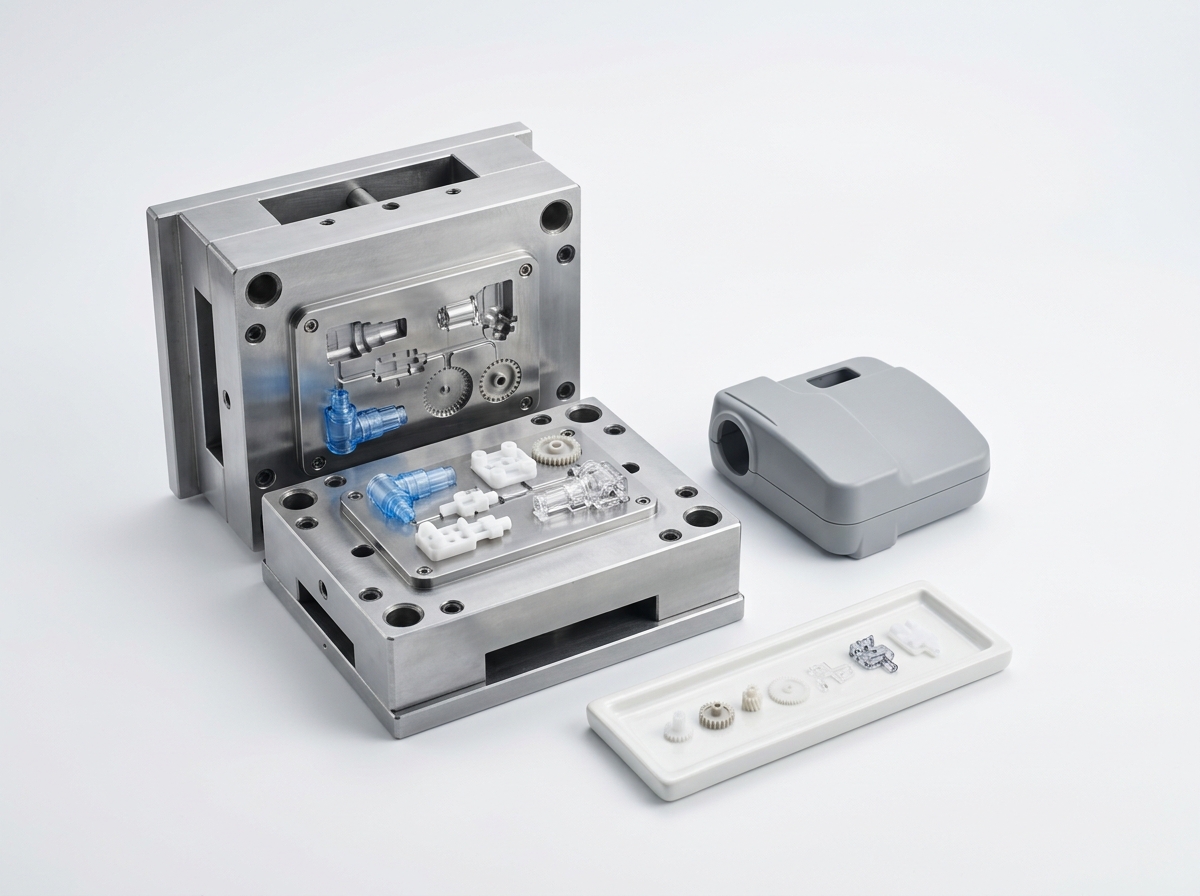 Supply chain and design support: why suppliers matter for medical device components
The best molding supplier is not only a machine operator; it is a technical partner. Medical programs move faster when the supplier can review drawings, flag manufacturability risks, and propose changes before tooling is cut.
That support matters most when launch timing is tight. A poor gate design or an unbalanced wall section can delay the project for weeks. An experienced supplier can usually identify those risks during the design-for-manufacturing stage and reduce the chance of costly revisions.
Cross-functional support is also important for OEM and ODM projects. Medical brands often need a supplier that can move from concept to sample to pilot to production without losing documentation quality. If a company also produces related items such as 3D mold solutions or broader plastic shell mold projects, that breadth can help when a device family includes enclosures, accessory parts, and packaging-adjacent components.
For companies managing multiple SKUs, the ability to standardize mold base designs, part families, and inspection formats can reduce lead-time variability and simplify inventory planning.
Economic impact of high-quality injection molding in medical programs
Quality defects are expensive because they compound. Scrap consumes resin and machine time, rework consumes labor, and delayed launches consume market opportunity.
According to FDA recall data, device recalls can extend across multiple classes of severity, which is why preventive quality control is financially smarter than corrective action. While the exact cost depends on device complexity, many manufacturers use the principle that late-stage quality failures are far more expensive than early-stage engineering fixes.
On the manufacturing side, cycle time and cavity efficiency directly influence unit economics. A more stable process can reduce downtime, improve yield, and lower inspection burden. Even a small reduction in scrap rate can materially change cost per part when volumes are high.
Industry practice shows that process capability, not headline machine speed, usually determines profitability. A fast cycle that produces unstable parts is less valuable than a slightly slower cycle that yields consistent, compliant output.
| Cost Driver | Quality Effect | Business Impact | Best Mitigation |
|---|---|---|---|
| Scrap | Material loss | Higher unit cost | Stable process window |
| Rework | Labor and time loss | Delivery delay | Design for molding |
| Validation failure | Restart of qualification | Launch postponement | Early risk review |
| Field defect | Recall or complaint handling | Brand and regulatory risk | Incoming and in-process control |
In medical molding, quality is not a premium feature; it is the cost-control strategy.
How to evaluate a high-quality injection molding supplier for medical device components
The right supplier should be able to explain how it controls risk, not just how it makes parts. Ask for evidence, not slogans.
Strong supplier screening usually includes documentation review, process capability data, machine capability, metrology methods, and change-control discipline. If the supplier cannot explain how it handles resin lot changes, tool maintenance, or nonconforming product, that is a warning sign.
You should also look at communication performance. Medical programs often involve design changes, validation questions, and documentation requests under time pressure. A supplier with slow response times can create hidden project risk even if its molding quality is good.
- Review quality certifications and medical experience.
- Request process capability and inspection records for similar parts.
- Confirm traceability for material batches and production lots.
- Check how engineering changes are approved and documented.
- Verify the supplier can support pilot runs and production scale-up.
If your sourcing strategy includes diversified product families, it can help to work with one engineering-focused partner across household appliance mold, consumer product mold, and medical-related programs, but only when quality systems are equally strong across those categories.
Common defects in medical injection molding and how to prevent them
Most injection molding defects are predictable once you know the physics behind them. Prevention is cheaper than correction.
Flash usually points to tool wear, poor clamp force, or excessive pressure. Sink marks are often tied to thick sections and poor packing. Warpage often indicates uneven cooling or unbalanced geometry. Short shots usually signal insufficient fill, low melt temperature, or venting problems. Each defect has a different cause, so root-cause discipline matters.
Medical parts deserve extra scrutiny because many defects are hidden until assembly or end use. A part may pass a basic visual check but fail during snap-fit testing, leak testing, or sterilization exposure. That is why functional verification should be part of the acceptance plan.
- Use consistent wall thickness wherever possible.
- Position gates to balance flow and minimize weld lines.
- Design vents for trapped air removal.
- Specify inspection criteria for cosmetic and functional defects.
- Track defects by cavity, shift, and resin lot.
When these controls are in place, high-quality injection molding becomes repeatable enough for regulated medical supply chains.
What buyers should remember before they source medical device components
The best sourcing decisions are made by comparing technical evidence, not by comparing the cheapest quote. A low-cost mold that cannot hold tolerance is not a savings. A fast sample that cannot validate is not progress. A supplier with strong engineering support, documented controls, and medical-relevant quality discipline is often the safer and more economical choice over the product life cycle.
For regulated parts, the answer to “why is high-quality injection molding critical?” is that it protects the device, the patient, the launch schedule, and the business model at the same time. That is why medical procurement teams should judge suppliers on process capability, validation readiness, material control, and communication quality, not price alone.
FAQ
What makes high-quality injection molding different for medical device components?
It requires tighter control of dimensions, material traceability, cleanliness, validation, and documentation than general consumer molding.
Why is precision molding so important for medical parts?
Because small dimensional errors can affect fit, sealing, sterilization performance, and device reliability.
Which standards matter most for medical injection molding suppliers?
Common references include ISO 14971:2019, ISO 13485:2016, and U.S. quality system requirements under 21 CFR Part 820.
How do I know whether a molded medical component is stable enough for production?
Ask for process capability data, inspection methods, validation records, and evidence of controlled resin and tool management.
What defects are most dangerous in medical injection molding?
Flash, contamination, warpage, short shots, and hidden dimensional drift are among the most common risks.
Can a supplier that makes other plastic products still be a good medical partner?
Yes, if it can demonstrate medical-grade quality discipline, documentation, and traceability rather than only general molding capacity.
What is the most important sourcing question for medical device components?
Whether the supplier can produce the same compliant part consistently, at scale, with verified controls.
Post time: Sep-09-2026