
- OEM plastic product development services reduce the gap between concept, prototype, and mass production.
- Custom plastic products perform better when moldability, material behavior, and assembly constraints are designed together.
- Plastic manufacturing suppliers with design support and trial feedback usually shorten launch cycles and lower rework risk.
- One-stop mold and finished-part supply helps global buyers reduce vendor switching, logistics friction, and quality drift.
OEM plastic product development is attractive to global buyers because it combines engineering, tooling, and plastic manufacturing into one accountable process, which is especially important when a product must hold dimensional accuracy, pass assembly checks, and stay consistent across volume production; for example, plastics quality decisions are often verified with standards such as ISO 20457:2018 and material testing methods such as ASTM D638, while measurement traceability can be anchored in NIST practices. For buyers of custom plastic products, the value is not only cost control but also faster risk reduction when moving from drawing, sample, and pilot run to stable plastic manufacturing.
Why OEM Plastic Product Development Services Fit Global Sourcing Goals
OEM plastic product development services solve a procurement problem, not just a production problem.
Global companies rarely buy plastic parts in isolation; they buy lead time, consistency, and accountability across the full product lifecycle. That is why OEM plastic product development is often preferred over fragmented sourcing models where design, mold making, and production sit with different vendors. When one supplier is responsible for plastic manufacturing from concept review to final shipment, the buyer gets fewer handoff errors and clearer root-cause ownership if issues appear during trial or mass production.
For consumer electronics, appliances, and industrial equipment, plastic parts often sit at the interface between appearance and function. A housing must look clean, fit the assembly, survive handling, and maintain dimensions through repeated production. This is where custom plastic products provide a stronger fit than off-the-shelf parts, because the geometry can be tuned to the product platform, fastening method, and cosmetic requirements.
In high-volume programs, even a small dimensional shift can create downstream losses. A tolerance stack that seems minor on a CAD file can become a scrap or rework issue when the part must mate with PCBs, displays, seals, or metal frames. Buyers therefore look for plastic manufacturing partners that can comment on draft angle, wall thickness, gate placement, weld lines, and ejection strategy before steel cutting starts.
For a quick view of capabilities, many buyers compare a supplier’s plastic injection mold services with their custom plastic products capacity, because tooling and part output need to be aligned early. Buyers with housing-heavy programs also often review plastic shell mold solutions and, for more complex geometry, 3D mold development.
What Global Buyers Expect from Custom Plastic Products
Custom plastic products must be designed for manufacturability before they are designed for marketing.
Many sourcing teams focus first on appearance, but in plastic manufacturing the more expensive failures often come from hidden geometry. Thin ribs, deep undercuts, uneven wall thickness, and poor gate location can all cause sink marks, warpage, short shots, or unstable assembly. A strong OEM plastic product development process checks those risks early, then converts design intent into a robust mold structure.
For housing parts used in consumer electronics and appliances, buyers usually care about three outputs: appearance consistency, assembly fit, and mechanical durability. PC is a common choice for transparent or impact-resistant parts because it combines transparency, toughness, and dimensional stability better than many commodity polymers in this application class. That is one reason global companies often ask for material comparison during the quotation stage instead of after the mold is already built.
Common evaluation items include size stability after cooling, clamp line visibility, knit line location, and whether secondary operations are needed. If a custom plastic product needs ultrasonic welding, screw fastening, or snap-fit assembly, the mold and part geometry should be optimized together. A bad fit at this stage often creates a hidden cost later in assembly labor or warranty service.
OEM plastic product development also matters when a company needs several SKUs under one platform. Reusing a base structure while changing color, trim, logo, or interface features is more efficient than starting every project from zero. That is why multi-product buyers often prefer suppliers that can handle both plastic product development and ongoing mold spare parts supply for long-term maintenance.
| Buyer Need | Typical Plastic Requirement | Practical Impact | Common Risk if Missed |
|---|---|---|---|
| Consumer electronics housing | High cosmetic quality, stable fit | Better brand perception and assembly speed | Visible defects, rework |
| Home appliance parts | Dimensional consistency and heat resistance | Reliable mass assembly | Warping, mismatch, returns |
| Industrial covers | Structural reliability and repeat supply | Longer service life | Downtime and replacement cost |
| Daily-use consumer goods | Cost efficiency and quick SKU change | Competitive pricing | Margin pressure |
How Plastic Manufacturing Reduces Launch Risk
Plastic manufacturing reduces launch risk when design, tooling, and trial validation are treated as one system.
A product launch often fails not because the idea is weak, but because the transition from concept to production is poorly controlled. OEM plastic product development services reduce that risk by aligning the drawing, material, and tooling plan before mass production starts. In real sourcing workflows, that alignment can save weeks of back-and-forth because engineering feedback happens before steel is fixed.
The most valuable part of plastic manufacturing support is early DFM, or design for manufacturability. DFM reviews typically focus on wall thickness, rib ratio, draft, undercut strategy, gate position, ejection marks, and cooling balance. For example, if an enclosure has uneven walls, cooling shrinkage can lead to warpage, which then affects assembly flatness and cosmetic appearance.
Trial shots are the point where theory becomes evidence. A mature supplier will compare sample parts against drawing dimensions, perform fit checks, and report which features need correction before high-volume production. Buyers should expect measurable feedback, not vague reassurance. In many programs, prototype-to-production iterations are cheaper than correcting tooling after shipment starts.
For buyers who need transparent or impact-resistant components, PC injection mold services are often evaluated because PC is widely used for protective covers, light-transmitting parts, and product windows. In cases where the product has a complex profile or strong visual identity, 3D mold capability can be relevant for geometry that is difficult to produce with simpler tooling layouts.
| Development Stage | Main Output | Typical Decision | Risk Controlled |
|---|---|---|---|
| Concept review | Feasibility check | Can the design be molded? | Unbuildable geometry |
| Material selection | Resin choice | Does the part need PC, ABS, or another polymer? | Performance mismatch |
| Mold design | Cavity, gate, cooling, ejection | How will the part be filled and released? | Warping and defects |
| Trial validation | Sample verification | Does the part meet fit and appearance targets? | Late-stage rework |
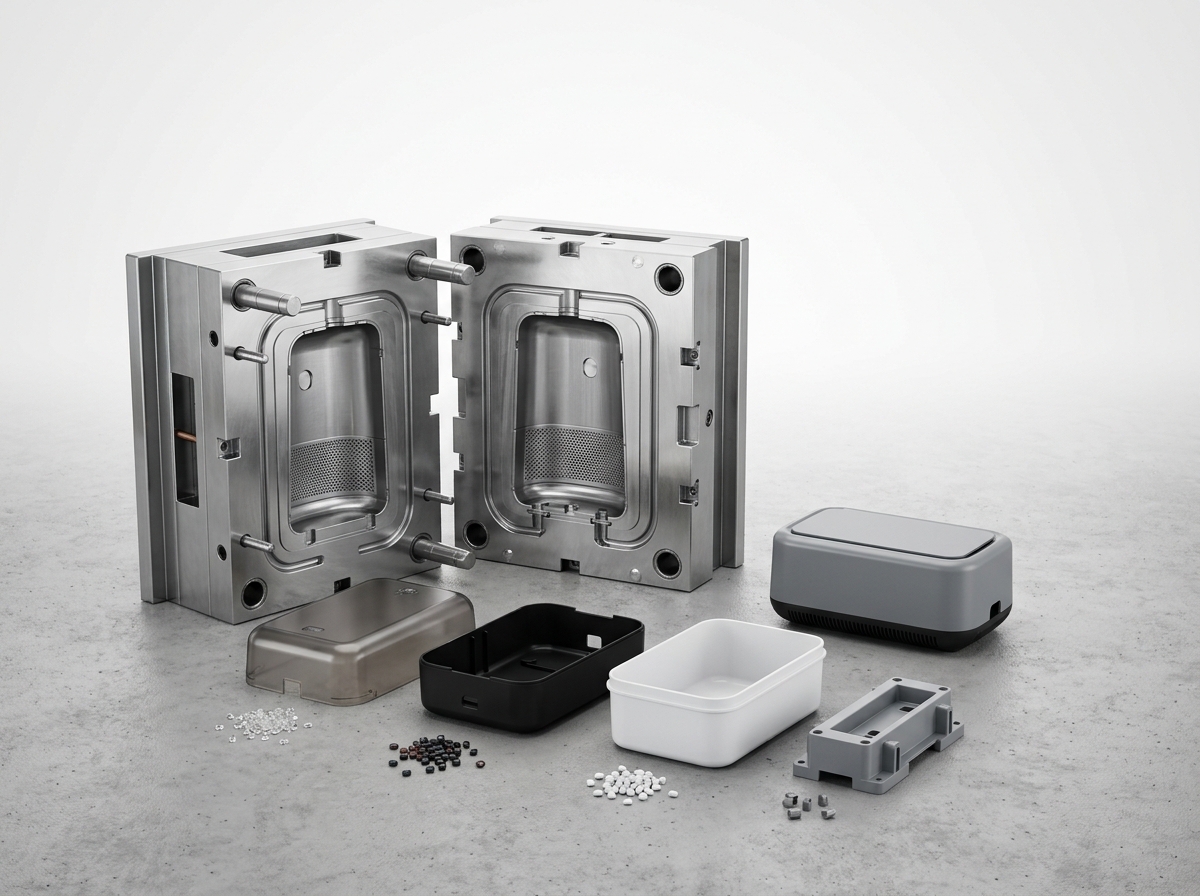 Standards, Data, and the Technical Side of Custom Plastic Products
Technical standards make OEM plastic product development more predictable for global procurement teams.
International buyers trust suppliers more when the project can be tied to standards, test methods, and measurable acceptance criteria. For plastics, ISO 20457:2018 is especially useful because it addresses tolerance measurement for molded plastic parts. In practice, this gives a common language for comparing drawings, samples, and mass-produced parts instead of relying on subjective inspection alone.
Material testing is another anchor point. ASTM D638 is a widely used tensile test method for plastic materials, helping teams compare strength and elongation behavior. For a buyer selecting custom plastic products, the important point is not the standard number alone, but the fact that the part can be validated in a repeatable way across batches and suppliers.
Precision expectations also depend on measurement discipline. NIST emphasizes traceability and measurement consistency, which matters when a supplier is checking part dimensions, fixture repeatability, and sampling reliability. For high-value assemblies, buyers should ask what inspection tools are used, how gauges are calibrated, and how acceptance data is recorded.
For a plastic housing project, the technical conversation often includes the following quantities: nominal wall thickness, shrink rate, tolerance target, and critical-to-fit features. While the exact numbers depend on geometry and resin, the supplier should be able to explain how a given wall section will cool and what dimensional drift may occur after molding. This is where a technically capable OEM plastic product development team separates itself from a simple press shop.
Global companies also care about whether the supplier can support documentation in English, manage file revisions, and respond quickly across time zones. Those soft skills sound basic, but they directly affect the cost of change orders and launch delays in plastic manufacturing programs.
| Reference | What It Helps Verify | Why It Matters in OEM Plastic Product Development |
|---|---|---|
| ISO 20457:2018 | Dimensional tolerance framework | Common language for molded part acceptance |
| ASTM D638 | Tensile properties | Material comparison and performance screening |
| NIST traceability guidance | Measurement consistency | Reliable inspection and repeatable QA |
Why Global Companies Prefer One-Stop Mold and Finished-Part Supply
One-stop supply is preferred because it reduces friction across engineering, production, and logistics.
When a buyer sources mold making from one company and finished plastic manufacturing from another, every problem becomes a coordination problem. If the part is out of spec, each vendor can point to the other side. If the shipment is late, responsibility can become blurred. OEM plastic product development services reduce this friction by creating a single operational line from mold design to part delivery.
This model is especially helpful for projects with tight launch windows. For example, a consumer electronics brand may need new custom plastic products for a seasonal release, while an industrial buyer may need a replacement part to keep equipment running. In both cases, the speed of feedback from sample to correction can determine whether the project meets market timing.
One-stop supply also improves lifecycle continuity. Molds wear, gates need maintenance, and spare components can fail over time. If the supplier already knows the original tool structure, it is easier to replace worn parts and maintain stable quality. That is one reason buyers often review mold spare parts alongside the main tooling package.
For global companies, another advantage is platform scaling. Once a base structure is validated, the same supplier can often create family molds or variant tooling for new versions. This reduces engineering learning time and helps product lines grow without rebuilding supplier relationships from zero.
How to Evaluate an OEM Plastic Product Development Supplier
The best supplier is the one that can prove control, not the one that claims capability.
Procurement teams should evaluate OEM plastic product development partners through evidence, not presentations. The right questions usually focus on design support, trial process, quality checks, communication speed, and after-sales support. A supplier that answers these clearly is more likely to deliver stable plastic manufacturing results.
- Ask for DFM feedback examples with real dimensional corrections.
- Request trial-report samples showing measured values, not only photos.
- Confirm which inspection tools and acceptance criteria are used.
- Check whether the supplier can support English documentation and revision control.
- Review how spare parts, mold maintenance, and production continuity are handled.
Buyers should also compare the supplier’s industry fit. A company experienced in appliance housings may understand appearance and assembly better, while a supplier serving industrial equipment may be stronger on structural reliability and long-term supply. The correct choice depends on the product’s use case, not just on machine tonnage or factory size.
For projects with complex geometry or premium appearance, a supplier’s plastic shell mold capability can be more important than price alone, because shell geometry often determines both the final look and the assembly behavior of the product. When buyers plan multi-year sourcing, they should also ask how the supplier handles design revisions, as product versions often change after launch.
| Evaluation Item | What Good Looks Like | Why It Matters |
|---|---|---|
| Design support | Clear DFM comments and correction proposals | Reduces tooling rework |
| Trial feedback | Measured data and photo evidence | Speeds approval |
| Communication | Fast English replies and file control | Prevents version mistakes |
| Lifecycle support | Spare parts and maintenance planning | Extends mold life |
Common Use Cases for OEM Plastic Product Development Services
Different industries choose OEM plastic product development for different reasons, but the same logic keeps appearing: the product must be repeatable, manufacturable, and commercially stable.
In consumer electronics, the focus is often snap-fit integrity, light-weighting, and surface finish. In home appliances, buyers prioritize structural strength, dimensional consistency, and reliable assembly. In daily-use products, cost efficiency and fast color or SKU switching become more important. In industrial accessories, the main concern is whether the part can survive long-term service and steady replenishment.
That is why custom plastic products are rarely judged on appearance alone. A good part supports the business model behind it. If a component must be sold in large volume, plastic manufacturing must be tuned for cycle time, scrap control, and process stability. If the item is a high-visibility brand part, then surface quality and repeatability become the deciding factors.
For products with transparent or protective roles, PC often appears in the material discussion. For parts with more general structural needs, the material choice may shift depending on cost, stiffness, impact resistance, and heat exposure. The supplier should be able to explain these trade-offs in plain language, backed by test logic rather than habit.
Final Buying Logic: Why Global Companies Keep Returning to OEM Partners
Global companies return to OEM plastic product development services because the model converts uncertainty into a managed process.
The buyer is not simply outsourcing manufacturing; they are outsourcing risk control, technical coordination, and scale readiness. When the supplier can support design review, tooling, trials, production, and spare-part continuity, the result is a smoother path from concept to commercial shipment. That is especially valuable for companies managing multiple SKUs, short launch windows, or cross-border supply chains.
In practical terms, the best OEM plastic product development partner is the one that helps a buyer answer four questions early: Can this part be molded? Will it meet the fit and appearance target? Can it be made consistently at volume? And can the supply continue after launch? If the supplier can answer those with data, samples, and a stable process, then custom plastic products become a strategic sourcing advantage rather than a procurement burden.
For companies comparing vendors, the strongest signal is not a broad promise of capability. It is a project-specific workflow that proves the supplier understands plastic manufacturing as a business-critical system, not just as machine output.
FAQ
What is OEM plastic product development?
OEM plastic product development is the process of turning a buyer’s concept, drawing, or sample into a moldable part and then into stable mass production through design review, tooling, trial, and manufacturing control.
Why do global companies choose custom plastic products instead of standard parts?
Global companies choose custom plastic products because they can match product geometry, assembly requirements, branding needs, and performance targets more closely than standard parts can.
What is the biggest benefit of plastic manufacturing under one supplier?
The biggest benefit is fewer handoffs. One supplier can coordinate design feedback, mold work, trial correction, and production planning, which lowers communication errors and launch risk.
How important is material selection in OEM plastic product development?
Material selection is critical because it affects impact resistance, transparency, heat behavior, dimensional stability, and cost. A wrong resin choice can create problems even if the mold is well made.
How do buyers judge whether a plastic supplier is reliable?
Buyers usually judge reliability by DFM quality, trial-report clarity, inspection discipline, communication speed, and the ability to support long-term spare parts and production continuity.
Why is PC often used in plastic housing applications?
PC is often used because it offers transparency, impact resistance, and good dimensional stability, which makes it suitable for protective and visible housing parts.
What should be asked before starting a new plastic product development project?
Buyers should ask about feasibility, material choice, mold structure, tolerance targets, trial process, lead time, and how changes will be managed after the first samples are approved.
Post time: Aug-17-2026