
- Custom injection molds are chosen when fit, appearance, and repeatability matter more than the lowest upfront tooling price.
- Injection mold services reduce launch risk by combining design review, DFM feedback, sampling, and production support in one workflow.
- OEM mold manufacturing is especially valuable for electronics, home appliances, industrial housings, and other high-volume programs.
- Quality is not only about the cavity finish; it also depends on shrinkage control, venting, cooling balance, and process validation.
- Global buyers prefer suppliers who can support English communication, fast documentation, and stable export logistics.
Custom injection molds are a strategic manufacturing choice for brands that need consistent quality, scalable output, and a clear path from prototype to mass production. In precision molding, even a small process shift can matter: ISO 20457:2018 defines dimensional tolerances and inspection discipline for molded parts, while common moldmaking practices often target repeatability in the low-micron-to-hundred-micron range depending on part geometry and material behavior. For buyers comparing injection mold services with generic tooling quotes, the real question is not price alone but whether the supplier can deliver stable output, accurate documentation, and a reliable launch plan for OEM mold manufacturing.
Why custom injection molds matter for global brands
Custom injection molds matter because global brands do not buy tooling in isolation; they buy business certainty.
When a product must launch on time, fit a regulated supply chain, and hold visual consistency across thousands or millions of parts, a generic mold package becomes risky. A custom tool can be engineered around the parting line, wall thickness, gate location, ejection behavior, and material shrinkage profile. That engineering alignment is what turns a design file into a manufacturable part.
In consumer-facing categories, small defects can become expensive quickly. A slight sink mark on a visible appliance housing, a weak snap-fit on a device shell, or inconsistent gloss on a display surface can trigger rework, return costs, or a delayed launch. That is why buyers often look for plastic shell molds when the application demands appearance, fit, and structural reliability at the same time.
| Decision factor | Generic tooling | Custom injection molds |
|---|---|---|
| Dimensional fit | Limited optimization | Built around product tolerances |
| Cosmetic control | Standard finish only | Surface, texture, and gate position optimized |
| Engineering support | Often minimal | DFM, sampling, and process tuning included |
| Launch risk | Higher for complex parts | Lower with validated tooling |
The brand-level value is simple: custom tooling reduces the number of decisions left unresolved after design freeze. That is especially important for OEM programs where multiple departments, suppliers, and markets depend on the same part specification.
What injection mold services include beyond tooling
Good injection mold services cover much more than machining steel.
Strong suppliers usually combine part review, mold flow thinking, steel selection, trial support, sample correction, and production readiness. In other words, the service is a process, not a single purchase order. That matters because many tooling failures are not caused by machining defects; they are caused by weak early decisions about draft angles, rib layout, gate placement, or cooling uniformity.
A practical workflow usually starts with drawings, reference samples, material requirements, and target volume. For transparent housings, for example, 3D molds are often evaluated when the geometry is complex, highly branded, or visually distinctive. In that case, the supplier has to balance visual identity with ejection stability and surface quality.
- Review drawings, samples, and performance targets.
- Confirm material, shrinkage assumptions, and cosmetic grade.
- Evaluate manufacturability with DFM feedback.
- Build and test the mold with trial shots.
- Refine dimensions, venting, cooling, and ejection.
- Lock the process for repeatable production.
This workflow is particularly relevant for buyers who need a single partner for tool build and part supply. One-stop sourcing can reduce supplier handoff delays, shorten feedback loops, and simplify quality responsibility.
OEM mold manufacturing and the logic of repeatability
OEM mold manufacturing is valuable because it creates repeatability where custom products would otherwise drift.
Injection molding is a volume process, but volume alone does not guarantee consistency. The mold must be stable under thermal cycling, the process window must be wide enough to survive normal variation, and the part design must tolerate shrinkage and release behavior. Global brands value OEM mold manufacturing because it supports this entire system instead of treating the mold as a one-time asset.
For production programs, repeatability is often the hidden KPI. A mold that produces a good first article but drifts after repeated cycles is expensive even if the initial quote looked attractive. Buyers often ask about cavity balance, wear resistance, and lifecycle support because tool life affects total landed cost. For ongoing programs, mold parts availability can be as important as the original tool build, since inserts, cores, ejector components, and wear items help extend uptime.
Ejection strategyDeformation riskWill the part release without whitening or twist?
| Tooling topic | Why it matters | Typical buyer question |
|---|---|---|
| Steel choice | Wear life and polishability | Will the tool last for the planned volume? |
| Cooling design | Cycle time and warp control | Can the part cool evenly? |
| Venting | Burn marks and fill quality | Will trapped gas damage the surface? |
For global brands, the real value of OEM mold manufacturing is not simply lower unit cost after launch. It is the ability to scale without rediscovering the same production problem at every new order.
How custom injection molds support electronics, appliances, and industrial parts
Custom injection molds are especially effective in categories where fit and appearance are both non-negotiable.
Consumer electronics housings often need tight assemblies, hidden fasteners, and high cosmetic consistency. Home appliance parts tend to require larger flat surfaces, stable snap features, and durable texture retention. Industrial components may prioritize stiffness, heat resistance, and long service life. The mold strategy changes because the use case changes.
For a visible housing, the mold must protect against sink marks, flow lines, and weld line weakness. For a structural component, rib layout and material selection become more important than mirror finish. For example, PC materials are widely used in transparent or impact-resistant housings because they combine optical clarity with toughness and dimensional stability. That makes OEM plastic parts a practical route for brands building product families with similar form factors but different branding or function.
| Application | Common priority | Tooling focus |
|---|---|---|
| Consumer electronics | Appearance and fit | Gate marks, texture, snap-fit accuracy |
| Home appliances | Consistency and assembly | Flatness, rigidity, parting line control |
| Industrial equipment | Reliability and lifecycle | Wear life, heat resistance, serviceability |
| Transparent housings | Clarity and impact resistance | Polish quality, venting, material flow |
These differences explain why global brands rarely choose a one-size-fits-all mold strategy. They want tooling that matches the function, not just the geometry.
What global buyers evaluate before choosing a mold supplier
Global buyers evaluate risk, not just capability.
Procurement teams usually compare engineering response time, communication quality, sample accuracy, quote transparency, and post-delivery support. A supplier that communicates quickly but cannot hold dimensions is still a weak option. Likewise, a highly capable shop that cannot explain its validation steps clearly can create delays in a cross-border program.
The most trusted suppliers usually provide drawing review, English documentation, clear trial reports, and predictable logistics coordination. That is why international buyers often favor suppliers that can handle technical communication as well as manufacturing. If the product line requires several plastic categories, a broader range such as plastic molds can help consolidate sourcing across multiple SKU families.
- Check whether the supplier asks for drawings, samples, and target volumes before quoting.
- Review how they explain shrinkage, tolerance, and material selection.
- Ask for sample control steps after the first mold trial.
- Confirm how design changes are managed during tooling.
- Verify export communication, packing, and shipping readiness.
A strong supplier reduces coordination overhead. In procurement terms, that can matter as much as the mold price itself.
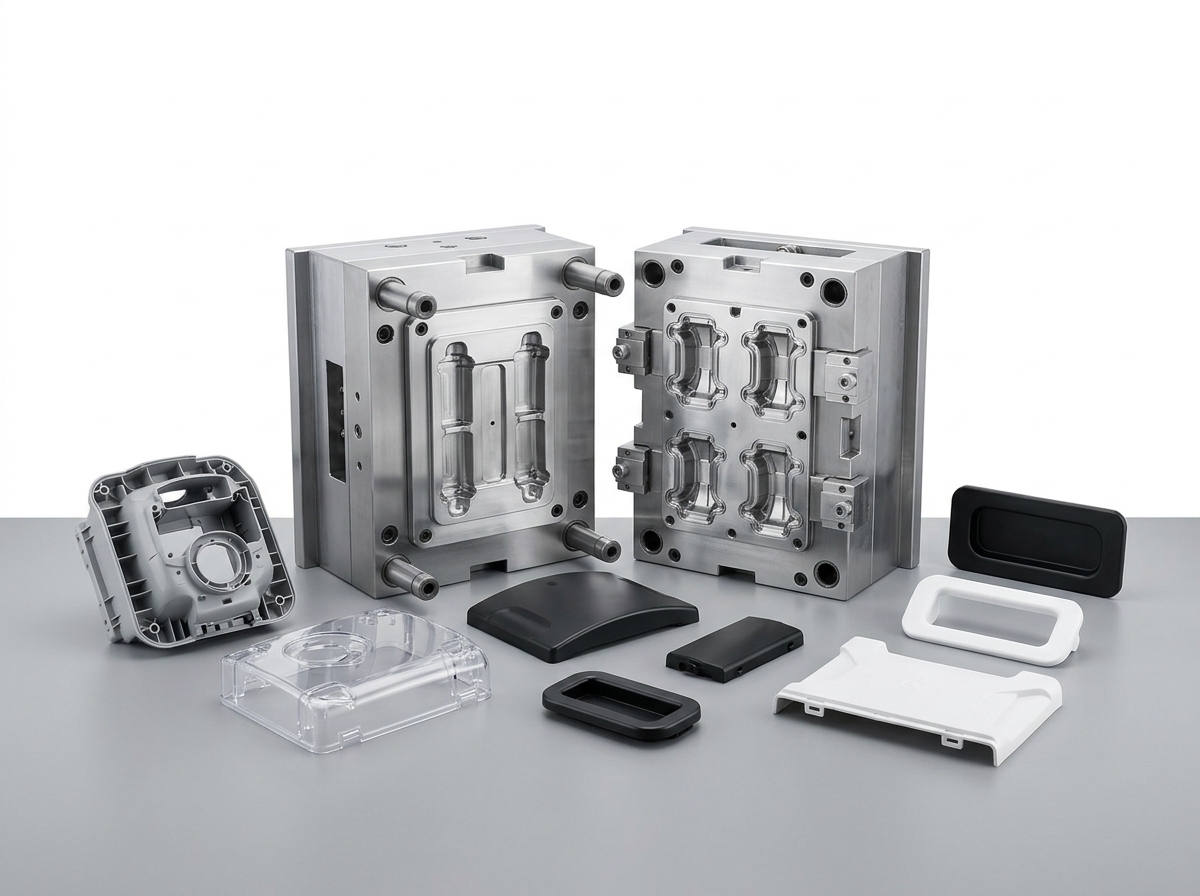 Materials, tolerances, and standards that shape mold decisions
Material choice and tolerance strategy define whether a custom mold will succeed in production.
Plastic molds are rarely built without considering shrinkage, stiffness, flow length, and cosmetic behavior. For example, PC is often selected when impact resistance and dimensional stability are important, while softer or more flexible materials may be better for grips, seals, or comfort-driven parts. The mold must be designed around the resin, not the other way around.
Standards help buyers avoid vague claims. ISO 20457:2018 covers general tolerances for thermoplastic molded parts, and ISO 294-4:2017 addresses test conditions used in injection molding of test specimens. ASTM D955 is commonly used to measure linear shrinkage of plastics, while ASTM D638 remains a standard reference for tensile properties of plastics. These standards do not replace engineering judgment, but they give teams a shared language for sampling and approval.
Dimensional control is also tied to process stability. A mold that is technically correct but poorly vented can create burn marks or incomplete fills. A mold with unbalanced cooling can create warp, which is often more damaging than a visible cosmetic mark because it affects assembly and sealing.
| Standard | What it helps control | Why buyers care |
|---|---|---|
| ISO 20457:2018 | Tolerances for molded parts | Helps define acceptable variation |
| ISO 294-4:2017 | Injection molding test conditions | Supports repeatable material evaluation |
| ASTM D955 | Linear shrinkage | Supports cavity compensation |
| ASTM D638 | Tensile properties | Helps compare material performance |
For brands, the benefit is control. Standards turn supplier promises into measurable acceptance criteria.
Cost, lead time, and launch risk in custom injection molds
Custom injection molds are chosen when the total economics beat the risk of compromise.
Upfront tooling cost is only one part of the equation. Buyers also need to consider trial revisions, scrap from unstable startup runs, assembly rework, missed launch windows, and the cost of supply disruption. In high-volume programs, a small reduction in scrap or cycle time can offset a meaningful share of tooling expense over the life of the part.
Cycle time is one of the most important economic levers. In many production environments, cooling accounts for a major share of total cycle time, which is why mold cooling design is so important. A well-designed tool can improve throughput without changing the machine or the resin. That is also why one-piece solutions such as household molds are often planned with production rhythm and retail demand in mind rather than only prototype convenience.
| Economic factor | Typical impact | Buyer decision |
|---|---|---|
| Longer cycle time | Lower hourly output | Improve cooling and part design |
| Higher scrap during launch | Material and labor loss | Require trial control and process validation |
| Late engineering changes | Tool rework and delay | Freeze drawing scope earlier |
| Poor spare-part support | Unexpected downtime | Confirm service and mold parts availability |
According to industry estimates, many OEM programs recover the value of strong tooling decisions through lower startup scrap, fewer rejections, and more stable repeat orders. That is why experienced buyers often spend more time on supplier evaluation than on the initial quote.
Why one-stop mold and part supply is attractive for export buyers
One-stop mold and part supply reduces coordination risk for international projects.
Export buyers often need more than fabrication. They need documentation, packing discipline, communication across time zones, and a supplier who can help manage samples and mass production together. When mold build and part supply sit in separate hands, responsibility gets split. When one supplier manages both, troubleshooting is usually faster.
This is especially helpful for fast-moving consumer programs. If a brand is preparing a launch, the best supplier is often the one that can translate an idea into a tested part while keeping the project organized. That includes design feedback, mold trial correction, and stable reorders. For buyers managing product families, this is often the difference between a one-off tooling quote and a long-term manufacturing relationship.
- Fewer supplier handoffs.
- Clearer accountability for quality issues.
- Faster trial-to-production transition.
- Better support for repeat orders and revisions.
That is why global brands often value injection mold services that sit close to the full product lifecycle, not just the toolroom.
How to choose the right injection mold services partner
The right partner is the one that lowers your project risk the most.
Start with the part, not the factory brochure. Ask whether the supplier can explain material behavior, draft angles, gate choices, shrinkage compensation, and dimensional verification in plain English. Then ask how they handle trials, how they document corrections, and how they support volume production after approval.
If your project includes a distinctive shape or brand-driven appearance, a supplier with experience in 3D molds may be better suited than a shop focused only on standard housings. If your project is broad and multi-category, a supplier that can cover multiple product types may simplify sourcing.
- Confirm whether they provide DFM feedback before cutting steel.
- Ask how they validate part dimensions after sampling.
- Check if they support spare parts and long-term maintenance.
- Review communication speed and technical clarity.
- Compare total project cost, not only the mold price.
For global brands, the best supplier is usually the one that makes the next order easier, not just the first one possible.
FAQ
Why do global brands choose custom injection mold services?
They choose them because the tooling can be engineered for exact part geometry, appearance, and repeatable mass production.
What is the difference between injection mold services and OEM mold manufacturing?
Injection mold services describe the broader support package, while OEM mold manufacturing emphasizes custom tooling and production built around the buyer’s product specification.
Are custom injection molds better for high-volume production?
Yes, because they are optimized for the part, the resin, and the planned output, which improves repeatability and reduces launch risk.
What industries use custom injection molds the most?
Electronics, appliances, industrial equipment, toys, household products, and other categories that depend on stable fit and visual consistency.
How do buyers judge mold quality before mass production?
They review sample accuracy, dimensional reports, surface quality, cycle stability, and how quickly the supplier resolves trial issues.
Which standards matter most in molded parts?
Common references include ISO 20457:2018, ISO 294-4:2017, ASTM D955, and ASTM D638 for tolerance, testing, shrinkage, and tensile properties.
Why is one-stop mold and part supply useful for export projects?
It reduces handoff risk, speeds up corrections, and gives buyers a single point of accountability for sampling, production, and reorders.
Post time: Sep-04-2026