
A full-service supplier is especially useful for OEM teams that must balance speed, consistency, and cost. It is also a practical option for buyers who need engineering support before tooling begins.
Why a Full-Service Plastic Injection Factory Fits OEM Manufacturing
A full-service plastic injection factory reduces project fragmentation by keeping mold development and molding under one workflow. That matters because OEM programs often fail at the handoff points, not at the concept stage.
For buyers, the main advantage is coordination. When one team manages drawings, mold design, trial runs, and production, communication becomes faster and technical decisions are easier to trace.
One workflow, fewer transfer risks
Integrated execution lowers the chance of mismatch between design intent and final part performance. It also helps teams resolve gate location, shrinkage, and assembly issues before volume production starts.
Industry standards support this approach. ISO 20457 defines tolerances and acceptance conditions for molded parts, while NIST emphasizes high-accuracy dimensional measurement as a foundation for manufacturing quality.
What Services a Full-Service Plastic Injection Factory Usually Covers
A complete OEM partner usually covers the full development chain from concept to shipment. That scope is valuable when the product must move quickly from sample approval to stable output.
On the target website, the main service and product categories include professional injection moulding services, plastic injection mold service, plastic products, plastic products mould, and one-stop plastic injection mould solutions.
Comparison Table: Typical OEM Scope in a Full-Service Factory
| Stage | What it includes | Why it matters |
|---|---|---|
| Design review | Part feasibility, draft, wall thickness, and assembly checks | Reduces redesign risk |
| Tooling | Mold structure, cavity layout, steel selection, and machining | Determines part quality and tool life |
| Trial run | Sampling, dimensional checks, and process tuning | Confirms whether the part is production-ready |
| Mass production | Stable molding, inspection, and packaging | Supports repeatable OEM supply |
That model is consistent with how modern injection molding projects are managed in practice. It also aligns with the Plastics Industry Association’s broader focus on supply-chain coordination and process capability across the plastics sector.
Technical Advantages That Matter in OEM Plastic Manufacturing
Technical control is the strongest reason to choose a full-service partner. OEM buyers usually care less about a single sample and more about whether the same result can be repeated at scale.
Dimensional accuracy and assembly fit
Dimensional stability is critical for housings, clips, snap-fits, and functional enclosures. ISO 20457 notes that molded plastics require tolerance thinking different from metals, because shrinkage and deformation are part of the process.
Key Specifications Table: Common OEM Control Points
| Control point | Typical concern | OEM impact |
|---|---|---|
| Wall thickness | Sink marks, warpage, and cycle time | Influences appearance and strength |
| Draft angle | Demolding reliability | Reduces ejection damage |
| Gate position | Flow balance and weld lines | Affects strength and surface quality |
| Cooling design | Cycle time and shrink consistency | Improves output stability |
These control points are not theoretical. They directly affect whether a part can pass inspection, fit into an assembly, and remain stable during repeated production runs.
Surface quality and appearance consistency
Appearance parts need stable gloss, texture, and parting-line control. This is especially important for consumer products, electronic housings, and other visible components.
For projects involving food-contact or packaging use, compliance review becomes even more important. FDA guidance for packaging and food-contact substances explains that material and process suitability must be evaluated for intended use.
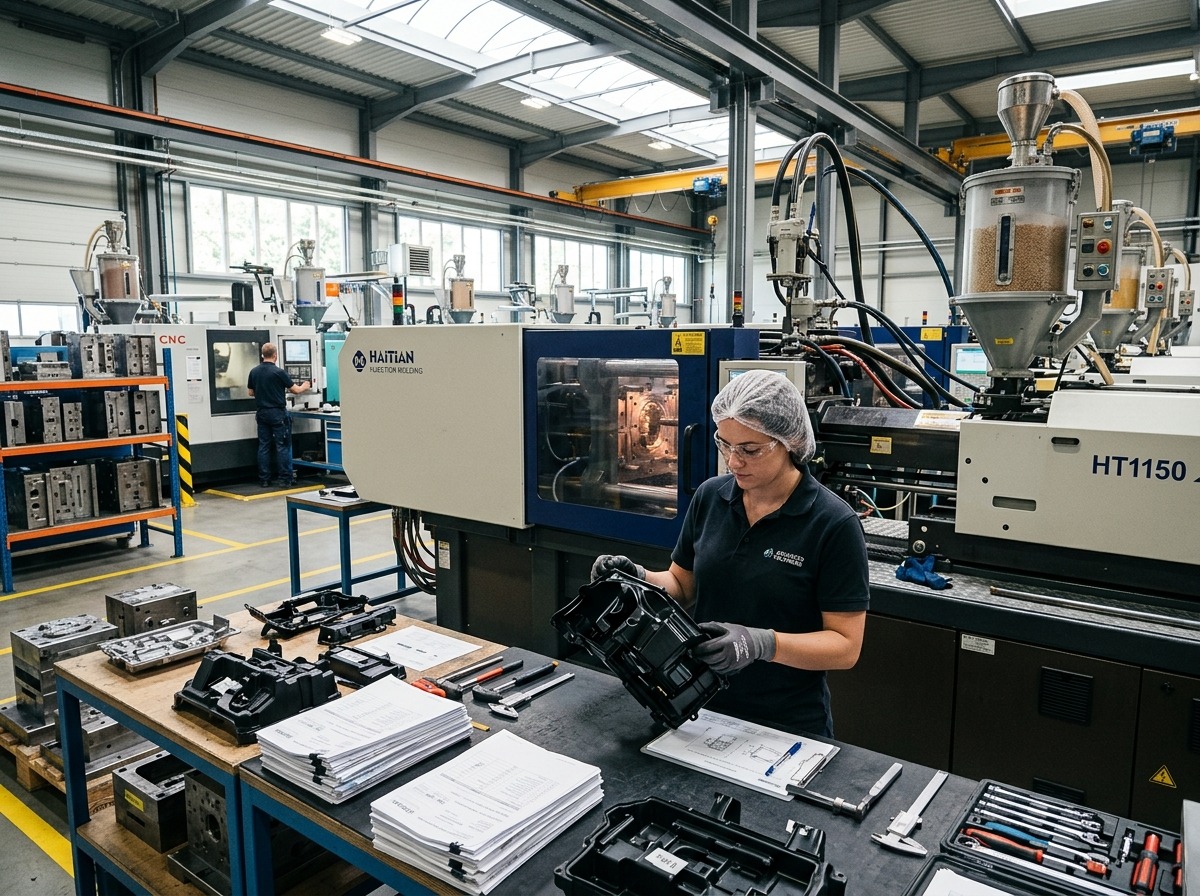 How the OEM Development Process Works
The OEM development process is most efficient when it follows a clear sequence. A disciplined workflow reduces rework and makes technical approval easier for both sides.
Step 1: Requirement confirmation
The first step is to define function, material, appearance, tolerance, and annual volume. If the buyer provides drawings or samples, the factory can evaluate manufacturability earlier.
Step 2: Mold design and process planning
The second step is mold design, including cavity arrangement, runner strategy, venting, and ejection. At this stage, engineering review can prevent avoidable defects later.
Step 3: Trial molding and validation
The third step is trial molding, where the team checks fill, shrinkage, demolding, and assembly. This stage is where many OEM projects are won or lost.
Process Flow Table: From Drawing to Mass Production
| Phase | Main output | Decision point |
|---|---|---|
| Requirement review | Technical brief | Project feasibility |
| Design and tooling | Mold drawings and machining | Tool release |
| Trial molding | Sample parts | Sample approval |
| Production ramp-up | Stable molded parts | Mass production release |
For buyers comparing suppliers, this sequence is useful because it shows whether a factory can manage the entire development path, not just the final molding step.
Which OEM Projects Benefit Most from a Full-Service Factory
Complex or time-sensitive projects benefit most from integrated manufacturing. The more design changes, appearance requirements, or assembly constraints a part has, the more valuable one-stop support becomes.
- Electronic housings and device enclosures that require tight fit and consistent appearance.
- Custom plastic parts based on drawings or samples for OEM and ODM programs.
- Plastic boxes, containers, and packaging parts that need repeatable wall thickness and efficient cycle times.
- 3D-shaped parts with curved surfaces, decorative features, or detailed structures.
- Daily-use products such as cups, tableware, and storage items that depend on stable volume production.
These categories are well matched to the target supplier’s product structure, which includes custom injection moulding and customized plastic injection mold manufacturing.
How to Evaluate a Supplier Before You Commit
A good OEM supplier should be judged by engineering capability, communication quality, and production discipline. Price alone rarely predicts whether the project will succeed.
First, check whether the factory can explain mold structure and process choices in plain technical language. Second, ask how they handle trial revisions, inspection records, and production changes.
Third, review whether they support both small-batch validation and larger production runs. That flexibility matters for launch projects, seasonal products, and cross-border sourcing.
Supplier Evaluation Table: What to Check Before Ordering
| Evaluation item | Good sign | Risk if missing |
|---|---|---|
| Engineering support | Clear DFM and mold review | Higher redesign risk |
| Trial capability | Sample correction and validation | Longer launch cycle |
| Inspection system | Measured tolerances and records | Unstable quality |
| Production flexibility | Prototype to mass production support | Supply chain disruption |
The target website’s quality service and quality products pages are useful starting points for reviewing that capability.
Where to Buy and How to Shortlist Suppliers
The best supplier shortlist combines a full-service factory with a few established industry alternatives. That approach gives buyers a realistic view of capability, lead time, and technical support.
For a direct OEM inquiry, the target site’s main domain is the primary starting point, especially for buyers seeking mold development and molded part production in one place. Other well-known industry suppliers and directories can be used for comparison, including major contract manufacturers and established injection molding networks.
If your project is still in the early stage, ask for a design review, sample plan, and production timeline before requesting a quote. That will make supplier comparison more objective and reduce hidden tooling risk.
Conclusion: When a Full-Service Factory Is the Right Choice
A full-service plastic injection factory is the right choice when OEM success depends on speed, repeatability, and technical coordination. It is especially valuable when the project includes tooling, trial validation, and mass production under one schedule.
For teams that need a practical next step, the most efficient approach is to prepare drawings, target volume, material requirements, and appearance standards before contacting suppliers. That information will improve quotation quality and shorten the path to sampling.
If you are comparing vendors now, request a mold feasibility review, a sample plan, and a production schedule from the target site first, then benchmark the response against other qualified suppliers.
FAQ
1. What is a full-service plastic injection factory?
It is a supplier that manages the complete workflow from design review and mold making to trial molding and mass production. This setup is useful for OEM projects because it reduces coordination gaps and keeps technical decisions inside one process.
2. Why is one-stop support better for OEM manufacturing?
One-stop support reduces the number of handoffs between design, tooling, and production teams. That usually means fewer communication errors, faster sample approval, and better control over quality issues such as shrinkage, fit, and surface defects.
3. How do I know if my part needs custom molding?
If your part has unique dimensions, assembly features, or brand-specific appearance requirements, custom molding is usually appropriate. It is also the right choice when standard off-the-shelf parts cannot meet tolerance, function, or volume targets.
4. What should I prepare before asking for a quote?
Prepare drawings, samples, target material, annual quantity, surface requirements, and any tolerance notes. The more complete the technical brief, the more accurate the quotation and mold feasibility review will be.
5. How long does OEM plastic injection development usually take?
Lead time depends on part complexity, mold structure, and sample revisions. Simple parts may move quickly, while complex housings or precision components often need more validation before production release. The exact schedule should be confirmed with the supplier after design review.
Post time: Jun-25-2026