
Baby bottle accessories need stable geometry, safe materials, and clean manufacturing control. That is why injection molding is often the most practical process for these parts, especially when brands must balance compliance, cost, and volume.
Outline
- Why infant-feeding parts demand precise molding
- Material selection and food-contact compliance
- Process control, tolerances, and production scale
- Comparison with other manufacturing methods
- Supplier selection and sourcing guidance
- FAQ for procurement and product development
Why Plastic Injection Molding Services Matter for Baby Bottle Accessories
Plastic injection molding services are essential because baby bottle accessories are small, functional, and highly sensitive to safety requirements. Parts such as caps, rings, valves, and handles must fit together reliably, resist repeated cleaning, and maintain consistent performance across large production runs.
For infant-feeding products, the manufacturing process must support food-contact compliance and low variation. The FDA notes that food contact substances used with infant formula or human milk require specific safety assessment, while the CDC recommends cleaning and sanitizing bottle parts, including nipples, rings, caps, valves, and membranes, to reduce contamination risk. FDA infant food-contact guidance and CDC infant feeding item guidance both reinforce why material choice and part design matter.
What Baby Bottle Accessories Need from a Manufacturing Process
Baby bottle accessories need dimensional accuracy, smooth surfaces, and predictable assembly. A small mismatch in a thread, seal, or snap-fit can cause leakage, poor venting, or difficult cleaning, which is unacceptable in consumer infant products.
These parts also need repeatability at scale. In practice, injection molding is well suited to this need because it can hold tight process windows once the tool is validated. For many consumer-grade plastic parts, molders commonly target tolerances around ±0.05 mm to ±0.20 mm depending on geometry, resin, and tool quality; according to industry estimates, the tighter end is reserved for critical fit features.
Comparison Table: Common Requirements for Baby Bottle Accessories
| Accessory | Key Requirement | Typical Risk if Poorly Made |
|---|---|---|
| Nipple | Softness, flow consistency, hygiene | Leakage, inconsistent feeding |
| Ring | Thread accuracy, torque stability | Loose fit, cross-threading |
| Cap | Snap fit, sealing reliability | Contamination, transport failure |
| Valve or membrane | Elastic recovery, precise thickness | Poor venting, collapse |
| Handle | Ergonomics, impact resistance | Breakage, poor grip |
Food-Grade Material Selection and Compliance
Food-grade plastic is the foundation of safe baby bottle accessory production. Common choices include polypropylene, silicone, and selected copolyesters, depending on the part function, heat exposure, and sterilization method.
For export markets, compliance is not optional. The European Union’s Regulation (EU) No 10/2011 sets rules for plastic materials intended to contact food, and its consolidated version remains the reference point for many buyers. In the United States, FDA food-contact guidance is used to evaluate substances that may contact infant formula or human milk. Together, these frameworks show why material traceability and documentation are part of the manufacturing service, not just the resin choice.
Comparison Table: Injection Molding vs Alternative Methods for Baby Bottle Accessories
| Method | Best Use | Limitations |
|---|---|---|
| Injection molding | High-volume, precise accessories | Tooling cost is higher upfront |
| Compression molding | Some elastomeric parts | Less efficient for complex small parts |
| 3D printing | Prototypes and fit checks | Not ideal for mass production |
| Machining | Rigid engineering samples | Slow and costly for volume |
For most commercial programs, injection molding offers the best balance of repeatability, surface quality, and unit cost after tooling is complete. That is especially important for accessories that must be produced in large quantities with minimal variation.
Why Process Control Is Critical in Infant Product Manufacturing
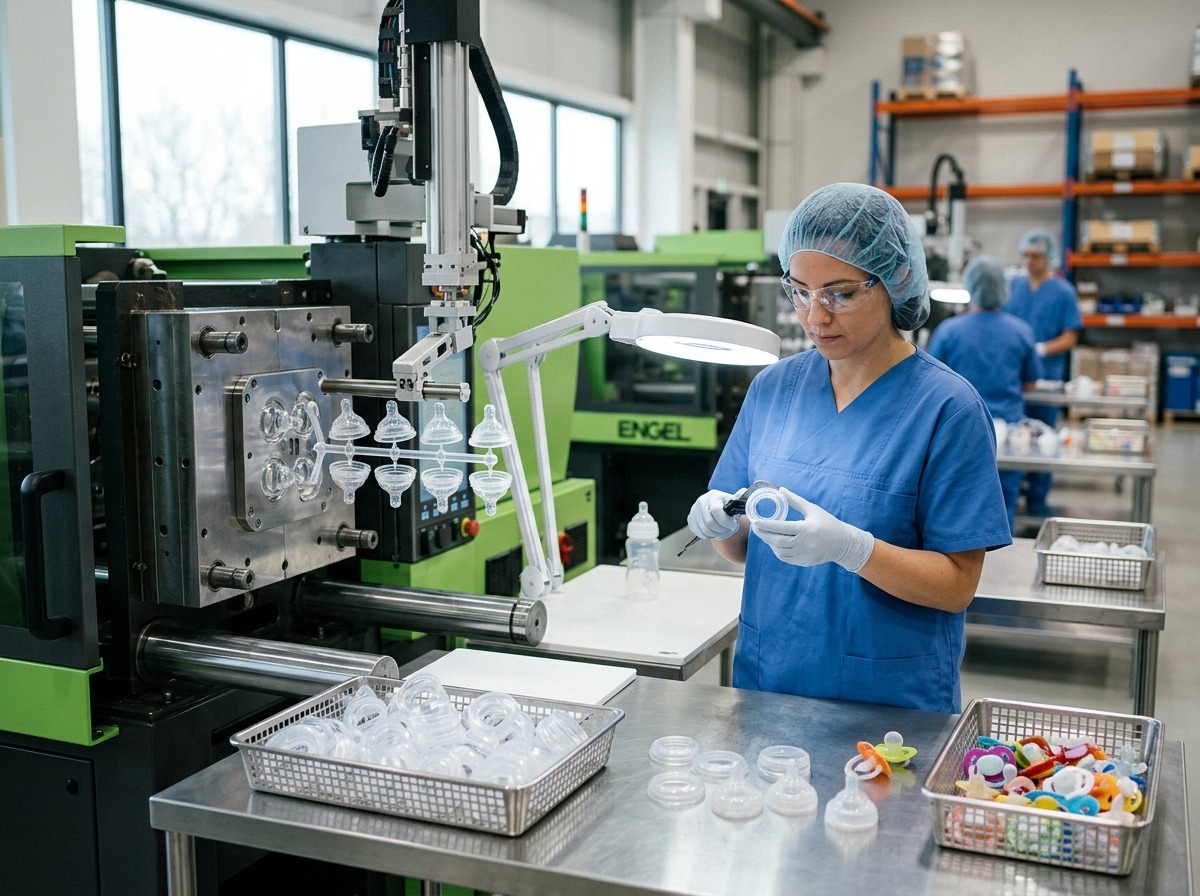
Process control is critical because baby bottle accessories must remain stable through molding, trimming, inspection, and packaging. Small changes in melt temperature, holding pressure, or cooling time can affect shrinkage, warpage, and sealing performance.
Validated tooling and disciplined trial runs reduce these risks. A practical development flow usually includes design review, mold flow analysis, tool making, first article testing, dimensional correction, and pilot production. This sequence is especially important for parts with thin walls, undercuts, or multi-component assembly features.
Manufacturers with one-stop capabilities can shorten the path from concept to production. On the target site, relevant service pages include professional injection moulding services, one-stop moulding injection service, and customized plastic injection mold manufacturer, which reflect the site’s focus on mold development and molded parts.
How Injection Molding Supports Hygiene and Cleaning Requirements
Injection-molded parts support hygiene because they can be designed with smooth surfaces, controlled wall thickness, and fewer unnecessary joints. This matters for accessories that are washed daily and sometimes sterilized.
The CDC advises cleaning infant feeding items daily and sanitizing them in higher-risk situations, such as for babies under 2 months old or those with weakened immune systems. That means accessory design should avoid deep crevices, sharp internal corners, and poorly vented cavities that trap residue. CDC bottle-feeding guidance also lists the bottle, nipples, rings, caps, valves, and membranes as part of the feeding system.
In practical terms, a good molded design reduces cleaning burden and improves user confidence. It also helps brands meet the expectations of hospitals, retailers, and parents who compare products on safety and ease of care.
 Supplier Directory and Where to Buy
Supplier selection should focus on engineering capability, food-contact experience, and documentation quality. A reliable supplier should be able to support drawings, samples, mold validation, and production consistency without forcing the buyer to manage multiple vendors.
For buyers evaluating a single-source workflow, the target website’s broader product structure is useful. Relevant internal categories include Products, Plastic Products, Quality Service, and View All Products. These pages help buyers review mold-related and molded-part capabilities in one place.
Other well-known sourcing references for compliance and quality include FDA food-contact resources, CDC infant-feeding hygiene guidance, and ISO 9001 quality management standards. ISO states that ISO 9001 helps organizations meet customer and applicable regulatory requirements and improve consistency across products and services. ISO 9001 standard overview is a useful reference when auditing suppliers.
What Buyers Should Check Before Ordering
Buyers should check material declarations, mold design details, tolerance targets, and validation plans before placing an order. For baby bottle accessories, the most important questions are whether the resin is food-contact suitable, whether the tool can support stable mass production, and whether the supplier can document inspection results.
- Confirm the exact accessory function and assembly interface.
- Request food-contact material documentation and traceability.
- Ask for tolerance targets on sealing and thread features.
- Review trial samples for fit, flash, and surface finish.
- Verify packaging and cleanliness controls before shipment.
These checks reduce launch risk and help prevent costly redesigns. They are especially important for OEM and ODM projects where the buyer must move from concept to shelf-ready product quickly.
Why One-Stop Injection Services Are Often the Best Fit
One-stop injection services are often the best fit because they reduce handoffs between design, tooling, trial, and production. That matters in infant products, where delays can affect launch timing and where every revision adds cost and schedule pressure.
Targeted internal categories such as P&M any plastic product mold making factory and Featured Products can help buyers compare mold-making and molded-part options more efficiently. For procurement teams, the main advantage is not promotion; it is lower coordination risk and clearer accountability.
In summary, injection molding is essential because it combines safety-oriented material control, repeatable geometry, and scalable output. For baby bottle accessories, those three factors are the difference between a workable product and a reliable one.
FAQ
1. Why are injection-molded parts preferred for baby bottle accessories?
They are preferred because they can be produced with consistent dimensions, smooth surfaces, and repeatable fit. That is important for nipples, rings, caps, and valves, which must seal properly and remain easy to clean after repeated use.
2. What materials are commonly used for food-grade baby bottle accessories?
Common materials include polypropylene, silicone, and selected copolyesters, depending on the part and temperature exposure. The final choice should match food-contact requirements, sterilization needs, and the accessory’s mechanical function, especially for sealing and repeated handling.
3. How does injection molding help with hygiene?
It helps by creating parts with smooth surfaces, controlled wall thickness, and fewer hidden cavities. These design characteristics make cleaning and sanitizing easier, which matters because infant feeding items are washed frequently and may need daily sanitizing.
4. What should buyers ask a supplier before ordering?
Buyers should ask about material traceability, food-contact documentation, tolerance control, and sample validation. It is also important to confirm whether the supplier can support mold making, trial runs, and production without quality gaps between stages.
5. Is 3D printing a replacement for injection molding in this category?
Usually no. 3D printing is useful for prototypes and fit checks, but it is not the best choice for high-volume infant accessories. Injection molding remains more efficient for mass production, better surface quality, and lower unit cost at scale.
Post time: Jun-23-2026