
- Custom injection molds align part design, material behavior, and production volume before tooling is finalized.
- Good mold design improves dimensional stability, appearance, assembly fit, and long-term repeatability.
- In product development, mold decisions affect tooling cost, cycle time, scrap risk, and time to market.
- For OEM and ODM projects, early mold engineering feedback is often more valuable than late-stage fixes.
- Supplier capability matters because design support, trial feedback, and production stability all influence final business results.
Custom injection molds matter in product development because injection molding is a high-repeatability manufacturing process, and the tooling defines the quality envelope from the first sample onward. According to ISO 20457:2018, plastics parts are commonly evaluated through dimensional and performance requirements that depend on product function, not just appearance. That matters for a custom injection mold used in consumer electronics, appliance housings, and industrial enclosures, where tolerance control, assembly fit, and surface consistency often determine whether a launch succeeds or stalls. When a project needs transparent PC housings, complex 3D geometry, or one-stop tooling and parts delivery, mold design becomes a strategic development step rather than a back-end manufacturing detail. For suppliers and buyers alike, this is why a custom plastic injection mold can directly shape product competitiveness, not only production feasibility.
Why custom injection molds shape product development decisions
Custom injection molds convert an idea into a controlled production system, which is why they sit at the center of product development. A design may look correct in CAD, but the mold reveals whether wall thickness is uniform, whether the part can eject cleanly, and whether shrinkage or warpage will compromise fit. In other words, mold design tests manufacturability before scale-up, reducing the risk of expensive downstream revisions.
For teams developing electronics housings or appliance covers, this is especially important because appearance and assembly are both visible to the customer. A shell may need tight clip engagement, consistent gloss, hidden parting lines, and stable dimensions across thousands of cycles. If the mold is designed poorly, the product may pass a first sample but fail during mass production when heat history, gating, or cooling imbalance begins to show up.
| Development stage | What the mold influences | Typical risk if ignored | Business impact |
|---|---|---|---|
| Concept review | Wall thickness, draft, undercuts | Non-moldable geometry | Redesign before tooling |
| Prototype trial | Gate location, flow, venting | Short shots, weld lines, burn marks | More T0/T1 iterations |
| Pilot run | Cooling balance, ejection stability | Warp, sticking, cosmetic defects | Higher scrap and delays |
| Mass production | Repeatability, maintenance, cycle time | Downtime and inconsistent output | Cost per part rises |
One practical benchmark comes from precision manufacturing standards. The commonly referenced geometric framework in ISO 1101:2017 defines how tolerances are specified for form, orientation, location, and runout. For molded parts, that language matters because functional interfaces such as snap fits, bosses, sealing lips, and alignment ribs depend on more than a nominal dimension. The more accurately these requirements are translated into mold design, the fewer surprises occur during assembly testing.
For buyers comparing suppliers, this is where 3D mold solutions can be useful for parts with complex curves, asymmetry, or high visual requirements. A complex surface is not just aesthetic; it can affect tooling split lines, venting, ejection strategy, and polishing workload. In product development, those details often decide whether the part feels premium or merely acceptable.
How mold design affects cost, cycle time, and quality
Mold design affects economics as much as it affects geometry. A custom injection mold with balanced cooling and proper gate placement can lower cycle time, while a poorly designed tool can lock the project into higher unit costs for its entire life. Since injection molding economics are heavily cycle-time driven, even a few seconds per shot can matter over large volumes.
NIST publishes guidance that helps designers think in process terms, not just part terms. In NIST measurement and calibration guidance, measurement traceability is emphasized as a foundation for reliable dimensional control. In practical product development, that means the mold should be validated with measured data, not visual judgment alone. If dimensions are drifting, the team needs to know whether the root cause is steel movement, cooling asymmetry, material moisture, or ejection stress.
| Factor | Good mold design | Poor mold design | Why it matters |
|---|---|---|---|
| Cooling layout | Balanced, close to cavity geometry | Hot spots and uneven shrinkage | Lower warp and shorter cycles |
| Gate design | Controlled fill and pack | Weld lines and sink marks | Better cosmetics and strength |
| Venting | Air escapes predictably | Burn marks and short shots | Improved fill consistency |
| Ejection | Uniform release force | Sticking and deformation | Less scrap and damage |
For transparent or impact-resistant housings, PC is often chosen because it combines toughness and clarity. According to standard material datasheets used in industry, polycarbonate typically shows tensile strength in the range of about 55 to 75 MPa, with a glass transition temperature near 147 C. Those values are useful in product development because they explain why PC can survive impact while still supporting visually clean exterior parts. When paired with appropriate mold design, that material behavior helps reduce cracking, whitening, and fit issues in consumer-facing enclosures.
In practical sourcing terms, a supplier that offers custom plastic parts alongside tooling can reduce coordination friction. Instead of transferring responsibility between a mold shop and a molding vendor, the project stays within one technical chain, which often speeds engineering feedback and keeps revision ownership clearer. That is especially valuable when a launch schedule leaves little room for multiple rounds of handoffs.
Why custom injection molds improve launch speed and risk control
Custom injection molds improve launch speed because they compress iteration into a structured workflow. A good development team does not wait until mass production to discover functional problems; it uses the mold trial to identify them early, when changes are still manageable. This is why mold development often begins with drawings, samples, target material, and expected production volume rather than with tooling alone.
For new product introduction, speed is not only about making a part quickly. It is about making the right part quickly, with enough stability to pass assembly, packaging, and field tests. In many launch programs, a tool that reaches stable dimensional output sooner is more valuable than a cheaper tool that requires repeated rework.
- Review the part geometry and identify undercuts, draft, ribs, and sealing areas.
- Confirm material selection, shrinkage behavior, and appearance requirements.
- Define tolerance-critical dimensions and assembly interfaces.
- Choose gate, vent, cooling, and ejection strategies before cutting steel.
- Validate first articles with measurement data, not just visual inspection.
A useful industry reference for manufacturing quality systems is ISO 9001:2015, which emphasizes process control and documented consistency. While ISO 9001 is not a mold standard, it explains why repeatable tooling output matters. A product development team can only scale confidently if the supplier can maintain the same part performance over time, not just during the first trial run.
This is why fast response, English communication, and documentation discipline matter for export-oriented projects. When an overseas buyer asks for revision comments, sample reports, or shipment timing, the supplier that can respond quickly often saves more time than a lower-cost vendor that replies slowly. For companies sourcing from a mold parts supplier, that responsiveness can directly affect project continuity and machine uptime.
Custom injection molds for electronics, appliances, and industrial parts
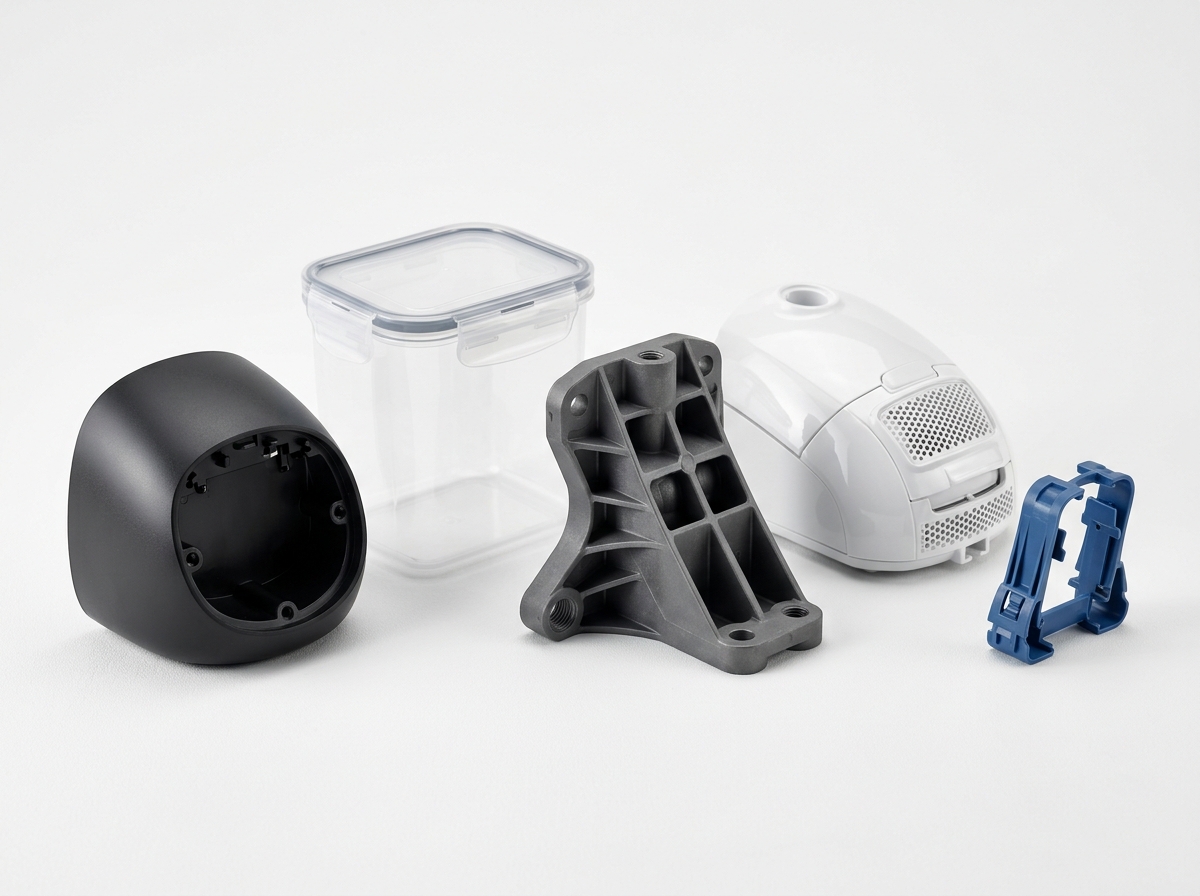
Different industries value different features in custom injection molds, so product development must start from the end-use environment. Consumer electronics usually prioritize fit, snap strength, texture, and cosmetic consistency. Home appliances often require larger shells, stable assembly, and durable screw bosses. Industrial parts need long-term reliability and consistent supply, especially when replacement cycles are tied to equipment uptime.
For electronics housings, the challenge is often hidden complexity. A part may look simple externally, but it may need internal ribs, cable paths, clip points, EMI-related geometry, and precise stack-up alignment. If the mold does not respect those constraints, assembly issues show up after the launch, when they are hardest and most expensive to correct.
| Application | Key mold priority | Typical material focus | Development risk |
|---|---|---|---|
| Consumer electronics | Snap fit and cosmetic finish | PC, ABS, PC/ABS | Visible defects or weak clips |
| Home appliances | Dimensional stability and rigidity | PP, ABS, PC blends | Poor assembly and creep |
| Industrial equipment | Reliability and repeat supply | PC, PA, reinforced grades | Downtime from part failure |
| Household goods | Cost and fast changeover | PP, PE, PS | Margin pressure |
For product lines that need multiple variants, a supplier with broad tooling capability can be valuable. A factory that handles home appliance molds as well as consumer electronic molds can help standardize engineering approaches across families of products. That matters when a company wants to expand a platform rather than develop every SKU from scratch.
One reason custom molds are important in these sectors is that appearance and function are inseparable. A front panel that meets color and texture goals but fails on clip durability is still a bad part. Likewise, a mechanically strong bracket that warps during cooling can cause assembly misalignment. Product development is successful when the mold design respects both.
 How to evaluate a custom mold supplier before production
The best custom injection mold supplier is the one that reduces development uncertainty, not the one that only promises low tooling cost. Procurement teams should look at design support, trial feedback speed, communication quality, and maintenance capability because those factors determine total project risk. In practice, the lowest initial quote can become the highest total cost if the tool needs repeated correction.
For buyers, a supplier evaluation should include technical evidence. Ask whether the vendor reviews parting line strategy, cooling balance, ejection marks, and material shrinkage before steel cutting. Ask how first articles are measured and how deviations are reported. Ask whether spare mold components are available, because downtime risk rises when wear parts cannot be replaced quickly.
- Check whether the supplier can analyze drawings, samples, and target volumes.
- Confirm support for DFM, mold flow review, and trial correction.
- Review communication speed for engineering questions and file revisions.
- Ask about maintenance parts, lead times, and after-sales support.
- Compare not only tooling price but also expected trial count and launch risk.
For companies that want a broader manufacturing relationship, a one-stop partner can reduce handoff loss. A supplier capable of both tooling and production can shorten the loop between design revision and sample confirmation, which is useful when market windows are narrow. That is one reason many buyers prefer a plastic mold partner with project-level engineering support rather than a purely transaction-based vendor.
When evaluating quality control, standardized inspection logic matters. Under ISO 20457:2018, production quality is best understood through systematic verification rather than single-point inspection. For molded parts, that means consistent measurement plans, repeatable fixture methods, and clear acceptance criteria across trials and production runs.
Common mold design mistakes that hurt product development
Most mold-related product delays come from predictable design mistakes, not random shop-floor events. The most common issue is designing for appearance first and manufacturability later. Another is assuming a prototype material or 3D print will behave like an injection-molded part, even though shrinkage, flow, and stress distribution are completely different.
Another frequent problem is ignoring maintenance from the beginning. A mold is a production asset, and every cavity, core, slide, and ejector system will wear over time. If the project has no spare part plan, a simple worn component can stop delivery and affect customer service.
| Mistake | Likely consequence | How to prevent it | Impact level |
|---|---|---|---|
| No draft angle review | Part sticks in cavity | Check release direction early | High |
| Uneven wall thickness | Sink and warp | Balance geometry in CAD | High |
| Poor gate placement | Weld lines and fill issues | Simulate flow before steel | High |
| No spare wear parts | Long downtime | Plan replacements in advance | Medium |
In many development programs, a custom mold is important precisely because it forces these decisions early. If the design team catches the problem before tooling, the fix is usually a CAD change. If the problem appears after launch, the fix may involve rework, customer complaints, or even product recalls. That is why custom molds are best understood as risk management tools, not just as manufacturing assets.
For heavily visual products, the mold also defines the surface story. Polish level, texture depth, and gate vestige all affect how the consumer perceives quality. A technically acceptable part can still fail commercially if it looks cheap in the hand.
When custom injection molds create the most value
Custom injection molds create the most value when the product has enough volume, design specificity, or quality sensitivity to justify tooling precision. They are especially important for OEM and ODM projects, where differentiation, assembly fit, and repeatability matter more than generic production.
They are also valuable when a company plans multiple variants. If the base architecture is stable, a modular mold strategy can support family tooling, faster changeovers, and lower engineering rework across SKUs. That helps brands move from a single product to a product platform without rebuilding the entire manufacturing plan each time.
- Use custom tooling when shape complexity affects function or appearance.
- Use custom tooling when assembly tolerances are tight.
- Use custom tooling when repeat production quality must stay stable over long runs.
- Use custom tooling when launch timing depends on fast sample correction.
For many buyers, this is where a development partner’s scope matters most. If a supplier can support auto parts molds, electronics housings, appliance components, and replacement mold parts, the buyer gains a more resilient sourcing base. A broader process range often means better learning transfer from one project to the next, which can shorten the next development cycle.
FAQ
What makes custom injection molds different from standard molds?
Custom injection molds are built for a specific part, material, and production goal, while standard molds are more generic and less tailored to design details.
Why are custom injection molds important in new product development?
They validate manufacturability early, reduce redesign risk, and help align appearance, function, and volume targets before mass production.
How does mold design affect product quality?
Mold design controls cooling, filling, ejection, and surface quality, all of which influence warpage, cosmetic defects, and part consistency.
What industries benefit most from custom injection molds?
Consumer electronics, home appliances, industrial equipment, household goods, toys, and automotive components all benefit when precision and repeatability matter.
Why is PC often used in molded housings?
PC offers a practical mix of impact resistance, transparency, and dimensional stability, making it suitable for protective and visual enclosures.
What should buyers check before ordering a custom mold?
They should review DFM support, trial feedback process, inspection methods, maintenance planning, and communication speed before committing.
How do custom molds help with time to market?
They reduce trial-and-error by catching geometry and process problems early, which helps teams move from sample to launch more predictably.
Post time: Sep-07-2026