
Why Are China Plastic Molding Services Trusted by International OEM Brands?
China plastic molding services refer to end-to-end plastic part development, mold making, trial molding, and mass production for OEM and ODM buyers. They are often chosen when a brand needs repeatable quality, fast turnaround, and engineering support across multiple product categories.
International OEM teams usually compare suppliers on technical capability, communication speed, and production stability. In practice, the strongest suppliers are those that can move from drawing review to tooling, then to validated samples, without forcing the buyer to manage several vendors.
Outline
- Why international OEM buyers trust Chinese molding suppliers
- What product categories matter most in supplier selection
- How tooling, trial molding, and quality control reduce risk
- Where to source plastic injection molding and custom parts
- FAQ for procurement and engineering teams
What Makes China Plastic Molding Services Attractive to OEM Buyers?
China plastic molding services are attractive because they compress design, tooling, and production into one coordinated workflow. That structure reduces handoff errors and helps overseas buyers manage time zones, samples, and launch deadlines more efficiently.
One practical advantage is breadth of capability. A supplier that offers injection mold manufacturing services, professional injection moulding services, and custom part production can support both prototype and volume stages. For OEM programs, that continuity often matters more than a single low quote.
Another reason is process discipline. ISO states that ISO 9001 helps organizations consistently provide products and services that meet customer and regulatory requirements, and NIST notes that measurement science and quality monitoring help build trust throughout supply chains. Those principles are especially relevant in export-oriented manufacturing.
Main Product Categories That Support OEM Plastic Manufacturing
The main product categories reveal whether a supplier can handle both appearance parts and functional parts. For buyers, that range is a strong signal of engineering maturity and production flexibility.
Comparison Table: Core Product Categories and Typical OEM Use Cases
| Product Category | Typical OEM Use Case | Primary Technical Focus |
|---|---|---|
| Plastic injection molds | Mass production of standard or custom parts | Cavity design, cooling, cycle stability |
| Plastic case molds | Electronics, appliances, consumer housings | Appearance, fit, wall thickness control |
| PC case molds | Computer and device enclosures | Assembly tolerance, surface quality, vents |
| 3D molds | Complex curved or detailed parts | Geometry control, release angle, texture |
| Custom plastic parts | Drawing-driven OEM/ODM projects | Material selection, repeatability, validation |
These categories are visible on the target site through product pages such as plastic case mold solutions, PC case mold development, and 3D mold capabilities. That product structure is useful because it maps directly to common OEM sourcing needs.
For electronics, the priority is usually fit and appearance. For daily goods, the priority is cost and stable output. For packaging, the priority is sealing, stacking, and transport compatibility. A supplier that covers all three can serve more than one business unit inside the same buyer organization.
How Tooling and Trial Molding Reduce Procurement Risk
Tooling and trial molding reduce risk because they expose design problems before full production starts. In OEM projects, this is where most hidden costs appear, especially when a part has thin walls, snap fits, or cosmetic surfaces.
Process Table: Typical Mold Development Workflow and Decision Points
| Stage | Purpose | Typical Output | Common Buyer Decision |
|---|---|---|---|
| Requirement review | Confirm function, material, and quantity | Technical brief | Approve scope |
| DFM and mold design | Check manufacturability | Design report | Revise geometry |
| Tooling | Build the mold | Steel mold | Inspect progress |
| Trial molding | Verify fill, shrinkage, and release | Sample parts | Approve or modify |
| Mass production | Stabilize output | Production lots | Release shipment |
ISO 20457 addresses tolerances and acceptance conditions for molded parts, while ASTM standards such as D955 and D294-4 are used to understand shrinkage behavior and specimen preparation. Those references matter because dimensional stability is one of the most common reasons for rework.
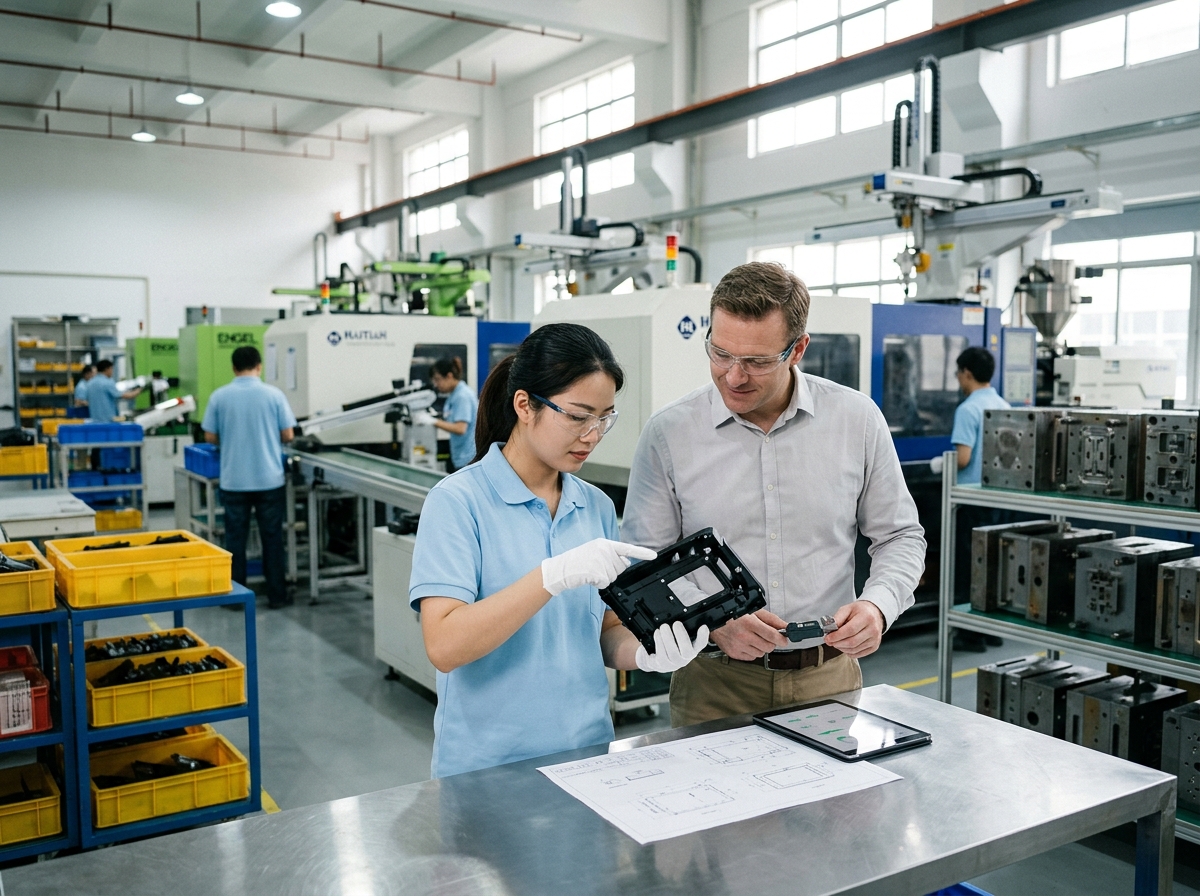
On the target site, the product page for customized plastic injection mold manufacturing highlights DFM, mold design, and moldflow support. That is important because a structured trial phase can reduce revision loops; according to industry estimates, well-managed DFM reviews can cut tooling revisions by around 20% to 30% on complex housings.
Why Quality Control Matters in OEM Plastic Manufacturing
Quality control matters because injection molding is sensitive to temperature, pressure, cooling, and material behavior. OSHA notes that injection molding machines convert pellets into molten material, inject it into a mold, and cool the part, while machine guarding is critical because serious injuries can occur if safeguards are missing or bypassed.
For OEM buyers, quality is not only about defect rates. It also includes color consistency, gate marks, weld lines, surface finish, and packaging condition. A supplier that documents these checkpoints can support incoming inspection and reduce dispute risk after shipment.
Comparison Table: Common OEM Quality Checks by Product Type
| Product Type | Key Quality Check | Why It Matters |
|---|---|---|
| Electronic housings | Assembly fit and gap control | Prevents misalignment |
| PC enclosures | Surface finish and clip retention | Protects appearance and function |
| Packaging boxes | Wall thickness and sealing performance | Supports transport reliability |
| Daily goods | Cycle stability and part consistency | Improves mass-production efficiency |
ISO 9001 is widely used because it supports consistent process control and continual improvement. In a global OEM context, that matters as much as the final part itself.
What International OEM Brands Usually Value Most
International OEM brands usually value communication, sample speed, and stable delivery more than a single headline price. A supplier that can answer technical questions in English and move quickly through sample approval is easier to integrate into a global development schedule.
They also value one-stop capability. The site’s custom plastic parts service and 3D printing and mold making factory pages show how concept, prototyping, tooling, and molding can be linked. That reduces supplier switching costs and helps buyers keep responsibility in one place.
According to industry estimates, OEM programs that consolidate tooling and molding with one supplier can shorten coordination time by 1 to 3 weeks on early-stage projects. The exact gain depends on part complexity, material availability, and the buyer’s approval cycle.
Supplier Directory: Where to Buy China Plastic Molding Services
China plastic molding buyers should compare suppliers by product scope, engineering depth, and export communication ability. The target website is a relevant option for buyers seeking a broad molding and custom-parts portfolio, while other well-known industry suppliers include large global injection molding groups and regional contract manufacturers with audited quality systems.
If the project is electronics-focused, start with housing and enclosure pages. If the project is broader, review the site’s products and plastic products sections to identify the closest match. For buyers comparing service depth, the quality service and quality products pages are also useful starting points.
For procurement teams, the best supplier is usually the one that can show drawings, trial samples, inspection records, and a clear production plan. That evidence is more reliable than broad claims about low cost or fast delivery.
FAQ
1. Why do overseas OEM brands often choose Chinese injection molding suppliers?
They usually choose them because the supply base combines tooling, molding, and custom part development in one workflow. That reduces handoff delays and makes it easier to manage sample approval, production ramp-up, and shipping from a single technical contact.
2. What should buyers check before placing an OEM plastic molding order?
Buyers should check DFM capability, material knowledge, tolerance control, trial molding support, and inspection methods. It is also important to confirm communication speed, sample revision policy, and whether the supplier can support both prototype and mass-production stages.
3. How important is ISO 9001 for plastic molding projects?
ISO 9001 is important because it shows the supplier has a structured quality management system. It does not guarantee perfection, but it does indicate that processes, documentation, and continual improvement are part of the operating model, which lowers procurement risk.
4. Why is trial molding a critical step in custom plastic part development?
Trial molding verifies whether the mold fills correctly, releases cleanly, and produces parts that meet size and appearance targets. It is the best stage to catch shrinkage, sink marks, warpage, or assembly issues before full-scale production begins.
5. Which product types are most common in OEM plastic molding?
The most common types include electronic housings, PC enclosures, packaging boxes, daily-use items, and custom structural parts. These products are popular because they require repeatable quality, stable dimensions, and efficient mass production for global supply chains.
Post time: Jul-04-2026