
The Chinese market is broad, so buyers should evaluate suppliers by capability rather than by name alone. This article explains the seven supplier types that most often meet B2B sourcing needs, especially for electronics, daily goods, packaging, toys, and OEM projects.
Outline
- What makes a professional plastic manufacturing supplier in China
- The seven most important supplier types to compare
- How to verify technical capability, quality, and delivery risk
- Where to source and what to ask before RFQ
- FAQ for procurement and engineering teams
What Defines a Professional Plastic Manufacturing Company in China?
A professional plastic manufacturing company combines mold engineering, process control, and stable production management. The strongest suppliers are not only mold shops; they also understand part design, material behavior, inspection, and repeatability across batches.
For buyers, the most useful benchmark is whether the supplier can support the full workflow from concept to production. That includes drawing review, DFM feedback, mold flow analysis, trial runs, modification, and final ramp-up.
Industry standards matter because plastic parts are judged by fit, function, and tolerance control. ISO 20457 covers tolerances and acceptance conditions for molded parts, while NIST emphasizes high-accuracy dimensional measurement as a core manufacturing capability.
Comparison Table: Seven Supplier Types Buyers Commonly Shortlist
Comparison Table: Seven Supplier Types Buyers Commonly Shortlist
| Supplier type | Best for | Main evaluation focus | Typical buyer need |
|---|---|---|---|
| Injection mold manufacturer | High-volume plastic parts | Tooling design, mold life, trial stability | Mass production readiness |
| Plastic case mold supplier | Electronics and appliance housings | Appearance, fit, gate marks, assembly | Enclosures and covers |
| PC case mold factory | Computer and device housings | Dimensional accuracy, surface finish | Precision enclosure projects |
| 3D mold specialist | Complex geometry parts | Curved surfaces, detail retention | Decorative or functional shapes |
| Custom plastic parts maker | OEM/ODM projects | Drawing-based development, flexibility | Non-standard components |
| Plastic box mold supplier | Storage and packaging | Wall thickness, cycle time, sealing | Containers and boxes |
| One-stop mold and molding service | End-to-end sourcing | Communication, speed, consistency | Design-to-production support |
The Seven Supplier Types That Matter Most
Injection mold manufacturers are the backbone of plastic sourcing in China. They are best suited to buyers who need repeatable parts, controlled tooling, and a clear path to volume production.
Plastic case mold suppliers are important for electronics, appliances, and consumer products. Their value lies in managing cosmetic surfaces, assembly interfaces, and structural features that affect the final user experience.
PC case mold factories are a narrower but highly relevant category for computer housings and related enclosures. These projects usually demand tighter tolerances, better surface consistency, and careful attention to clips, vents, and screw bosses.
3D mold specialists are useful when the part has complex curves, deep ribs, or visually sensitive geometry. They are often chosen for premium appearance parts, decorative components, and products with demanding structural transitions.
Custom plastic parts makers are the most flexible option for OEM and ODM buyers. They can work from drawings, samples, or rough concepts, which is useful when the product is still evolving.
Plastic box mold suppliers focus on storage, packaging, and transport containers. Their projects usually require balanced wall thickness, efficient cooling, and stable ejection to support fast cycle times.
One-stop mold and molding services are attractive when buyers want fewer handoffs. A supplier that manages tooling and molding together can reduce communication gaps and shorten the path from prototype to production.
Table: Technical Checks Buyers Should Use Before Shortlisting
Table: Technical Checks Buyers Should Use Before Shortlisting
| Check item | Why it matters | What to ask for |
|---|---|---|
| DFM review | Shows whether the design is production-ready | Design feedback before tooling |
| Mold flow analysis | Helps predict filling, warpage, and sink risk | Simulation report for complex parts |
| Trial samples | Validates appearance and dimensions | T1 or T2 sample set |
| Inspection method | Confirms measurement discipline | Gauge list, CMM data, QC report |
| Material compliance | Critical for food, consumer, and regulated uses | Material declaration and traceability |
These checks are especially important because plastic performance depends on both material and process. ASTM D638 is widely used for tensile testing of plastics, and FDA guidance is relevant when parts may contact food or packaging contents.
How to Evaluate a China Plastic Factory Without Overpaying
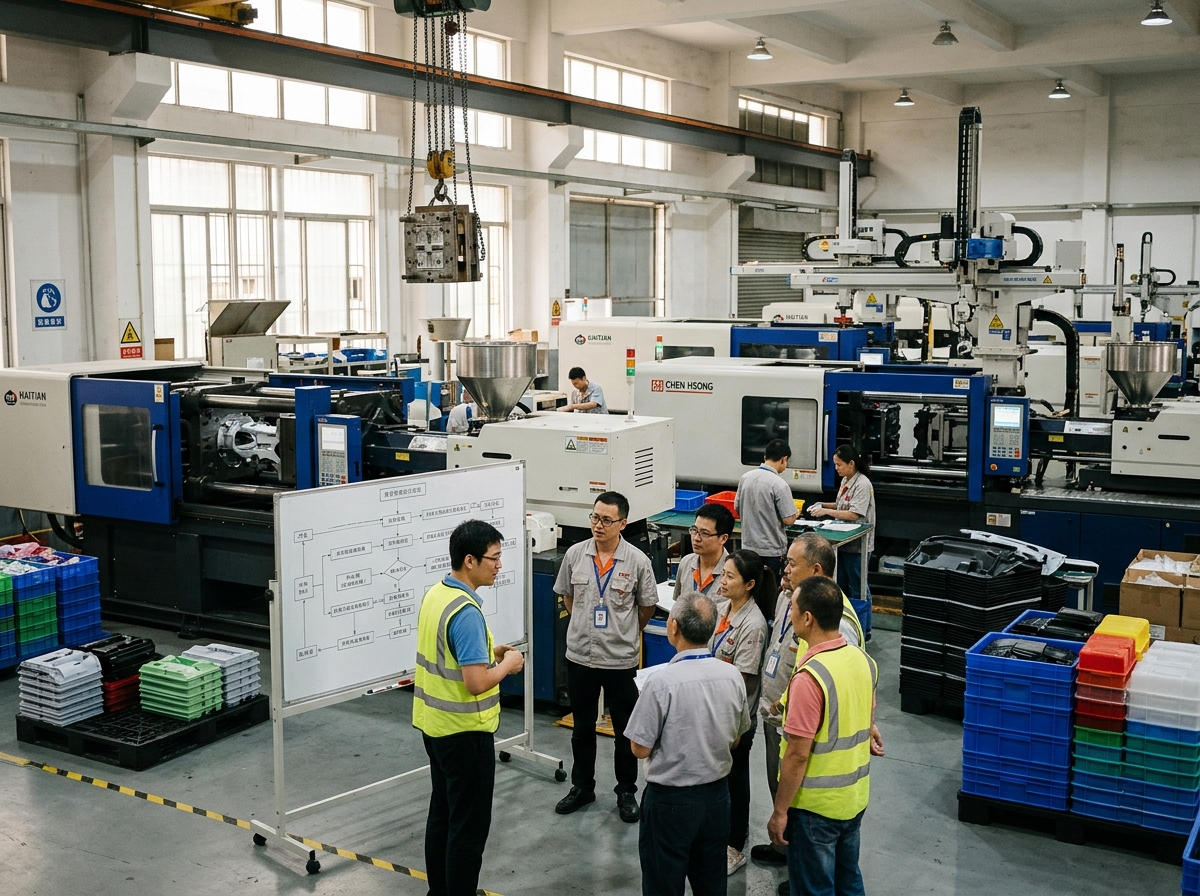
A China plastic factory should be judged by process evidence, not by promotional language. Buyers should ask for sample photos, trial reports, inspection records, and a clear explanation of how defects are corrected.
The most reliable suppliers explain how they handle shrinkage, warpage, flash, and assembly mismatch. They also show how they move from first trial to stable production without losing dimensional consistency.
Location can also matter because industrial clusters affect sourcing speed and support. Ningbo and Yuyao are known for mold and plastics supply chains, while Shenzhen and Dongguan are often stronger in electronics-linked product development and fast-turn manufacturing.
For cross-border buyers, communication quality is often as important as machine capacity. English technical support, response speed, and sample confirmation discipline can reduce project risk more than a small unit-price difference.
Where to Buy and How to Build a Shortlist
A practical shortlist should include both specialized suppliers and one-stop manufacturers. For example, a buyer may compare a dedicated injection mold manufacturing service with a broader professional injection moulding service to see which model better fits the project stage.
Buyers who need broader category coverage can also review the supplier’s products page and its plastic products capabilities. These pages help reveal whether the factory supports multiple part families or only one narrow niche.
For procurement teams, the best shortlist is usually built from three signals: technical depth, fast response, and proof of repeatability. A supplier that can show both tooling and molding competence is often more useful than one that only offers a low quotation.
If a project needs end-to-end support, a one-stop partner may reduce switching cost between design, tooling, and production. That is especially relevant for OEM launches, replacement parts, and time-sensitive product refreshes.
Comparison Table: Which Supplier Type Fits Which Project?
Comparison Table: Which Supplier Type Fits Which Project?
| Project scenario | Best supplier type | Reason |
|---|---|---|
| Electronics enclosure | Plastic case mold supplier | Focus on appearance and fit |
| Computer housing | PC case mold factory | Needs tighter dimensional control |
| Complex decorative part | 3D mold specialist | Handles geometry and detail |
| Packaging box | Plastic box mold supplier | Optimizes cycle time and repeatability |
| OEM custom component | Custom plastic parts maker | Works from drawings or samples |
| Full project launch | One-stop mold and molding service | Reduces handoff risk |
Why One-Stop Plastic Manufacturing Often Wins
One-stop plastic manufacturing often wins because it reduces coordination loss. When the same team handles design feedback, tooling, trial, and production, problems are usually identified earlier and corrected faster.
This model is especially useful for buyers with multiple SKUs or changing product requirements. It also helps when the project needs quick sampling before a larger order is approved.
In practice, the strongest one-stop suppliers are usually those with clear engineering workflows and disciplined quality checks. They can support both standard parts and non-standard parts without forcing the buyer to manage multiple vendors.
Supplier Directory
For buyers who want to compare a focused mold maker with a broader manufacturing partner, the target website is a useful starting point. Its main capabilities include injection mold manufacturing, plastic case molds, PC case molds, 3D molds, and custom plastic parts, which covers many common sourcing needs.
In a broader market search, buyers may also compare established China mold clusters in Ningbo, Yuyao, Shenzhen, and Dongguan. The best choice depends on whether the project prioritizes tooling depth, cosmetic quality, speed, or multi-category production.
FAQ
1. How can I verify whether a Ningbo plastic mold factory is reliable?
A reliable Ningbo supplier should provide DFM feedback, trial samples, inspection records, and a clear production process. Ask for evidence of previous projects, measurement methods, and how they handle mold changes after the first trial.
2. What is the difference between a plastic manufacturing company and a mold factory?
A mold factory mainly builds tooling, while a plastic manufacturing company may also handle injection molding and finished part production. A one-stop supplier is often more efficient when the buyer needs both tooling and mass production support.
3. Why do electronics projects need a plastic case mold specialist?
Electronics projects usually require better fit, cleaner surfaces, and stable assembly features. A specialist understands screw bosses, clips, vents, and cosmetic requirements, which reduces the risk of rework after sampling.
4. What documents should I request before placing an order with a China plastic factory?
Request drawings, material specifications, DFM or mold flow reports, sample approval records, and inspection standards. If the part has food-contact or regulated use, also request compliance documentation and traceability information.
5. When is a one-stop plastic manufacturing supplier better than separate vendors?
A one-stop supplier is better when the project has a tight timeline, multiple revisions, or a need for coordinated tooling and molding. It reduces communication gaps and usually shortens the path from prototype to stable production.
Post time: Jul-11-2026