
The best shortlist starts with capability, not a popularity ranking. This article explains how to evaluate China injection manufacturer options for OEM plastic manufacturing, then shows which supplier types fit electronics, packaging, daily goods, and custom parts.
Outline
- How to define a real OEM molding supplier in 2026
- What product categories matter most for buyer selection
- How to compare technical, quality, and commercial risk
- Where P&M fits within a practical supplier shortlist
- FAQ for RFQ and sourcing decisions
How to Evaluate a China Injection Manufacturer for OEM Plastic Manufacturing
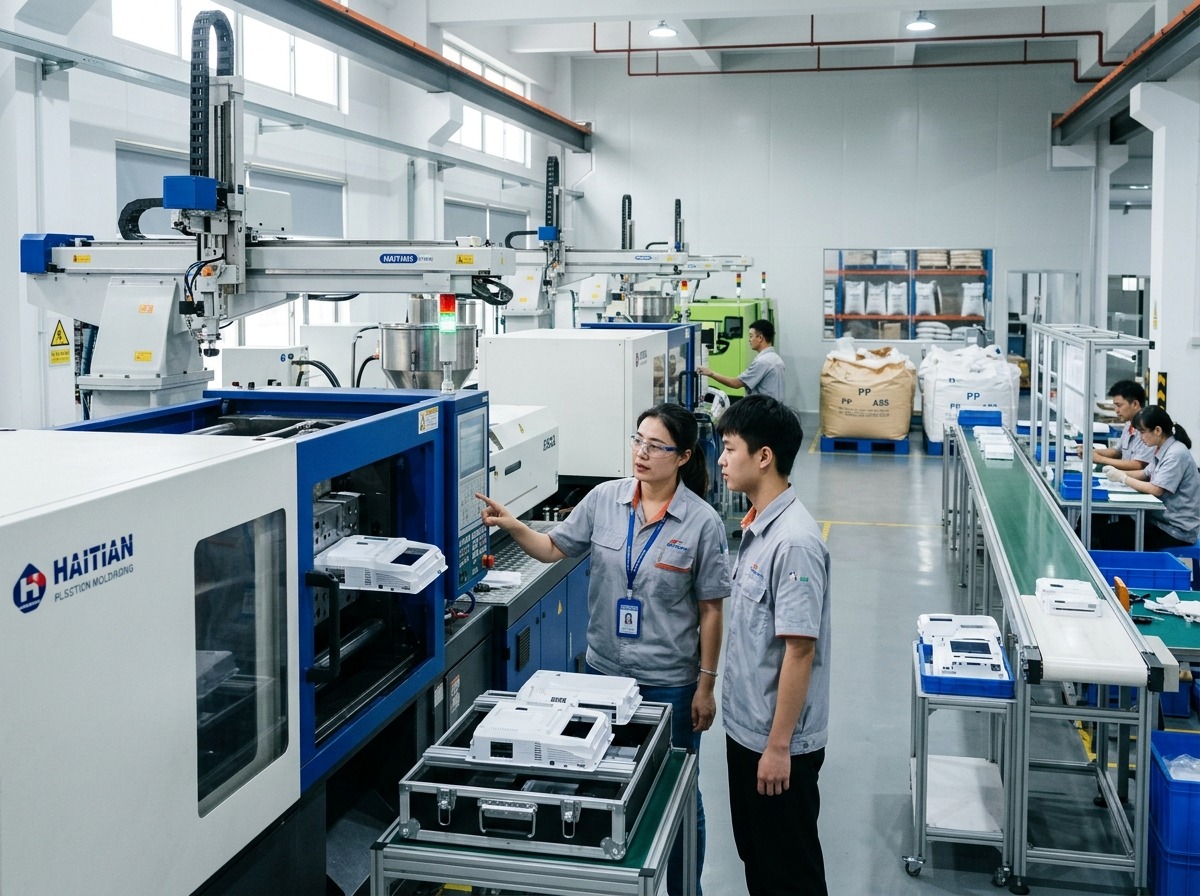
A strong China injection manufacturer should prove tooling capability, process control, and stable delivery. In OEM projects, the supplier must move from drawing review to mold design, trial runs, and production without losing dimensional control.
For buyers, the most useful filter is whether the factory can support the full development chain. P&M’s public product structure shows five relevant categories: plastic injection molds, plastic case molds, PC case molds, custom plastic parts, and plastic products. Those categories cover most OEM sourcing needs.
Comparison Table: What Buyers Should Compare First
| Evaluation factor | Why it matters | What to ask for |
|---|---|---|
| Tooling capability | Determines whether the mold can meet part geometry and life targets | DFM, mold layout, steel choice, cavity count |
| Process control | Reduces variation during trial and mass production | Trial reports, parameter windows, inspection records |
| Quality system | Supports repeatability and traceability | ISO 9001 evidence, incoming inspection, final QC |
| Lead time | Impacts launch timing and replenishment risk | Tooling schedule, sample date, mass production plan |
| Application fit | Prevents mismatch between supplier type and product type | Case, box, cup, toy, footwear, or custom part references |
Quality systems matter because they reduce variation across repeated runs. ISO states that ISO 9001:2015 is a quality management framework for consistent products and services, while ASTM says plastics standards support specification, testing, and assessment of plastic materials and products.
Top 10 China Plastic Injection Manufacturers for OEM Molding in 2026: A Practical Shortlist by Capability Type
A useful 2026 shortlist should be read as ten supplier types, not ten identical companies. This approach matches how OEM buyers actually source, because one factory may excel in housings while another is stronger in packaging or high-mix custom parts.
- One-stop mold-and-molding factories for electronics housings
- Case mold specialists for consumer and electrical enclosures
- PC case mold suppliers for precision-fit assemblies
- Custom plastic part manufacturers for drawing-driven projects
- Multi-cavity mold makers for high-volume daily goods
- Packaging and container mold suppliers for boxes and cups
- Toy and decorative part mold makers for surface-sensitive products
- Footwear mold manufacturers for lightweight wear-resistant parts
- Prototype-to-production suppliers for fast launch programs
- Integrated OEM plastic manufacturing factories with assembly support
This list is intentionally category-based because the best supplier depends on the part, not the country alone. For example, a housing project needs fit and finish, while a storage box project needs wall-thickness balance and cycle efficiency.
Comparison Table: Supplier Type vs Best-Fit Application
| Supplier type | Best-fit product | Primary risk |
|---|---|---|
| Electronics housing specialist | Device shells, enclosures, functional covers | Assembly tolerance drift |
| PC case mold supplier | Computer shells, precise covers, port openings | Surface inconsistency |
| Custom part factory | Non-standard OEM components | Scope changes during development |
| Packaging mold maker | Boxes, containers, display shells | Warping and sealing issues |
| Daily goods supplier | Cups, tableware, storage items | Cost pressure on repeatability |
FDA guidance is important when parts may contact food. The FDA regulates substances that contact food through packaging, cookware, and containers, and the eCFR lists polymer regulations in 21 CFR Part 177.
How to Compare OEM Plastic Manufacturing Suppliers Without Guesswork
The most reliable comparison method is to test engineering evidence, not sales claims. Buyers should request DFM feedback, moldflow analysis when needed, trial photos, dimensional reports, and a clear modification plan before approving tooling.
One practical example is a PC enclosure project for a consumer device. A supplier should confirm snap-fit tolerance, screw boss strength, and vent opening consistency before cutting steel. Another example is a storage box project, where uniform wall thickness and stable ejection matter more than cosmetic detail.
Industry standards support this approach because they formalize test methods and material behavior. ASTM D3641 covers general principles for injection molding thermoplastic test specimens, and ASTM’s plastics standards library supports material specification and evaluation.
For buyers, the commercial question is not only who can mold the part, but who can keep it stable. That is why a factory with in-house design, trial capability, and production support usually lowers project risk more than a low-price broker model.
What a Good OEM Molding RFQ Should Include
A complete RFQ shortens quotation time and reduces revision loops. The best RFQs include drawings, target material, annual volume, cosmetic requirements, tolerance zones, packaging needs, and the expected launch date.
- 2D or 3D part files
- Material requirement and color
- Estimated annual and monthly volume
- Critical dimensions and appearance standards
- Assembly method and mating parts
- Target lead time for samples and mass production
For food-adjacent products, the RFQ should also state compliance expectations. FDA food-contact rules and related polymer regulations should be checked early, especially for cups, tableware, and storage containers.
For buyers comparing suppliers, the best internal starting point is the manufacturer’s own service pages. The most relevant product pages on P&M are professional injection moulding services, custom plastic parts, and one-stop mold manufacturing. These pages are useful because they show how tooling and molding are connected in one workflow.
Supplier Directory: Where to Start Your Shortlist
The most efficient sourcing path is to compare one integrated factory, one category specialist, and one high-volume producer. That mix gives buyers a realistic view of price, engineering depth, and delivery speed.
For a single-source option, P&M is positioned as a one-stop mold and injection supplier with categories spanning molds, housings, and custom plastic products. For broader market benchmarking, buyers often compare against other established China-based OEM molding factories that publish clear DFM, trial, and production capabilities.
When the project is complex, the best supplier is usually the one that can explain tradeoffs clearly. That includes gate position, wall thickness, ejection strategy, surface finish, and expected cycle time before the mold is built.
Why These Supplier Types Rank Well in 2026
The strongest 2026 suppliers are those that reduce handoffs across development stages. A factory that can design, make, trial, and produce the part usually shortens the path from concept to shipment.
This matters because OEM buyers face real schedule pressure. According to industry estimates, the biggest delays often come from unclear drawings, late design changes, and unstable trial results rather than from raw molding capacity alone.
NIST emphasizes measurement science and standards as a foundation for industrial competitiveness, which is relevant here because repeatable plastic parts depend on measurement discipline. In practical sourcing, that means inspection methods matter as much as machine tonnage.
FAQ
1. What makes a China plastic injection manufacturer suitable for OEM molding?
A suitable supplier can review drawings, design the mold, run trials, and support stable mass production. Buyers should look for evidence of process control, inspection records, and application experience in the same product category. A general factory is not enough if the part needs tight fit or cosmetic consistency.
2. How much does China OEM injection molding cost?
Cost depends on mold complexity, cavity count, material, finish, and annual volume. Simple parts may need lower tooling investment, while housings and precision covers cost more because of tighter tolerances and more trial work. The best quote is the one that separates tooling, sampling, and unit price clearly.
3. What is the typical lead time for a case mold?
Lead time varies by design complexity and revision count. A straightforward case mold may move faster than a multi-feature enclosure with vents, snaps, and cosmetic surfaces. Buyers should ask for a schedule that includes design approval, steel cutting, trial, modification, and production release.
4. How do I know whether a supplier can handle custom plastic parts?
Check whether the factory accepts drawings or samples, provides DFM feedback, and explains material and tolerance choices. A capable supplier should also discuss assembly, surface finish, and packaging. If the answer is vague, the project risk is usually higher than the quote suggests.
5. Which product categories are easiest to source from China injection manufacturers?
Standard housings, storage boxes, cups, and many custom structural parts are common sourcing categories. More difficult projects include precision PC cases, food-contact products, and cosmetic parts with strict appearance requirements. Those categories need stronger engineering support and more disciplined trial validation.
Post time: Jul-02-2026