
The reliability of a China injection factory depends less on price and more on repeatable engineering discipline. For buyers sourcing custom plastic parts, the best suppliers combine mold design, trial molding, inspection, and production support in one controlled workflow.
What Makes a China Injection Factory Reliable?
A reliable supplier is one that reduces risk before tooling starts. In practice, that means clear drawings, realistic tolerances, material selection guidance, and a documented approval path for samples and production.
Quality Systems and Process Control
Quality systems are the first sign of a dependable factory. ISO explains that ISO 9001:2015 is a quality management framework used to deliver consistent products and improve customer satisfaction, while ASTM D3641 provides a standardized practice for injection molding test specimens, which helps keep reporting and process description uniform.
Process control matters because injection molding is sensitive to temperature, pressure, cooling, and mold release. NIST emphasizes measurement science and manufacturing support as a foundation for industrial competitiveness, which is why factories with inspection discipline usually perform better over time.
Trial Molding and Sample Approval
Trial molding is where a factory proves whether the mold can actually produce acceptable parts. The most reliable suppliers document filling, shrinkage, warpage, gate marks, ejection behavior, and assembly fit before moving to volume production.
For buyers, the trial stage should not be treated as a formality. It is the point where design assumptions meet real material behavior, and it often reveals whether the supplier understands plastic injection molding beyond basic machine operation.
Main Product Categories to Review on the Supplier Website
The target website focuses on several core mold and part categories that are relevant to sourcing decisions. These categories help buyers match product complexity with the right manufacturing capability.
Comparison Table: Core Product Categories and Typical Buyer Needs
| Category | Typical Use | Key Buying Concern |
|---|---|---|
| Plastic injection molds | Mass production of standard or custom parts | Tool life, cycle stability, and dimensional accuracy |
| Plastic case molds | Electronics, appliances, consumer housings | Appearance quality and assembly fit |
| PC case molds | Computer and electronic enclosures | Surface finish, tolerance control, and venting |
| 3D molds | Complex curved or detailed parts | Geometry accuracy and release performance |
| Custom plastic parts | OEM and ODM projects | Drawing compliance and repeatability |
For a quick review of the supplier’s scope, buyers can start with injection molding services, then compare the broader plastic product range and the company’s professional injection moulding services. These pages help confirm whether the factory is set up for both tooling and production.
How to Screen Reliable Chinese Injection Molding Manufacturers
The best screening method is to evaluate engineering evidence, not sales language. A serious buyer should ask for mold design files, DFM feedback, trial reports, inspection records, and sample photos from similar projects.
Screening Checklist for Buyers
- Request DFM review before mold cutting.
- Confirm material compatibility and shrinkage assumptions.
- Ask how trial molding defects are corrected.
- Check whether inspection tools match the part tolerance.
- Verify communication speed and English technical support.
Reliable Chinese injection molding manufacturers usually answer these questions with documents, not vague promises. If a supplier cannot explain gate position, cooling strategy, or sample rejection criteria, the project risk is usually higher than the quoted price suggests.
Comparison Table: Reliable vs. High-Risk Supplier Signals
| Evaluation Area | Reliable Signal | High-Risk Signal |
|---|---|---|
| Engineering support | DFM and moldflow review available | No technical review before tooling |
| Trial molding | Documented sample approval process | Samples sent without explanation |
| Quality control | Measured inspection and traceability | Visual check only |
| Communication | Clear English updates and timelines | Slow replies and unclear commitments |
Why Location and Industry Cluster Still Matter
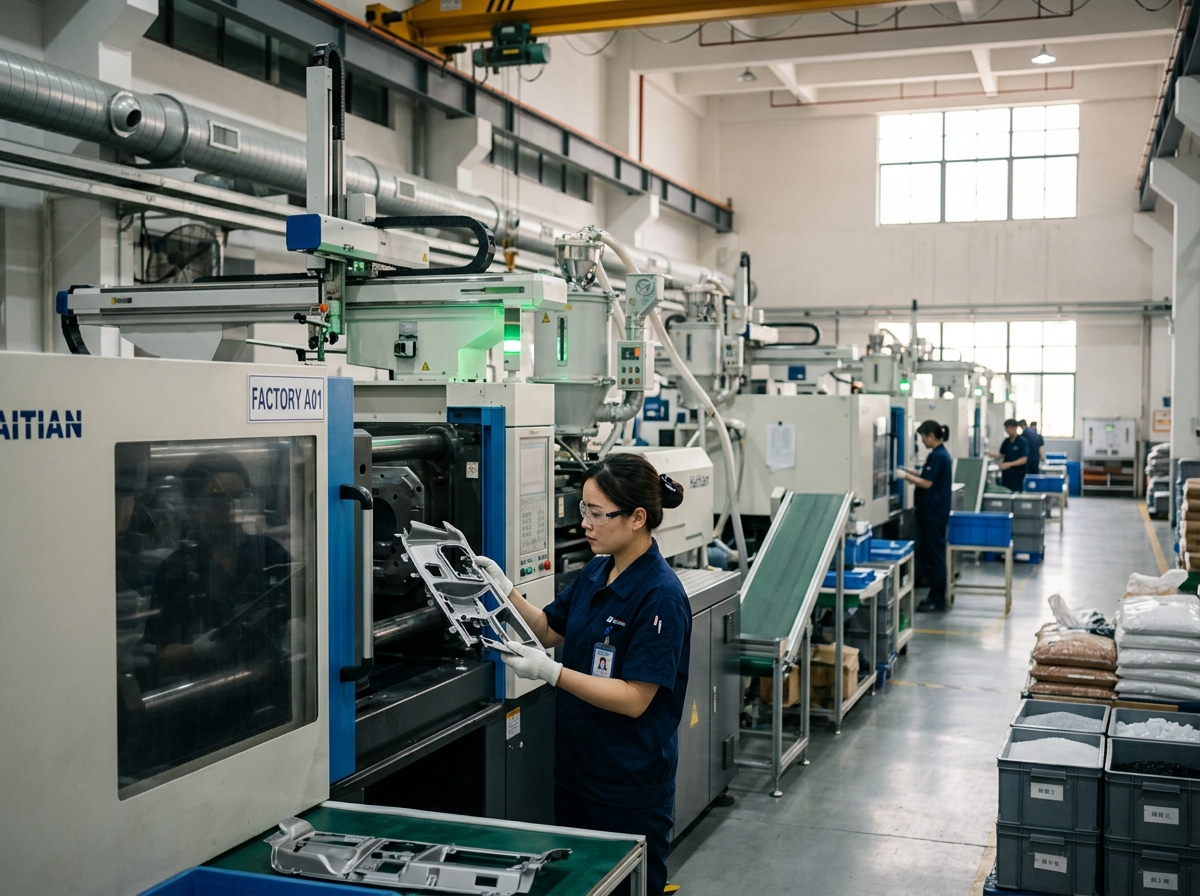
Location is a practical reliability factor because it affects supply chain speed and technical support. The company profile states that P&M is based in Yuyao, near Ningbo Port, which places it inside a well-known mold manufacturing cluster with logistics advantages. That regional advantage does not replace technical capability, but it can improve lead time and coordination. For international buyers, the combination of factory access, port proximity, and export experience often reduces friction during sampling and shipment.
Where Plastic Injection Molding Fits Different Applications
Application fit is another way to judge whether a factory is reliable for your project. A supplier that handles electronics housings may not be equally strong in packaging, toys, or footwear, so buyers should match product type to proven experience.
Application Scenarios by Industry
- Electronics: enclosures, PC housings, and functional structural parts.
- Daily goods: cups, tableware, storage boxes, and containers.
- Packaging: shells, display parts, and transport containers.
- Toys and decoration: spheres, shapes, and surface-detail parts.
- OEM and ODM: custom plastic parts based on drawings or samples.
For buyers who need a broader service scope, the website’s custom molds and mould service pages are useful starting points. They indicate whether the supplier can support one-off development or repeat production with the same engineering team.
What to Ask Before You Place an Order
The right questions reveal whether the factory can manage risk across the full project cycle. Buyers should ask about lead time, tooling steel, cavity count, sample revision limits, and whether the factory can support production ramp-up after approval.
According to industry estimates, many project delays come from unclear sample expectations rather than machine capacity. That is why a reliable factory should define acceptance criteria for dimensions, appearance, assembly, and packaging before mass production begins.
Trial Molding Checklist
- Confirm part drawing revision and tolerance targets.
- Review material grade and drying requirements.
- Check gate, vent, and ejection performance.
- Measure critical dimensions on first samples.
- Approve only after fit, finish, and function are verified.
If a supplier can explain this workflow clearly, it is usually a stronger candidate for long-term sourcing. Buyers can also review the company’s quality service and quality products pages to see how inspection and delivery are positioned.
Supplier Directory: Reliable Options and Industry Resources
A balanced sourcing list should include both a capable China injection factory and neutral industry references. This helps buyers compare technical claims against recognized standards and sourcing guidance.
- P&M homepage for mold and custom part categories.
- Featured Products for a quick view of core offerings.
- View All Products for broader category comparison.
- ISO 9001:2015 overview for quality management expectations.
- International Trade Administration for sourcing and trade resources.
Other well-known industry references include ASTM for molding-related practices and NIST for measurement and manufacturing support. These sources do not replace supplier audits, but they help buyers set more objective evaluation criteria.
Conclusion: How to Choose the Most Reliable Factory
The most reliable supplier is the one that proves repeatability, not the one that promises the lowest quote. In China injection molding sourcing, the safest choice is a factory that offers clear DFM review, controlled trial molding, measurable quality checks, and responsive project communication.
For buyers comparing plastic injection molding partners, the best next step is to request a sample plan, a trial report template, and a tolerance discussion before tooling starts. That approach reduces risk, shortens approval cycles, and makes supplier comparison much more objective.
FAQ
1. What is the fastest way to judge a China injection factory’s reliability?
The fastest test is to ask for DFM feedback, trial molding records, and inspection data from a similar project. A reliable supplier can explain risks, corrections, and acceptance criteria clearly. If the answers stay generic, the project risk is usually higher than the quote suggests.
2. Why is trial molding so important in plastic injection molding?
Trial molding confirms whether the mold can produce parts that meet size, appearance, and assembly requirements. It reveals issues such as shrinkage, warpage, short shots, and ejection marks. Without a proper trial stage, mass production may repeat hidden defects at scale.
3. Are Chinese injection molding manufacturers suitable for OEM and ODM projects?
Yes, many are suitable when they can work from drawings, samples, or concept files. The key is whether the factory can support engineering review, tooling, sample revision, and production ramp-up. OEM and ODM projects need more than machine capacity; they need process control.
4. What documents should I request before approving a mold order?
Buyers should request part drawings, DFM notes, mold design details, material recommendations, and a sample approval plan. For complex parts, a moldflow report is also useful. These documents help prevent misunderstandings and make supplier comparison more objective before tooling begins.
5. How do I compare a China injection factory with suppliers in other countries?
Compare them on engineering support, lead time, communication quality, and inspection discipline rather than country alone. A factory with strong documentation and stable trial results may be a better fit than a closer supplier with weak process control. The best choice depends on project risk, not geography alone.
For buyers who want to move forward, the most practical next step is to shortlist two or three factories, request the same technical documents from each, and compare them side by side. That method is usually the most reliable way to identify a strong long-term plastic injection molding partner.
Post time: Jul-10-2026