
- Fast production speed is driven more by cooling, cavity count, and automation than by injection pressure alone.
- Rapid injection molding is best for time-sensitive launches, but only if part design, resin selection, and tooling strategy are aligned.
- High-volume programs usually win on total throughput when they use balanced gating, hot runners, and well-controlled ejection.
- The fastest process for one part may be the slowest for another if the geometry creates sink marks, warpage, or long cooling time.
- Quality loss can erase speed gains, so cycle time must be evaluated together with scrap rate, dimensional control, and mold maintenance.
Which injection molding process delivers faster production speed depends on how quickly a part can be cooled, ejected, and repeated, not just how fast the machine injects resin. Industrial molding quality is often judged against process capability targets such as tolerance verification under ISO 20457:2018, while mold and machine behavior are commonly checked with methods aligned to ISO 10791-1:2016 and tooling accuracy expectations in NIST measurement practices. For buyers of automatic latches, home appliance parts, or industrial parts, the fastest route is usually a design-for-manufacture approach that reduces cooling mass, simplifies undercuts, and supports stable multi-cavity output.
Why injection molding process speed is usually limited by cooling time
Cooling time is the main bottleneck in most plastic manufacturing cycles.
In many molded parts, injection and packing may take only seconds, while cooling can consume more than half of the total cycle. That is why the fastest injection molding process is usually the one that removes heat most efficiently. Thin-wall parts, efficient water lines, conformal cooling, and hot runner systems all reduce waiting time. For a standard PP or ABS part, a well-designed tool can often move from a 30-second cycle to a significantly shorter cycle when thermal mass is lowered and gate freeze is controlled. In contrast, thick PC housings, structural ribs, and cosmetic surfaces often require longer cooling to avoid warpage, sink marks, or gloss variation.
For buyer-side planning, this means speed starts at the drawing stage. If you are sourcing a plastic injection mold for a consumer device, the mold structure, wall thickness, and runner layout matter more than machine tonnage alone. The most common mistake is asking for fast cycle time before the part geometry is ready for it.
Rapid injection molding versus conventional injection molding process
Rapid injection molding is faster to launch, while conventional injection molding is faster to scale.
Rapid injection molding is usually chosen for prototypes, pilot builds, bridge production, or short lead-time commercial launches. It prioritizes quick tool build, simplified steel selection, and fast iteration. Conventional injection molding is better when the part is stable, demand is predictable, and long-term cost per piece matters more than early tooling speed. The trade-off is simple: rapid injection molding can compress development time, but a mature conventional tool often wins on output efficiency once the design is frozen.
| Process type | Typical purpose | Speed advantage | Main limitation |
|---|---|---|---|
| Rapid injection molding | Prototype, pilot, urgent launch | Shorter tool lead time and faster first parts | Less ideal for very high volume |
| Conventional injection molding | Mass production | Lower cycle time after optimization | Longer upfront tool development |
| High-cavitation injection molding | Large-volume programs | Highest hourly output | Higher tooling complexity and balancing risk |
If your goal is fast time-to-market, rapid injection molding usually delivers the first sellable parts faster. If your goal is fastest production speed over months of production, a high-cavitation conventional tool normally wins once the process is tuned.
Which injection molding process delivers the highest output rate?
High-cavitation molding typically delivers the highest hourly output when the part is small and balanced.
A single-cavity mold may be excellent for large, complex, or precision parts, but a 16-cavity or 32-cavity mold can multiply output if the part is simple and the machine can fill all cavities evenly. This is where plastic manufacturing economics change. The machine may still run at a 20-second cycle, but the output per hour rises sharply because multiple parts are produced each shot. For packaging, caps, closures, small consumer components, and some electrical parts, cavitation is often the biggest speed lever.
The catch is that output speed is only real if all cavities are within acceptable variation. An unbalanced gate design can create different fill times, flash, short shots, or size drift. That is why high-speed production should be paired with cavity pressure monitoring, balanced hot runner design, and in-process quality checks. A mold supplier experienced in 3D mold development can be especially valuable for parts with non-standard geometry, because complex surfaces often require more careful balance than a simple flat shell.
| Tool strategy | Example cavity count | Speed effect | Best fit |
|---|---|---|---|
| Single-cavity | 1 | Lower hourly output | Large or complex housings |
| Multi-cavity | 4 to 8 | Moderate output gain | Appliance and consumer parts |
| High-cavitation | 16 to 64 | Highest output per cycle | Small standardized components |
How hot runner systems improve rapid injection molding
Hot runner systems usually improve production speed by eliminating sprue solidification.
In a cold runner system, the runner must cool and be removed with each cycle, which adds material waste and handling time. A hot runner keeps the melt channel heated, so the part can be ejected without runner trimming. This reduces cycle waste, lowers scrap, and supports faster automation. For high-volume plastic manufacturing, the speed gain may be modest in seconds but substantial in overall throughput because the process becomes cleaner and easier to automate.
Hot runners are especially useful for plastic housing mold applications where cosmetic quality matters. They can also help stabilize gate balance in multi-cavity tools. However, they require disciplined temperature control and maintenance. If the thermal profile drifts, the process may become unstable and create stringing, drool, or uneven fill. In speed-focused programs, the best hot runner is the one that preserves both cycle time and part consistency.
Material choice can make the same injection molding process much faster or slower
Resin selection directly affects flow, cooling, and cycle time.
Materials with high melt viscosity or larger shrinkage demand more careful packing and longer cooling. PC, for example, is often used in transparent or impact-resistant housings, but it typically needs tighter temperature control than commodity polyolefins. That is why PC housing projects often require more process discipline than a simple PP shell. Material datasheets from major resin suppliers commonly show mold temperature ranges that differ significantly across polymers, and those differences influence production speed immediately.
| Material | Typical use | Speed implication | Production risk |
|---|---|---|---|
| PP | General consumer parts | Fast cooling and easy flow | Lower stiffness |
| ABS | Electronics housings | Balanced speed and surface quality | Can warp if poorly cooled |
| PC | Clear or impact-resistant housings | Often slower cooling | Stress whitening and warpage |
The fastest process is not always the cheapest resin. A faster-cycling material that fails cosmetic or structural requirements can create more rework than it saves. For buyers, the right question is not only which injection molding process is fastest, but which process is fastest while still holding appearance, strength, and dimensional stability.
How to compare production speed without ignoring quality
Cycle time only matters when the part still meets specification.
A fast process that generates flash, sink marks, short shots, or dimensional drift is not a real production advantage. In precision work, quality standards matter because speed can hide instability until rejects accumulate. Tolerance management is usually measured with process capability, first article inspection, and in-line sampling. Standards such as ISO 20457:2018 give a framework for checking molding tolerances, while suppliers often use dimensional inspection, cavity pressure checks, and visual criteria to prevent false speed gains.
For high-visibility products such as appliance covers or consumer electronics shells, even a small defect rate can offset the value of a shorter cycle. If a part saves two seconds but doubles scrap, the real throughput drops. The fastest production speed is therefore the one that keeps good-parts-per-hour high, not just machine cycles per hour.
- Check cycle time, not just injection time.
- Track scrap rate separately from output rate.
- Verify dimensional stability after cooling, not only at ejection.
- Confirm that automation can handle the part without scuffing or deformation.
- Review mold maintenance frequency, because wear changes speed over time.
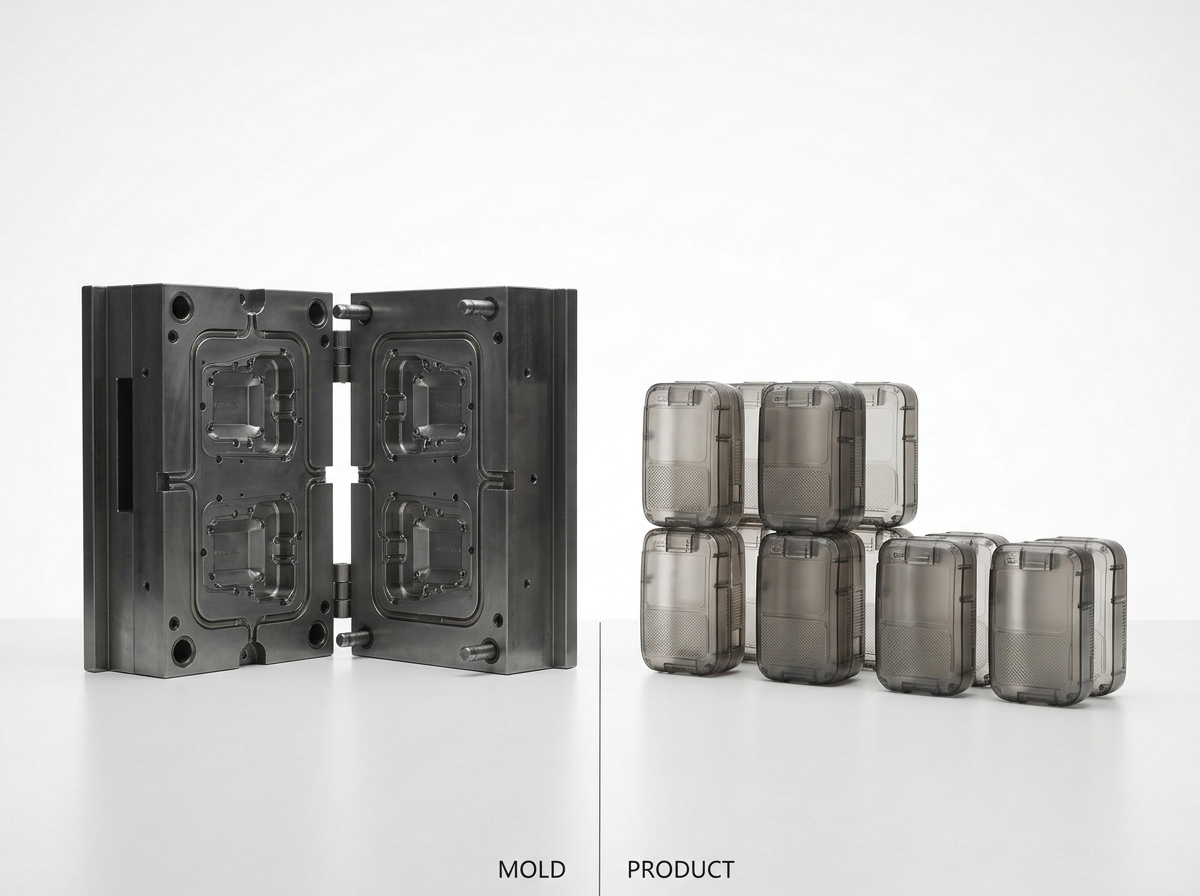 Decision guide for buyers choosing the fastest injection molding process
The best process choice depends on volume, geometry, and launch timing.
For a new product launch, buyers usually need speed in two different forms: fast tooling and fast unit production. A rapid injection molding approach is stronger on the first point. A high-cavitation automated production tool is stronger on the second. If your part is a simple, repetitive component, the fastest long-run answer often includes a multi-cavity mold, hot runner, and automatic takeout. If your part is a large cosmetic shell, the fastest practical route may be a carefully cooled single-cavity or two-cavity tool that preserves surface quality.
- Define the required monthly volume.
- Estimate whether the geometry supports multi-cavity balancing.
- Check whether the resin tolerates fast cooling without warpage.
- Decide whether launch speed or unit speed matters more.
- Confirm that inspection and packaging can keep up with molding output.
For buyers working with home appliance parts or industrial parts, supplier communication matters as much as press tonnage. A responsive engineering team can shorten trial loops, adjust gate location, and correct cooling imbalance before production starts.
Real-world speed gains usually come from process integration, not one machine setting
The fastest injection molding process is usually a system, not a single parameter.
In practical production, speed comes from the combination of mold design, resin selection, machine capability, automation, and quality control. A good example is an electronic housing made in ABS or PC/ABS. If the part is designed with uniform wall thickness, the mold uses balanced gating, the cooling circuit is optimized, and the part is removed automatically, the cycle can be made much shorter than a manually handled, over-thick, poorly vented design. The same logic applies to automatic latches, where consistent ejection and low deformation are critical for downstream assembly.
Industry reports from the U.S. Census Bureau and trade organizations consistently show that manufacturing competitiveness depends on throughput, but throughput only scales when the process is stable. For this reason, production speed should be evaluated with trial shots, mold-flow analysis, and pilot runs before final tooling approval.
When a buyer asks which injection molding process delivers faster production speed, the most accurate answer is this: the fastest process is the one designed around the part, not forced onto it.
What to ask a supplier before choosing rapid injection molding
Supplier questions often reveal whether speed claims are realistic.
Ask for the expected cycle time range, cavity layout, gating strategy, and cooling approach. Ask whether the quoted speed assumes manual handling or full automation. Ask how dimensional control will be verified and how many trial iterations are expected before approval. If the project involves a visible exterior surface, ask how surface defects will be controlled at speed. If the part is for export, ask how documentation, sample approval, and shipping coordination will affect the launch schedule.
- What is the estimated cycle time per shot?
- How many cavities are planned, and how will they be balanced?
- Will the tool use a hot runner or a cold runner?
- What dimensional checks will be done during pilot production?
- How will automation reduce handling and packing time?
These questions help separate real rapid injection molding capability from generic sales claims. They also make it easier to compare different factories on a like-for-like basis.
FAQ
Which injection molding process is fastest for mass production?
High-cavitation automated injection molding is usually the fastest for mass production because it increases output per cycle and reduces handling time.
Is rapid injection molding always faster than conventional molding?
Rapid injection molding is usually faster for tooling and first parts, but conventional molding can be faster in long-run output once the tool is fully optimized.
What has the biggest impact on cycle time?
Cooling time usually has the biggest impact on cycle time, especially for thicker parts and materials with slower heat dissipation.
Does a hot runner make molding faster?
Yes, a hot runner often improves speed by removing sprue cooling and reducing runner waste, especially in multi-cavity tools.
Which material supports faster plastic manufacturing?
In general, easier-flowing materials such as PP often support faster cycles than higher-performance materials like PC, but part requirements must come first.
How do I balance speed and quality?
Use cycle time, scrap rate, and dimensional stability together as your decision metrics, not cycle time alone.
What should buyers check before approving a fast mold?
Buyers should check cavity balance, cooling design, automation readiness, inspection methods, and whether the mold can maintain output over time.
Post time: Sep-21-2026