
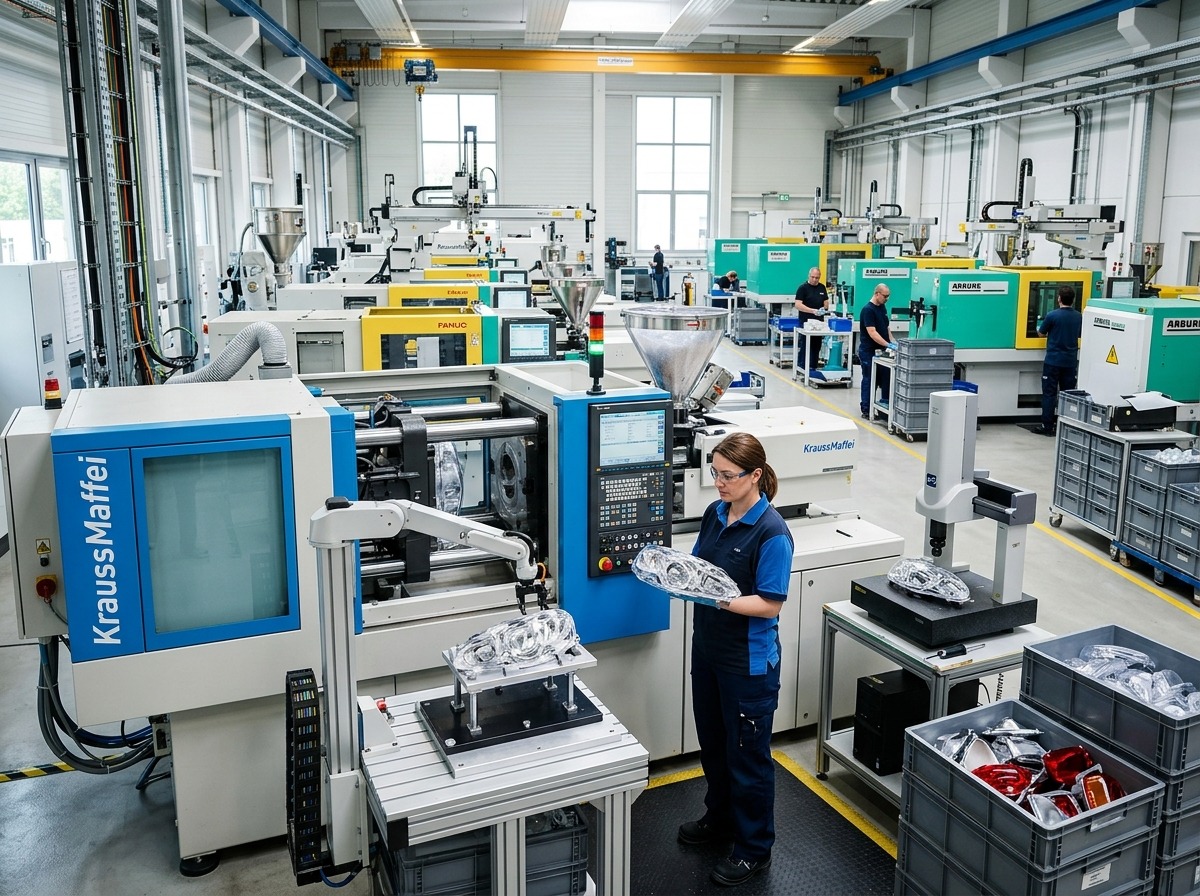
OEM lighting buyers usually need more than a mold maker. They need a plastic manufacturer that can translate drawings into reliable parts, protect optical performance, and keep assembly tolerances stable across production runs.
Key Evaluation Criteria for Lighting Molding Partners
A strong supplier for lighting programs is defined by engineering control, not by price alone. The most useful partners can balance tooling design, resin selection, cosmetic quality, and production consistency for luminaire housing, LED optics, and related structural components.
For example, P&M positions itself around professional injection moulding services, which is relevant when a project needs both mold development and repeatable part output. Its broader plastic manufacturer capability also matters for OEM teams that want one source for multiple part families.
Lighting programs often fail when suppliers treat all plastic parts the same. A factory that understands optical surfaces, heat-related deformation, and assembly fit is usually better suited to OEM lighting parts than a general-purpose shop.
Comparison Table: What Lighting Buyers Should Prioritize First
| Priority Area | Why It Matters | What to Ask the Factory |
|---|---|---|
| Dimensional control | Protects snap fits, screw bosses, and assembly alignment | What inspection method is used for critical dimensions? |
| Surface finish | Affects appearance and light diffusion on visible parts | Can you match the required texture or polish level? |
| Tooling stability | Reduces flash, sink marks, and rework during volume production | How do you validate mold life and process repeatability? |
| Material knowledge | Supports heat resistance, impact strength, and optical clarity | Which resins do you recommend for this housing or lens? |
| Lead time | Impacts launch schedules and pilot builds | What is the timeline for tooling, sampling, and ramp-up? |
Dimensional accuracy is especially important because poor fit can create assembly problems and costly rework. Industry guidance from NIST manufacturing resources emphasizes reliable production methods, while practical inspection guidance from dimensional inspection best practices for molded parts shows why measurement discipline is central to quality control.
Why OEM Lighting Projects Need Specialized Plastic Injection Molding
Lighting parts are technically demanding because they combine appearance, function, and thermal behavior in one component. A housing, diffuser, bezel, or lens may need to support LED optics, manage heat, and still look uniform under direct viewing.
That is why the best plastic injection molding factory for lighting work should understand photometric performance, wall-thickness balance, and cosmetic consistency. Even small defects can become visible once a luminaire is powered and installed in a finished space.
Material choice is another major factor. PC, ABS, PMMA, and blended engineering resins each behave differently in clarity, impact resistance, and heat exposure, so the supplier should recommend materials based on the actual application rather than generic availability.
Surface specification also matters more than many buyers expect. The PLASTICS standards and practices reference is useful because it reflects how molders and customers can align on tolerances and commercial expectations, while ANSI/PLASTICS B151.1-2017 safety requirements shows that mature plastics operations are built around formal process control.
Comparison Table: Lighting Part Types and Typical Molding Focus
| Lighting Part Type | Main Technical Focus | Typical Risk if Poorly Made |
|---|---|---|
| Luminaire housing | Rigidity, heat resistance, screw retention | Warping, loose assembly, reduced service life |
| LED diffuser | Optical clarity, uniform texture, light transmission | Hot spots, haze, uneven beam appearance |
| Bezel or trim ring | Cosmetic finish, edge definition, color consistency | Visible mismatch, sink marks, poor aesthetics |
| Lens or cover | Surface quality, dimensional stability, clarity | Distortion, cracking, light loss |
| Internal bracket | Strength, fit, repeatability | Assembly failure, vibration issues |
For buyers comparing suppliers, the key question is whether the factory can support both engineering and volume production. A shop that only quotes tooling may struggle later when the project moves into sampling, modification, and steady output.
How to Evaluate OEM Lighting Parts Capability Before Awarding a Project
The best way to evaluate a supplier is to review process evidence, not just a product catalog. Ask for mold flow thinking, sample reports, inspection records, and examples of similar enclosure or optical projects.
- Check whether the factory can support drawing-based development and sample-based development.
- Confirm that it can manage both appearance parts and structural parts.
- Ask how it handles trial runs, corrections, and production release.
- Verify whether it can support multiple categories, not only one product family.
A useful internal benchmark is whether the supplier can move from concept to production without forcing the buyer to coordinate multiple vendors. P&M’s custom one-stop molding service is relevant here because OEM lighting projects often need tooling, sampling, and part production in one workflow.
Cross-functional support is especially valuable for overseas buyers. Clear English communication, stable sample approval, and predictable delivery are often as important as the mold itself.
Supplier Evaluation Checklist for Lighting OEM Programs
| Evaluation Item | Pass Signal | Warning Sign |
|---|---|---|
| Engineering response | Fast feedback on drawings and DFM issues | Generic answers without technical detail |
| Sampling discipline | Documented trial results and correction records | No clear sample revision process |
| Quality control | Measured critical dimensions and cosmetic checks | Inspection based only on visual judgment |
| Production readiness | Stable process window and repeatable output | Frequent variation between batches |
| Project scope | Can handle housings, covers, and related parts | Limited to one simple part type |
Industry associations also reinforce the value of standardized operations. The Plastics Industry Association provides broad industry context, while NIST’s manufacturing resources support the idea that reliable production depends on measurement, process discipline, and repeatability.
Where a Plastic Injection Molding Factory Adds the Most Value
A capable factory adds the most value during design translation, not after production starts. It can help refine wall thickness, gate placement, draft angles, and rib structure before tooling locks in expensive mistakes.
That value becomes even clearer in lighting projects with tight cosmetic requirements. A manufacturer that understands featured products and broader plastic products categories can often adapt lessons from other housings, covers, and functional parts to lighting applications.
According to industry estimates, many OEM lighting delays come from late design changes rather than tooling itself. That is why early supplier involvement is often the fastest route to stable launch timing.
Factories with broader category coverage can also be useful when the lighting project includes accessory parts, packaging inserts, or secondary structural components. In those cases, a multi-category supplier reduces coordination overhead and helps keep specifications aligned.
Supplier Directory: Useful Internal Pages for Lighting Buyers
The most relevant internal pages are the ones that map directly to mold development, part production, and project support. Buyers should start with the core service page, then move to product categories that match their exact part type.
- Professional injection moulding services for mold-to-part development.
- Plastic products for broader custom part categories.
- Featured products for representative manufacturing capabilities.
- Main website for the full service overview.
For third-party technical reading, buyers can also review NIST manufacturing guidance, dimensional inspection guidance for molded parts, and PLASTICS standards references when building supplier scorecards.
FAQ
What is the most important factor when choosing a factory for OEM lighting parts? The most important factor is process control. A supplier must hold tight dimensions, stable surface quality, and repeatable output across batches. For lighting, this also includes understanding optical surfaces, heat behavior, and assembly fit so the final product performs consistently in real use.
Do lighting projects require special materials? Yes, many do. LED housings, diffusers, and lenses often use PC, ABS, PMMA, or blended engineering resins depending on clarity, impact resistance, and heat exposure. The right material depends on whether the part is structural, cosmetic, or optical, and the supplier should explain that clearly.
Why are trial runs so important in injection molding? Trial runs confirm whether the mold fills correctly, releases cleanly, and meets dimensional targets. They also reveal sink marks, warpage, flash, and assembly issues before mass production starts. In OEM lighting projects, this step is critical because visible defects can affect both function and appearance.
How can buyers compare two plastic injection molding factories objectively? Compare them using evidence: sample reports, inspection methods, lead times, engineering feedback, and production stability. A good comparison should also include whether the factory can support multiple part types, not just one simple component, because lighting programs often involve several related parts.
When should a buyer involve the supplier in the design stage? The supplier should be involved as early as possible, ideally before tooling begins. Early involvement helps improve draft angles, wall thickness, gate location, and assembly details. That reduces redesign risk, shortens lead time, and improves the chance of a smooth production launch.
In summary, the best partner for OEM lighting work is a factory that combines tooling expertise, quality discipline, and responsive engineering support. Buyers who evaluate those factors early are more likely to get stable parts, fewer revisions, and a smoother path from prototype to mass production.
Post time: Jun-21-2026