
- Custom plastic product development is a procurement and engineering process, not just a molding quote.
- Material choice, draft angles, wall thickness, and tolerancing decisions affect cost, cycle time, and quality.
- For OEM plastic products, the best suppliers reduce risk through DFM, trial reports, and production control.
- Buyers should evaluate tooling, manufacturing, and post-launch support as one system.
Custom plastic product development is the process of converting a product idea into a manufacturable plastic part or assembly, and it matters because modern injection molding can hold dimensional tolerances as tight as about ±0.005 mm in controlled contexts while still supporting high-volume output, according to ISO 20457:2018. For procurement teams, that means the real decision is not only whether a part can be molded, but whether the design, material, and tool strategy can meet the assembly, appearance, and cost targets of plastic manufacturing, plastic housing molds, and broader OEM plastic products programs.
What custom plastic product development means in 2026
Custom plastic product development means coordinating product design, tooling, and production so the final part can be made repeatedly with stable quality.
In 2026, buyers expect more than basic molding capability. They want a supplier who can interpret drawings, flag hidden risks, suggest resin alternatives, and forecast whether a product should be built with a single-cavity tool, a multi-cavity tool, or a more complex solution such as 3D mold development.
The practical goal is simple: reduce redesign loops before steel is cut. That is especially important for consumer electronics, home appliances, toys, footwear components, and industrial accessories, where appearance, fit, and stable delivery all matter at once.
| Development Stage | Main Output | Typical Buyer Risk Reduced | Example Numeric Check |
|---|---|---|---|
| Concept review | Function and appearance direction | Wrong form factor | Overall size, wall thickness, key interfaces |
| DFM review | Moldable design feedback | Draft, sink, warpage | Draft angle often starts at 1 to 3 degrees depending on texture |
| Prototype validation | Sample parts | Fit and ergonomics errors | Dimensional deviation and assembly clearance |
| Tooling and trial | T0/T1 trial report | Late tooling changes | Cycle time, shrinkage, gate quality |
| Production launch | Stable mass production | Supply interruption | First-pass yield and rework rate |
How plastic manufacturing decisions affect cost, quality, and lead time
Plastic manufacturing decisions shape the economics of the entire project.
Material choice, cavity count, part geometry, and surface finish influence the mold price, the cycle time, and the scrap risk. A part that looks simple on a sketch can become expensive if it has thick sections, deep ribs, undercuts, or cosmetic surfaces that require tight process control.
For example, polycarbonate is often selected for transparent or impact-resistant housings because it combines toughness with dimensional stability. In practice, PC offers a tensile strength range commonly cited around 55 to 75 MPa and a heat deflection temperature that can reach roughly 125 to 135 C depending on grade and test load, according to supplier datasheets and resin literature. That makes it useful for protective covers, clear shells, and electronic housings where appearance and impact resistance both matter.
For buyers comparing options, the message is clear: resin selection is not a line item, it is a system decision. If your product must survive drops, assembly pressure, or outdoor use, the wrong polymer can force thicker walls, longer cycle times, or weaker snap-fits.
| Common Resin | Typical Strength or Thermal Data | Best Fit Use Case | Buyer Watchout |
|---|---|---|---|
| PC | 55 to 75 MPa tensile strength; about 125 to 135 C HDT | Transparent housings, guards, protective covers | Stress cracking and moisture sensitivity in some grades |
| ABS | Moderate impact strength; stable moldability | Consumer electronics shells, appliance panels | Lower heat resistance than PC |
| PP | Lightweight, low density | Daily-use products, caps, containers | Dimensional stability can be lower than engineering resins |
| PA | Strong, wear resistant | Industrial clips, functional parts | Moisture absorption affects dimensions |
Why OEM plastic products need DFM before tooling
OEM plastic products perform better when design for manufacturability happens before mold steel is ordered.
DFM is where costly surprises are usually prevented. A qualified supplier should review wall thickness, rib layout, gate location, ejector marks, draft, undercuts, and assembly tolerances before final approval. This is not a theoretical exercise; it is how a buyer avoids burn marks, short shots, flash, warpage, and poor cosmetic consistency later.
The industry reference point for tolerancing is useful here. ISO 20457:2018 defines general tolerances for plastics molded parts and provides a structured basis for communication between buyer and supplier. In procurement terms, this helps turn vague expectations like “good fit” into measurable requirements.
For functional assemblies, the best suppliers also link tolerance targets to the final application. A consumer electronics shell may need tighter cosmetic and clip-fit control than a utility cover, while a daily-use product may prioritize throughput and unit cost over premium finish.
If your project includes multi-part assemblies, consider reviewing assembly parts and company capabilities early, because compatibility across tooling, packaging, and shipping often matters as much as the molded part itself.
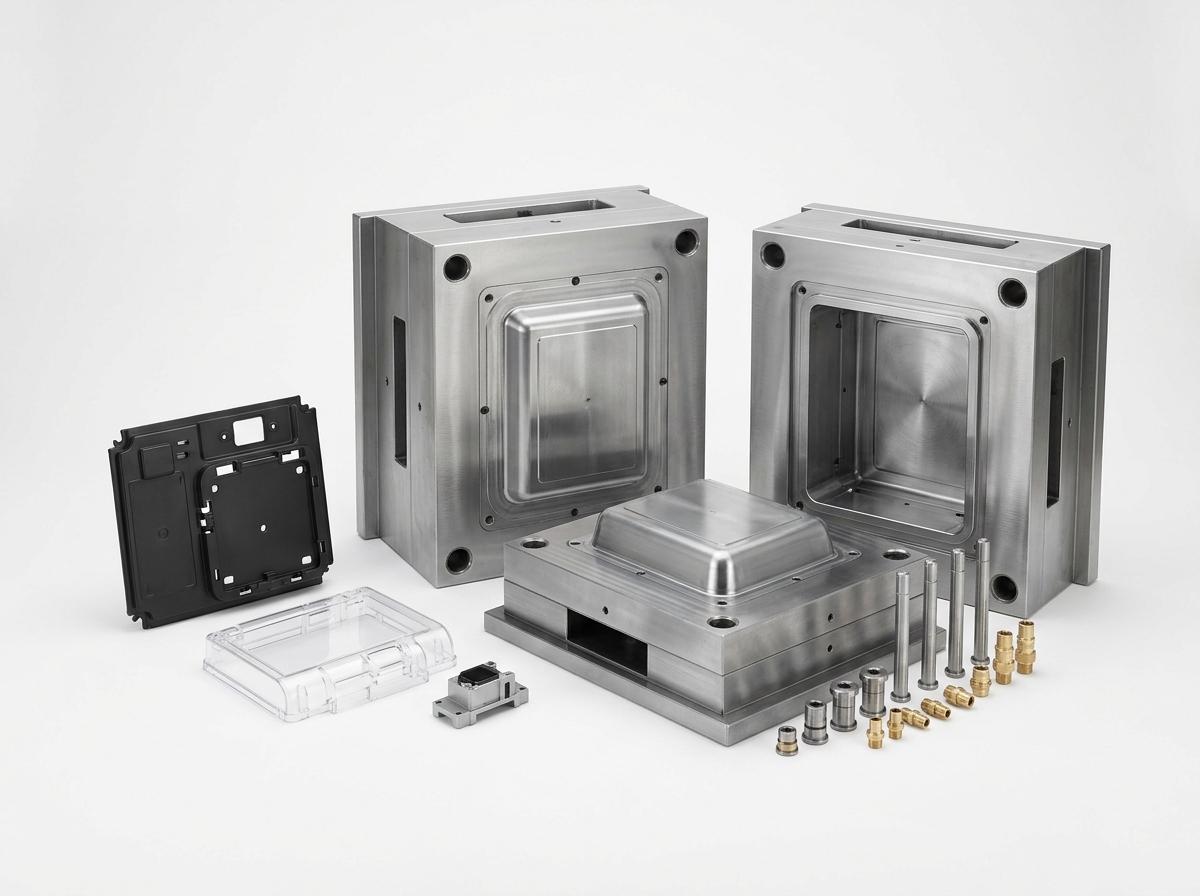 Injection molding, 3D molds, and housing molds: which path fits your product
Injection molding remains the dominant route for repeatable plastic production because it supports consistency, speed, and multi-cavity scaling.
For standardized parts, injection molding is usually the lowest-risk path once the design is mature. For highly differentiated products, a 3D mold strategy or a specialized housing mold may be more suitable when the geometry includes curves, branding surfaces, or visible design cues.
The right choice depends on volume, appearance, and launch timing. A fast-moving startup may prefer a simple mold to reach market sooner, while a long-life industrial product may justify more complex tooling because the annual demand can spread the cost over more units.
| Tooling Path | Best For | Typical Advantage | Typical Constraint |
|---|---|---|---|
| Injection mold | High-repeat parts | Stable unit cost at scale | Upfront tooling investment |
| Plastic housing mold | Electronics and appliance shells | Good balance of appearance and function | Cosmetic defects are easier to see |
| 3D mold | Complex surfaces and branded shapes | Distinctive visual design | Longer design validation |
| Multi-cavity mold | High-volume SKUs | Lower unit cost per shot | Higher balance and maintenance demands |
In many OEM programs, the best outcome comes from matching mold structure to commercial reality, not to engineering pride. A modest tool that launches on time can outperform a perfect tool that misses the market window.
What buyers should ask before approving a mold project
Buyers should ask operational questions before they approve steel.
The fastest way to reduce project failure is to inspect the supplier’s development discipline, not just the price quote. Ask how they validate design assumptions, how they report trials, how they manage communication in English, and how they protect schedule when a sample fails.
- Can the supplier review drawings and suggest material or geometry changes before tooling?
- Will you receive trial reports with measured dimensions and defect notes?
- How are critical dimensions defined for the first article inspection?
- What is the expected lead time for tooling, sample correction, and production ramp?
- How does the supplier handle spare parts and mold life support?
This is especially relevant for export-oriented sourcing, where file exchange, response speed, and logistics coordination can influence launch dates as much as machining accuracy.
Surface quality, fit, and functional performance in plastic product development
Surface quality is not cosmetic only; it often determines market acceptance and assembly success.
For consumer-facing parts, visual defects such as sink marks, weld lines, gloss inconsistency, and flow marks can become commercial defects. For functional parts, poor fit can create rattling, leakage, stress concentration, or premature failure.
In electronics and home appliance projects, dimensional control and appearance consistency are often linked. If a shell must align with buttons, displays, clips, and internal frames, even a small geometric error can cascade through the assembly.
That is why development teams should specify both critical dimensions and visual zones. A part can be acceptable structurally but rejected if the B-side marks, parting line, or texture mismatch is visible on a retail shelf.
For reference, plastics testing and dimensional communication become more reliable when buyers use standard terminology and documented inspection criteria. NIST’s measurement resources emphasize traceable measurement practice in industrial quality systems, which supports reproducibility across suppliers and batches; see NIST Physical Measurement Laboratory.
How to evaluate a supplier for plastic manufacturing and OEM plastic products
The best supplier is the one that lowers your total project risk, not the one that only offers the lowest mold price.
For custom plastic product development, supplier evaluation should include design support, trial capability, production stability, and after-sales service. A one-stop partner can reduce handoff losses between mold making and part production, which often saves time when a product needs revision after the first trial.
For procurement teams, a practical scorecard is useful.
| Evaluation Area | What Good Looks Like | Why It Matters | Evidence to Request |
|---|---|---|---|
| Engineering support | DFM feedback before tooling | Reduces redesign cost | Marked-up drawings, recommendations |
| Trial control | Measured T0/T1 samples | Improves launch readiness | Trial report, sample data sheet |
| Production stability | Consistent lot-to-lot output | Protects brand quality | Inspection plan, defect logs |
| Communication | Fast English response | Supports export projects | Email turnaround, document set |
In practical terms, a supplier that can explain mold flow, gate position, cooling strategy, and shrinkage control is usually better prepared than one that only quotes unit price.
Quantitative checkpoints that prevent costly mistakes
Quantitative checkpoints keep custom plastic product development from becoming guesswork.
The most effective teams define measurable targets early: critical dimensions, acceptable cosmetic defects, cycle time, material grade, and package drop or assembly requirements. If the part is an electronic housing, for instance, the project should connect structural targets to interface measurements and functional checks.
Useful checkpoints include the following.
- Wall thickness consistency across structural zones.
- Draft angle adequate for clean ejection and surface protection.
- Gate placement that avoids visible cosmetic or high-stress regions.
- Material grade matched to heat, impact, and aging requirements.
- Trial samples measured against the approved drawing, not against visual intuition.
One useful standard for durability validation is ASTM D4169, which provides a performance testing framework for shipping containers and systems. For projects where packaging and transport affect final product quality, that standard helps teams simulate handling risks before shipment; see ASTM D4169.
For environmental and material safety questions, compliance teams often also consult the U.S. EPA plastics and waste resources, especially when recycled content or lifecycle concerns affect sourcing strategy; see EPA plastics data.
What the 2026 buying guide should help you decide
The 2026 guide to custom plastic product development should help you decide whether a project is technically ready, commercially viable, and operationally manageable.
That means the best guide is not a catalog of factory claims. It is a decision framework that answers whether the part should be injection molded, what resin fits the use case, how the mold should be structured, which tolerances are realistic, and what evidence you need before mass production.
For buyers, the most important outcome is confidence. If the supplier can translate drawings into samples, samples into trials, and trials into stable production, then the development process becomes a controlled path rather than a sequence of surprises.
When that happens, custom plastic product development stops being a sourcing risk and becomes a repeatable way to launch OEM plastic products faster, with less rework and better cost control.
FAQ
What is custom plastic product development?
It is the process of turning a product idea, drawing, or sample into a manufacturable plastic part through design review, tooling, sampling, and production planning.
How does plastic manufacturing differ from product design?
Product design defines the function and shape, while plastic manufacturing determines whether that design can be molded repeatably, economically, and within tolerance.
Why is DFM important for OEM plastic products?
DFM helps identify wall thickness, draft, gate, and assembly issues before tooling begins, which reduces redesign cost and launch delays.
What materials are common for plastic housings?
ABS, PC, PP, and PA are common choices, with PC often used for transparent or impact-resistant housings and ABS used for general-purpose shells.
When should a buyer choose injection molding?
Injection molding is usually best when the part must be repeated many times with stable quality and the upfront tooling cost can be spread over volume.
How do I evaluate a mold supplier?
Check DFM support, trial reports, communication speed, sample accuracy, and long-term support for tooling and spare parts.
What standards help define quality in plastic parts?
ISO 20457:2018 is useful for tolerance communication, while ASTM D4169 can support packaging and transport testing for finished products.
Post time: Aug-18-2026