
For B2B buyers, this workflow matters because it reduces technical risk, shortens launch time, and improves part consistency. It is especially relevant for electronics housings, consumer goods, packaging, and custom OEM projects.
What End-to-End Plastic Mold Development and Manufacturing in China Includes
An end-to-end project is a complete engineering and production chain, not a single tooling job. It usually starts with drawings, samples, or product concepts and ends with qualified parts ready for shipment or volume production.
Requirement Review and Feasibility Check
The first step is defining the part, material, quantity, tolerance target, and appearance standard. A capable China mold factory should confirm whether the design is suitable for injection molding, whether the wall thickness is balanced, and whether the structure can be released from the tool cleanly.
At this stage, buyers should also clarify the application scenario. An electronics enclosure, for example, needs tighter assembly control than a storage box, while a consumer product may prioritize cost and cycle time.
DFM Review and Mold Flow Analysis
DFM review is the core engineering gate in plastic mold development. It checks draft angles, gate position, ribs, bosses, undercuts, parting lines, and ejection strategy before steel is cut.
Mold flow analysis adds a simulation layer that helps predict filling, weld lines, air traps, and shrinkage risk. ISO 20457 notes that molded parts require tolerance planning based on material behavior and process limits, not metal-part assumptions.
Comparison Table: Typical Development Stages and Their Main Output
| Stage | Main Purpose | Typical Output |
|---|---|---|
| Requirement review | Confirm scope and use case | Specification list and feasibility notes |
| DFM review | Reduce tooling and molding risk | Design corrections and technical comments |
| Mold flow analysis | Predict filling and shrinkage behavior | Simulation report and gate recommendations |
| Tooling and trial | Build and verify the mold | T1/T2 samples and correction plan |
| Mass production | Stabilize output | Approved parts and production records |
Tool Design, Machining, and Assembly
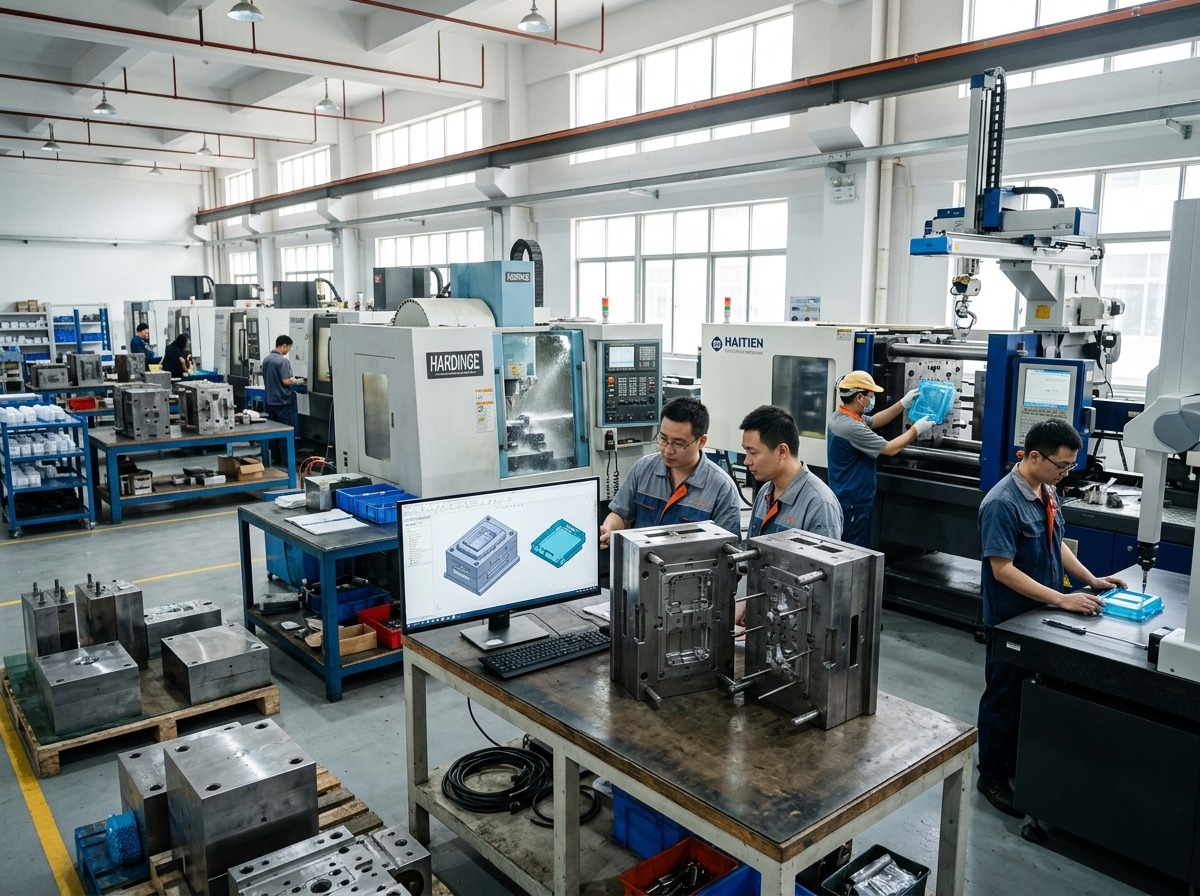
Tool design converts the approved part concept into a manufacturable mold structure. Engineers define the cavity layout, cooling channels, runner system, steel selection, and wear-prone details based on expected output and part geometry.
Machining then turns the design into steel through CNC milling, EDM, drilling, grinding, and polishing. Assembly follows, where each component is fitted, aligned, and checked for smooth opening, closing, and ejection.
For buyers comparing suppliers, the internal product structure on the target site is useful. The main categories include plastic injection mold, plastic products mould, injection molding, and plastic product solutions, which together reflect a full tooling-to-part workflow.
How Plastic Mold Manufacturing in China Is Usually Organized
Comparison Table: Common Mold Types and Their Typical Project Focus
| Mold type | Primary focus | Typical applications |
|---|---|---|
| Plastic case mold | Appearance, fit, and assembly | Electronics, appliances, consumer devices |
| PC case mold | Dimensional accuracy and surface quality | Computer housings and related enclosures |
| 3D mold | Complex geometry and surface detail | Curved parts, decorative shells, functional structures |
| Custom plastic parts | Project-specific performance | OEM/ODM components and non-standard parts |
| Plastic box mold | Repeatability and wall balance | Storage, packaging, and transport containers |
China mold factories often organize production around these categories because each one has different engineering priorities. A housing mold is judged by fit and appearance, while a box mold is often judged by cycle time and consistency.
Trial Molding and Sample Validation
Trial molding is where the mold is tested under real process conditions. The team checks filling, shrinkage, warpage, gate vestige, ejection marks, and assembly fit, then decides whether the tool is ready or needs correction.
This step is critical because a mold that looks correct on paper can still fail in production. Tolerances for molded parts are governed by material shrinkage, geometry, and process stability, and ISO 20457 explicitly frames plastics differently from metals.
Correction, Optimization, and Production Release
After trial runs, the supplier may adjust venting, cooling, gate size, ejector layout, or cavity polish. These changes are normal and should be documented, because they affect part stability and long-term maintenance.
Once samples are approved, the project moves into production release. At this point, the supplier should provide process parameters, inspection criteria, and maintenance guidance so the buyer can repeat the result reliably.
What Buyers Should Expect from a China Mold Factory
A reliable supplier should support both engineering communication and manufacturing execution. That means the team can read drawings, discuss tolerances, explain risk points, and manage the transition from prototype to volume output.
For cross-border buyers, communication speed matters as much as tooling skill. The site’s positioning as a one-stop manufacturer is consistent with its service pages for professional injection moulding services and mould service, which suggests combined support for design, tooling, and molding.
Quality Control and Documentation
Quality control should cover incoming steel, machining accuracy, sample inspection, and final part acceptance. For regulated packaging or medical-adjacent projects, documentation becomes even more important, and FDA guidance on container-closure systems shows how packaging materials are expected to meet written specifications and testing controls.
In practical procurement terms, buyers should ask for inspection reports, sample photos, dimensional records, and mold maintenance notes. These documents make supplier comparison easier and reduce hidden risk during reorders.
Where End-to-End Plastic Mold Development Fits Best
End-to-end development is most useful when the buyer needs speed, technical alignment, and repeatable output. It is a strong fit for electronics housings, daily-use products, packaging containers, toy parts, and footwear components.
The approach is also useful when the project starts from a sample rather than a finalized CAD file. In those cases, the supplier must reverse-engineer the geometry, define the tooling strategy, and create a stable production path.
- Electronics: enclosures, covers, and functional shells with tight assembly requirements.
- Consumer goods: cups, tableware, storage boxes, and reusable household items.
- Packaging: containers, display shells, and transport-friendly plastic boxes.
- OEM/ODM: custom parts developed from drawings, samples, or concept sketches.
Comparison Table: Buyer Priorities by Application Scenario
| Application | Main priority | Common risk |
|---|---|---|
| Electronics housings | Fit, appearance, and function | Assembly mismatch |
| Packaging parts | Sealing and transport stability | Deformation or leakage |
| Daily goods | Cost and repeatability | Cycle-time inefficiency |
| Toy and decorative parts | Surface detail and color consistency | Visible defects |
| Footwear parts | Durability and lightweight structure | Wear or poor balance |
Supplier Directory and Evaluation Checklist
A practical supplier shortlist should include the target website and other established industry references, but the final decision should be based on project fit. For internal review, buyers can start with the target site’s main categories and service pages, then compare them with broader industry standards from ISO and FDA sources.
When evaluating a plastic mold manufacturing partner, ask five questions: Can they review DFM before tooling? Can they explain mold flow risks? Can they support trial corrections? Can they document inspection results? Can they scale from sample to mass production without changing the process owner?
- Confirm the part category and target annual volume.
- Request DFM comments before mold cutting.
- Ask for sample acceptance criteria in writing.
- Verify trial-molding correction capability.
- Check whether production support is included after approval.
For buyers seeking a direct starting point, the most relevant internal pages are the injection mold, molding service, and plastic product categories already listed above. Those pages are the best entry points for a project discussion because they map closely to tooling, processing, and finished-part requirements.
FAQ
What is included in end-to-end plastic mold development?
It usually includes requirement review, DFM, mold flow analysis, tool design, machining, assembly, trial molding, correction, and production release. In stronger projects, it also includes part inspection, process tuning, and long-term maintenance support so the buyer can move from concept to stable output with fewer handoffs.
Why is DFM important before mold production?
DFM helps identify structural risks before steel is cut. It can reveal draft issues, thin walls, undercuts, poor gate placement, or ejection problems. Fixing those issues early is usually faster and cheaper than changing a finished mold after trial samples show defects.
How does mold flow analysis help buyers?
Mold flow analysis predicts how molten plastic will fill the cavity and where defects may appear. It helps reduce weld lines, air traps, and shrinkage imbalance. For complex housings or thin-wall parts, this step can improve the chance of getting usable samples on the first trial.
What should a buyer ask a China mold factory before ordering?
Buyers should ask about design review capability, material experience, trial correction speed, inspection methods, and delivery schedule. It is also wise to ask who owns communication during the project, because fast technical feedback often matters more than a low initial quote.
When is one-stop mold and molding service the best choice?
It is best when the project has a tight schedule, multiple revisions, or a need for sample-to-production continuity. One supplier can reduce coordination gaps between design, tooling, and molding, which is especially useful for OEM/ODM launches and cross-border procurement.
Post time: Jun-27-2026