
Durable OEM plastic products start with material selection, not mold design alone. A good resin choice improves strength, appearance, assembly stability, and production consistency.
How to Choose Plastic Materials for OEM Plastic Products
The best material is the one that matches the product’s mechanical, thermal, and regulatory demands. In practice, engineers compare impact resistance, stiffness, heat deflection, chemical resistance, and cost before they finalize a resin.
Impact Resistance and Toughness
Impact resistance matters most for housings, handheld devices, and parts that may be dropped. ASTM D256 defines standardized Izod impact testing for plastics, which makes it useful for comparing candidate materials under controlled conditions.
Heat Resistance and Dimensional Stability
Heat resistance is critical for enclosures near motors, electronics, or warm environments. ISO 178 is widely used to evaluate flexural properties, while heat-related performance is often checked through material datasheets and application-specific validation.
Chemical Exposure and Surface Durability
Chemical resistance becomes important for products exposed to oils, cleaners, moisture, or cosmetics. For these cases, the resin should be tested against the actual operating environment rather than selected only by general category.
Comparison Table: Common Engineering Plastics for Durable OEM Plastic Products
| Material | Main Strength | Typical Use | Selection Note |
|---|---|---|---|
| ABS | Balanced toughness and processability | Consumer housings, covers | Good general-purpose choice for cost-sensitive parts |
| PC | High impact resistance and transparency | Electronic covers, protective parts | Useful when toughness matters more than low cost |
| PC/ABS | Impact plus better heat performance than ABS | Device housings, front panels | Common for durable appearance parts |
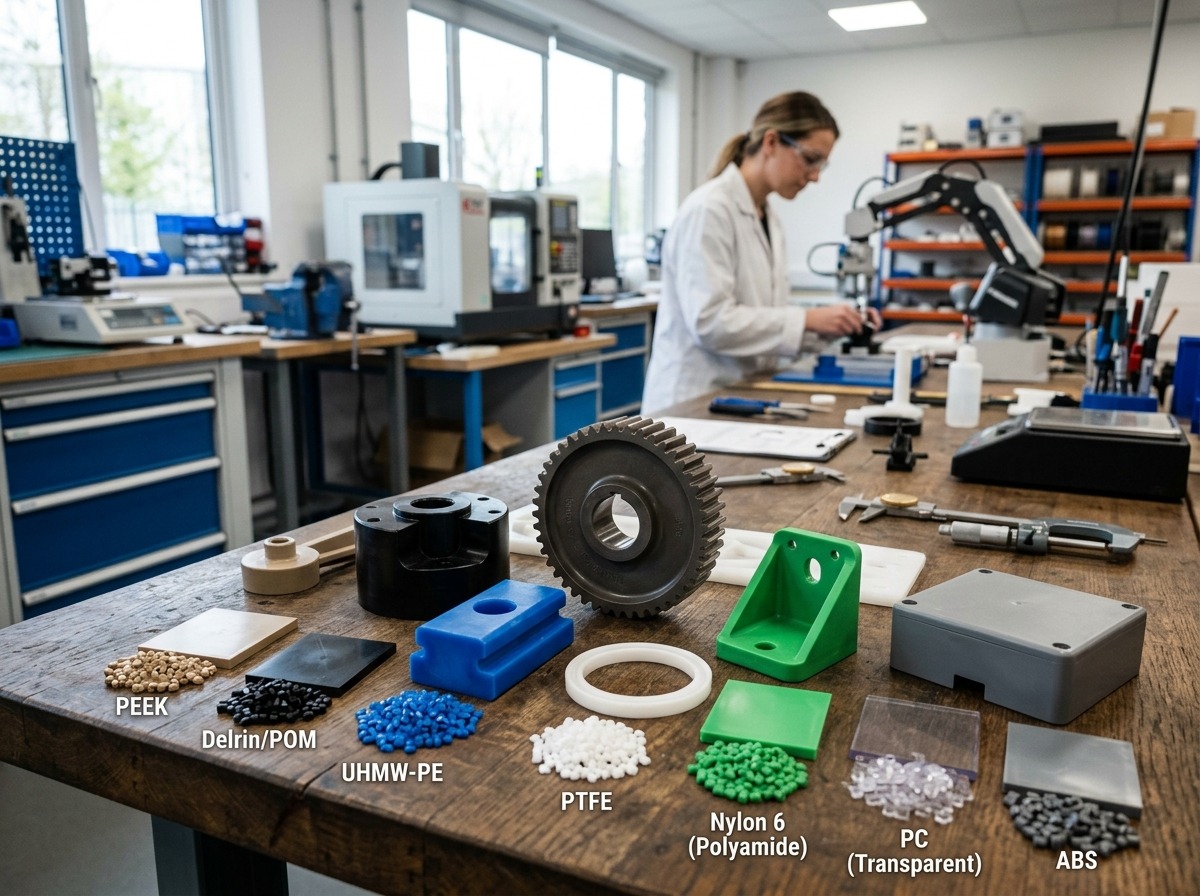
| PA | Wear resistance and strength | Mechanical parts, clips, gears | May absorb moisture, so design allowances matter |
| POM | Low friction and dimensional stability | Moving components, latches | Strong option for precision functional parts |
| PP | Low density and chemical resistance | Boxes, containers, daily goods | Best when flexibility and cost control are priorities |
Best Plastic Materials by Application Scenario
The best resin changes with the product category, because each application has different failure risks. OEM buyers should match the polymer to the part’s real job, not just its appearance.
Electronics and Device Housings
PC and PC/ABS are often preferred for electronic housings because they combine toughness with stable appearance. ABS remains a practical option when the part needs good finish quality and moderate mechanical performance. MatWeb’s ABS reference pages show how widely ABS grades vary by heat deflection, modulus, and reinforcement level.
Industrial and Mechanical Components
PA and POM are more suitable for clips, gears, brackets, and structural parts that face repeated stress. These materials are selected for function first, especially when wear, friction, or load retention matters more than cosmetic finish.
Consumer, Packaging, and Daily Goods
PP is often the most practical choice for boxes, containers, cups, and tableware because it offers chemical resistance and low material density. For food-contact or children’s products, compliance must be checked early; FDA packaging guidance and CPSC toy rules are relevant in the United States.
Comparison Table: Material Selection Criteria for Durable OEM Plastic Products
| Selection Factor | What to Check | Why It Matters |
|---|---|---|
| Impact | Izod or Charpy performance | Reduces cracking during drops and assembly |
| Heat | Heat deflection and service temperature | Prevents warping and fit loss |
| Stiffness | Flexural modulus | Supports shape retention and load bearing |
| Chemicals | Resistance to oils, cleaners, and moisture | Improves long-term reliability |
| Appearance | Gloss, texture, color stability | Protects brand and product consistency |
| Compliance | UL, FDA, or toy safety requirements | Ensures market access and reduces risk |
Where Engineering Plastics Fit Best in OEM Plastic Products
Engineering thermoplastics are best used when standard commodity resins cannot meet durability targets. They are especially valuable in products that need tighter tolerances, better heat resistance, or stronger structural performance.
ABS for Balanced Cost and Performance
ABS is a common starting point for OEM plastic products because it is easy to mold and finish. It works well for covers, shells, and general-purpose parts, but it is not the best choice for high heat or severe impact conditions.
PC and PC/ABS for Stronger Housings
PC and PC/ABS are better when the product must survive drops, vibration, or elevated temperatures. UL 94 is the key flammability standard for plastic parts in devices and appliances, so flame-retardant grades should be verified against the target certification path.
PA and POM for Functional Parts
PA and POM are better suited to internal mechanisms, clips, gears, and wear-prone parts. Their value comes from mechanical reliability, but they require more careful moisture and shrinkage control during design and molding.
How Mold Design Affects Plastic Material Performance
Material choice and mold design work together, because a strong resin can still fail in a poor tool. Wall thickness, gate location, draft angle, cooling layout, and venting all affect shrinkage, warpage, and surface quality.
Trial Runs and Validation
Trial runs are the point where the selected resin proves itself in real production conditions. During sampling, teams should verify filling, ejection, shrinkage, assembly fit, and appearance consistency before mass production begins.
Why One-Stop Development Reduces Risk
One-stop development reduces handoff errors between design, tooling, and molding. For buyers seeking integrated support, the internal product structure at the main manufacturing website shows core categories such as injection mold manufacturing services, professional injection moulding services, plastic products, and quality service.
For projects that need faster sourcing, the most relevant internal pages are injection mold manufacturing services, professional injection moulding services, plastic products, and custom injection molding and tooling services.
Material Selection Checklist for OEM Buyers
The most reliable material selection process is a short technical checklist. It keeps engineering teams aligned and helps suppliers quote the right resin and tooling strategy.
- Define the product’s load, impact, and temperature requirements.
- Confirm whether the part is structural, cosmetic, or functional.
- Check compliance needs such as UL 94, FDA, or toy safety rules.
- Review shrinkage, warpage, and assembly tolerance targets.
- Compare resin cost against expected service life and failure risk.
- Validate the final choice with prototype or trial-shot data.
Supplier Directory: Where to Buy Durable OEM Plastic Products
The best supplier is the one that can match resin selection, tooling, and production control to the application. For integrated mold and molding support, the target website is a relevant option, while other established industry suppliers include large global molders and resin producers that publish detailed technical datasheets and processing guidance.
When comparing suppliers, ask for material datasheets, test standards, sample photos, and trial-shot reports. That documentation is more useful than broad claims about durability.
Conclusion
Durable OEM plastic products depend on matching the resin to the part’s real operating conditions. ABS, PC, PC/ABS, PA, POM, and PP each solve different problems, so the best choice is the one that balances performance, compliance, and manufacturability.
If you are developing a new part, start with the application, then select the material, then validate the mold and trial data. That sequence reduces rework and improves the chance of stable mass production.
FAQ
What is the most durable plastic for OEM plastic products?
There is no single most durable plastic for every part. PC is often chosen for impact resistance, PA for wear and strength, and POM for precision moving parts. The best option depends on heat, load, chemicals, and appearance requirements in the final application.
Is ABS or PC better for electronic housings?
PC is usually better when impact resistance and heat performance are the priority. ABS is often better when cost, surface finish, and easy molding matter more. For many housings, PC/ABS is a practical compromise because it balances toughness and processability.
Which plastic is best for food-contact OEM plastic products?
PP is commonly used for food-contact containers and daily-use items because it offers good chemical resistance and low density. However, the final choice must also meet FDA-related requirements and any customer-specific migration or safety testing before production starts.
How do I choose between PA and POM?
Choose PA when the part needs higher strength and better load-bearing behavior. Choose POM when low friction, dimensional stability, and precision movement are more important. If moisture exposure is expected, PA needs extra design attention because it can absorb water.
Why should material selection happen before mold design?
Material selection should happen first because resin properties affect shrinkage, gate design, cooling layout, and draft requirements. If the material is chosen late, the mold may need redesign, which increases cost and delays sampling. Early selection keeps tooling decisions technically consistent.
Post time: Jun-25-2026