
- Durability in consumer plastic products depends on impact resistance, creep, heat deflection, and chemical exposure.
- PC, ABS, PC/ABS, PA66, PBT, PP, and POM cover most durable consumer-product use cases in 2026.
- Material selection should be matched to mold design, wall thickness, surface finish, and cycle-time targets.
- Standards and test methods matter: validated performance data is more reliable than marketing claims.
For durable consumer plastic products, the most important decision is not whether a resin is “strong,” but whether it survives the real loading profile, such as drops, daily flexing, UV, heat, and repeated assembly. In practice, engineering plastics like PC, PA66, PBT, and PC/ABS are used when appearance and long-term function must coexist, while commodity options like PP remain valuable when chemical resistance, fatigue life, and cost control matter. Precision molded parts often target tight dimensional consistency, and guidance from ISO 20457:2018 is useful when evaluating tolerances, shrinkage behavior, and repeatability. If you are sourcing through plastic injection molds, plastic housings, or custom plastic parts, material choice should be locked together with mold design and production goals, not treated as a separate decision.
Best Plastic Materials for Durable Consumer Products: What Actually Matters in 2026
Material durability is a system property, not a single number. A resin that looks excellent on a datasheet can still fail in service if the part has thin ribs, poor gate placement, stress concentrators, or a surface finish that amplifies scratches. For consumer plastic products, the most common failure modes are impact cracking, creep under continuous load, brittle fracture at low temperature, chemical stress cracking, UV embrittlement, and cosmetic wear. The right engineering plastics reduce these risks by balancing impact strength, stiffness, thermal performance, and processability.
Test methods give the selection process structure. For example, ASTM D256 covers Izod impact resistance, ASTM D638 covers tensile properties, and ASTM D648 covers heat deflection temperature. These tests do not replace real-use validation, but they make comparisons more meaningful than informal claims like “high strength” or “super tough.”
Quick Comparison of Consumer Plastic Materials
The fastest way to narrow a shortlist is to compare the materials by how they fail in use, not by resin family alone. The table below summarizes typical decision drivers for durable consumer plastic products.
| Material | Key Strength | Typical Weakness | Best Consumer Use Case | Selection Note |
|---|---|---|---|---|
| PC | High impact resistance, transparency, good dimensional stability | Scratch sensitivity, hydrolysis risk in severe environments | Transparent covers, protective housings, lenses | Often chosen when drop resistance matters more than cost |
| ABS | Good appearance, easy molding, balanced toughness | Lower heat and chemical resistance than engineering plastics | Interior housings, appliance trims, electronics shells | Strong choice when cosmetics and cost both matter |
| PC/ABS | Improved impact and heat balance | More expensive than ABS | Premium consumer electronic enclosures | Common in parts that need stiffness and drop survival |
| PA66 GF | High stiffness, load-bearing capability | Moisture sensitivity, warpage risk | Structural brackets, clips, reinforced frames | Often used when long-term load and heat are critical |
| PBT | Good electrical properties, dimensional stability | Lower impact toughness than PC | Connectors, appliance components, sensor housings | Useful for precision parts needing stable geometry |
| PP | Excellent chemical resistance and fatigue life | Lower stiffness and surface premium feel | Caps, containers, hinges, household parts | Great for flexing parts and cost-sensitive programs |
| POM | Low friction, wear resistance, excellent machinability | Can be sensitive to impact and UV | Gears, latches, sliding parts, mechanisms | Best when repeated motion and low wear dominate |
When PC Is the Best Choice for Durable Consumer Plastic Products
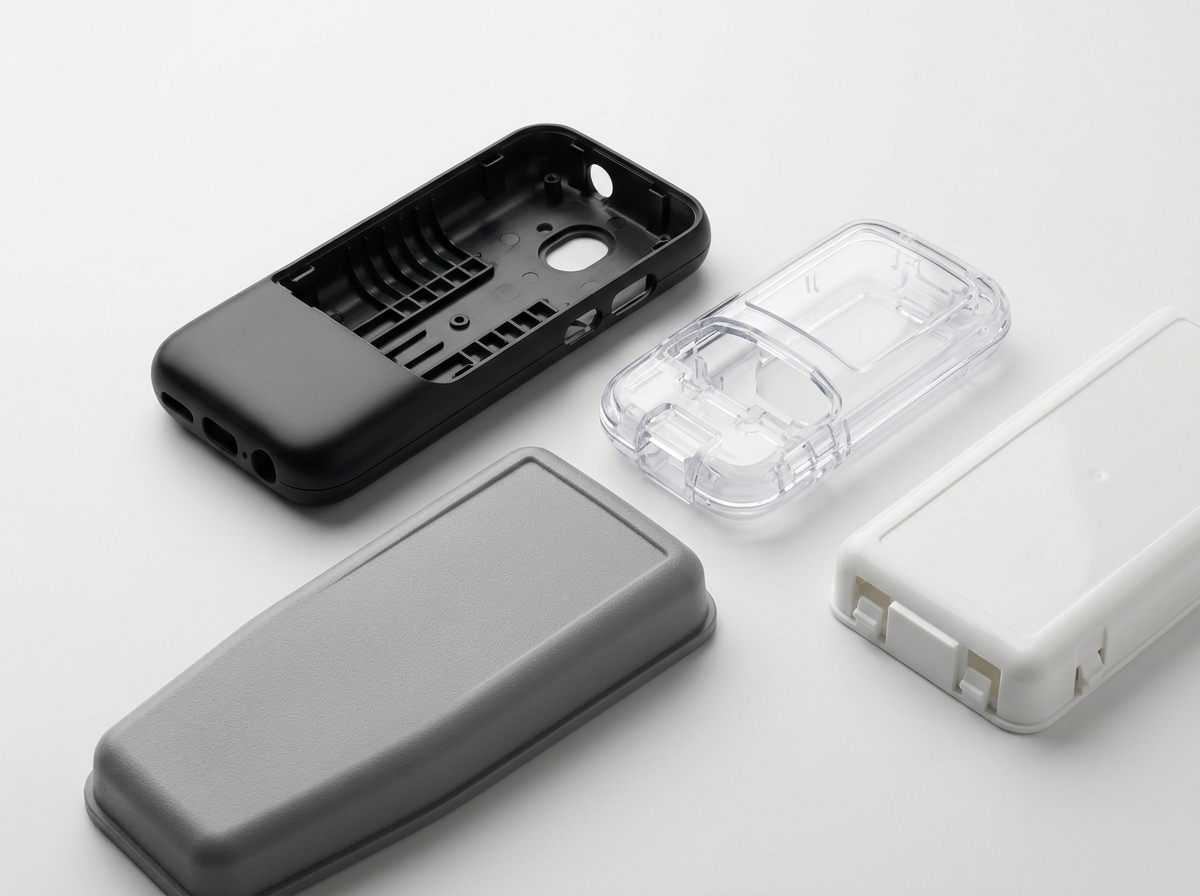
PC is often the most practical answer when a consumer product must survive impact without becoming opaque or brittle. Polycarbonate is known for high toughness, making it suitable for clear guards, appliance windows, protective covers, and portable-device shells. In real design work, PC is favored when the product has a drop hazard, a public-facing cosmetic requirement, and a need for controlled wall thickness. It is especially useful for parts developed through 3D mold tooling or complex enclosure programs where visible geometry and structural performance must coexist.
The downside is that PC is not a universal solution. It can scratch more easily than some alternatives and may need coatings or texture control for better wear resistance. If the product will experience repeated chemical cleaning, sun exposure, or surface abrasion, the design team should confirm compatibility before cutting steel. For many consumer plastic products, the right use of PC is in the outer shell or transparent zone, while another resin is used for hidden structural elements.
ABS and PC/ABS for Consumer Plastic Products with Strong Cosmetics
ABS remains a workhorse because it balances moldability, surface quality, and cost. It is widely used in appliance housings, small electronics, and decorative components where the part must look clean after molding and remain stable in everyday use. When a program needs better heat resistance or impact performance than ABS alone can deliver, PC/ABS becomes a more robust option. This blend is common in premium consumer electronics and appliance covers because it often improves toughness while retaining good finish quality.
From a manufacturing perspective, ABS and PC/ABS are attractive because they are process-friendly, which helps control cycle time and cosmetic consistency. That matters when a supplier is managing OEM plastic parts for multiple SKUs. The best material choice is usually the one that reduces downstream defects, not the one with the highest headline strength. Cosmetic consistency, gate vestige control, and weld-line management often matter more than a small improvement in tensile strength.
Why PA66 and PBT Matter for Structural Consumer Plastic Parts
PA66 and PBT are often chosen when a product needs dimensional stability under load, especially in brackets, connectors, latch systems, and internal structures. Glass-filled PA66 is especially strong in stiffness and heat resistance, but it must be managed carefully because moisture uptake can change dimensions and mechanical behavior. That makes it a good fit for durable consumer plastic products that sit inside appliances or protected devices rather than exposed exterior surfaces.
PBT is a frequent choice for electrical and appliance components because it offers stable geometry and good electrical insulation. It is commonly used when the part must hold tight fit relationships across a production run. In precision mold programs, the interaction between resin shrinkage and mold cooling is decisive, which is why selecting material and tool design together is smarter than selecting either in isolation.
| Material | Typical Advantage | Typical Risk | Better For | Not Ideal For |
|---|---|---|---|---|
| PA66 GF | High stiffness and load capacity | Moisture-driven dimensional change | Structural supports, clips, frames | Cosmetic outer shells in humid environments |
| PBT | Stable dimensions and good insulation | Less impact toughness than PC | Electrical housings, connectors | High-drop transparent parts |
| POM | Wear resistance and low friction | Can be brittle in some conditions | Gears, cams, moving interfaces | Large impact-loaded covers |
PP and POM for High-Cycle Consumer Plastic Components
PP is one of the most practical consumer plastics when fatigue resistance and chemical resistance matter more than stiffness. It is widely used in containers, closures, flexing features, and parts that need living-hinge behavior. A living hinge is a design case where PP often outperforms more rigid plastics because it tolerates repeated bending without immediate cracking. That is why PP remains important in household goods, packaging-adjacent products, and low-cost durable items.
POM, by contrast, is valued for sliding wear, low friction, and mechanical precision. It is ideal for small moving parts such as gears, latches, and mechanical interfaces inside consumer products. If your product has repetitive motion, POM can reduce wear noise and preserve function over time. For these parts, a supplier experienced in injection molding parts can help tune gate location, cooling, and mold polish so the final mechanism stays reliable.
How to Match Material to Product Scenario
The best plastic materials for durable consumer products are scenario-specific. A transparent hand-held device may need PC. A premium appliance front panel may do better with PC/ABS. A structural internal bracket may need PA66 GF. A moving gear or latch may need POM. A squeeze cap or hinge may need PP. The right answer comes from mapping the product’s environment and failure risk before material selection begins.
- Define the main failure mode: impact, creep, wear, heat, UV, or chemicals.
- Set the appearance requirement: glossy, matte, transparent, painted, or textured.
- Confirm the geometry: wall thickness, ribs, snaps, undercuts, and weld lines.
- Check production scale: prototype, short run, or high-volume tooling.
- Validate against test methods such as ASTM D256, ASTM D638, and ASTM D648.
This process is especially important for plastic shell mold programs because shell failures are visible to the end user immediately. A design that looks fine in CAD can still fail if the resin is too brittle for the rib layout or if the wall thickness creates sink marks and warpage. Material selection should therefore be treated as part of the total tooling strategy.
Design and Tooling Factors That Change Material Performance
The same resin can behave very differently depending on the mold. Gate placement, venting, cooling layout, draft angle, rib thickness, and weld-line location all influence durability. A well-designed mold can improve part consistency and reduce residual stress, which in turn improves impact performance and dimensional stability. This is why consumer plastic products are rarely “saved” by resin choice alone if the mold design is weak.
In practice, the manufacturing team should consider how the part will be cooled and ejected, where stress will accumulate, and whether the material needs a cosmetic finish or a textured wear surface. For example, a glossy PC shell may show scratches faster than a textured ABS/PC panel, even when both pass basic strength tests. Molding discipline matters because durability is often lost at the process level, not the polymer level.
| Design Factor | Effect on Durability | Common Issue | Practical Fix |
|---|---|---|---|
| Wall thickness | Controls sink, cooling, and warp | Uneven shrinkage | Keep thickness uniform where possible |
| Gate location | Influences weld lines and stress | Cracks near knit lines | Move gates away from high-stress areas |
| Cooling layout | Affects cycle time and stability | Warpage and long cycles | Balance cooling channels |
| Rib design | Raises stiffness without mass growth | Sink marks | Use conservative rib ratios |
| Surface texture | Changes scratch visibility | Early cosmetic wear | Select texture to mask handling marks |
What Buyers Should Ask a Plastic Materials Supplier
The most reliable supplier is the one that can explain trade-offs, not just list resin names. When sourcing durable consumer plastic products, buyers should ask how the material performs in real loading, what test standard was used, and whether the mold and part geometry were considered together. This is especially relevant when evaluating manufacturing capability for new product launches.
- What is the expected failure mode under real use?
- Which test standards support the material claim?
- How will shrinkage and warpage be controlled?
- Will the part need UV stabilization, coatings, or fillers?
- Is the resin chosen for the part or for the tooling constraints?
For buyers in consumer electronics, household goods, toys, and appliances, these questions separate an engineering-backed proposal from a generic sales pitch. They also help reduce later cost from rework, cosmetic rejects, and field failures.
Quantitative Benchmarks to Keep in Mind
Durability decisions improve when they are anchored to measurable thresholds. ISO 20457:2018 is useful for discussing tolerances in injection-molded parts, while ASTM test methods provide consistent ways to compare material behavior. In practical consumer-product programs, teams often target consistent dimensions at the part level within a tight process window, and many high-volume programs aim for repeatability on the order of hundredths of a millimeter depending on geometry and resin. For structural confidence, material screening often includes impact, tensile, and heat-deflection checks before tooling release.
On the process side, cycle time is heavily influenced by wall thickness, cooling efficiency, and resin flow. A thinner wall can shorten cycle time, but only if the part remains strong enough and the gate design supports stable filling. In consumer manufacturing, the lowest total cost is often achieved by choosing a resin that reduces rejects, rework, and cosmetic waste rather than one that is simply cheapest per kilogram.
Practical Shortlist for 2026
For most durable consumer plastic products in 2026, the shortlist usually looks like this:
- PC for impact resistance, transparency, and protective housings.
- ABS for balanced cost, appearance, and everyday durability.
- PC/ABS for premium housings needing both toughness and finish quality.
- PA66 GF for structural parts that must carry load and heat.
- PBT for stable electrical and appliance components.
- PP for fatigue resistance, chemical resistance, and living hinges.
- POM for gears, latches, and wear-prone moving parts.
If the product has unusual geometry, multiple materials, or strict visual requirements, a tooling partner that can support mold development, trial feedback, and production stability becomes especially important. That is where custom plastic injection molding can reduce risk by aligning resin choice, tooling design, and assembly intent from the start.
FAQ
What is the best overall plastic for durable consumer products?
PC is often the best all-around option when impact resistance and appearance both matter, but it is not always the lowest-risk choice for wear or chemical exposure.
Is ABS durable enough for consumer products?
ABS is durable enough for many housings and trims, especially when the part is indoors and not exposed to extreme heat or aggressive chemicals.
When should I choose glass-filled nylon?
Choose PA66 GF when stiffness, structural strength, and heat resistance matter more than cosmetic perfection or moisture stability.
What plastic is best for moving parts?
POM is often best for gears, latches, and sliding components because it offers low friction and good wear resistance.
Which material is best for chemical resistance?
PP is usually one of the strongest choices for chemical resistance in consumer products, especially for caps, containers, and flexible features.
Why do material tests matter if the resin datasheet already exists?
Datasheets are useful, but they do not replace part-specific testing under standards such as ASTM D256, ASTM D638, and ASTM D648.
How do I reduce warpage in durable plastic parts?
Reduce warpage by improving wall uniformity, balancing cooling, controlling gate location, and selecting a resin that fits the geometry and loading conditions.
Post time: Aug-10-2026