
Introduction
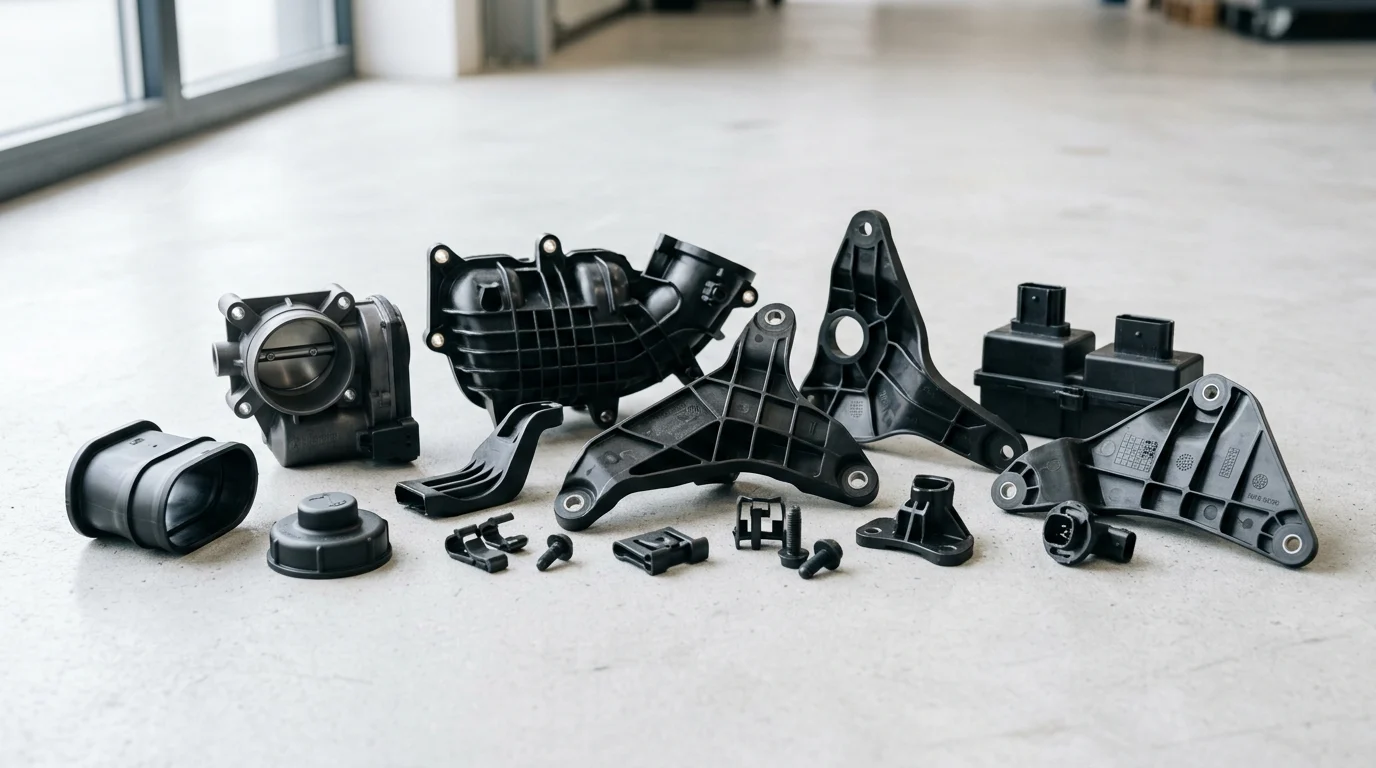
Choosing an injection molding approach for automotive plastic components is less about one “best” process and more about matching material, tooling, and production requirements to the part’s function. Interior trim, under-hood housings, structural brackets, and EV components each impose different demands on heat resistance, dimensional stability, surface quality, cycle time, and cost. This article outlines the most effective molding solutions for these applications, including how part geometry, resin selection, mold design, and quality controls affect performance at scale. By the end, readers will have a clear framework for evaluating which molding strategies deliver the right balance of durability, efficiency, and manufacturability for automotive programs.
Why automotive plastic parts need strategic injection molding
The modern automotive industry relies heavily on advanced polymers to meet stringent regulatory standards, consumer expectations, and manufacturing efficiencies. Transitioning from traditional metal fabrication to specialized polymer processing has fundamentally transformed vehicle architectures. Strategic injection molding is the cornerstone of this evolution, allowing original equipment manufacturers (OEMs) and Tier 1 suppliers to produce complex, high-precision components at scale.
Without a highly optimized molding strategy, manufacturers risk compromised structural integrity, aesthetic flaws, and inefficient production cycles. As the sector accelerates toward electrification and enhanced fuel efficiency, the demand for dimensionally stable, lightweight, and resilient plastic components has never been higher.
Cost, weight, durability, and design drivers
The primary catalyst for replacing metal with engineered polymers is lightweighting. Industry data consistently demonstrates that reducing vehicle weight by just 10% can improve fuel economy by 6% to 8%, while simultaneously extending the battery range of electric vehicles (EVs). Today, plastics account for approximately 50% of a modern vehicle’s volume but only 10% of its total weight.
Beyond weight reduction, injection molding offers unparalleled design flexibility. Complex geometries that would require multiple machining operations in metal can be consolidated into a single molded part, reducing assembly time and associated labor costs. Durability is another critical driver; advanced thermoplastics resist corrosion, chemical degradation, and impacts far better than many legacy materials, extending the overall lifecycle of the vehicle.
Performance needs for interior and exterior parts
Automotive applications are broadly categorized into interior and exterior environments, each dictating distinct performance thresholds. Interior components, such as dashboard fascias, door panels, and center consoles, require exceptional aesthetic finishes, low volatile organic compound (VOC) emissions to prevent cabin odor, and robust UV resistance to withstand prolonged sun exposure without fading or embrittlement.
Conversely, exterior components like bumpers, grilles, and mirror housings face punishing environmental conditions. These parts must maintain high impact resistance and dimensional stability across extreme temperature fluctuations, often engineered to perform reliably from -40°C in winter climates to over 80°C under direct summer sunlight. Strategic injection molding ensures that specific resin formulations are perfectly matched to these disparate operational demands.
Best injection molding solutions for automotive plastic parts
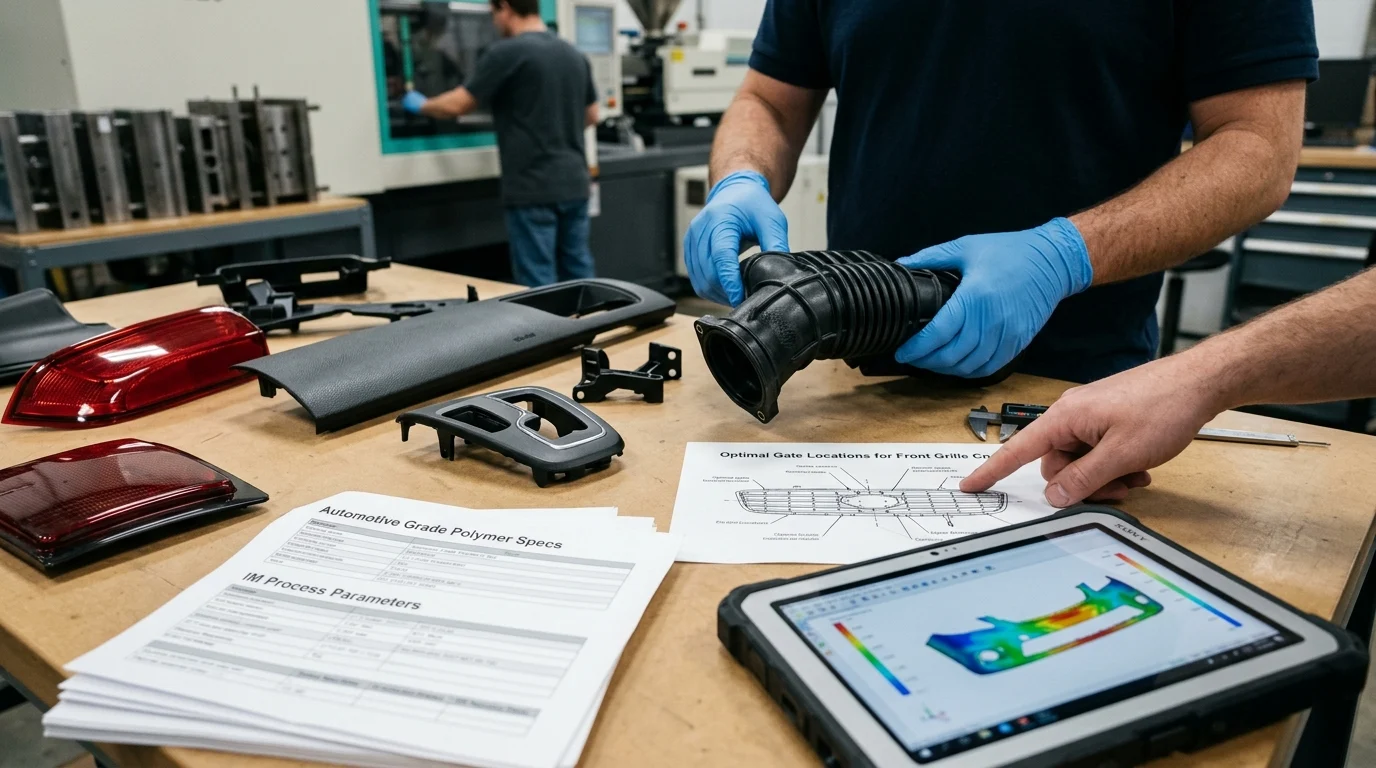
Identifying the optimal manufacturing technique is critical for balancing cost, performance, and scalability. The automotive sector utilizes several advanced variations of the standard injection molding process to address specific functional and aesthetic requirements.
From multi-material integration to internal cavity creation, the chosen molding solution directly dictates the physical properties and unit economics of the final part.
Processes suited to different automotive applications
While conventional injection molding is ubiquitous for standard brackets and housings, specialized processes are necessary for complex automotive parts. Two-shot (2K) or multi-shot molding is extensively used to combine multiple materials or colors in a single cycle. This is ideal for producing weather seals, soft-touch interior buttons, and integrated gasket assemblies, eliminating secondary bonding operations.
Gas-assist injection molding is another highly effective technique, particularly for thick-walled components like interior door handles and structural bezels. By injecting inert nitrogen gas into the melt stream, this process hollows out the thick sections, reducing material consumption by 20% to 30%, minimizing cycle times, and drastically reducing the risk of sink marks on class-A surfaces.
Material selection for performance and manufacturability
Resin selection is the foundation of part performance. Polypropylene (PP) remains the most widely used automotive plastic due to its low cost, chemical resistance, and excellent performance in bumper fascias and interior trims. For applications requiring higher impact strength and rigidity, Acrylonitrile Butadiene Styrene (ABS) and Polycarbonate/ABS (PC/ABS) blends are standard for instrument panels and exterior trim.
Under-the-hood applications demand engineering-grade resins capable of withstanding aggressive automotive fluids and extreme thermal stress. Polyamide 66 (PA66), often reinforced with 30% to 50% glass fiber, is heavily utilized for engine covers, intake manifolds, and radiator end tanks, as it can maintain structural integrity at continuous operating temperatures up to 150°C. Selecting the right automotive plastic components requires a deep understanding of both thermal properties and moldability.
Comparing process, resin, tooling, and cost
To navigate the complexities of process, resin, and tooling, manufacturers must conduct rigorous cost-benefit analyses. The table below outlines the comparative attributes of common automotive resins to guide material and process selection.
| Material Type | Typical Automotive Application | Continuous Heat Resistance | Relative Cost Profile | Key Manufacturability Trait |
|---|---|---|---|---|
| Polypropylene (PP) | Bumpers, interior trim, battery cases | Up to 100°C | Low | High flow, prone to warpage if unreinforced |
| ABS | Dashboard components, console trim | Up to 90°C | Medium | Excellent surface finish, good dimensional stability |
| PC/ABS Blend | Exterior grilles, structural interior parts | Up to 110°C | Medium-High | High impact strength, requires precise mold temp control |
| PA66 (Glass Filled) | Intake manifolds, fluid reservoirs | Up to 150°C | High | Abrasive to tooling, requires hardened steel molds |
Tooling costs scale aggressively with material complexity. Highly abrasive materials like glass-filled nylon require hardened steel molds, which increases initial capitalization but lowers the long-term cost per part by extending the mold’s operational life.
Quality, compliance, and production stability
In the automotive supply chain, quality is not merely an objective; it is a rigid prerequisite. Defective parts can lead to catastrophic assembly line stoppages or massive liability in the event of consumer recalls.
Maintaining production stability requires stringent process controls, advanced metrology, and strict adherence to international quality management frameworks designed specifically for the automotive sector.
Controls for warpage, sink marks, flash, and dimensional accuracy
The most common injection molding defects—warpage, sink marks, flash, and short shots—are heavily mitigated through scientific molding practices. Warpage occurs when a part cools unevenly; this is controlled by designing highly conformal cooling channels within the mold and regulating the coolant flow to maintain uniform cavity temperatures. Sink marks in thick sections are managed by optimizing hold pressure and utilizing techniques like the aforementioned gas-assist molding.
Dimensional accuracy is paramount, particularly for parts that must mate with metal chassis components or other plastic assemblies. Automotive tolerances are extraordinarily tight, often requiring precision within ±0.05 mm for critical snap-fits and mounting points. Achieving this level of repeatability requires closed-loop control systems on the injection molding machines, continuously monitoring melt temperature, injection speed, and cavity pressure.
Automotive standards, PPAP, and validation requirements
Compliance in automotive manufacturing is governed by the IATF 16949 standard, which emphasizes defect prevention, variation reduction, and continuous improvement. Suppliers must operate within this framework to be considered for OEM contracts. A critical component of this compliance is the Production Part Approval Process (PPAP).
PPAP requires suppliers to submit comprehensive documentation—ranging from Level 1 to Level 5—proving that the manufacturing process can consistently produce parts meeting the customer’s design intent at the quoted production rate. Furthermore, the industry standard for quality demands exceptionally low failure rates, typically mandating that defect rates remain below 50 Parts Per Million (PPM). Validation protocols include rigorous dimensional layouts, material certifications, and capability studies (Cpk > 1.33) before mass production can commence.
Sourcing, tooling, and cost planning
The economic viability of an automotive component program hinges on intelligent sourcing and meticulous cost planning. Tooling represents the most significant upfront capital expenditure in the injection molding lifecycle.
A well-structured procurement strategy evaluates not just the piece price, but the total cost of ownership, factoring in mold longevity, maintenance schedules, and the technical competence of the manufacturing partner.
Evaluating mold design and supplier capability
Evaluating a mold design requires analyzing the expected production volume and the abrasiveness of the chosen polymer. For mid-volume production or non-abrasive resins like standard PP, pre-hardened P20 tool steel is often sufficient, reliably yielding around 300,000 shots. However, for high-volume runs or glass-filled engineering resins, tools must be machined from fully hardened H13 or S136 steel, which can withstand 1,000,000 or more cycles without degrading.
Supplier capability extends beyond simply cutting steel. A competent partner will utilize advanced Moldflow simulation software to predict fill patterns, identify potential weld lines, and optimize gating locations before any metal is cut. Partnering with experienced manufacturers of automotive plastic components ensures that the supplier has the necessary infrastructure to handle large-tonnage presses and automated part extraction critical for automotive scales.
Quoting, prototyping, validation, and ramp-up
The quoting and ramp-up phases follow a predictable but rigorous timeline. Standard automotive tooling lead times typically range from 4 to 8 weeks, depending on mold complexity and cavity count. Mold costs can vary dramatically, starting around $10,000 for simple, single-cavity prototype tools and scaling well beyond $100,000 for complex, multi-cavity production molds featuring hot runner systems and intricate side actions.
Prototyping is often executed using softer aluminum tooling (T1 samples) to validate the design geometry and fitment before committing to hardened steel. Once T1 samples are approved, the process moves through validation testing, process capability optimization, and ultimately, a controlled ramp-up to full-rate production. Accurate cost planning must account for these iterative sampling and adjustment phases to prevent budget overruns.
Choosing the right molding solution
Finalizing the manufacturing strategy requires a holistic view of the project’s lifecycle. There is no universally superior molding solution; rather, the best approach is derived from a careful alignment of part geometry, mechanical requirements, and economic constraints.
Decision-makers must continuously balance the iron triangle of manufacturing: speed, quality, and cost, ensuring that the selected process scales elegantly from initial launch through the vehicle’s end of life.
Matching part function, volume, cost, and quality targets
Matching the molding solution to the target profile involves evaluating the Minimum Order Quantity (MOQ) against the tooling amortization schedule. For instance, an automotive interior trim piece requiring an MOQ of 10,000 units annually might justify a single-cavity P20 mold, whereas a fastener required in the millions necessitates a 16-cavity H13 mold to drive the unit cost down to fractions of a cent.
| Production Volume Strategy | Typical Annual Volume | Preferred Tooling Material | Recommended Molding Process | Cost Focus |
|---|---|---|---|---|
| Low-Volume / Niche Vehicles | < 20,000 units | Aluminum / P20 Steel | Standard Injection | Minimizing upfront tooling CAPEX |
| Mid-Volume / Standard Trims | 20,000 – 100,000 units | P20 / NAK80 Steel | Standard / Gas-Assist | Balancing tool life and piece price |
| High-Volume / Global Platforms | > 100,000 units | Hardened H13 / S136 | Multi-Cavity / 2K Molding | Minimizing cycle time and piece price |
Ultimately, securing high-quality automotive plastic components relies on early supplier involvement. By engaging injection molding experts during the initial design-for-manufacturability (DFM) phase, OEMs can engineer out unnecessary costs, select the most appropriate polymer blends, and establish a robust validation framework that guarantees long-term production stability.
Further reading:
Key Takeaways
- The most important conclusions and rationale for automotive plastic components
- Specs, compliance, and risk checks worth validating before you commit
- Practical next steps and caveats readers can apply immediately
Frequently Asked Questions
Which injection molding process is best for automotive plastic components?
It depends on the part. Standard molding suits brackets and housings, 2K molding fits soft-touch or sealed parts, and gas-assist works well for thick handles and bezels with fewer sink marks.
What materials are commonly used for automotive plastic parts?
PP is common for trims and bumpers, ABS or PC/ABS for interior and exterior appearance parts, and glass-filled PA66 for under-the-hood components needing heat and chemical resistance.
How does injection molding help reduce vehicle weight?
It replaces heavier metal parts with engineered polymers and allows part consolidation. This can cut assembly steps while helping improve fuel economy or EV range.
How can PlasticMetalMold support automotive plastic component projects?
PlasticMetalMold can help match resin, tooling, and molding process to your part’s performance, finish, and cost targets, especially for high-precision automotive applications.
What should be checked before starting an automotive injection molding tool?
Confirm part function, resin grade, wall thickness, tolerance needs, surface finish, and production volume. Early DFM review helps avoid warpage, sink marks, and unnecessary tooling changes.
Post time: Jun-16-2026