
- OEM injection molding is strongest when repeatability, durability, and supply continuity matter more than one-off fabrication.
- Industrial plastic parts often benefit from resin and gate design choices that reduce warpage, sink, and assembly mismatch.
- A good OEM partner supports DFM, tool trials, process windows, and ongoing production control, not just mold machining.
- Quality and compliance should be benchmarked against measurable standards, not marketing claims.
- One supplier covering tooling and molded parts can reduce coordination cost and speed up launch timing.
OEM injection molding for industrial applications is most valuable when a buyer needs industrial plastic parts that are accurate, durable, and scalable, with tolerances and process stability that can be verified against standards such as ISO 20457:2018 and dimensional inspection methods such as NIST guidance on dimensional measurement. In industrial programs, a well-managed mold can support thousands to millions of cycles, while a poorly matched design can create recurring scrap, assembly delays, and rework. For sourcing teams, the core question is not whether injection molding is suitable, but whether the OEM injection molding solution can align material, tooling, validation, and replenishment around the real use case.
Why OEM injection molding solutions matter for industrial plastic parts
The biggest advantage of OEM injection molding is repeatable manufacturing at a cost point that improves as volume rises.
Industrial buyers usually care about part function first and unit price second, because a low-cost part that fails in assembly or in use is expensive in the real system.
Injection molding is especially strong for housings, covers, brackets, connectors, guards, and structural components where geometry must remain consistent across long production runs.
It also fits projects where product families share a common platform, because a single mold strategy can support multiple SKUs with controlled insert or cavity changes.
For buyers comparing supply models, see the site’s plastic injection mold solutions, plastic housing mold options, and custom plastic parts services for how tooling and molded output are usually connected in one workflow.
Core benefits of OEM injection molding for industrial applications
OEM injection molding improves industrial sourcing by combining engineering control with production repeatability.
That combination matters because industrial plastic parts often need to pass both mechanical and visual requirements before they are acceptable for production use.
| Benefit | Industrial impact | Typical measurable outcome | Where it matters most |
|---|---|---|---|
| Repeatability | Stable part-to-part dimensions | Capability targets such as Cp/Cpk tracking at critical dimensions | Assembly interfaces, latch features, sealing surfaces |
| Tool-based scalability | High output once tooling is validated | Shorter per-part cycle time after process tuning | Mass production, replenishment, multi-SKU supply |
| Design integration | Part, mold, and process co-optimized | Lower risk of warpage, sink marks, and flash | Precision housings, covers, and brackets |
| Material flexibility | Resin matched to performance needs | Better impact, heat, or chemical resistance | Industrial enclosures, protective shells, fixtures |
Repeatability is the first reason industrial buyers choose OEM injection molding, because a validated process can hold the same geometry across long runs better than many hand-built alternatives.
Scalability is the second reason, because once a tool is stable, the marginal cost per part drops significantly as volume increases, especially for programs with recurring demand.
Design integration is the third reason, because OEM teams can adjust wall thickness, ribbing, draft angle, gate position, and cooling layout before production starts, rather than discovering defects after launch.
Material flexibility is the fourth reason, because industrial plastic parts may need flame resistance, UV resistance, impact strength, or dimensional stability depending on the environment.
How OEM injection molding supports industrial performance targets
The best OEM injection molding solutions are built around measurable performance targets, not general promises.
For a buyer, that means asking whether the supplier can convert drawings into parts with verified dimensional control, acceptable surface quality, and stable cycle behavior.
In mold design, ASTM standards are often used alongside customer specifications to define material test methods, while process qualification can be tied to actual production data instead of subjective inspection alone.
A practical example is a PC housing used for a control device or protective cover, where transparency, impact resistance, and fit are all relevant at the same time.
Polycarbonate is commonly selected because its tensile strength is around 60-70 MPa and its Izod impact performance is notably high relative to many commodity plastics, making it suitable for demanding enclosures and guards, according to material datasheets from major resin suppliers and test methods defined in ASTM standards.
For dimension verification, many industrial teams reference coordinate measurement and inspection practices grounded in metrology guidance from NIST, especially when critical features affect assembly, sealing, or safety.
| Industrial requirement | OEM injection molding response | Typical engineering lever | Result |
|---|---|---|---|
| Fit and assembly | Control shrinkage and critical dimensions | Cavity compensation, gate location, cooling balance | Lower assembly stress and rework |
| Appearance consistency | Stabilize surface finish and flow behavior | Material drying, mold polish, venting | Fewer blemishes and color variation |
| Structural strength | Reinforce load paths | Ribs, bosses, wall transitions | Better stiffness without excess material |
| Supply continuity | Plan tooling and spare parts strategy | Maintenance schedule, mold components | Reduced downtime risk |
For industrial buyers, the real performance gain is not a single fast cycle, but a predictable production window that allows planning, stocking, and shipment without constant firefighting.
OEM injection molding vs alternative manufacturing methods
OEM injection molding is not always the right choice, but it becomes the strongest option when part volume, repeatability, and geometry complexity intersect.
Compared with machining, injection molding usually offers much lower piece cost at scale, but it requires upfront tooling investment and more detailed design validation.
Compared with 3D printing, injection molding is usually slower to start but far more economical and stable for production volumes.
Compared with thermoforming, injection molding typically gives better control over ribs, bosses, clips, and enclosed geometry.
| Method | Best for | Strength | Limitation | Typical industrial use |
|---|---|---|---|---|
| OEM injection molding | Repeatable plastic parts | High scalability and part consistency | Tooling lead time and initial cost | Housings, covers, brackets |
| CNC machining | Low-volume rigid parts | Fast design changes | Higher per-part cost | Fixtures, prototypes, small batches |
| 3D printing | Early validation | Rapid iteration | Limited production economics | Fit checks, sample development |
| Thermoforming | Large thin-wall shells | Lower tooling complexity | Less geometric freedom | Panels, trays, enclosures |
If your part needs clips, internal bosses, cable routing features, or controlled wall transitions, OEM injection molding is usually easier to industrialize than forming or machining.
If your part only needs a simple geometry and very low volume, another process may be more economical.
That is why a serious supplier should help compare process routes before tooling starts, not after the design is frozen.
Material selection in OEM injection molding for industrial plastic parts
Material choice is one of the biggest drivers of part success or failure.
Industrial plastic parts rarely fail because the resin name is wrong alone; they fail because the resin, wall design, and load environment were not considered together.
Common resin families include ABS for balance and finish, PC for impact resistance and transparency, PP for chemical resistance and flexibility, PA for strength and wear resistance, and PBT for electrical and dimensional performance.
For industrial housings, PC and PC/ABS are frequent choices when appearance and impact strength both matter.
For structural clips or load-bearing brackets, PA or glass-filled grades may be more suitable, depending on humidity and creep requirements.
According to common datasheet ranges, glass-filled nylon can raise stiffness substantially, but it may also increase shrink variation and wear on molds, so the trade-off must be engineered rather than assumed.
| Material | Approx. tensile strength | Key advantage | Watch-out | Typical industrial part |
|---|---|---|---|---|
| ABS | 35-45 MPa | Good balance of cost and processability | Lower heat resistance than engineering resins | Covers, trims, protective shells |
| PC | 60-70 MPa | High impact resistance and transparency | Needs good drying and process control | Transparent guards, instrument windows |
| PP | 25-35 MPa | Chemical resistance and low density | Lower stiffness | Containers, caps, utility parts |
| PA6 | 50-80 MPa | Strength and wear resistance | Moisture absorption affects dimensions | Clips, gears, brackets |
For industrial procurement, the question is not which resin is strongest on paper, but which one stays stable in the real environment of heat, vibration, chemicals, and load.
That is why OEM injection molding solutions should include material counseling as part of the quoting process.
 How tooling quality changes the value of OEM injection molding
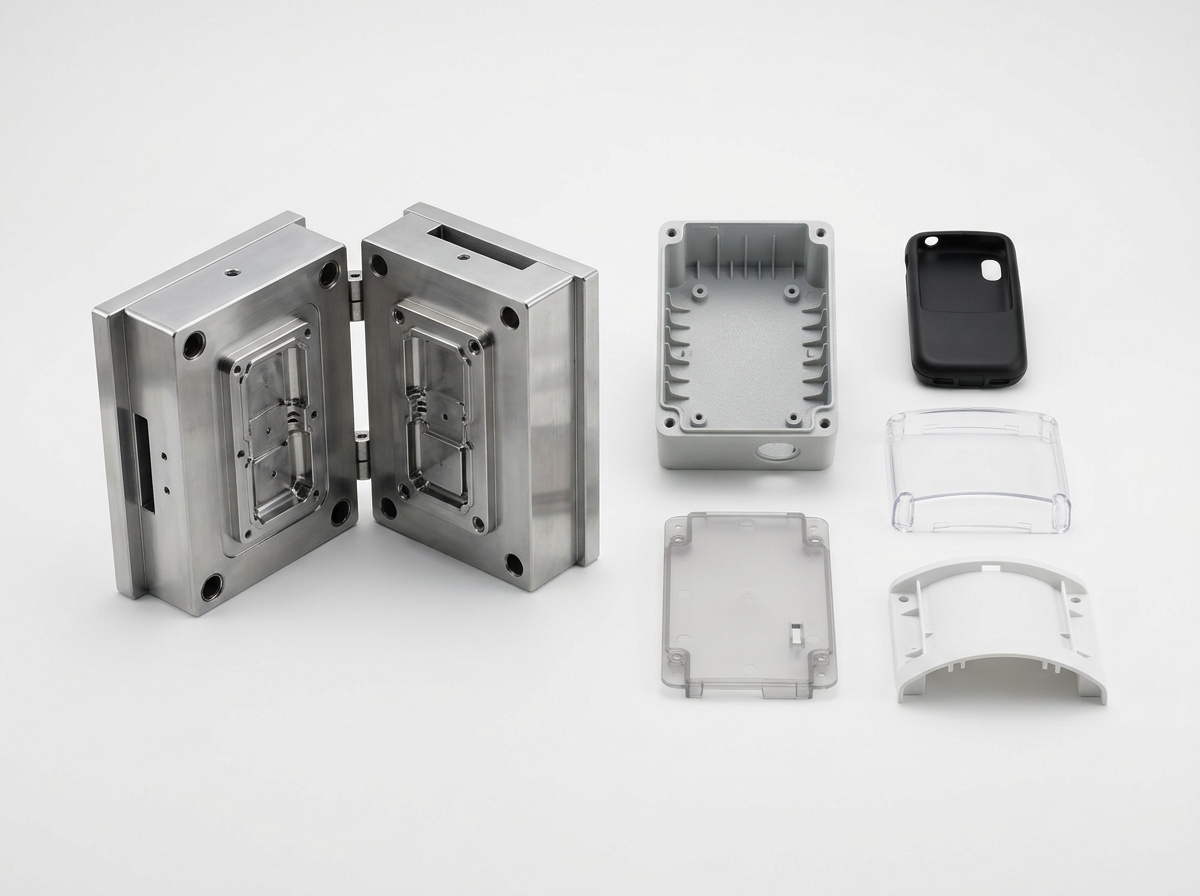
The mold is the process, because tooling quality directly affects part quality, cycle stability, and maintenance cost.
In industrial programs, a mold that is dimensionally accurate but poorly cooled can still generate scrap due to warpage, sink, or inconsistent shrinkage.
Likewise, a polished cavity that looks perfect on day one may become a cost problem if venting, ejection, or wear points were not planned for high-volume use.
That is why mold development should usually include DFM review, flow analysis, trial shots, and corrective tuning before approval for mass production.
Many experienced OEM suppliers also plan spare inserts, ejector pins, and other wear parts so the production line can recover quickly from routine maintenance events.
This is especially important for industrial customers that depend on uninterrupted replenishment rather than one-time project delivery.
| Tooling element | Why it matters | Common failure if ignored | Business effect |
|---|---|---|---|
| Cooling layout | Controls cycle time and shrink balance | Warpage and long cycles | Higher cost and unstable part geometry |
| Gate design | Shapes flow and weld line behavior | Weak spots or cosmetic marks | Lower strength and appearance quality |
| Venting | Lets trapped air escape | Burn marks or short shots | Scrap and rework |
| Ejection system | Removes parts without damage | Stress whitening or deformation | Surface defects and returns |
Tooling quality has a long tail effect, because every production hour spent fixing a mold is an hour not producing saleable parts.
For industrial buyers, that makes tooling review a financial decision, not only an engineering one.
What procurement teams should ask before choosing an OEM injection molding supplier
The right supplier should be evaluated on process control, communication, and production discipline, not just quoted unit price.
A useful first step is to ask how the supplier handles drawings, samples, mold trials, and engineering changes before final approval.
Then ask how they measure and document critical dimensions, how they manage material traceability, and how they support repeat orders over time.
For cross-border industrial programs, response speed and documentation quality can matter almost as much as machining capability, especially when launch windows are tight.
- Can the supplier review drawings and suggest manufacturable changes before tool cutting?
- Can it document inspection results for key dimensions and cosmetic criteria?
- Does it support trial reports, sample approvals, and change tracking?
- Can it maintain consistent output across repeat orders and multi-cavity tools?
- Does it offer spare parts planning and mold maintenance guidance?
Buyers who source through a multi-category supplier often gain coordination efficiency, especially when they need several product families from one project.
You can see how a broader sourcing structure may work through the site’s plastic shell mold page and OEM and ODM service overview.
Real-world industrial use cases for OEM injection molding
Industrial OEM injection molding is most effective when the part must solve a functional problem repeatedly, not just look finished.
In electrical equipment, it is often used for enclosures that protect wiring while preserving access and assembly speed.
In appliance systems, it can produce fronts, covers, and internal supports that must fit consistently across multiple production lots.
In factory equipment, it is common for guards, brackets, and operator interface parts that must survive mechanical stress and daily handling.
In consumer-facing industrial products, such as smart devices or portable equipment, appearance and structure both matter, so PC or PC/ABS housings are often considered early in the design stage.
For these applications, OEM injection molding adds value by reducing variation, supporting better fit, and lowering the number of separate suppliers involved in the launch.
That is especially relevant when a project includes both the mold and the molded product, because design intent can be preserved better when the same engineering team manages both steps.
Common mistakes that reduce the value of OEM injection molding
Most expensive molding problems begin before the mold is made.
The most common mistake is freezing a design without confirming wall thickness, draft angle, undercut strategy, or material behavior.
A second mistake is selecting a resin based only on price, without checking heat, chemical, or load requirements.
A third mistake is failing to agree on inspection criteria, which creates disputes when appearance or fit is judged differently by each side.
A fourth mistake is underestimating lead time for tooling changes, especially when the project schedule has already been compressed.
- Do not assume a CAD model is automatically mold-ready.
- Do not choose material before defining the load and environment.
- Do not skip trial feedback and correction loops.
- Do not ignore spare parts and maintenance planning for high-volume programs.
When these errors are avoided, OEM injection molding becomes much easier to justify economically and operationally.
How to compare OEM injection molding suppliers objectively
The best comparison is based on evidence, not presentation.
A procurement team can score suppliers on engineering support, sample quality, communication speed, tooling discipline, and post-launch stability.
| Evaluation factor | What to verify | Evidence to request | Why it matters |
|---|---|---|---|
| Engineering support | DFM and material advice | Redlined drawings, process recommendations | Reduces rework before tooling |
| Quality system | Inspection and traceability | Sample report, control plan, lot records | Improves confidence in repeatability |
| Tooling capability | Mold design and maintenance plan | Tool drawings, spare part list | Supports long-term production |
| Communication | Response speed and clarity | Email turnaround, meeting notes | Reduces launch delay risk |
If a supplier can explain how a part will be made, measured, and maintained, it is usually more reliable than one that only quotes a price.
That is the practical advantage of a true OEM injection molding partner in industrial sourcing.
When OEM injection molding delivers the highest ROI
OEM injection molding tends to deliver the highest return when volumes are moderate to high, geometry is repeatable, and failure cost is high.
The ROI is also stronger when the part is part of a product family, because one mold strategy can serve several end products or revisions.
For example, a platform housing with shared architecture across multiple SKUs can justify the tooling expense faster than a one-off decorative part.
Another high-ROI case is when the part is exposed to industrial use and must remain consistent over time, because lower defect rates reduce warranty and assembly cost.
In those scenarios, the real savings come from fewer stoppages, fewer rejected parts, and fewer engineering changes after launch.
For many industrial buyers, that is more valuable than chasing the lowest possible quoted part price.
In public manufacturing discussions, productivity improvements are often framed around waste reduction and process stability; the same logic applies here, where better tooling and process control lower scrap and rework pressure.
Frequently asked questions about OEM injection molding solutions
What is OEM injection molding in industrial manufacturing?
OEM injection molding is a production model where a supplier designs and builds the mold, then manufactures plastic parts to the buyer’s specification for an industrial application.
Why do industrial buyers prefer injection molding for plastic parts?
Industrial buyers prefer it because it offers repeatability, scalable output, and better control over complex features such as ribs, bosses, clips, and housings.
Which materials are most common for industrial plastic parts?
ABS, PC, PP, PA, and PBT are common choices, with selection driven by impact, heat, chemical resistance, stiffness, and cost.
How does tooling quality affect part quality?
Tooling quality affects cooling balance, flow behavior, ejection, and venting, all of which influence warpage, flash, surface finish, and cycle stability.
What should I ask before approving an OEM injection molding supplier?
Ask about DFM support, material guidance, trial reports, inspection records, spare part planning, and how they manage repeat production.
Is OEM injection molding good for low-volume projects?
It can be, but the tooling investment is usually harder to justify unless the part is complex, the design is locked, or the program is expected to scale later.
How do I reduce risk in an OEM injection molding project?
Reduce risk by validating design for manufacturability, agreeing on measurement criteria early, testing the material under real conditions, and planning mold maintenance before launch.
In summary, OEM injection molding solutions are valuable for industrial applications because they connect design, tooling, material selection, and process control into one repeatable system.
When that system is managed well, industrial plastic parts become easier to launch, easier to replenish, and easier to keep consistent over time.
For procurement teams, the best outcome is not just a lower quote, but a more predictable product lifecycle from first sample to long-term production.
David Chen
Post time: Sep-13-2026