
- One-stop manufacturing reduces coordination loss by putting design, tooling, molding, assembly, and logistics under one project flow.
- OEM plastic products benefit most when appearance, fit, and repeatability must be controlled from the first sample to full-scale production.
- The best supplier is not just a mold shop; it is a process partner that supports DFM, trial feedback, and stable mass production.
- Quantifiable quality targets matter: injection molding commonly holds part variation within ISO 286-style fit planning, while optical and structural parts often require tighter process control than general consumer items.
- For export buyers, faster document response, English communication, and shipment coordination can be as important as tooling capability.
Plastic product manufacturing is easier to manage when the whole chain is integrated, because tooling, sampling, and production decisions affect final cost, lead time, and defect risk. In precision-oriented projects, injection molded parts are often expected to hold dimensional consistency close to the process capability required for assembly, and mold design choices made early will determine whether that is realistic. According to ISO 286-1, fits and tolerances should be planned systematically, not treated as afterthoughts. For buyers comparing plastic injection molds, plastic housing molds, and custom plastic parts, the real question is whether the supplier can translate a drawing into a stable, scalable product with fewer revisions and fewer hidden costs.
Why one-stop plastic product manufacturing is more efficient for OEM plastic products
One-stop plastic product manufacturing is more efficient because it removes the weakest link in multi-vendor projects: fragmented responsibility. When design, mold fabrication, injection molding, and post-processing are split across vendors, each handoff creates a risk of mismatch in geometry, material choice, surface finish, or schedule. With one supplier responsible for the full workflow, the project owner can review one set of drawings, one trial report, one defect log, and one delivery plan.
This structure is especially useful for OEM plastic products with a short commercialization cycle. Product teams often discover that a minor rib change, gate relocation, or wall-thickness adjustment can reduce sink marks, improve filling balance, or shorten cycle time. That kind of feedback is much faster when the mold maker also owns trial molding and production. In high-mix programs, the benefit is even clearer: instead of coordinating separate procurement, engineering, and logistics teams, the buyer manages one accountable partner.
There is also a cost-control advantage. A one-stop supplier can optimize the part, mold, and molding process together, which often avoids the expensive pattern of building a mold first and solving manufacturing problems later. For plastic product manufacturing, that is a major difference because tooling is not just a capital asset; it defines the part’s long-term manufacturability.
| Project model | Typical handoffs | Main risk | Best use case |
|---|---|---|---|
| Separate vendors | 3 to 5 | Spec drift and delayed feedback | Simple low-risk parts |
| One-stop manufacturing | 1 to 2 | Supplier dependence | OEM plastic products with tight schedules |
| Hybrid model | 2 to 3 | Partial responsibility gaps | Programs needing internal design control |
For export buyers, the practical value is even more visible. A supplier that can answer engineering questions, issue trial data, and support packing or shipment preparation reduces the time lost to translation, duplicate meetings, and document rework. That is why many buyers search for a plastic product manufacturing partner rather than a single process vendor.
How plastic injection mold design drives manufacturing quality
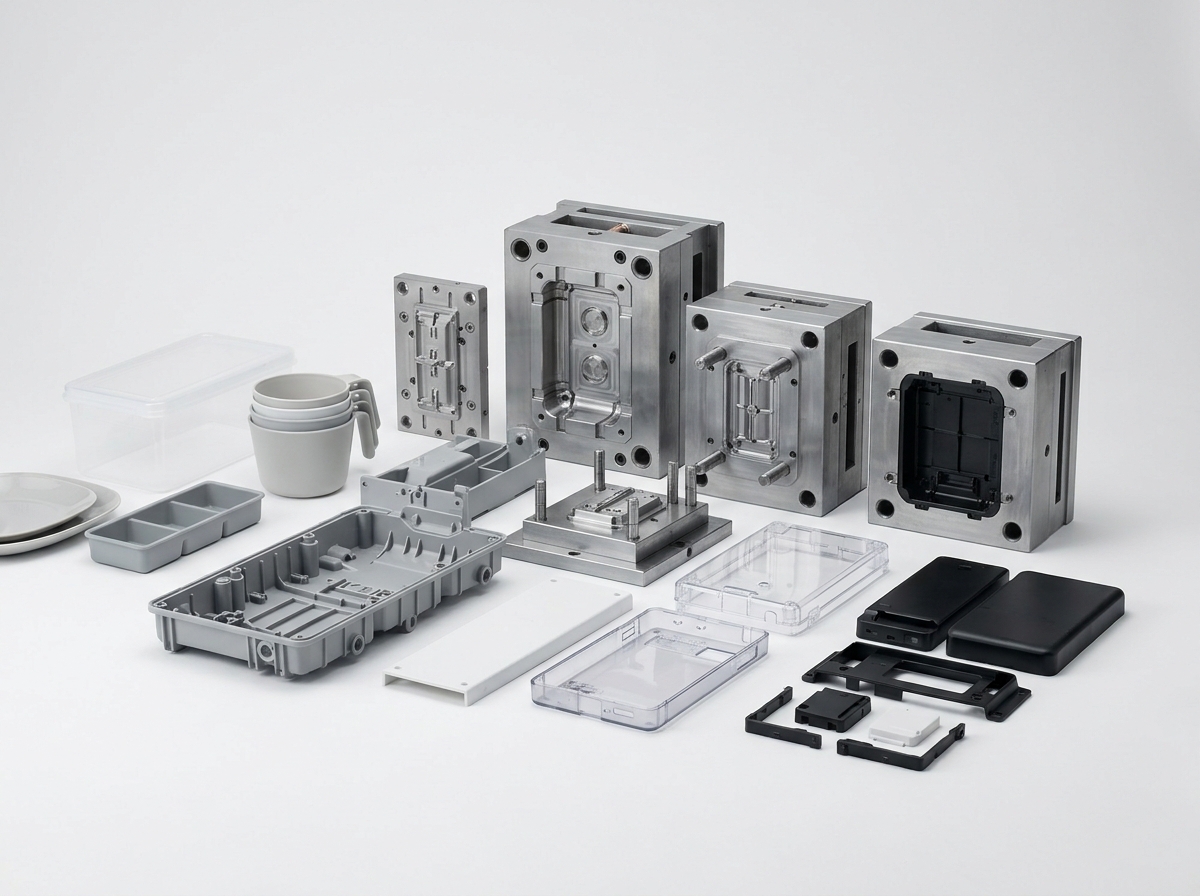
Mold design is the decisive factor in whether a part can be made consistently at scale. In plastic product manufacturing, the mold is not only a forming tool; it is a precision system that controls filling, cooling, ejection, and final part stability. If the gate location is wrong, the part may warp. If cooling is uneven, cycle time rises and shrinkage becomes inconsistent. If venting is inadequate, burn marks or short shots can appear.
For housings and structural components, mold design must balance appearance and strength. Consumer electronics and appliance parts often need clean parting lines, uniform wall thickness, and stable snap-fit geometry. A plastic housing mold is usually expected to support both cosmetic quality and assembly accuracy, which means draft angles, ribs, bosses, and ejector placement all need to be planned together.
Complex geometry adds another layer. A 3D mold solution is often used when the product has curvature, undercuts, or a distinctive visual profile. In these cases, the mold must preserve the design intent while still allowing demolding and stable production. That is one reason DFM review before tooling is so valuable: it can reveal whether a product is truly moldable as drawn.
According to ASTM D638, tensile properties of plastics are commonly evaluated through standardized test methods, but even a strong material can fail in production if the mold design creates stress concentration or uneven packing. In other words, the material spec alone does not guarantee a good part; the mold and process matter just as much.
| Design factor | Typical engineering target | Why it matters |
|---|---|---|
| Wall thickness variation | Kept as uniform as possible | Reduces sink and warp risk |
| Draft angle | Enough to release cleanly | Protects surface and cycle stability |
| Cooling balance | Symmetrical where possible | Improves dimensional repeatability |
| Gate placement | Optimized for flow and appearance | Affects weld lines and fill balance |
When buyers evaluate mold suppliers, they should ask not only whether the tool can be built, but whether the tool can support stable mass production. That is the point where engineering support becomes more important than basic machining capacity.
Where one-stop manufacturing creates the most value across product categories
One-stop plastic product manufacturing creates the greatest value in industries where quality, lead time, and repeat order stability all matter at the same time. Electronics, home appliances, toys, footwear, and industrial components each have different requirements, but they share one common need: the product must be reproducible without continuous firefighting.
For consumer electronics, structural accuracy and snap-fit reliability are critical. A small mismatch in boss position or connector opening can affect assembly yield. For appliance parts, dimensional consistency and appearance uniformity are often the main concerns because customers notice visible defects immediately. For toy and leisure products, surface quality and batch stability support brand consistency and packaging efficiency.
Industrial components place more emphasis on long-term supply and reliability. These parts may not need the most decorative finish, but they must hold up under repeated use, environmental exposure, or assembly stress. In this context, a supplier that offers plastic spare parts and mold maintenance support can reduce downtime risk across the full product lifecycle.
For footwear-related components, weight reduction and wear resistance are often more important than visual complexity. A plastic shoe parts program may focus on comfort, durability, and repeatable mass output rather than ultra-tight cosmetic tolerances. That is another example of why one-stop manufacturing is useful: the supplier can adapt process priorities to the end-use case instead of forcing every part through the same factory logic.
| Industry | Primary requirement | Manufacturing risk | One-stop benefit |
|---|---|---|---|
| Consumer electronics | Fit, snap strength, appearance | Assembly mismatch | Faster design-feedback loop |
| Home appliances | Consistency, surface finish | Visible defects | Unified quality control |
| Toys and leisure | Stable batches, cost control | Color and geometry drift | Better SKU switching |
| Industrial parts | Reliability, supply continuity | Unplanned stoppage | Faster spare-part response |
Buyers searching for OEM plastic products usually care less about factory size and more about whether the supplier can align all these category-specific requirements into one production system.
What technical standards and test data matter in plastic product manufacturing
Technical standards matter because they turn subjective quality claims into measurable acceptance criteria. In plastic product manufacturing, the most useful standards are the ones that support design, material selection, and verification. That is especially true when a buyer needs a supplier to justify a tolerance choice, test a resin, or confirm that a component can survive real-world loading.
For dimension planning, ISO 286-1 provides a framework for limits and fits. For plastics testing, ASTM D638 defines tensile property measurement, while ASTM D790 covers flexural properties. These standards do not make a part good by themselves, but they provide a language for comparing materials and validating performance.
Material selection also affects manufacturing success. PC is a common choice for transparent or impact-sensitive housings because it offers good clarity, toughness, and dimensional stability relative to many general-purpose plastics. For electrical and protective covers, that balance often makes PC suitable when a product needs both strength and visual quality. However, the design must still account for shrinkage, flow length, and stress at corners.
In practice, a useful qualification flow often includes dimensional inspection, appearance review, assembly fit testing, and mechanical testing. Buyers should ask for clear reports instead of general promises. The more the supplier documents trials, the easier it is to support later production changes, especially for export programs.
- Confirm the target tolerance before tooling starts.
- Match resin choice to heat, impact, and appearance needs.
- Request trial data with dimensions, photos, and defect notes.
- Check whether the supplier can support ongoing mold maintenance.
- Make sure test methods are named, not just described vaguely.
When these steps are built into one-stop plastic product manufacturing, the project becomes easier to audit and easier to scale.
How one-stop suppliers reduce launch risk and total project cost
One-stop suppliers reduce launch risk because they compress decision loops. Every product launch has uncertainty: tool correction, cosmetic tuning, packaging alignment, and volume ramp-up. If different vendors control each step, even a minor issue can become a cross-company dispute. With one accountable partner, the problem is easier to isolate and fix.
The cost advantage is often misunderstood. One-stop manufacturing is not always cheaper on the first quotation line, but it can lower total project cost by preventing rework, shipping delays, and duplicate engineering time. This is especially important in OEM plastic products where a small tooling adjustment can save repeated assembly issues later.
Lead time is another major factor. In many programs, the fastest route to market is not the cheapest part price, but the shortest path to stable samples. A supplier that can handle a custom plastic parts request from evaluation through mass production can often compress the schedule by removing waiting time between vendors.
Cross-border buyers also benefit from better communication discipline. English document control, prompt drawing feedback, and shipment coordination are not glamorous capabilities, but they matter greatly when projects span multiple time zones. In export-oriented procurement, that operational reliability can be as valuable as the machine list.
| Cost driver | Separate vendors | One-stop model | Effect on project |
|---|---|---|---|
| Engineering revisions | Repeated across vendors | Centralized | Lower rework risk |
| Sampling coordination | Multiple handoffs | Single feedback loop | Shorter approval time |
| Logistics | Split responsibility | Unified shipment plan | Less delay exposure |
| Quality accountability | Difficult to assign | Clear ownership | Faster problem resolution |
For most buyers, this is the hidden value of plastic product manufacturing: not just making parts, but reducing the friction that slows a product from drawing to shelf.
How to choose the right one-stop plastic product manufacturing partner
The right supplier should be judged by process depth, not by promotional language. A good one-stop partner can explain design tradeoffs, recommend resin options, manage tooling, provide trial feedback, and support volume production without forcing the buyer to coordinate every step manually.
Start by asking whether the supplier can review your drawing or sample before quoting the mold. Early evaluation shows whether they understand manufacturability, not just pricing. Next, ask how they manage trial reports, dimensional checks, and corrective actions. Finally, confirm whether they can support future spare parts, mold maintenance, and repeat orders, because long-term service is part of true one-stop manufacturing.
A practical evaluation checklist is below.
- Does the supplier offer DFM feedback before tooling?
- Can they explain material tradeoffs for your application?
- Do they provide trial samples with measurable inspection data?
- Can they support post-launch mold maintenance and spare parts?
- Do they communicate clearly in export-style project workflows?
If the answer is yes to most of these questions, the supplier is likely to be more than a basic mold shop. That is the kind of partner most buyers need for OEM plastic products with repeat demand or tight launch windows.
For buyers reviewing internal product lines, pages such as plastic injection molds, 3D molds, and about the company can help compare capabilities, but the real decision should still be based on engineering response quality and production control.
Common mistakes buyers make in one-stop plastic product manufacturing
Most procurement problems come from assuming the lowest quote is the lowest total cost. In plastic product manufacturing, that is often false because tooling modifications, shipping rework, and late-stage quality fixes can exceed the original savings.
Another mistake is treating appearance, structure, and process as separate topics. They are connected. A glossy surface may hide sink problems in early review but fail under production pressure. A strong rib can still cause warp if the cooling layout is weak. Buyers should think in systems, not isolated specifications.
A third mistake is not defining acceptance criteria early. If tolerance, color, gloss, assembly fit, and packaging expectations are not written down, the project may appear successful at sample stage and still fail in volume. That is why one-stop suppliers are useful: they can help translate business goals into technical checkpoints before the first shot is made.
According to the NIST manufacturing focus on measurement and process control, consistent measurement and repeatable data collection are central to stable production. In practical terms, that means buyers should value inspection discipline as much as machining capability.
- Do not approve tooling before DFM review.
- Do not rely on visual sample approval alone.
- Do not skip material validation for load-bearing parts.
- Do not separate packaging planning from production planning.
- Do not ignore spare-part and maintenance needs after launch.
FAQ
What are the main advantages of one-stop plastic product manufacturing services?
The main advantages are fewer handoffs, faster feedback, clearer responsibility, and better control over quality and schedule. It also helps buyers manage OEM plastic products from design to shipment in one workflow.
Is one-stop manufacturing better for custom plastic parts?
Yes, especially when the part needs tooling, sample correction, and volume production. Custom projects benefit because design-for-manufacture feedback can happen earlier and more consistently.
Why does mold design matter so much in plastic product manufacturing?
Mold design controls filling, cooling, ejection, and part stability. A well-designed mold improves appearance, dimensional consistency, and cycle efficiency.
What standards should buyers ask about when sourcing plastic parts?
Buyers should ask about dimensional tolerance planning and material test methods such as ISO 286-1, ASTM D638, and ASTM D790.
Which industries benefit most from one-stop plastic product manufacturing?
Electronics, home appliances, toys, footwear, and industrial components benefit most because they need repeatability, communication speed, and stable production support.
How can buyers reduce risk when choosing an OEM plastic products supplier?
Ask for DFM feedback, trial reports, inspection data, mold maintenance support, and clear communication processes before placing the order.
Does one-stop service always cost less?
Not always on the first quote, but it often lowers total project cost by reducing rework, delays, and miscommunication.
Post time: Jul-31-2026