
- Lowering cost starts with design simplification, not with price negotiation alone.
- Injection molding is the best value when the same custom plastic part must be made repeatedly and consistently.
- Material selection, tooling structure, and tolerances have a direct impact on unit price and lead time.
- Affordable plastic manufacturing should be measured by total landed cost, including tooling, rework, scrap, and logistics.
Affordable custom plastic parts manufacturing depends on matching the right process, resin, and tooling strategy to the product’s real use case, not just the nominal piece price. For many OEM plastic products, a well-controlled injection molded part can hold tight dimensional targets, and process capability is often benchmarked against standards such as ISO 20457:2018 for plastics molding and ASTM D638 for tensile testing of plastics. That matters because a cheaper quote that causes warpage, poor assembly fit, or high scrap is not affordable at all. The best decisions combine engineering review, realistic volumes, and supplier coordination across design, tooling, molding, and finishing.
What Makes Custom Plastic Parts Manufacturing Affordable?
The lowest-risk affordable solution is the one that minimizes total project cost over the full product life cycle.
Buyers often focus on tooling price first, but that is only one line item. A mold with simpler geometry, fewer sliders, and standard components can reduce upfront cost and also improve maintenance availability later. For example, if a part can be designed with a uniform wall thickness and adequate draft, the mold is easier to machine, the molding window is wider, and cycle stability is usually better. In many production environments, cycle time is one of the biggest cost drivers because every second saved affects annual output. Even a 2-second reduction in a 25-second cycle can increase output by about 8 percent, assuming the line runs continuously.
That is why many sourcing teams evaluate OEM plastic products through a total-cost lens rather than a unit-price lens. A part that is easier to mold often costs less to inspect, package, assemble, and ship.
Custom Plastic Parts: The Cost Drivers Buyers Should Control
Custom plastic parts become expensive when design choices force unnecessary complexity into the mold or the process.
| Cost Driver | Typical Impact | How to Reduce It |
|---|---|---|
| Tooling complexity | More slides and lifters increase machining and maintenance cost | Simplify undercuts and redesign snap fits |
| Dimensional tolerance | Tighter tolerance often requires more stable tooling and process control | Apply precision only where assembly needs it |
| Wall thickness variation | Raises sink, warp, and fill risk | Keep walls uniform and add ribs strategically |
| Material choice | Engineering resins cost more than commodity grades | Match resin properties to actual load and environment |
| Surface finish | High-gloss or textured surfaces can add polishing and validation time | Use finish levels only where user-facing appearance matters |
One practical benchmark is tolerance selection. ISO 20457 provides a framework for general tolerances in plastic molded parts, while critical assemblies may require tighter inspection plans. If a non-critical cosmetic cover does not need a very tight fit, over-specifying the tolerance can raise mold cost without improving performance. In many projects, keeping tolerance targets realistic is the simplest way to protect affordability.
Another major driver is material density and weight. A heavier part costs more to ship and may require a larger press, while a lighter part can often be packed more efficiently and molded faster. This is one reason engineers reviewing custom plastic parts for consumer products often redesign internal ribs before they ask for a more expensive resin.
Which Plastic Manufacturing Process Is the Most Cost-Effective?
Injection molding is usually the most affordable process for medium to high-volume custom plastic parts.
For low volume, prototype methods may be cheaper because they avoid the full tooling investment. For repeated production, however, injection molding spreads tooling cost across many parts, and the per-unit cost drops as output rises. That is why the same part can look expensive in a prototype quote and economical in a mass-production quote. Buyers should compare the break-even point, not just the first invoice.
| Process | Best Volume Range | Typical Strength | Cost Profile |
|---|---|---|---|
| 3D printed prototype | 1 to 100 pcs | Fast validation | Low tooling cost, high unit cost |
| Prototype injection tooling | 100 to 5,000 pcs | Market testing | Moderate tooling cost, lower unit cost |
| Production injection molding | 5,000+ pcs | Best repeatability | Higher tooling cost, lowest unit cost at scale |
| Thermoforming | Mid-volume panels and covers | Large parts, shallow geometry | Lower tooling cost, geometry limits |
If the product is a protective shell, appliance housing, or consumer electronic cover, a molded solution often wins because it supports repeatability and assembly consistency. When the design is still changing, a shorter tooling path or bridge tooling can reduce the financial risk of early mistakes.
For buyers comparing plastic molding suppliers, the key is not whether a supplier says they can mold a part, but whether they can recommend the most economical process for the forecast volume.
How Material Choice Changes the Price of OEM Plastic Products
Material selection is often the fastest lever for reducing cost without changing the product’s function.
Commodity polymers such as PP and PE are typically less expensive than engineering grades, while PC, ABS, PA, and filled compounds offer higher performance at a higher cost. The right choice depends on impact resistance, dimensional stability, heat resistance, transparency, and surface appearance. The knowledge base notes that PC is commonly used for transparent, impact-resistant, and dimensionally stable housings, which makes it a strong choice for electronics and protective applications. That said, if transparency is unnecessary, a lower-cost resin may solve the same problem.
| Resin | Typical Use Case | Key Advantage | Cost Effect |
|---|---|---|---|
| PP | Household items, caps, simple enclosures | Low density and good chemical resistance | Usually among the lowest-cost options |
| ABS | Consumer covers, appliance parts | Good balance of strength and finish | Moderate |
| PC | Transparent housings, protective parts | High impact resistance and stability | Higher than commodity grades |
| PA with glass fiber | Structural or load-bearing parts | Higher stiffness and heat resistance | Higher, with added processing complexity |
Industry testing also matters here. ASTM D790 defines flexural properties testing, which is useful when a part must resist bending under load. A resin that passes strength requirements in the lab but deforms during long-term service can create warranty cost that wipes out any savings from a lower purchase price.
Affordable Tooling Strategies for Custom Plastic Parts
Tooling design is where affordable custom plastic parts manufacturing is won or lost.
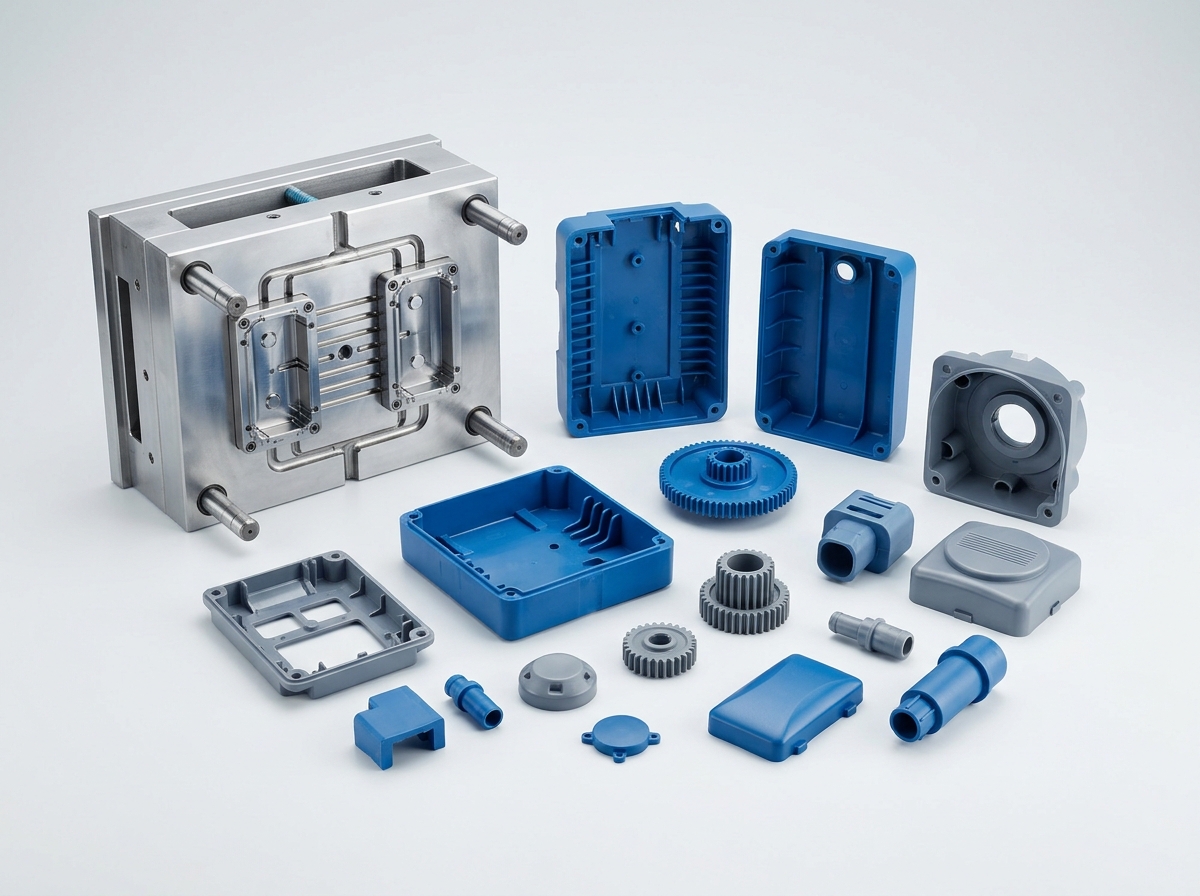
A well-planned mold structure can reduce both upfront cost and downstream maintenance. Standard mold bases, common hot runner configurations, and interchangeable inserts often lower cost while keeping the tool serviceable. One common mistake is treating every surface and feature as unique. That usually makes the mold expensive to machine and difficult to repair. Another cost trap is overusing polishing or cosmetic texturing where the part is hidden inside an assembly.
- Use standard components wherever the design allows it.
- Separate cosmetic surfaces from structural surfaces.
- Minimize the number of sliders, lifters, and actions.
- Design for uniform cooling to reduce warpage and cycle variation.
- Review the first DFM report before cutting steel.
For a buyer evaluating mill-turn parts and tooling components, this is where one-stop sourcing can reduce cost. Fewer handoffs usually mean fewer errors, fewer delays, and a faster path from drawing to production.
In precision mold work, process discipline matters as much as machine capability. The U.S. National Institute of Standards and Technology publishes measurement and calibration resources that support traceability and dimensional control; see NIST Physical Measurement Laboratory. For molded parts, traceable measurement is what keeps a supposedly low-cost part from becoming an expensive rework loop.
Where Custom Plastic Parts Save Money in Real Projects
The most affordable solution is often the one that prevents hidden losses in assembly, logistics, and field failure.
Consider a consumer electronics housing. If the housing is designed with poor snap-fit geometry, assembly may require screws, extra labor, or manual correction. That cost can exceed the mold savings from a simpler concept. If the part is redesigned with proper draft, rib layout, and boss reinforcement, the part may be easier to assemble and less likely to crack during drops. The same logic applies to appliance shells, industrial covers, and lightweight shoe components.
In many real projects, affordability comes from reducing three forms of waste: trial-and-error revisions, excess scrap, and slow changeovers. For products with multiple SKU variants, a family mold or modular insert strategy can reduce tooling duplication. For industrial customers, consistent supply and spare-part availability often matter more than the lowest initial quote because downtime is more expensive than resin.
For buyers exploring supplier capability and project support, the best question is simple: can the team help reduce total cost through design feedback, not just quote the drawing as-is?
How to Compare Affordable Solutions for Custom Plastic Parts Manufacturing
A disciplined comparison matrix is the easiest way to avoid paying for features you do not need.
| Decision Factor | Low-Cost Option | Better When… | Watch Out For |
|---|---|---|---|
| Volume | Prototype tooling | Demand is uncertain | Higher unit cost at scale |
| Material | Commodity resin | No extreme heat or load exists | May not suit impact or appearance needs |
| Tolerance | Standard tolerance bands | Assembly is not ultra-critical | Over-tight specs inflate tooling cost |
| Surface finish | Basic finish | Part is hidden or secondary | Cosmetic defects may be unacceptable on visible parts |
| Supplier model | One-stop mold and molding source | Project needs speed and coordination | Requires clear communication and quality control |
Affordable sourcing also depends on supplier responsiveness. For export-oriented projects, English documentation, fast feedback on drawings, and stable lead time management reduce the risk of delay. Those soft factors do not show up in the unit quote, but they strongly affect the real cost of a program.
When a buyer needs many moving pieces to work together, a supplier that can support custom plastic parts manufacturing from evaluation through sampling may actually be cheaper than a vendor that only sells tool steel and disappears after the first revision.
What Quality Checks Protect Low-Cost OEM Plastic Products?
Quality control protects affordability because defects are usually more expensive than prevention.
A low-cost part is only valuable if it stays within specification during repeated production. Common checks include first article inspection, dimensional sampling, appearance review, and functional fit testing. For structural validation, ASTM tensile and flexural methods such as ASTM D638 and ASTM D790 provide standardized ways to compare material behavior. If a part must survive loading, a resin that looks fine but fails mechanical testing is not a bargain.
In molded housing work, the most useful checks are often practical rather than abstract:
- Measure critical dimensions against the assembly drawing.
- Check gate vestige, sink marks, flash, and weld lines.
- Confirm snap-fit retention and screw boss strength.
- Run a small pilot batch before full production.
The goal is not perfection. The goal is stable, predictable output at the lowest acceptable cost.
When Is a Custom Plastic Part Actually Affordable?
A custom plastic part is affordable when its design, tooling, and process all align with the expected production volume.
For a startup, that may mean a simple prototype tool and limited launch quantity. For an appliance brand, it may mean a stable production mold with optimized cycle time and consistent appearance. For an industrial buyer, it may mean a durable tool with spare inserts and a controlled supply plan. The correct answer changes with use case, but the principle does not: affordability is the result of engineering decisions, not just supplier quotes.
That is why smart buyers review drawings early, compare process options, and ask suppliers to explain where cost is being created. If the part is visible, loaded, or safety-related, the cheapest option is rarely the most affordable over time.
FAQ
What is the cheapest way to make custom plastic parts?
The cheapest way is usually to simplify the geometry, choose a commodity resin when possible, and use the least complex process that still meets the volume target. For many repeat parts, injection molding becomes the lowest-cost option after the tooling is amortized.
Are injection molded parts always more affordable than 3D printed parts?
No. Injection molding is usually cheaper at scale, but 3D printing or prototype tooling can be more affordable for very low volumes, early-stage validation, or designs that are still changing.
How can I reduce tooling cost without hurting quality?
Reduce sliders, undercuts, and cosmetic complexity, and apply tighter tolerances only where assembly requires them. Standard components and consistent wall thickness are also important cost savers.
Why does material choice affect the price so much?
Resin cost, processing behavior, and performance requirements all affect the final quote. Commodity materials are generally cheaper, while engineering grades such as PC or glass-filled nylon cost more because they offer more demanding performance.
What documents should I prepare before requesting a quote?
Provide 2D drawings, 3D files, material requirements, expected annual volume, surface finish expectations, and key tolerance points. The more complete the data, the more accurate the cost estimate.
How do I know if a supplier is truly cost-effective?
Look beyond the unit price. A cost-effective supplier reduces revisions, keeps quality stable, communicates quickly, and supports production planning. That combination usually lowers total project cost.
What standards matter for custom plastic parts quality?
Common references include ISO 20457 for molding tolerance guidance and ASTM D638 or ASTM D790 for mechanical property testing. Standards help you compare samples and avoid vague quality claims.
Post time: Jul-13-2026