
- Single-cavity molds reduce risk during product launch, engineering changes, and tolerance tuning.
- Multi-cavity molds improve output and lower piece cost when part design and demand are already stable.
- Cavity count affects not only cycle time and tooling price, but also cooling balance, scrap risk, and maintenance complexity.
- The best mold choice depends on part geometry, resin behavior, quality targets, and production forecast.
Choosing a single-cavity mold or a multi-cavity mold is a production strategy decision, not just a tooling decision. For injection mold projects, the key tradeoff is between flexibility and throughput: a single-cavity mold gives you simpler validation, while a multi-cavity mold can dramatically improve economics once demand is proven. For example, ISO 20457:2018 defines general tolerances for molded parts, and precision-critical applications often tighten those tolerances further after process capability studies. If your project involves appliance housings, consumer electronics enclosures, or PC material parts that need stable dimensions and clean appearance, the cavity strategy will shape everything from sampling speed to long-term cost. You can also compare different build approaches on the plastic injection mold page, the plastic shell mold page, and the 3D mold page, especially if your part has complex surfaces or visible cosmetic requirements.
Single-Cavity Mold vs Multi-Cavity Mold: The Core Difference
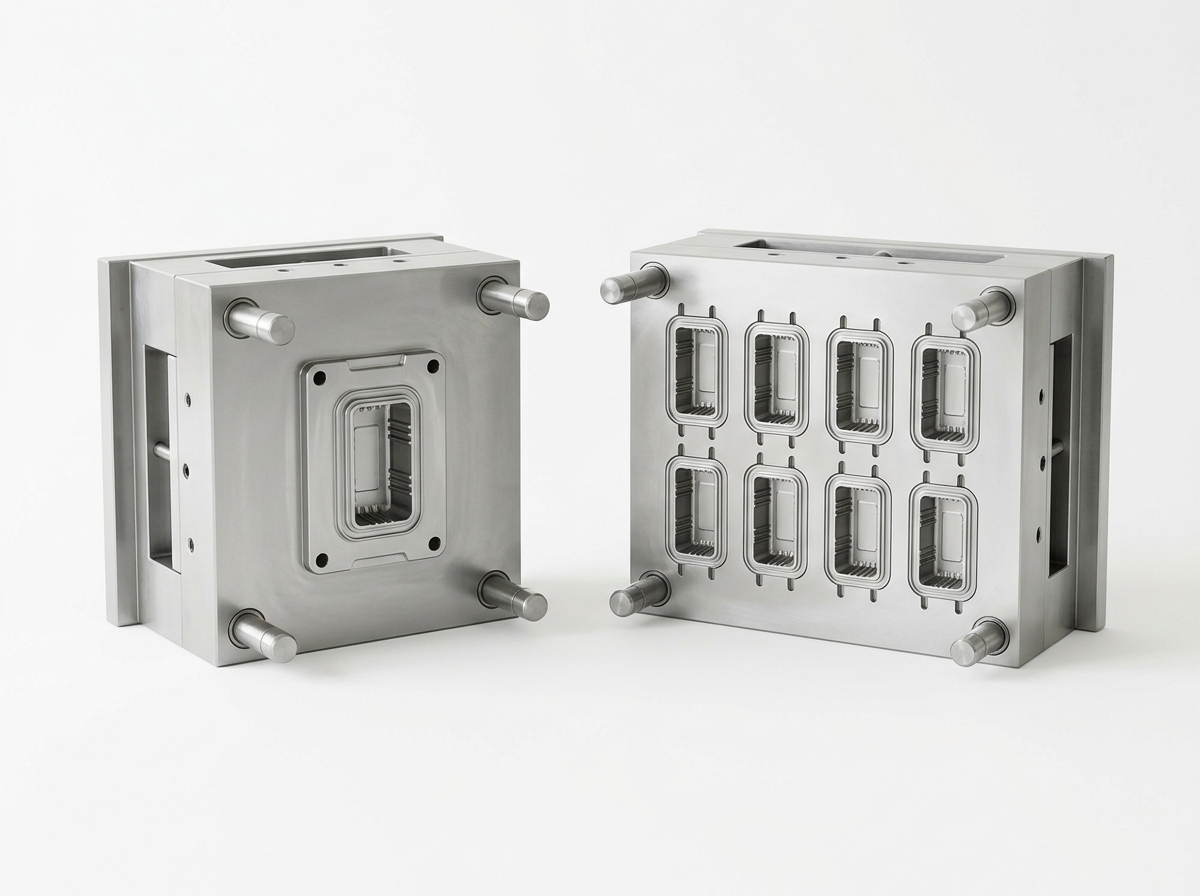
The core difference is output per cycle. A single-cavity mold produces one part per shot, while a multi-cavity mold produces two, four, eight, or more parts per shot from the same injection cycle.
That sounds simple, but the operational impact is large. A single-cavity mold is easier to fill, cool, inspect, and correct. A multi-cavity mold multiplies productivity, but it also multiplies the importance of gate balance, runner design, venting, cooling symmetry, and process window control.
| Comparison Item | Single-Cavity Mold | Multi-Cavity Mold |
|---|---|---|
| Parts per cycle | 1 | 2 to 64+ |
| Tooling complexity | Lower | Higher |
| Sampling and debugging | Faster | More demanding |
| Unit cost at scale | Higher | Lower |
| Flexibility for design changes | Better | Weaker |
| Best for | Large, complex, or early-stage parts | Stable, repeatable, high-volume parts |
In injection mold sourcing, this table is the starting point, not the full answer. The real decision depends on volume, resin, tolerance, and risk tolerance.
When a Single-Cavity Mold Is the Smarter Choice
A single-cavity mold is usually the better choice when your project is still moving through design verification or when the part has demanding geometry.
This is especially true for high-visibility products such as appliance fronts, consumer device housings, or industrial covers. If the product has undercuts, long flow lengths, thick-to-thin transitions, or very strict cosmetic requirements, one cavity makes it easier to control filling and shrinkage.
For many PC material enclosures, single-cavity tooling is preferred in early stages because polycarbonate is sensitive to processing conditions and can show stress marks, flow lines, or warpage if the mold is not tuned carefully. The process becomes easier to stabilize when there is only one cavity to balance.
A single-cavity mold is also easier to integrate with pilot production. If you need to validate assembly fit, snap-fit strength, boss performance, or surface finish before committing to mass production, the lower complexity helps your engineering team respond faster.
- Use a single-cavity mold when the design is still changing.
- Use it when the part is large or technically difficult to fill evenly.
- Use it when cosmetic quality matters more than output.
- Use it when you need fast troubleshooting during first article approval.
For buyers comparing options across categories, the household mold page and the toy mold page show how one-cavity strategies often fit lower-risk launches, custom shapes, and appearance-driven products.
When a Multi-Cavity Mold Creates Better Economics
A multi-cavity mold is the right answer when demand is predictable and part design has already been proven.
The business reason is straightforward: if one cycle time is fixed, producing more parts per shot spreads machine time, labor, and tooling amortization across more units. That lowers cost per part. In high-volume programs, the savings can outweigh the higher mold cost quickly.
For example, if a part has a 20-second cycle time, a single-cavity tool produces 180 parts per hour at theoretical maximum. A four-cavity mold can raise that to 720 parts per hour under the same cycle time, assuming the press size, resin flow, and cooling system support it. In real factories, actual output is lower because of handling, inspection, and downtime, but the throughput advantage remains significant.
Multi-cavity molds are common in consumer goods, caps, connectors, medical consumables, and other stable, repetitive products. They are especially useful when buyers want to reduce piece price and secure long-term supply stability.
| Scenario | Single-Cavity Result | Multi-Cavity Result |
|---|---|---|
| Low annual demand | Lower tooling risk | Too much capital tied up |
| Stable high demand | Higher unit cost | Better cost amortization |
| Frequent design revisions | Easy to modify | Higher change risk |
| Strict delivery schedule | Limited output | Higher hourly output |
If your procurement team is building a sourcing roadmap, review the industrial mold page and the one-stop service page to see how tooling strategy connects with supply chain speed and production continuity.
What ISO Standards and Mold Tolerances Mean in Practice
Standards matter because cavity count only creates value if the parts remain within specification.
For molded parts, dimensional control is often discussed using ISO standards such as ISO 20457:2018, which provides general tolerances for molded parts made from thermoplastics. In practical sourcing, this helps teams align on what level of variation is acceptable before pilot tooling starts.
For mold build and verification, many plants also reference metrology and process documentation practices aligned with NIST measurement standards. That matters because a multi-cavity tool can only be judged fairly if cavity-to-cavity variation is measured consistently.
In structural applications, buyers should also consider resin datasheets and standardized test methods. For example, ASTM D638 is commonly used for tensile properties of plastics, while ASTM D790 is widely used for flexural properties. These tests help determine whether a design can survive clipping, stacking, transport, or repeated handling.
| Standard or Test | What It Helps Define | Why It Matters for Mold Choice |
|---|---|---|
| ISO 20457:2018 | General tolerances for molded parts | Clarifies acceptable part variation |
| ASTM D638 | Tensile properties | Useful for snap-fit and load-bearing parts |
| ASTM D790 | Flexural properties | Useful for brackets and structural covers |
| NIST measurement standards | Metrology consistency | Supports cavity comparison and process control |
In other words, a multi-cavity mold is only a good decision if every cavity can repeatedly produce parts that fit the same assembly standard. If not, the theoretical output advantage disappears in rework and scrap.
How Cavity Count Affects Cycle Time, Scrap, and Process Stability
Cavity count changes the economics of the press, but it also changes process sensitivity.
In a single-cavity mold, fill balance is simpler because melt flow only needs to reach one cavity. In a multi-cavity mold, especially one with uneven flow paths, cavity pressure can differ from one pocket to another. That can lead to short shots, weld-line variation, differential shrinkage, or part-to-part cosmetic inconsistency.
The most important engineering point is that cooling often limits cycle time more than injection itself. If the part is thick, the cycle cannot be shortened just by adding cavities. Instead, the mold must be designed with balanced cooling channels and adequate venting.
Research and industry practice consistently show that process stability depends on controlled melt temperature, mold temperature, and packing pressure. For PC parts, for example, resin handling is critical because material quality and drying discipline directly affect appearance and dimensional stability.
- Check whether the cycle is fill-limited or cooling-limited.
- Measure cavity-to-cavity weight variation, not just visual appearance.
- Watch for warpage after ejection, not only immediately at release.
- Confirm that the press can supply enough clamp force for all cavities.
A common sourcing mistake is assuming that more cavities automatically mean lower cost. If cavity imbalance raises scrap, the piece price advantage can disappear quickly, especially for precision housings and cosmetic covers.
Cost Model: Tooling Price vs Piece Price
The best mold choice is often revealed by total cost over the product life, not by the mold quote alone.
A single-cavity mold usually costs less to build, but each part carries more machine time and labor burden. A multi-cavity mold costs more up front, but it can lower cost per piece if annual volume is high enough.
To evaluate this correctly, buyers should compare four variables: tooling investment, cycle time, annual demand, and defect rate. This is especially important for OEM and ODM programs where long-term replenishment is expected.
| Cost Factor | Single-Cavity Mold | Multi-Cavity Mold |
|---|---|---|
| Upfront tooling investment | Lower | Higher |
| Machine time per part | Higher | Lower |
| Scrap exposure per shot | Lower | Higher |
| Tool maintenance complexity | Lower | Higher |
For a product with unstable demand, a smaller upfront investment usually makes more sense. For a product with repeat orders and a clear sales forecast, the economics often favor more cavities.
If you are comparing suppliers, the custom plastic parts page is useful for understanding how tooling strategy connects with finished part delivery, while the about page can help you evaluate process capability, communication style, and export experience.
 Industry-Driven Selection for Electronics, Appliances, and Industrial Parts
Different industries benefit from different cavity strategies.
Consumer electronics often need tighter cosmetic control, more attention to snap-fit features, and stronger attention to assembly variation. That makes single-cavity or low-cavity tooling attractive in the early phase, especially for new product introductions.
Home appliances often combine decorative surfaces with structural ribs and thicker walls. When the design is stable and demand is large, multi-cavity tooling can reduce unit cost significantly without sacrificing fit, provided the cooling design is robust.
Industrial parts are different again. They usually prioritize long-term supply continuity, mechanical reliability, and consistency across batches. If a component is safety-relevant or field-service-sensitive, buyers may prefer a more conservative cavity count to protect quality.
For toy and leisure goods, appearance and SKU flexibility often matter more than the absolute lowest piece price. For shoe-related plastic parts, light weight and wear resistance may influence whether a smaller cavity count is needed to control surface quality.
- Electronics: prioritize cosmetics, snap fits, and tolerance consistency.
- Appliances: prioritize stable scaling, durability, and assembly repeatability.
- Industrial components: prioritize reliability, documentation, and long supply life.
These category differences are why a good injection mold supplier does not start with cavity count alone. It starts with the product’s function, expected annual usage, and acceptable quality risk.
How to Decide: A Practical Mold Selection Checklist
The right cavity count becomes obvious when you ask the right questions.
Use the checklist below to decide whether a single-cavity mold or a multi-cavity mold fits your project.
| Decision Question | If Yes, Lean Toward | Reason |
|---|---|---|
| Is the design still changing? | Single-cavity mold | Easier debugging and modification |
| Is annual demand high and stable? | Multi-cavity mold | Better cost amortization |
| Is the part large or difficult to fill? | Single-cavity mold | Lower flow and balance risk |
| Is the part simple and repeatable? | Multi-cavity mold | Higher throughput potential |
| Are cosmetic defects unacceptable? | Single-cavity mold or low-cavity mold | Better process control |
- Estimate annual volume realistically, not optimistically.
- Define the tolerance target before asking for a quote.
- Clarify whether the project is pilot production or mass production.
- Confirm resin behavior, especially for PC and other engineering plastics.
- Ask how cavity balance and cooling uniformity will be verified.
This checklist is especially useful when you are comparing multiple injection mold quotations that look similar on paper but differ greatly in risk profile.
Common Mistakes Buyers Make When Choosing Cavity Count
The most expensive mistake is choosing cavity count before defining business volume.
Many buyers ask for the lowest tooling price and only later discover that their unit cost is too high for the target market. Others choose a large multi-cavity mold too early, only to struggle with design changes, cavity mismatch, or weak demand.
Another common mistake is ignoring press compatibility. A multi-cavity mold may require a larger machine, higher clamp force, or tighter process control than the factory originally planned. If the molding machine cannot support the tool, the theoretical design advantage becomes unusable.
A third mistake is underestimating maintenance. More cavities mean more wear points, more cleaning time, and more opportunities for imbalance. That does not make multi-cavity tooling bad; it simply means it requires better preventive maintenance and stronger documentation.
- Do not choose cavity count from tooling price alone.
- Do not ignore machine tonnage and shot size limits.
- Do not overlook cooling symmetry and venting.
- Do not assume cosmetic parts can tolerate the same process window as functional parts.
When a sourcing team avoids these mistakes, the tooling decision becomes much easier to defend internally and much easier to execute on the shop floor.
FAQ: Single-Cavity Mold vs Multi-Cavity Mold
1. Which is cheaper, a single-cavity mold or a multi-cavity mold?
A single-cavity mold is usually cheaper to build, but a multi-cavity mold can be cheaper per part when production volume is high enough to justify the tooling investment.
2. Which mold type is better for new product development?
A single-cavity mold is usually better for new product development because it is easier to debug, adjust, and validate before mass production.
3. When does a multi-cavity mold make sense?
A multi-cavity mold makes sense when part design is stable, demand is predictable, and the production goal is lower unit cost through higher output.
4. Does a multi-cavity mold increase scrap risk?
It can, because cavity imbalance or cooling variation may create part-to-part differences. Good design and process control are essential.
5. Is a single-cavity mold better for large parts?
Yes, large parts often favor a single-cavity mold because filling, packing, and cooling are easier to control.
6. Can multi-cavity molds be used for precision parts?
Yes, but only if cavity balance, cooling design, and process capability are tightly controlled and verified against the required tolerance standard.
7. What should I ask a mold supplier before choosing?
Ask about annual volume assumptions, target tolerance, resin compatibility, cycle time estimate, press requirements, and how cavity consistency will be measured.
For procurement teams that want a broader sourcing picture, start with the application pages for electronics molds, home appliance molds, and parts molds to match cavity strategy with real end-use requirements.
Post time: Sep-03-2026