
For procurement teams and engineers, the right manufacturing process depends on material, tolerance, volume, and end-use environment. This comparison focuses on practical selection criteria, not theory alone.
Plastic Injection Molding vs. Die Casting: The Core Decision
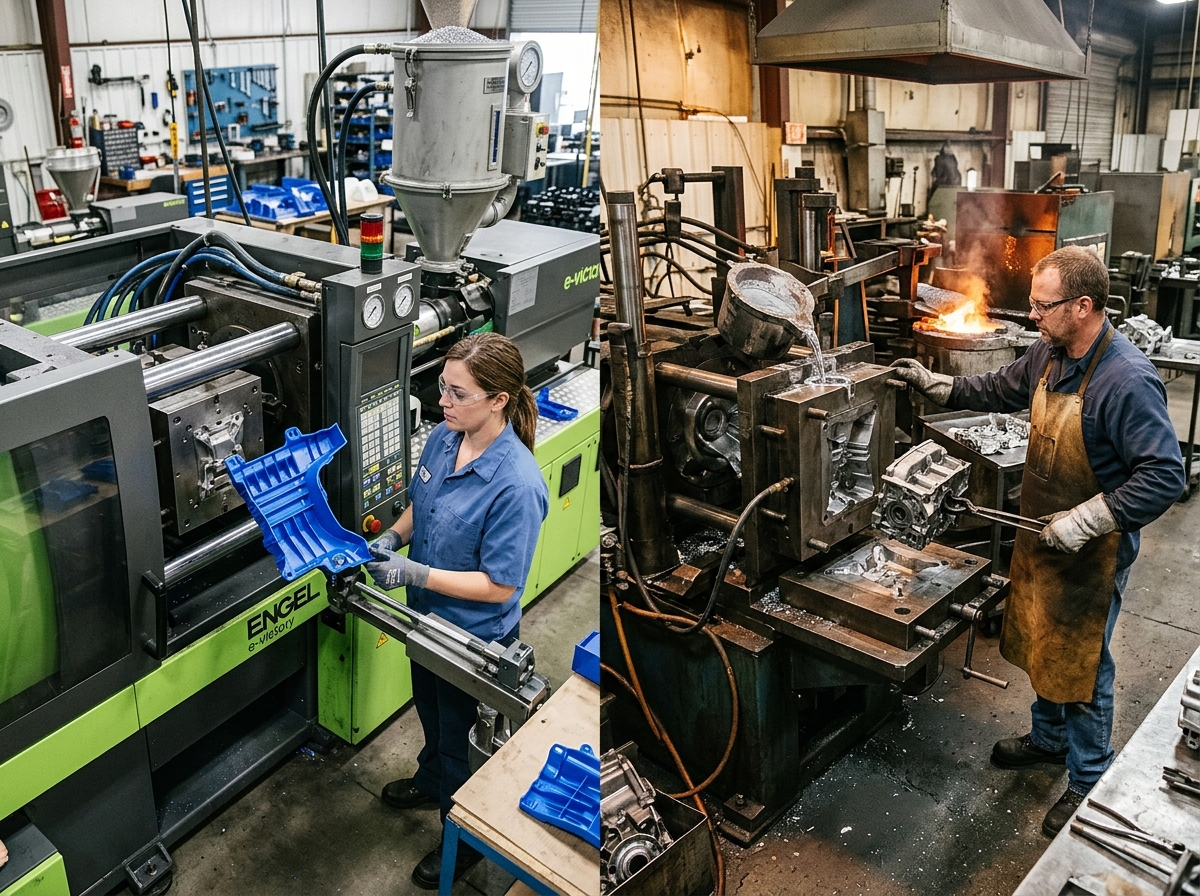
Plastic injection molding is the preferred process for most polymer parts because it supports complex geometry, fast cycle times, and scalable production. Die casting is the preferred process for metal parts that need stiffness, thermal resistance, and a premium surface after finishing. According to NADCA technical standards, die casting guidance emphasizes alloy properties, precision tolerances, GD&T, and quality assurance, which shows how process choice is tied to engineering requirements, not just price.
In my own DFM reviews, the first question is always whether the part truly needs metal. If the answer is no, plastic often wins on tooling flexibility, part weight, and design freedom. If the answer is yes, die casting becomes the more appropriate route.
Comparison Table: Plastic Injection Molding vs. Die Casting
Comparison Table: Plastic Injection Molding vs. Die Casting
| Criteria | Plastic Injection Molding | Die Casting |
|---|---|---|
| Material | Thermoplastics and some thermosets | Aluminum, zinc, magnesium, and other nonferrous alloys |
| Typical part use | Housings, covers, consumer goods, functional plastic parts | Metal housings, brackets, heat-sensitive structural parts |
| Typical tolerance expectation | Often around ±0.05 mm to ±0.20 mm, depending on geometry and resin, according to industry estimates | Tighter metal-feature control is possible, but depends on alloy and die design |
| Tooling cost | Usually lower than high-pressure metal tooling | Usually higher because of die complexity and thermal loading |
| Production speed | Very fast for repeatable plastic parts | Fast for metal parts, especially at scale |
| Part weight | Lightweight | Heavier than plastic equivalents |
For a plastic injection molding project, the economics usually improve as volume rises. For die casting, the economics improve when the part must remain metallic and production volume is high enough to absorb die cost.
Key Process Parameters That Change the Outcome
Process windows matter because they directly affect quality, cycle time, and scrap rate. Injection molding typically uses clamping, filling, holding, cooling, mold opening, and ejection, as described in professional injection moulding services and supported by process literature from MIT on the physics of injection molding.
Die casting uses a different thermal regime. Aluminum die casting commonly runs with melt temperatures around 660°C to 700°C, while zinc and magnesium alloys use lower or comparable ranges depending on the alloy family; die temperatures are also controlled closely to reduce soldering and porosity. NADCA’s 2024 standards emphasize alloy properties, tolerances, and process guidance for high-pressure die casting.
Key Specifications for Typical Process Selection
| Parameter | Plastic Injection Molding | Die Casting |
|---|---|---|
| Machine force | Commonly selected from small presses to large presses, often 80T to 650T for many consumer and enclosure parts; larger platforms are used for bigger parts | Selected by shot size and die size rather than clamp force alone |
| Temperature control | Resin drying, melt temperature, mold temperature | Alloy melt temperature, die temperature, lubrication, thermal balance |
| Defect sensitivity | Sink, warp, short shot, flash, splay | Porosity, soldering, flash, die wear |
| Cycle driver | Cooling time is often the main driver | Metal solidification and die thermal control are critical |
These numbers are not universal specifications. They are practical selection ranges used in industry estimates, and final values depend on part size, wall thickness, material, and tooling strategy.
When Plastic Injection Molding Is the Better Choice
Plastic injection molding is better when the part needs low weight, electrical insulation, cosmetic flexibility, or integrated features such as ribs and snap fits. It is also the better choice for consumer goods, packaging, electronics enclosures, and custom plastic parts that must be produced repeatedly with stable appearance.
For example, a PC housing often needs tight assembly control, consistent surface finish, and efficient mold iteration. That is why many teams choose a dedicated PC case mold instead of forcing a metal process into a plastic product requirement. The same logic applies to a plastic case injection mould for electronics and appliance housings.
- Choose plastic when weight reduction matters.
- Choose plastic when color matching and texture are important.
- Choose plastic when snap-fit assembly can replace fasteners.
- Choose plastic when the product needs insulation or corrosion resistance.
When Die Casting Is the Better Choice
Die casting is better when the part must be metal, must dissipate heat, or must carry higher structural loads than a plastic part can support. It is common in automotive housings, metal brackets, and compact components where rigidity and thermal performance are critical.
Die casting also becomes attractive when the design requires thin-wall metal features with repeatable geometry. However, the tooling and process control burden is higher, and porosity management is often a design constraint. NADCA’s technical resources explicitly cover porosity, die design, and process control because those issues shape final part quality.
In practice, die casting is rarely the best answer for a part that can be redesigned in polymer. It is strongest when the product specification already demands metal performance.
 Decision Matrix for Engineers and Buyers
The best manufacturing process is the one that matches product function, not the one with the lowest first quote. A simple decision matrix helps teams avoid tooling mistakes and late-stage redesigns.
Decision Matrix: Which Manufacturing Process Fits Best?
| Project Need | Better Fit | Reason |
|---|---|---|
| High-volume plastic enclosure | Plastic injection molding | Lower part weight, stable repeatability, efficient mass production |
| Metal heat sink housing | Die casting | Metal thermal conductivity and structural rigidity |
| Complex cosmetic shell | Plastic injection molding | Better freedom for texture, color, and integrated features |
| Thin-wall metal component | Die casting | Supports high-volume metal geometry with controlled tooling |
| OEM custom part with frequent revisions | Plastic injection molding | Faster design iteration and easier material changes |
For buyers, the most useful question is not “Which process is stronger?” It is “Which process reduces total project risk across tooling, validation, and mass production?”
DFM Lessons From One-Stop Mold Development
One-stop mold development reduces risk because design, tooling, trial, and production are managed in a single workflow. That matters for OEM and ODM programs where schedule slips often come from supplier handoffs, not from the molding machine itself.
On the plastic side, a supplier that offers customized plastic injection mold manufacturer services can shorten the path from drawing to sample. For broader programs, a plastic products mould portfolio helps teams manage enclosures, boxes, cups, and other repeatable product families under one technical standard.
Based on common DFM practice, the most important trial-mold checks are fill balance, shrinkage, gate vestige, ejection marks, and assembly fit. If those items are not stable at trial, mass production will usually magnify the problem.
Where to Buy and Supplier Directory
The right supplier should match the part family, not just the process label. For plastic programs, the target website’s main categories include injection molding, plastic products, PC case mold, plastic case injection mould, and professional plastic moulds.
For a complete sourcing shortlist, buyers often compare one-stop plastic mold makers with established die casting suppliers and regional toolmakers. In die casting, industry-standard references such as NADCA are useful for evaluating design rules, tolerances, and quality expectations before RFQ release.
Conclusion: Which Manufacturing Method Is Better?
Plastic injection molding is better for most high-volume plastic parts, while die casting is better for metal parts that need strength and heat resistance. The better method is the one that matches product function, tolerance needs, and lifecycle cost.
If the part is a housing, cover, box, or custom plastic component, plastic injection molding usually offers the best balance of cost and repeatability. If the part must be metal, die casting is the more appropriate manufacturing process.
FAQ
1. Is plastic injection molding cheaper than die casting?
Plastic injection molding is often cheaper per part at scale when the product can be made in polymer. Die casting may have higher tooling and process costs, but it becomes competitive when the part must be metal and production volume is high enough to justify the die investment.
2. Which process gives tighter tolerances?
Both can achieve good dimensional control, but the answer depends on geometry, material, and process stability. Plastic parts often target practical tolerances around ±0.05 mm to ±0.20 mm in many projects, while die casting can achieve precise metal features with strong die design and process control.
3. Can plastic injection molding replace die casting?
In some cases, yes. Engineers often replace metal parts with engineered plastics to reduce weight, simplify assembly, and lower corrosion risk. However, it cannot replace die casting when the product truly needs metal strength, thermal conductivity, or high-temperature performance.
4. What is the biggest risk in die casting?
Porosity is one of the most important risks because it can affect strength, sealing, and machining. Thermal imbalance, die wear, and soldering also matter. That is why industry standards from NADCA place strong emphasis on design, quality assurance, and process control.
5. What should buyers ask before choosing a supplier?
Buyers should ask about DFM support, trial-mold validation, tolerance capability, tooling lead time, and production stability. For plastic projects, it also helps to confirm whether the supplier can support custom plastic parts, enclosure molds, and one-stop development from drawing to mass production.
Post time: Jul-09-2026