
- OEM is design-led: the buyer defines the part, and the factory manufactures it.
- ODM is solution-led: the factory offers a ready or semi-ready product architecture that can be customized.
- For custom plastic products, the biggest decision factors are tooling ownership, lead time, IP control, and total landed cost.
- Injection molding quality is driven by tolerances, material choice, gate design, and process stability, not just by the business model.
- In electronics, appliances, and industrial housings, OEM often wins on differentiation, while ODM often wins on speed.
OEM plastic manufacturing and ODM plastic manufacturing are often compared as if they were just sourcing labels, but the real difference is engineering control. A typical injection molding tolerance stack can be affected by material shrinkage, part geometry, and mold precision, while ISO 20457:2018 defines general tolerances for plastic moldings and helps buyers align expectations on dimensional accuracy. For buyers of custom plastic products, this is not an abstract issue: a housing that is off by even 0.2 mm can affect snap fits, sealing performance, and assembly yield. If you are also comparing packaging, prototyping, or product readiness options, the source pages for plastic packing and custom plastic products are useful starting points for scope alignment before tooling begins.
OEM Plastic Manufacturing vs ODM Plastic Manufacturing: the core business difference
OEM plastic manufacturing is best understood as buyer-defined manufacturing, while ODM plastic manufacturing is best understood as factory-developed manufacturing with buyer customization. In OEM projects, the customer usually provides drawings, CAD data, samples, brand standards, and performance requirements, and the manufacturer focuses on design for manufacturability, mold making, trial runs, and stable production. In ODM projects, the factory already has a base product, a platform mold, or a design concept, and the buyer selects, modifies, or rebrands it. This distinction matters because tooling, engineering effort, and IP ownership are handled very differently.
The most important operational difference is control. In OEM, the buyer controls geometry, materials, surface finish, and functional targets. In ODM, the supplier controls the base architecture, and the buyer typically negotiates cosmetic changes, logo placement, color, packaging, or limited structural edits. For sourcing teams, that changes the risk profile. OEM usually reduces product duplication risk and supports brand differentiation. ODM usually reduces time-to-market and lowers early development cost.
| Dimension | OEM Plastic Manufacturing | ODM Plastic Manufacturing |
|---|---|---|
| Design ownership | Buyer-owned or buyer-directed | Supplier-owned base design |
| Tooling control | Custom mold built for one product | Existing mold platform or modified tool |
| Development lead time | Often 8 to 16 weeks for mold build plus validation | Often 2 to 8 weeks for adaptation and launch |
| Unit cost at scale | Usually lower after volume ramp if optimized | Can be competitive early, but less unique |
| IP differentiation | High | Moderate to low |
Those lead times vary by complexity, but they are realistic planning ranges for injection molding projects that require design review, tooling, trial shots, and engineering sign-off. For complex housings, the mold itself may require multiple slides, lifters, or a 3D mold strategy to handle undercuts and styling surfaces. That is why many buyers of plastic household products and plastic electrical products choose OEM when appearance, fit, and repeated assembly accuracy matter more than speed alone.
How custom plastic products are developed in an OEM workflow
OEM custom plastic products are built through a structured engineering workflow, not just ordered from a catalog. The process normally starts with part definition, then moldability review, then DFM, then tooling, then sampling, then process validation, and finally mass production. Buyers often underestimate the front-end work. A part that looks simple in CAD can still fail because wall thickness is uneven, ribs are too thick, draft angles are insufficient, or gate placement creates weld-line weakness.
For injection-molded housings, a practical early checklist should include material selection, nominal wall thickness, undercut count, cosmetic class, assembly interface, and expected production volume. PC is a common choice when transparency, impact resistance, and dimensional stability are important, especially in electronics or protective covers. According to NIST material data resources and common engineering references, polycarbonate typically offers high impact resistance and useful dimensional stability, but the actual grade must be matched to heat, UV, and flame-retardancy requirements. For buyers developing transparent or semi-transparent housings, the difference between a generic resin choice and a specified grade can directly affect yellowing, warpage, and long-term durability.
| Typical OEM development item | Why it matters | Typical planning value |
|---|---|---|
| Wall thickness | Controls sink, cycle time, and warpage | 1.5 to 3.0 mm for many housings |
| Draft angle | Improves ejection and surface quality | 1 to 3 degrees depending on texture |
| Dimensional tolerance | Protects fit and assembly performance | Often aligned to ISO 20457:2018 |
| Spindle or machine capability | Supports repeatability during mold making or machining | High-speed machining may reach 10,000 RPM or more |
Because OEM is specification-led, it works especially well for appliances, consumer electronics, industrial devices, and any project where the exterior shell must meet exact branding and functional targets. In those cases, a supplier with strong plastic automotive parts experience may also bring useful discipline in tolerance control, because automotive programs often demand stronger process documentation and tighter quality control than casual consumer products.
When ODM plastic manufacturing makes more sense
ODM plastic manufacturing makes more sense when the buyer needs a faster commercial launch than a fully custom engineering cycle can support. This model is common when a distributor, startup, or private-label buyer wants to enter a market with lower up-front tooling risk. Instead of financing a new product from scratch, the buyer starts with a proven platform and changes only the commercially visible elements.
That can be a smart decision when the product category is crowded and the key purchase driver is availability, not unique form factor. Examples include storage accessories, basic household components, simple industrial covers, and some consumer accessory categories. ODM is also practical when you need to test market demand before committing to a fully dedicated mold. If the first sales phase validates the channel, the buyer can later migrate from ODM to OEM by redesigning the part and building exclusive tooling.
- Choose ODM when speed to shelf is more important than unique geometry.
- Choose ODM when your team lacks in-house engineering bandwidth.
- Choose ODM when you need lower initial cash outlay and faster sampling.
- Choose OEM when your brand depends on proprietary appearance or function.
There is an important tradeoff here. ODM can reduce risk in the beginning, but it can also limit defensibility if competitors can source similar parts. For products sold on major marketplaces, that risk is not theoretical. The more unique your design, the harder it is for a competitor to copy your value proposition with the same supplier base. That is why many mature procurement teams use ODM to validate demand, then move to OEM once the sales model is proven.
What procurement teams should compare before choosing OEM or ODM
The best comparison framework is not just price per unit. It is total project cost across tooling, sampling, iteration, logistics, quality risk, and lifecycle support. A low unit price can be misleading if the mold needs frequent rework or if poor dimensional control causes high assembly scrap. In many manufacturing programs, the hidden cost is not resin or machining; it is the cost of delay and reapproval.
From a quality perspective, one useful benchmark is the guidance in ISO 20457:2018 for tolerances on molded plastic parts. Another useful reference is ASTM D790 for flexural properties and ASTM D256 for impact resistance, both of which are widely used in material validation for plastic components. These standards do not tell you what product to make, but they do help teams compare suppliers on a common technical basis. If a supplier cannot explain how their process supports the relevant standard, that is a warning sign.
| Buying question | OEM answer | ODM answer | Best use case |
|---|---|---|---|
| Who owns the design? | Buyer | Supplier | IP-sensitive products |
| How fast can we launch? | Slower | Faster | Seasonal or urgent launches |
| Can we differentiate strongly? | Yes | Limited | Brand-led categories |
| Is engineering support needed? | High | Moderate | Early-stage buyers |
For custom plastic products, another practical issue is how stable the supplier is across repeat orders. A one-time prototype success does not guarantee mass-production success. Buyers should ask for mold maintenance plans, spare parts support, gate and vent inspection practices, and process window control. Those details matter because plastic molds are production assets, and the cost of unexpected downtime can exceed the cost of tooling optimization very quickly.
Industry scenarios where OEM plastic manufacturing is usually the better choice
OEM plastic manufacturing is usually the better choice when product identity depends on fit, finish, and function. This is especially true in consumer electronics, home appliances, and industrial equipment housings. In these categories, a small mismatch in snap fit, screw boss alignment, or panel flatness can affect not just appearance but also assembly labor and field reliability.
For appliance panels and electrical enclosures, dimensional accuracy is often tied to safety and user experience. If a cover does not seat correctly, the issue may appear as a cosmetic problem, but it can also lead to vibration noise, ingress risk, or shortened service life. For that reason, buyers often request PC or PC blends for transparent or semi-transparent parts, flame-retardant grades for electrical products, and textured mold surfaces for fingerprint resistance and scratch masking.
OEM is also the natural fit when a buyer wants to integrate multiple product versions into one family. A platform approach can reduce engineering overhead while preserving differentiation. For example, one base housing can support several SKUs with different inner brackets, colorways, or front bezels. This is where a factory with plastic injection part experience becomes valuable, because part-level design choices directly affect assembly, packing, and downstream quality.
- Define the application and target environment first.
- Lock the critical dimensions before mold fabrication.
- Choose resin based on heat, impact, and appearance requirements.
- Validate sample parts under real assembly conditions.
- Plan mold maintenance and reorder strategy before launch.
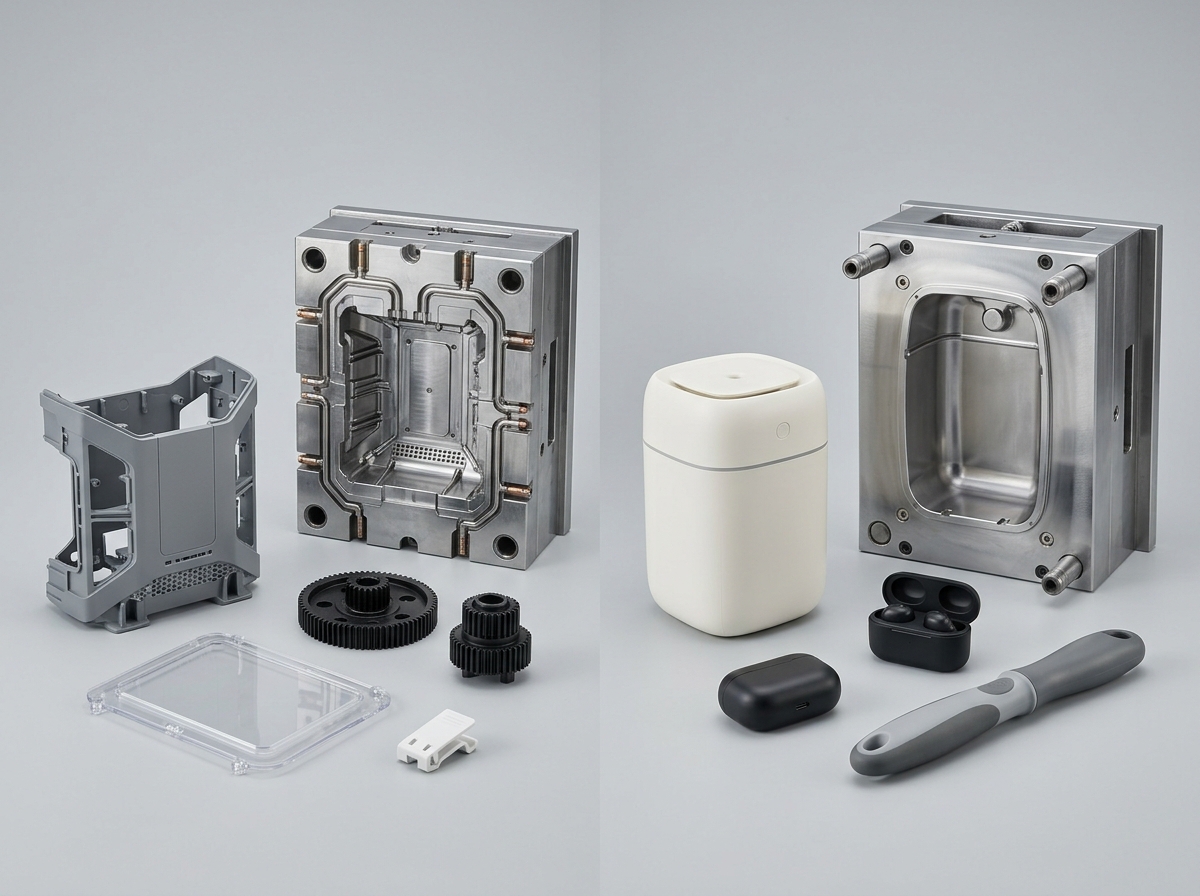
Where ODM plastic manufacturing creates the most value
ODM plastic manufacturing creates the most value when the buyer wants commercial speed and predictable execution. This is common in trading, distribution, private label, and catalog expansion. If the buyer has strong channel access but limited engineering depth, ODM can shorten the path to revenue by removing several development stages.
ODM also works well for items where the product architecture is already standardized and the customer’s competitive edge comes from pricing, packaging, or local service rather than patentable design. In these cases, the supplier’s existing know-how reduces project uncertainty. The buyer can focus on order planning, quality acceptance, and market positioning instead of starting with CAD and mold flow analysis.
That said, ODM should still be treated as a technical sourcing process, not a shortcut. The buyer should confirm material grade, color stability, surface finish, dimensional consistency, and post-molding operations such as trimming, ultrasonic welding, or assembly. The more the product will be touched, displayed, or assembled into a branded system, the more important it becomes to inspect cosmetic standards and lot consistency.
How to evaluate a supplier for OEM or ODM plastic products
The best supplier is not simply the cheapest one; it is the one whose engineering, communication, and delivery system matches your project risk. That is especially true for export-oriented buyers who need English documentation, response discipline, and logistics coordination. A supplier that can produce a sample quickly but cannot maintain a stable process window is often more expensive in the long run.
Practical evaluation should include design review quality, mold trial feedback, sample traceability, and mass-production discipline. It also helps to ask whether the supplier can support both mold and finished-part delivery, because one-stop service usually reduces interface risk. A supplier that handles both tooling and production can reduce handoff delays, especially for urgent replenishment or product-line expansion.
- Ask for DFM comments before paying for tooling.
- Request a sample approval checklist with measurable criteria.
- Confirm resin grade, color code, and surface texture in writing.
- Verify mold maintenance and spare-part policy.
- Review lead time assumptions for both first article and repeat orders.
If your sourcing plan involves product families, multi-SKU launches, or long-term replenishment, one useful reference is plastic toy and plastic shoe accessories, because these categories often demand frequent styling changes, stable color control, and flexible production planning. The same supplier discipline applies whether you are sourcing a consumer shell or a functional industrial component.
OEM vs ODM plastic manufacturing: a decision framework for buyers
The right choice depends on what problem you are trying to solve. If you need a proprietary part that supports branding, fit, and long-term differentiation, OEM is usually the better path. If you need a faster commercial launch with lower initial development cost, ODM is usually the better path. The mistake many buyers make is treating the choice as permanent. In practice, it can be phased.
A smart buying strategy often begins with ODM for market validation, then shifts to OEM once demand is proven. That approach can reduce early financial exposure while preserving the option to build a differentiated product later. In other words, the business model should match the product life stage. New categories often benefit from speed, while mature categories often benefit from proprietary engineering.
| Project stage | Recommended model | Main objective | Risk level |
|---|---|---|---|
| Concept validation | ODM | Test demand quickly | Low to medium |
| Brand launch | OEM | Create differentiation | Medium |
| Scale-up | OEM | Optimize cost and repeatability | Medium |
| Catalog expansion | ODM | Broaden assortment fast | Low |
For buyers managing cross-border supply chains, one additional benchmark is process documentation. ISO 9001:2015 does not guarantee product quality by itself, but it does require a controlled quality management system, which helps buyers reduce variation in sampling, approval, and repeat production. That matters when you are comparing multiple suppliers across time zones and product categories.
Frequently asked questions about OEM plastic manufacturing and ODM plastic manufacturing
Is OEM plastic manufacturing more expensive than ODM?
OEM usually requires higher upfront development cost because the tooling is dedicated to your design, but it can be more cost-effective at scale if the part is optimized for production and volume is stable.
Who owns the mold in OEM and ODM?
In OEM, the buyer often pays for and controls the mold according to the contract; in ODM, the supplier usually keeps the base mold ownership unless a special agreement transfers it.
Which model is faster for new custom plastic products?
ODM is usually faster because it starts from an existing design platform, while OEM requires design review, mold build, sample trials, and validation.
Can an ODM product be turned into an OEM product later?
Yes. Many buyers use ODM to validate the market first and then move to OEM once sales justify exclusive tooling and deeper customization.
What materials are common for plastic housings?
ABS, PC, PP, and PC/ABS are among the most common choices, with PC favored when impact resistance, transparency, and dimensional stability are important.
What standards should buyers reference for molded parts?
Useful references include ISO 20457:2018 for tolerances on plastic moldings, ASTM D790 for flexural properties, and ASTM D256 for impact resistance.
How do I reduce risk when choosing a plastic manufacturing supplier?
Use a written DFM review, confirm material and tolerance requirements early, request sample approval criteria, and make sure the supplier can support both tooling and repeat production with consistent documentation.
In short, OEM plastic manufacturing is the right answer when the product must be yours in function and identity, while ODM plastic manufacturing is the right answer when speed, lower startup cost, and proven architecture matter most. For buyers of custom plastic products, the best decision is usually the one that balances engineering control, commercial timing, and long-term supply stability.
Post time: Jul-23-2026