
- Injection molding is the better production process for stable, repeatable, high-volume plastic parts.
- 3D printing is the better manufacturing process for prototypes, bridge runs, and highly complex geometries.
- The right choice depends on volume, tolerances, surface finish, lead time, and total cost of ownership.
- Production decisions should be based on part geometry, material requirements, and lifecycle demand, not only on unit price.
- A hybrid workflow often reduces risk: validate with print, scale with tooling.
When comparing injection molding vs 3D printing, the most important production metric is not the machine itself but the economics of repeatability: injection molding commonly achieves cycle times measured in seconds, while additive manufacturing builds parts layer by layer and usually takes far longer per unit. For dimensional control, the ISO GPS system and machine verification standards matter; for example, ISO 230-1:2022 defines geometric testing principles for machine tool accuracy, and NIST additive manufacturing research documents why process variability, orientation, and post-processing can affect final part quality. If you are sourcing from a injection mold supplier, plastic mold solutions, or a custom plastic parts manufacturer, the real question is which process will deliver the lowest total risk over the full product life cycle.
Injection Molding vs 3D Printing: The Production Decision in Plain English
Injection molding is the production process for repeatable plastic parts at scale. Molten polymer is injected into a steel or aluminum cavity, then cooled and ejected as a finished part. The upfront tooling cost is higher, but the cost per part drops sharply once volume rises.
3D printing is the production process for low-volume, geometry-driven parts. Material is deposited or cured layer by layer, which removes tooling lead time and makes design changes much easier. The tradeoff is that part cost, finish consistency, and throughput often become limiting factors as volume increases.
That difference explains why procurement teams, product engineers, and OEM buyers use the two methods for different business stages. If your project is a consumer electronics enclosure, a household appliance housing, or an industrial cover, a plastic enclosure mold is usually the production-ready path. If you are still validating snap fits, cable routing, or wall thickness, a printed prototype may be the smarter first step.
Injection Molding vs 3D Printing for Production Cost and Volume
Volume is the clearest separator between the two processes. In most commercial programs, 3D printing is strongest below a few hundred parts, while injection molding becomes more compelling once you need repeatable batches, especially when annual demand stretches into the thousands.
| Factor | Injection Molding | 3D Printing |
|---|---|---|
| Typical lead time | Tooling weeks to months, then seconds per part | Often hours to days per part |
| Best volume range | High volume, from thousands upward | Low volume, prototypes to short runs |
| Unit economics | Improves strongly as volume rises | Usually stays higher per part |
| Design changes | Costly after tooling is made | Relatively easy between builds |
For production buyers, the most useful calculation is total cost over the full program, not just the first sample. A molded part can have a higher tooling entry cost but a much lower marginal cost. A printed part may look cheaper at the start, yet become expensive when a launch moves from validation to scale.
The break-even point depends on geometry, material, tolerance, and machine time. That is why buyers should ask suppliers for both prototype and production quotations. A reputable OEM plastic parts supplier should be able to compare tooling amortization, cycle time, scrap risk, and downstream assembly cost, not just quote a unit price.
Injection Molding vs 3D Printing for Tolerance, Surface Finish, and Reliability
Injection molding is usually superior when the part must fit, seal, or stack consistently. This matters in electronics housings, appliance shells, and industrial covers, where small deviations can affect assembly yield or customer perception.
Modern injection molding programs often target tight part variation through gate design, cooling balance, shrink compensation, and process window control. In contrast, 3D printing quality can vary with build orientation, support strategy, layer bonding, and post-processing. NIST notes that additive manufacturing repeatability is strongly influenced by process control and metrology, which is why printed parts may require more inspection before release.
| Quality Attribute | Injection Molding | 3D Printing |
|---|---|---|
| Dimensional consistency | High after process stabilization | Moderate, process dependent |
| Surface finish | Typically smooth straight from mold | Often visible layer texture |
| Part-to-part repeatability | Strong in mature production | More variable across builds |
| Inspection burden | Lower at scale | Higher for critical parts |
For consumer-facing products, the visual side can matter as much as functional fit. A housing with knit lines, layer marks, or surface waviness may still work technically, but it can fail brand expectations. This is one reason plastic shell projects often move from printed mockups to a dedicated household appliance mold or enclosure mold once the design is frozen.
Injection Molding vs 3D Printing Materials and Engineering Constraints
Material selection can decide the process before cost does. Injection molding supports a broad range of thermoplastics used in production, while 3D printing materials are improving but still have different mechanical and thermal profiles depending on the technology.
For transparent or impact-resistant housings, polycarbonate is a common choice because it combines toughness with dimensional stability. In many commercial grades, polycarbonate has a tensile strength around 55-75 MPa and a heat deflection temperature that can exceed 120 C depending on formulation and test load. Those properties make it a frequent candidate for protective covers, electronics shells, and optical windows.
| Material / Property | Typical Production Relevance | Representative Value |
|---|---|---|
| Polycarbonate tensile strength | Impact-resistant housings | 55-75 MPa |
| Polycarbonate heat resistance | Thermal stability in enclosures | Over 120 C HDT in some grades |
| Injection-molded wall thickness | Common structural shells | About 1.5-3.0 mm in many consumer parts |
| Printed part anisotropy | Strength varies by build direction | Process dependent |
Material behavior under load matters more than material name alone. A printed nylon part can be excellent for jigs or fit checks, while a molded PC or ABS part may be better for long-term customer use. The decision should consider heat, creep, UV exposure, drop resistance, and regulatory needs.
If your product is part of a larger assembly, production planning should also include the mold strategy. A specialized 3D mold for complex shapes can help capture unusual curvature or differentiated styling, while a standard production mold is usually more economical for repeat SKUs.
When 3D Printing Is Better Than Injection Molding
3D printing is better when design risk is still high and speed matters more than unit cost. That is common in early-stage hardware, custom medical fixtures, and one-off industrial components.
Use 3D printing when you need to answer one of these questions quickly: Does the assembly fit? Does the ergonomic form feel right? Can the cable path, clip geometry, or internal rib layout survive real use? Because the process does not require steel tooling, the team can revise the model and print again without waiting for a mold change.
- Prototype validation before tooling investment.
- Short-run bridge production during product launch.
- Highly complex internal geometry that would be costly to tool.
- Custom spare parts with uncertain demand.
Printed parts are especially valuable when time-to-learning is more important than time-to-volume. In other words, if the project is still discovering what the final part should be, additive manufacturing can reduce expensive mistakes.
When Injection Molding Is Better Than 3D Printing
Injection molding is better when the product has a stable design and a real production horizon. That is true for appliance parts, consumer electronics shells, automotive interior pieces, and high-repeat industrial components.
Once the design is locked, molding usually offers stronger part consistency, lower labor per unit, and a clearer path to supply chain stability. For OEM and ODM buyers, this matters because launch delays, rework, and inconsistent quality quickly become more expensive than the mold itself.
In many programs, the key production advantages are cycle time, automation readiness, and easier multi-cavity scaling. A well-designed tool can support many parts per shot, and that has a direct effect on throughput. For buyers sourcing from a industrial parts mold factory or a precision mold components supplier, the real benefit is not only price but also repeatable delivery.
Injection molding is usually the right choice for long-life programs. If the part will be produced for months or years, tooling investment can be amortized across large quantities, and process control becomes a long-term competitive advantage.
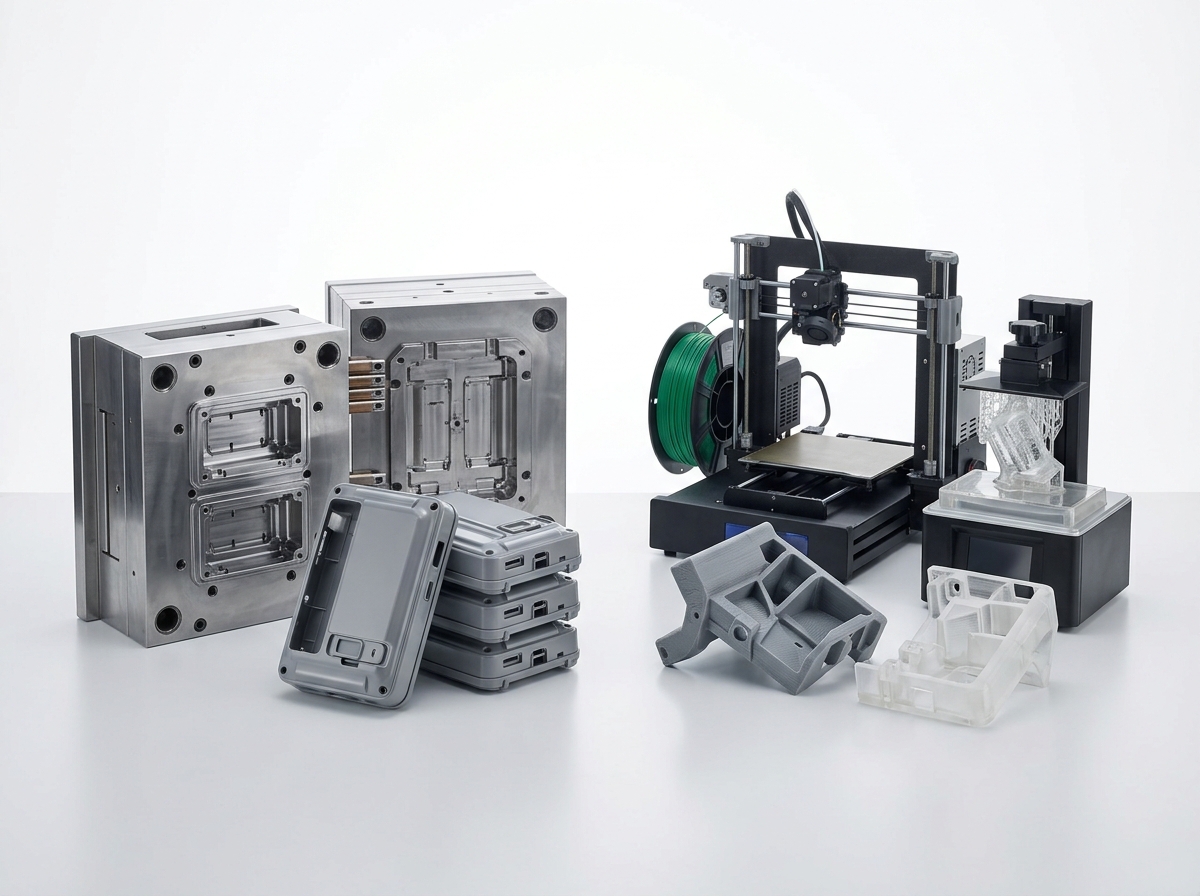 Production Workflow: From CAD to Mass Manufacturing
A disciplined workflow reduces both scrap and launch risk. The best teams do not choose between injection molding and 3D printing as a matter of ideology; they choose a sequence that matches the product stage.
- Freeze the key functional requirements: fit, finish, load, heat, and compliance.
- Build a printable prototype to test geometry, ergonomics, and assembly.
- Review part design for draft, ribs, gates, wall transitions, and undercuts.
- Move to tooling only after the design is stable enough for scale.
- Run first articles, adjust process windows, then lock in production parameters.
This staged method is common in successful OEM and ODM programs. It allows teams to keep learning early, then commit capital only when the commercial case is clear. For product categories with many SKUs, a supplier offering one-stop support for tooling and finished parts can reduce handoff friction and shorten the path from concept to shipment.
Injection Molding vs 3D Printing: Decision Table for Buyers
The best process depends on your business goal, not just the CAD file. Procurement teams can use the table below to align manufacturing choice with product stage.
| Business Need | Better Choice | Why |
|---|---|---|
| Fast prototype | 3D printing | No tooling delay |
| High volume launch | Injection molding | Lower unit cost at scale |
| Frequent design changes | 3D printing | Easier revision cycle |
| Consistent cosmetic finish | Injection molding | Smoother surface and repeatability |
| Complex internal channels | 3D printing | Geometric freedom |
| Long-term supply | Injection molding | Tool-based repeatability |
The table becomes more decisive when you add risk cost. If a late design change would delay launch by weeks, a printed prototype is cheaper. If a late quality problem could create thousands of rejects, a molded production path is safer.
Industry Standards and Verification That Matter in Production
Production quality should be tied to standards, not opinions. For dimensional control and machine verification, ISO and NIST references help teams speak the same language across design, tooling, and inspection.
Useful references include ISO 230-1:2022 for geometric testing principles, ASTM F42 additive manufacturing standards for the additive manufacturing framework, and NIST additive manufacturing research for measurement and repeatability concerns. For molding projects, these standards help define what “acceptable” really means when comparing prototype, pilot, and mass-production parts.
Standards do not replace engineering judgment, but they make supplier evaluation auditable. That is especially useful when comparing multiple vendors, since one may quote a low unit price while another offers better inspection discipline, faster response, or stronger process documentation.
How to Choose Between Injection Molding and 3D Printing for Your Product
The best choice is the one that fits your launch stage and supply target. Use the following checklist before you commit.
- If the design is still changing, start with 3D printing.
- If the design is stable and the part will be repeated often, move toward injection molding.
- If the product needs a polished consumer finish, favor molding.
- If the part geometry is highly complex and volume is low, favor printing.
- If long-term supply and consistent quality matter most, favor tooling.
Most production programs benefit from a hybrid strategy. Print to validate, mold to scale, and keep engineering change control tight during the transition. That sequence lowers scrap, reduces surprise costs, and gives buyers more confidence when moving from sample approval to mass shipment.
For sourcing teams, the right supplier is one that can support both stages. A partner with experience in custom plastic parts, mold development, and production planning can help you avoid the common mistake of treating prototype success as proof of mass-production readiness.
FAQ
Is injection molding cheaper than 3D printing for production?
Yes, in most high-volume cases, injection molding is cheaper per part. The tooling cost is higher at the start, but the unit cost usually drops as volume increases.
Is 3D printing good for end-use parts?
Yes, but mainly for low-volume or highly customized end-use parts. It is less ideal when you need high repeatability, cosmetic consistency, or large-scale throughput.
Which process has better surface finish?
Injection molding usually has better surface finish. Printed parts often show layer lines or require post-processing to match cosmetic expectations.
Which process is faster?
3D printing is faster for first samples, while injection molding is faster for repeated production after tooling is ready. The answer depends on whether you mean first part or full batch.
Can 3D printing replace injection molding?
Not in most mass-production programs. Additive manufacturing is excellent for prototyping and small runs, but molding remains the standard for many scaled consumer and industrial products.
What industries use injection molding most?
Consumer electronics, home appliances, automotive, medical, and industrial equipment all use injection molding heavily. These sectors need consistent geometry and stable supply.
How do I know which process fits my product?
Start with volume, tolerance, surface finish, and design stability. If those four factors point toward repeatability and scale, injection molding is usually the better manufacturing process.
Post time: Sep-06-2026