
For buyers planning a launch, the real question is not only how long the mold takes, but what drives the schedule. A well-managed custom mold manufacturing project balances design review, machining, trial runs, and final approval before production starts.
Typical Timeline for Custom Plastic Mold Production
The standard lead time for a plastic mold project is usually divided into design, tooling, trial, and adjustment stages. In many B2B projects, the total cycle is 4 to 12 weeks, although urgent programs may move faster and complex programs may take longer.
Timeline Comparison Table: Common Mold Development Stages
| Stage | Typical Duration | Main Output |
|---|---|---|
| Part review and DFM | 2-5 days | Geometry check, risk review, and moldability feedback |
| Mold design | 3-7 days | Tooling layout, gate plan, cooling plan, and steel selection |
| Tool machining and assembly | 2-5 weeks | Core and cavity fabrication, fitting, and mold assembly |
| T0/T1 trial and correction | 1-3 weeks | Sample validation, defect correction, and process tuning |
| Final approval and handoff | 3-7 days | Approved samples, documentation, and production release |
The schedule above is consistent with standard injection molding workflow logic, where trial conditions and reporting must be controlled carefully. ASTM D3641 notes that molding conditions vary by material and should be reported consistently, which is why trial time is often project-specific rather than fixed. ASTM D3641 standard practice for injection molding test specimens
Key Factors That Drive Mold Manufacturing Lead Time
Tooling complexity is the biggest reason a plastic mold takes longer than expected. Multi-cavity tools, sliders, lifters, deep ribs, undercuts, and polished cosmetic surfaces all add machining, fitting, and validation time.
Part geometry also changes the schedule because thin walls, large flat surfaces, and tight assembly tolerances increase the risk of warpage, sink marks, and shrink variation. NIST emphasizes high-accuracy dimensional measurement as a core manufacturing capability, which is especially relevant when a project depends on stable tolerances. NIST dimensional metrology overview
Material selection matters because different resins behave differently during filling and cooling. Engineering plastics, filled materials, and heat-sensitive resins often require more process tuning than standard commodity materials, so the trial phase can expand if the first shots do not meet specification.
Communication speed is another schedule driver, especially in OEM and ODM projects. If drawings, samples, acceptance criteria, and surface requirements are confirmed late, the project can lose days or even weeks before machining begins.
Lead Time by Product Type Table: What Usually Takes Longer
| Product Type | Typical Lead Time | Why It Changes |
|---|---|---|
| Simple plastic box mold | 4-6 weeks | Basic structure, fewer moving parts, faster sampling |
| Plastic case mold | 5-8 weeks | Appearance quality, wall uniformity, and fit checks |
| PC case mold | 6-10 weeks | Tight assembly tolerance, cosmetic finish, and venting control |
| 3D mold | 6-12 weeks | Complex surfaces, detailed geometry, and more correction loops |
| Custom plastic parts with strict tolerance | 6-12+ weeks | Dimensional verification and repeated trial optimization |
These ranges are practical estimates, not fixed rules, because each project has different acceptance criteria. Industry estimates also show that projects with cosmetic requirements or assembly-critical features usually need at least one additional trial round before approval.
How the Development Process Shapes the Schedule
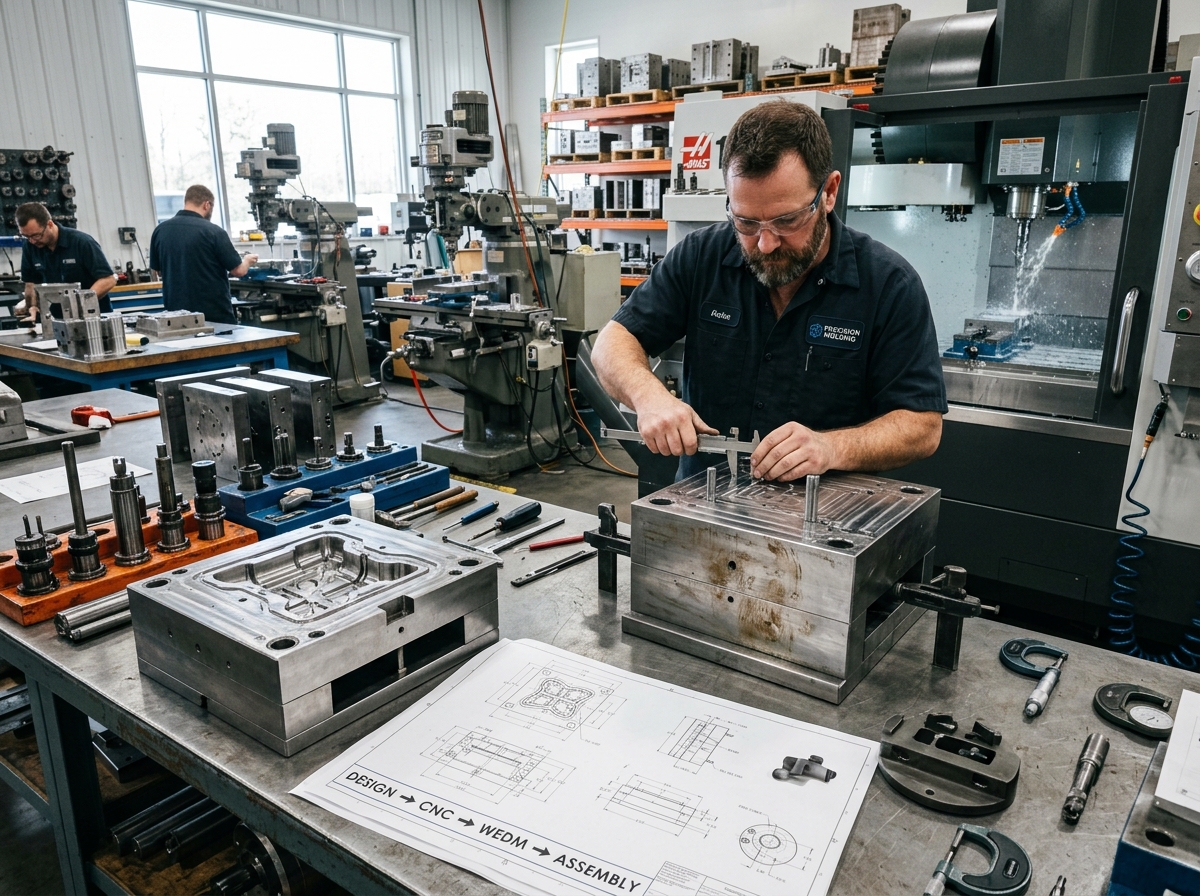
The development process is usually the best predictor of delivery time because each stage depends on the previous one. A disciplined workflow reduces rework, while a rushed workflow often creates hidden delays later in sampling.
- Confirm part drawings, samples, or concept requirements before tooling starts.
- Review wall thickness, draft angle, gate position, and ejection strategy.
- Approve the mold design and machining plan before steel cutting.
- Run T0 and T1 trials to verify fill, shrinkage, and release behavior.
- Lock the process window only after dimensions and appearance are stable.
This sequence is especially important for plastic case molds and PC case molds, where fit, appearance, and functional openings must align. A one-stop workflow can shorten the calendar because design, tooling, and injection support stay under one project plan.
For buyers comparing suppliers, a practical starting point is the manufacturer’s service structure. The internal pages for Injection Mold Manufacturing Services, Professional injection moulding services, and Products show how a supplier organizes tooling and production support across categories.
What Buyers Should Prepare to Avoid Delays
Clear input data is the fastest way to shorten a custom mold manufacturing schedule. The more complete the technical package, the fewer clarification loops the project needs before machining.
- 2D drawings with critical dimensions and tolerance notes
- 3D files in a common CAD format
- Material preference or performance requirements
- Surface finish expectations and cosmetic standards
- Target annual volume and expected mold life
- Sample photos if the project is based on an existing part
Buyers should also define the acceptance method before the first trial. For example, if a plastic mold is intended for electronics, the project should specify whether fit, screw boss strength, or surface gloss is the main approval criterion.
Dimensional inspection is not optional in precision projects because small deviations can affect assembly and function. RJG’s dimensional inspection guidance highlights the importance of careful measurement in injection molding, especially when defects or fit issues can create downstream costs. RJG guide to dimensional inspection in injection molding
Where Fast Delivery Is Realistic and Where It Is Not
Fast delivery is realistic when the part is simple, the material is standard, and the approval path is short. It is less realistic when the project includes deep undercuts, polished cosmetic surfaces, or strict assembly tolerances.
Plastic box molds and other simple container tools are often the quickest to complete because they usually have fewer moving components. By contrast, 3D molds and electronic housings often require more careful venting, cooling, and appearance control, which extends the trial phase.
For buyers who need a broader product range, a supplier with multiple categories can reduce sourcing friction. The pages for Plastic Products, Quality Service, and Quality Products are useful reference points when evaluating whether a vendor can support both tooling and finished parts.
The most efficient projects usually combine early DFM feedback, fast sample approval, and a single decision-maker on the buyer side. That combination often matters more than the nominal machine capacity of the factory.
Supplier Directory for Custom Plastic Mold Projects
A practical supplier shortlist should include one integrated mold maker, one high-volume injection partner, and one specialist for complex housings. This approach helps buyers compare lead time, technical depth, and communication quality without relying on a single quote.
For a one-stop option, the homepage at plasticmetalmold.com is the main internal reference point for mold making and custom plastic production. The site also presents broader service coverage through one stop moulding injection service custom design, P&M any plastic product mold making factory, and Featured Products.
External technical references are also useful when comparing suppliers. NIST supports dimensional measurement quality, while ASTM provides standardized molding test practices, both of which help buyers judge whether a supplier’s trial process is controlled and repeatable. NIST dimensional measurement services
Conclusion: How Long Does Custom Plastic Mold Production Usually Take?
Custom plastic mold production usually takes 4 to 12 weeks, but the real answer depends on part complexity, tolerance requirements, and trial stability. Buyers can shorten the schedule by preparing complete data, approving designs quickly, and choosing a supplier with integrated tooling and molding support.
If the project is a simple plastic mold, the timeline may stay near the lower end of the range. If it is a cosmetic housing, PC case mold, or complex 3D mold, the schedule usually moves toward the upper end because trial correction and dimensional validation take longer.
FAQ
1. Why do some custom mold projects finish in four weeks while others take twelve?
The difference usually comes from geometry, cavity count, material behavior, and approval speed. Simple parts with standard resin and clear drawings can move quickly, while complex housings or precision parts need more machining and trial correction before release.
2. What is the longest stage in custom plastic mold production?
Tool machining and trial correction are usually the longest stages. Machining takes time because steel must be cut, fitted, and assembled accurately. Trial correction can also extend the schedule if the first samples show shrinkage, warpage, or cosmetic defects.
3. Can a plastic mold be rushed without affecting quality?
It can be accelerated only to a point. Faster schedules are possible when the design is simple and the buyer responds quickly, but skipping DFM review or trial validation usually increases the risk of rework, dimensional issues, and delayed mass production.
4. How can buyers reduce lead time before mold making starts?
The best way is to provide complete 3D files, 2D drawings, material requirements, and acceptance criteria at the beginning. Fast feedback on design questions also helps. Clear input reduces clarification loops and prevents avoidable delays before machining begins.
5. Does one-stop mold and injection service really save time?
Yes, it often does because design, tooling, sampling, and production stay under one workflow. That reduces handoff delays between suppliers and makes trial feedback easier to apply. It is especially useful for OEM and ODM projects with tight launch schedules.
Post time: Jul-11-2026