
- Injection molding reduces unit cost at scale because tooling cost is spread across large production runs.
- It improves mass production efficiency through short cycle times, automated repeatability, and predictable quality control.
- Part design, mold design, and material selection determine whether the process delivers fast output or hidden rework.
- Standards such as ISO 20457:2018 and ASTM D4101 help define performance expectations for plastic parts and materials.
- For buyers, the fastest path to efficiency is usually a supplier that can support design review, trial runs, and stable mass production in one workflow.
Injection molding improves mass production efficiency by combining high-repeatability tooling with controlled process parameters, which is why it remains central to plastic manufacturing for electronics, appliances, industrial housings, and consumer products. The process is built for scale: a typical mold can produce the same part shape thousands of times with tight process control, and dimensional quality can be validated against recognized tolerances such as ISO 20457:2018. For teams sourcing custom housings or OEM components, the real question is not whether injection molding is fast, but how well the mold, material, and production plan are matched to the intended annual volume.
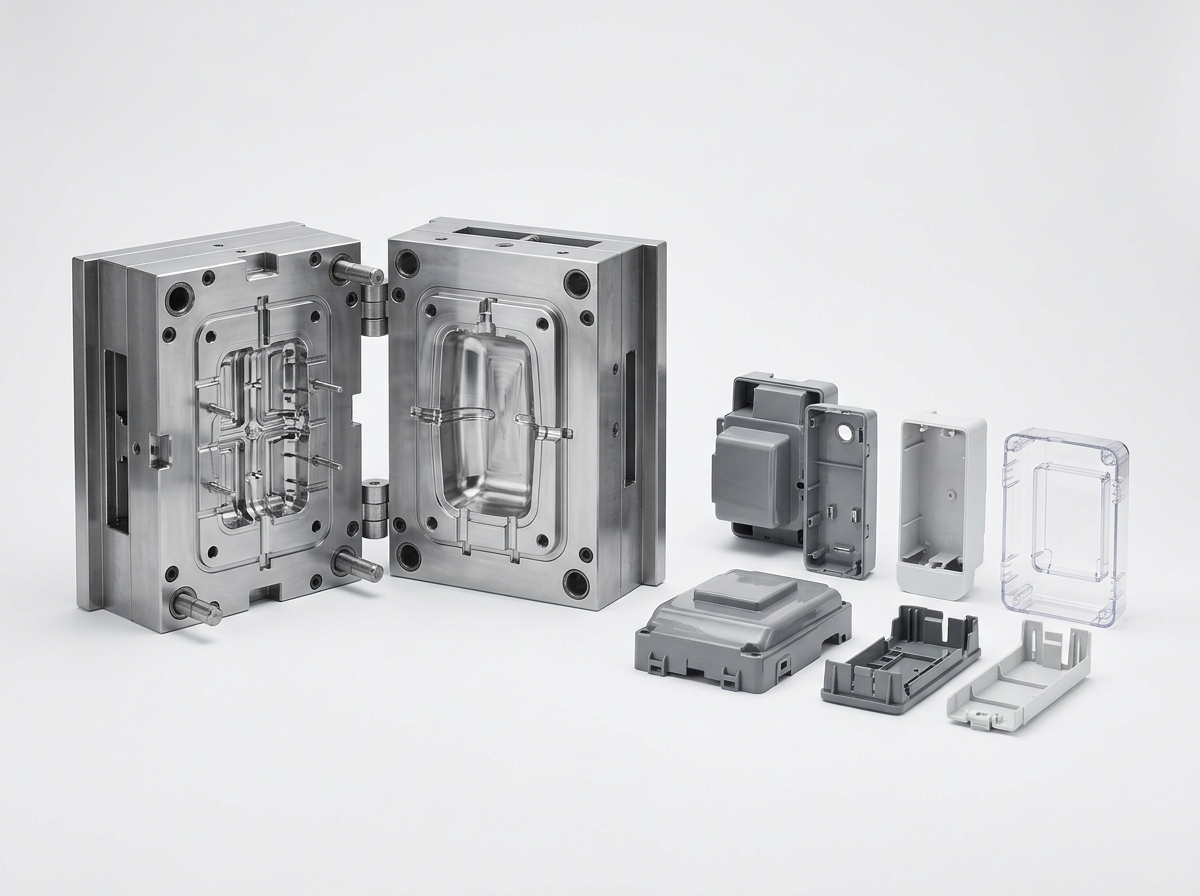
For buyers comparing suppliers, internal product scope matters as much as machine tonnage. If you are evaluating plastic injection mold solutions, plastic shell mold options, or 3D mold development, the efficiency conversation should always include tooling design, trial feedback speed, and how fast the supplier can move from prototype approval to stable output. In many projects, that transition determines the true cost of mass production more than the machine itself.
Why Injection Molding Scales Better Than Many Other Plastic Manufacturing Methods
Injection molding is efficient because it separates engineering cost from production cost. The mold is expensive to develop, but once approved, each additional part can be made with a highly repeatable sequence: plasticized material is injected, packed, cooled, ejected, and repeated.
That structure is ideal for mass production. Compared with machining or manual fabrication, the process requires less per-part labor and less operator intervention. Compared with many forming methods, it also offers better control over wall thickness, surface finish, and feature replication.
The efficiency gain becomes especially clear when a product must be manufactured in high volume with the same geometry. Consumer electronics housings, appliance covers, and industrial enclosures often depend on stable fit, visual consistency, and fast replenishment. Those needs align directly with injection molding.
| Production Method | Typical Strength | Typical Limitation | Best Fit for Mass Production |
|---|---|---|---|
| Injection molding | High repeatability, low unit cost at scale | Tooling cost and lead time | Very high |
| CNC machining | High precision and flexibility | Longer cycle per part, higher labor cost | Low to medium |
| Vacuum forming | Lower tooling cost | Limited detail and thickness control | Medium |
| 3D printing | Rapid prototyping and complex shapes | Slow for large volumes | Low |
This is why injection molding is often the preferred answer when sourcing teams ask how to improve plastic manufacturing efficiency without sacrificing part consistency. The method is not simply faster; it is structurally better suited for repeatable output.
How Injection Molding Improves Mass Production Efficiency in Practice
The biggest efficiency gain comes from cycle repeatability. Once process windows are locked in, a production cell can output parts with limited variation in shot size, cooling time, and ejection behavior.
That matters because small process drifts can create large downstream losses. A slightly warped housing may fail assembly. A weak weld line may crack in testing. A cosmetic defect may turn into scrap or rework. In high-volume production, one unstable parameter can affect thousands of parts.
According to the U.S. National Institute of Standards and Technology, process capability and dimensional control are core indicators of manufacturing performance, and the broader manufacturing quality framework emphasizes repeatability as a driver of productivity and reduced waste. See NIST Manufacturing Extension Partnership for manufacturing productivity resources and NIST Smart Manufacturing Systems Blueprint for discussion of data-driven production control.
In real purchasing terms, this means a supplier with disciplined process control can shorten approval loops, reduce trial-and-error adjustments, and stabilize output sooner. That is often more valuable than simply advertising a larger machine tonnage.
| Efficiency Driver | What It Controls | Typical Measurable Impact | Buyer Relevance |
|---|---|---|---|
| Cycle time | Seconds per part | Lower unit cost at volume | Direct |
| Automation | Labor per shift | Less manual handling | Direct |
| Cooling design | Part solidification | More stable ejection and less warp | High |
| Material consistency | Melt behavior and shrinkage | Fewer defects and less scrap | High |
For common thermoplastics, cycle time is often constrained more by cooling than by injection itself. That is why mold temperature control, gate placement, and wall-thickness balance matter so much. In many cases, reducing unnecessary wall thickness or improving cooling channel design produces a bigger throughput gain than increasing machine speed.
Tooling Design, Part Design, and Material Choice Decide the Real Output Rate
Injection molding efficiency starts before the first shot. A mold that is difficult to cool, vent, or eject will slow production regardless of machine capability.
Design for manufacturability is therefore a direct efficiency strategy. Uniform wall thickness reduces sink marks and warpage. Proper draft angles improve release. Balanced gating reduces uneven fill. Rib design can raise stiffness without adding excessive material. These are not cosmetic choices; they are throughput decisions.
Material choice also changes production speed. For example, polycarbonate is often selected for transparent or impact-resistant housings because it balances toughness and dimensional stability. That makes it useful for many protective and electronic enclosure applications. Material data sheets typically specify tensile strength, heat deflection behavior, and mold shrinkage ranges, all of which affect cycle design and final part quality. For material reference, see ASTM D4101 for polypropylene classification and ISO 20457:2018 for tolerances applicable to plastic molded parts.
| Design Factor | Good Practice | Efficiency Result |
|---|---|---|
| Wall thickness | Keep sections uniform where possible | Less warp, faster cooling balance |
| Draft angle | Use enough draft for clean ejection | Lower ejection force and fewer rejects |
| Ribs and bosses | Use reinforcement instead of thick walls | Lower cycle time and material use |
| Gate location | Balance fill and cosmetic needs | Stable filling and lower rework |
For OEM and ODM projects, this is where a knowledgeable supplier adds measurable value. A supplier that reviews drawings, samples, and target annual volume early can often prevent expensive tooling changes later.
If your project includes appliances, consumer electronics, or industrial equipment, a partner experienced in custom plastic injection molds can often identify manufacturability issues before they become production bottlenecks. That shortens the time from design freeze to stable output.
What the Numbers Say About Injection Molding Efficiency
Injection molding is efficient because its economics improve sharply with scale. The more parts a mold produces, the lower the tooling cost per part becomes.
A simple example explains the logic. If a mold costs a fixed amount to build, and the project requires tens of thousands of identical parts, the mold cost is diluted across the full quantity. At the same time, automated or semi-automated operation reduces direct labor per unit. That is why injection molding is usually unattractive for one-off parts but highly efficient for mass production.
The exact economics depend on part size, cavity count, material, and scrap rate. Still, industry benchmarks consistently show that high-volume plastic manufacturing depends on reducing downtime, minimizing reject rates, and improving first-pass yield. NIST manufacturing guidance highlights that even small improvements in process stability can produce disproportionate productivity benefits because downstream interruptions disappear.
| Economic Variable | Why It Matters | Typical Mass Production Effect |
|---|---|---|
| Tooling amortization | Spreads fixed cost over more parts | Lower unit cost as volume rises |
| First-pass yield | Less scrap and rework | Higher effective throughput |
| Labor content | Less manual handling per shot | Better consistency and lower overhead |
| Downtime | Less idle machine time | Higher OEE and faster delivery |
For many procurement teams, the practical decision metric is not machine price but total cost per acceptable part. That includes cycle time, scrap, trial shots, and any later assembly problems caused by dimensional drift.
When a supplier offers one-stop mold and finished-part delivery, the efficiency gain can be even larger. Fewer handoffs mean fewer communication delays, fewer specification mismatches, and less logistics waste. For project-based buyers, that operational simplicity is often worth more than a nominally cheaper tooling quote.
Where Injection Molding Can Lose Efficiency and How to Avoid It
Injection molding is efficient only when the process is designed for the product, not forced onto it. Poor part geometry or weak project management can erase the process advantage quickly.
Common efficiency killers include overcomplicated parting lines, excessive wall variation, insufficient venting, unstable material drying, and unclear acceptance criteria. A mold may still produce parts under these conditions, but output will be slower and more expensive than expected.
Another frequent issue is over-specification. If tolerances are tighter than the product function requires, the process becomes harder to control and scrap rises. ISO guidance such as ISO 20457:2018 helps buyers think about molded-part tolerances in a structured way instead of using arbitrary targets.
Buyers should also pay attention to trial response speed. The faster a supplier can interpret short-shot analysis, sink marks, flash, or gate vestige problems, the faster production can move toward stable mass manufacturing.
- Confirm the target annual volume before tooling starts.
- Ask for a manufacturability review on wall thickness, draft, and gating.
- Define cosmetic and functional acceptance criteria separately.
- Check whether material drying, cooling, and inspection are controlled on the shop floor.
- Verify that the supplier can support trial feedback, sample revision, and repeat production without changing communication channels.
For buyers sourcing through plastic shell mold solutions, these steps are especially important because appearance and assembly fit are often visible in the final product.
 Best Use Cases for Injection Molding in Mass Production
Injection molding works best when volumes are high, geometries repeat, and quality consistency matters. That describes many of the most common B2B plastic products.
Electronic enclosures need stable snap-fit features and clean surface finishes. Appliance parts need repeatable dimensions and long production runs. Industrial covers need toughness and consistent supply. Even consumer goods benefit from the process when several SKUs must be produced efficiently with the same quality expectations.
Because the process is highly scalable, it also fits inventory planning. Once a stable mold is approved, replenishment runs can be scheduled with less uncertainty than ad hoc fabrication methods. That helps reduce stockout risk while keeping per-part costs predictable.
| Application | Main Efficiency Need | Injection Molding Advantage |
|---|---|---|
| Consumer electronics | Snap fits, appearance, repeatability | Consistent detail replication |
| Home appliances | Long runs, fit, and durability | Stable dimensions and high output |
| Industrial equipment | Reliability and supply continuity | Repeatable production and scalable capacity |
| Consumer goods | Cost control and SKU flexibility | Low unit cost at high volume |
For products with complex surfaces or differentiated styling, a 3D mold development workflow can support more distinctive shapes while still preserving manufacturability. That is useful when visual identity matters as much as function.
How Buyers Can Evaluate a Supplier for Mass Production Efficiency
The best supplier is the one that shortens the path from design intent to stable output. For buyers, efficiency is a supply-chain outcome as much as a machine-room outcome.
When comparing suppliers, ask whether they can support drawing review, sample feedback, process tuning, and volume ramp-up in one workflow. That reduces the chance of delays between design approval and production launch. It also helps when project timing is tight, such as seasonal launches or urgent replenishment orders.
A practical supplier evaluation should include the following points:
- Ability to review part drawings and recommend mold changes before cutting steel.
- Experience with your target resin, especially impact-resistant or transparent grades such as PC.
- Clear communication on trial status, lead time, and mass production readiness.
- Capability to maintain stable quality across repeated production runs.
- Document control for export projects, including English communication and shipment coordination.
For buyers who want fewer handoffs, a one-stop partner can reduce hidden friction. For example, sourcing both tooling and finished parts from the same team can simplify accountability and shorten corrective action cycles.
If your project depends on continuous replenishment, then the most efficient supplier is not always the one with the lowest mold price. It is the one that delivers fewer revisions, fewer pauses, and fewer quality surprises over the full life of the program.
FAQ
What is the main reason injection molding is efficient for mass production?
The main reason is that injection molding combines repeatable tooling with low per-part labor, which lowers unit cost as production volume increases.
How does injection molding reduce plastic manufacturing costs?
It reduces plastic manufacturing costs by spreading tooling expense across many parts, improving cycle consistency, and lowering scrap through stable process control.
Is injection molding faster than CNC machining for large volumes?
Yes, injection molding is usually faster than CNC machining for large volumes because each cycle produces a finished part with minimal operator input.
What factors most affect injection molding cycle time?
Cooling time, wall thickness, material choice, mold design, and ejection behavior are the main factors that affect cycle time.
Why do tolerances matter in injection molding?
Tolerances matter because overly tight requirements can increase scrap, slow production, and raise tooling complexity. Standards such as ISO 20457:2018 help define realistic expectations.
When is injection molding not the best choice?
It is not the best choice for very low volumes, one-off parts, or projects that still require frequent design changes, because tooling cost is harder to justify.
How can buyers improve efficiency when sourcing injection molded parts?
Buyers can improve efficiency by choosing a supplier that offers design review, trial support, stable process control, and one-stop mold-plus-part delivery.
Post time: Sep-16-2026