
- Lighting plastic molds are judged by optical finish, dimensional repeatability, and assembly fit, not only by tool price.
- A strong plastic mold supplier should show DFM support, mold flow awareness, and test-shot reporting before mass production.
- For lighting housings and covers, material choice, gate location, and cooling design directly affect clarity, warpage, and cycle time.
- Verification should include sample reports, inspection tools, communication speed, and a realistic plan for spare parts and maintenance.
Choosing a plastic mold supplier for lighting products is a technical sourcing decision, not a simple vendor search. Lighting housings, lenses, diffuser parts, and decorative covers often need tight cosmetic control, stable assembly dimensions, and consistent repeatability across hundreds of thousands of cycles, which is why mold qualification should be judged against measurable criteria such as draft angle, shrinkage control, and test-part consistency. In precision tooling, even a small dimensional drift can affect snap-fit integrity or light leakage, so suppliers should be able to discuss acceptance criteria using standards such as ISO 20457:2018 for plastics molded parts tolerances and inspection logic, and they should be able to support documented checks rather than verbal promises alone.
What a reliable plastic mold supplier for lighting products must prove
A reliable plastic mold supplier must prove process control, not just machining capacity.
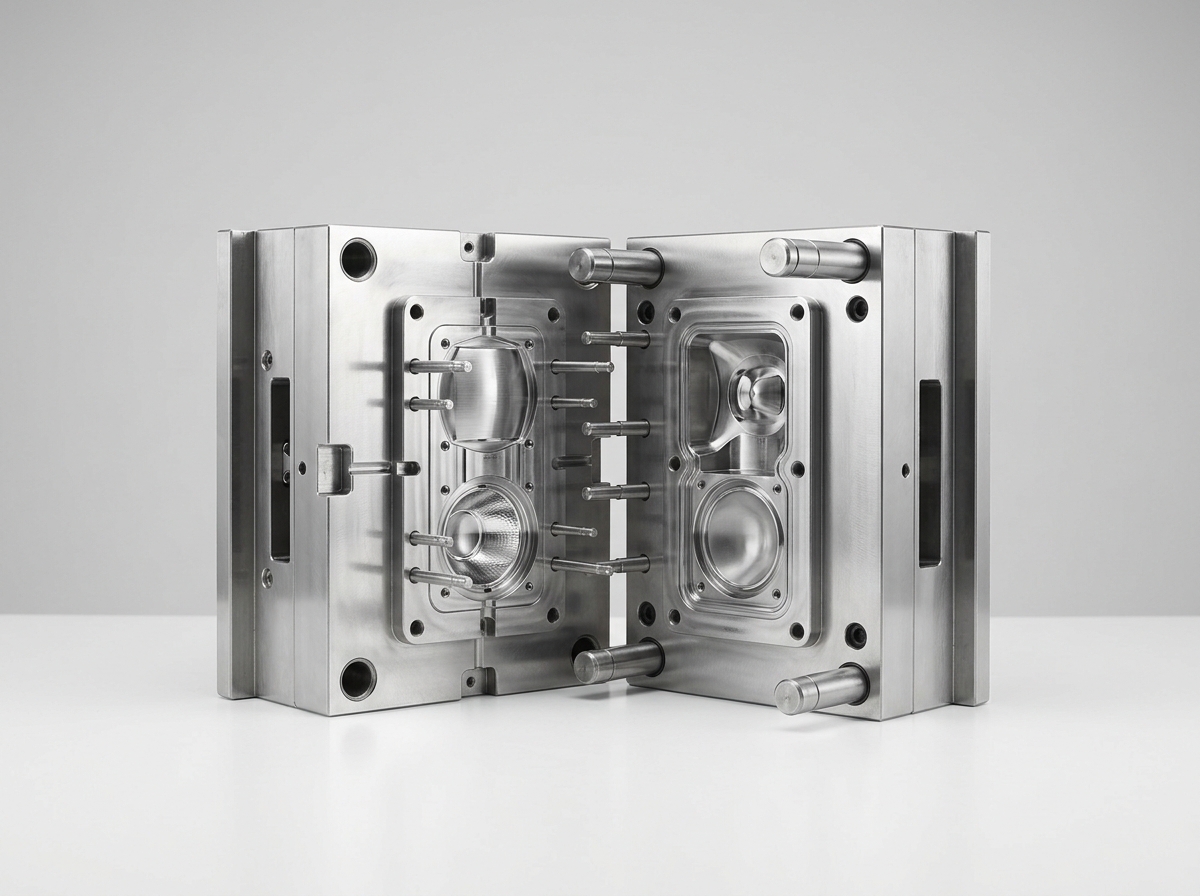
Lighting products expose weak suppliers quickly because the part must look clean, assemble smoothly, and hold its shape after repeated thermal cycling. A clear lens with sink marks, a reflector with flow lines, or a housing that distorts at the screw bosses can cause rejection even if the mold technically runs. That is why buyers should ask how the supplier handles gate placement, venting, cooling balance, and steel selection for the actual part geometry. A supplier serving lighting plastic molds should also show how they manage prototype-to-production transitions, especially when the final injection mold needs to preserve optical zones and hidden structural ribs in the same tool.
One practical benchmark is whether the supplier can translate a CAD file into a production-ready mold plan without overcomplicating the part. For a lighting housing, the most credible answer usually includes wall-thickness targets, rib ratio guidance, shrinkage assumptions, and a test plan for first article verification. The buyer is not only purchasing a mold; the buyer is buying repeatability, response time, and risk reduction over the full product life cycle.
Lighting plastic molds: which part requirements matter most
Lighting plastic molds succeed when cosmetic quality and functional accuracy are designed together.
Lighting components vary widely. A diffuser for a ceiling fixture may prioritize uniform light transmission, while a decorative lamp cover may prioritize gloss, texture, and scratch resistance. A street-light housing may need structural stiffness and weather resistance, while an LED bezel may need exact clip engagement and consistent wall thickness. The right plastic mold supplier should understand these differences and adjust the tooling strategy accordingly.
| Lighting part type | Main requirement | Common material | Typical risk |
|---|---|---|---|
| Clear lens | High transparency and low haze | PC / PMMA | Flow lines, stress marks |
| Diffuser | Uniform light distribution | PC, PMMA, modified PP | Uneven translucency |
| Housing | Strength and assembly fit | ABS / PC-ABS | Warping, sink marks |
| Outdoor cover | UV and impact resistance | UV-stabilized PC | Yellowing, cracking |
For many lighting applications, PC remains a preferred structural and optical material because it combines impact resistance with dimensional stability. The supplier should be able to explain drying conditions, melt-temperature sensitivity, and whether the part needs UV stabilization or surface protection. If the lighting product is exterior-facing, buyers should also ask how the mold and resin combination will handle long-term exposure and how the supplier validates appearance after production trials.
When the product involves premium visual appearance, a 3D mold or complex contour mold can be necessary to reproduce curved surfaces and brand-specific geometry. In those cases, a capable supplier should show how the design is machined, polished, and tested for knit lines and reflection defects. This matters because lighting parts are often judged by the end user before they are judged by the inspector.
How to evaluate an injection mold supplier before you send payment
The best supplier evaluation starts with evidence, not claims.
Before issuing a purchase order, buyers should request a structured package: product drawings, resin recommendation, cavity layout, gate concept, timeline, and sample-control plan. A serious injection mold partner can usually respond with DFM comments on undercuts, draft angles, ejector marks, and wall thickness. The reply quality often reveals whether the supplier has actual engineering depth or only sales coordination.
- Ask for at least one relevant lighting case study with photos, inspection data, and part function explanation.
- Request the supplier’s DFM comments before mold cutting, not after the first trial.
- Confirm what measurement equipment is used for critical dimensions and surface checks.
- Check whether the supplier can support spare inserts, maintenance plans, and mold revision history.
- Verify communication speed for English documents, sample feedback, and quotation revisions.
Suppliers that support export projects usually perform better when they can manage drawings, email response time, sample shipping, and cross-border coordination without confusion. For overseas buyers, this is often as important as CNC capability. A plant with excellent machines but weak project communication can still become a costly sourcing risk if a tooling change is needed under a launch deadline.
Plastic mold supplier quality checks for lighting projects
Quality checks should focus on repeatability, appearance, and assembly, because lighting defects are highly visible.
The practical question is whether the mold can produce acceptable parts across a full trial run, not just one perfect sample. Buyers should ask for first-shot, second-shot, and small-batch stability data, because a good mold may still reveal cooling imbalance, venting weakness, or ejector stress after repeated cycles. For lighting products, the supplier should also define what constitutes an acceptable cosmetic surface, since gloss, texture, and weld-line visibility can influence retail acceptance.
| Check item | What to verify | Why it matters | Evidence to request |
|---|---|---|---|
| Dimensional accuracy | Critical fit points | Assembly reliability | Inspection report |
| Surface finish | Gloss, texture, blemishes | Brand appearance | Sample photos and criteria |
| Warpage | Flatness and alignment | Light sealing and snap-fit | Trial data |
| Cycle stability | Part consistency over runs | Mass production confidence | Production trial records |
For metrology discipline, buyers can align with accepted coordinate-measurement practices and document the measurement plan internally. NIST guidance on dimensional metrology is useful as a reference point for defining uncertainty, gauge selection, and traceability in inspection workflows; see NIST Physical Measurement Laboratory. That matters because a supplier saying a part is “within tolerance” is less useful than a supplier showing how the tolerance was checked, with what instrument, and under what conditions.
When lighting parts are made for regulated or safety-sensitive environments, buyers should also ask whether the mold design supports consistency for downstream assembly checks. Even if the final product is not certified by the mold supplier, the tooling still influences whether the part can be assembled without forced fit, stress whitening, or visible mismatch.
Material selection for lighting plastic molds and injection mold performance
Material selection determines both visual performance and molding risk.
PC is widely used for lighting because it offers high impact resistance and reasonable heat performance, but it must be processed correctly to avoid bubbles, splay, and internal stress. PMMA can provide excellent clarity and surface appearance, but it is more brittle than PC and requires careful handling in impact-prone applications. ABS and PC-ABS are often chosen for housings and structural covers where appearance and toughness need to be balanced rather than maximized on one axis only.
| Material | Strength point | Trade-off | Best lighting use |
|---|---|---|---|
| PC | Impact resistance and stability | Stress sensitivity if processed poorly | Outdoor covers, protective lenses |
| PMMA | Clarity and gloss | Lower impact resistance | Decorative lenses, diffusers |
| ABS | Cost and moldability | Lower heat and weather resistance | Interior housings |
| PC-ABS | Balanced toughness and appearance | Less optical clarity | Functional housings |
Good suppliers discuss drying time, gate design, and packing pressure because lighting parts are sensitive to cosmetic defects. They also understand how resin choice affects cycle time and mold cooling. In real sourcing, that can be the difference between a stable launch and a production line that keeps chasing short shots, sink marks, or unexpected warp.
According to ASTM D1003, haze measurement is a standard way to evaluate light transmission in transparent plastics, which is especially relevant for lenses and diffusers. If a supplier cannot explain how clarity or haze is tested, the quality conversation is incomplete.
How to compare manufacturers, factory capacity, and project support
Factory size matters less than project control and mold lifecycle support.
Many buyers start with “manufacturer versus trading company,” but the real issue is whether the organization can manage engineering feedback, tool build, sample revision, and delivery without fragmentation. A direct factory often has stronger control over machining and modification, while a sourcing intermediary may offer broader coordination. Either can work, but lighting projects need a single point of accountability for drawings, change requests, and test-shot approvals.
A practical way to compare vendors is to score them on five dimensions: engineering support, trial quality, communication, delivery discipline, and after-sales response. A supplier that offers one-stop mold and finished-part supply can reduce handoff errors and lower coordination cost, especially when the buyer needs both tooling and production parts from the same source. That advantage is especially useful for buyers expanding into multiple SKUs or planning product family launches.
- Score engineering response quality on the first round of DFM comments.
- Check whether the supplier can explain root causes, not only symptoms.
- Confirm whether mold maintenance and spare components are available after launch.
- Evaluate whether the supplier can handle revision control without losing drawing history.
- Verify shipment and packaging standards for fragile lighting components.
If you need to compare product platforms, it helps to review the supplier’s broader manufacturing scope such as plastic mould services, injection mold solutions, plastic parts production, and the company profile on about us. These pages help buyers understand whether the supplier can support tooling, sampling, and part supply as one workflow rather than as disconnected services.
Common sourcing mistakes when buying lighting plastic molds
Most sourcing failures come from missing technical questions early.
The first mistake is selecting a supplier on the basis of price alone. A low tooling quote can hide weak cooling design, inadequate steel choice, or poor revision control, all of which cost more later. The second mistake is skipping sample validation and assuming that one acceptable part means the mold is production-ready. The third mistake is not defining cosmetic acceptance criteria for lighting surfaces, which often leads to disagreement after the trial run.
Another common problem is failing to plan for service life. Even a well-built injection mold needs maintenance, insert replacement, and periodic inspection. Buyers who ask about spare cavities, wear parts, and long-term support usually avoid much of the downtime that appears after launch. In lighting programs, that support can matter as much as lead time because product shipments are often tied to promotions, seasonal demand, or installation schedules.
The broader market context also matters. The U.S. Department of Energy notes that LED adoption has reshaped lighting demand and manufacturing requirements, especially for efficient thermal management and optical control; see U.S. DOE Solid-State Lighting. In practical sourcing terms, that means more lighting parts need stable geometry, better heat tolerance, and cleaner cosmetic surfaces than older lamp designs.
A decision framework for choosing the right plastic mold supplier
The best decision framework is technical, commercial, and operational at the same time.
Start by defining the product type: clear lens, diffuser, housing, or decorative cover. Then define the critical characteristics: transparency, impact resistance, snap-fit strength, surface finish, and monthly volume. Next, check whether the supplier can explain the mold structure in plain English while still using correct engineering terms. A good supplier should move comfortably between the part drawing, the mold design, and the production plan.
For buyers working with a new supplier, the highest-value question is often: “What could go wrong in this part, and how would you prevent it?” The answer should reference gate balance, venting, cooling, steel wear, and measurement method. If the response is vague, the risk is usually hidden in the tool.
- Define the lighting part’s cosmetic and functional critical points.
- Request a DFM review and compare it with your own engineering assumptions.
- Ask for sample and inspection evidence, not only a quotation.
- Check communication quality for changes, delays, and problem-solving.
- Confirm spare-part, maintenance, and mass-production support.
When these steps are in place, a plastic mold supplier becomes a project partner rather than a one-time vendor. That distinction matters most in lighting, where part appearance, fit, and repeatability directly affect the final product’s value in the market.
FAQ about plastic mold supplier selection for lighting products
How do I know if a plastic mold supplier is good for lighting parts?
A good supplier can explain how the mold will control appearance, shrinkage, warpage, and assembly fit, and can support those explanations with DFM feedback and sample reports.
What material is most common for lighting plastic molds?
PC is common for impact resistance and stability, while PMMA is often used for clarity and surface finish, and ABS or PC-ABS are common for housings.
Should I choose a manufacturer or a trading company?
Choose the organization that can prove engineering support, revision control, and reliable sample management, because those functions matter more than the business model alone.
What documents should I request before starting an injection mold project?
Request drawings, resin recommendations, cavity layout, DFM comments, timeline, sample-control plan, and inspection criteria.
How important is mold maintenance after delivery?
Very important, because wear parts, inserts, and periodic inspection help maintain cycle stability and reduce downtime during mass production.
Why do lighting molds need special attention to surface quality?
Because lighting parts are highly visible and cosmetic flaws such as flow lines, sink marks, or weld lines can directly affect acceptance by customers and retailers.
What is the most common mistake when buying a lighting plastic mold?
The most common mistake is choosing the lowest quote without checking process control, sample evidence, and long-term support.
Post time: Jul-14-2026