
- Choose the manufacturer by product complexity, not by price alone.
- Ask for mold design, trial feedback, and process validation evidence.
- Match material choice, tolerance target, and production volume to the application.
- For export projects, communication speed and document control matter as much as machining capability.
- A strong OEM plastic manufacturing partner reduces launch risk, scrap, and schedule drift.
If you are searching for a custom plastic product manufacturer, the real question is not “Who is cheapest?” but “Who can consistently convert my design into a stable production part?” In precision molding, process capability is often judged against tolerance standards such as ISO 20457:2018, while machine performance and repeatability should be checked against documented process data. For example, many modern injection systems run at injection pressures above 100 MPa and clamping forces from 50 to several thousand tons, depending on part size and complexity. If you need a partner for enclosures, you may also review plastic injection mold services, plastic housing mold solutions, and 3D mold development to see whether the supplier’s capabilities fit your product category.
How to Choose a Custom Plastic Product Manufacturer for OEM Plastic Manufacturing
The best manufacturer is the one whose strengths match your part’s technical and commercial risk.
For procurement teams, the first mistake is treating every plastic manufacturer as if they were interchangeable. They are not. A supplier that excels at simple daily-use parts may struggle with tight-tolerance housings, while a mold shop built for high-volume consumer goods may not be the best fit for low-volume industrial components that need engineering support and long-term tooling stability.
A practical selection process starts with your application. Consumer electronics demand clean fit, invisible parting lines, and reliable snap features. Appliance parts need dimensional stability and appearance consistency. Industrial accessories often need mechanical strength, heat resistance, and stable replenishment over time. If you are evaluating a custom plastic parts portfolio, the manufacturer should be able to discuss not only mold making, but also resin behavior, draft angle, rib design, and assembly load paths.
Custom Plastic Product Manufacturer Capability Checklist
A serious OEM plastic manufacturing partner should demonstrate engineering depth before production begins.
Do not start with a factory tour alone. Start with evidence. Ask for sample reports, previous project cases, tolerance capability ranges, material recommendations, and communication workflow. A capable plastic manufacturer should explain whether the part needs a single-cavity, multi-cavity, or family mold, and why. They should also identify risks such as sink marks, weld lines, warpage, short shots, and overpacking before steel is cut.
| Capability area | What to verify | Why it matters | Typical evidence |
|---|---|---|---|
| Design review | Draft, wall thickness, ribs, undercuts | Reduces tooling changes and mold defects | DFM report, annotated drawings |
| Tooling engineering | Cavity layout, gate location, venting | Affects fill balance and cosmetic quality | 3D mold analysis, tool plan |
| Process control | Injection pressure, hold time, cooling time | Improves repeatability | Trial records, parameter sheets |
| Quality control | Inspection method, sampling plan, Cpk targets | Supports stable shipment quality | FAI, in-process reports |
For export buyers, communication capability is part of manufacturing capability. A supplier that responds slowly to drawing questions can delay tooling launch by days or weeks. In cross-border programs, document clarity, time-zone discipline, and change tracking are critical because a small ambiguity in a 2D drawing can become a costly mold revision later.
OEM Plastic Manufacturing Materials: Match Resin to the Part Function
Material choice is the fastest way to improve or ruin a custom plastic project.
When buyers say they want a plastic product made “well,” they often mean different things. Some mean higher impact resistance. Others mean better appearance, tighter tolerance, or lower cost. The material must serve the use case. For transparent or semi-transparent housings, polycarbonate is often chosen because it combines high impact strength and dimensional stability. For outdoor or chemical-exposed parts, other engineering resins may be more appropriate. For basic consumer parts, commodity polymers can reduce cost if the load case is modest.
| Material | Common use case | Key strength | Selection caution |
|---|---|---|---|
| PC | Transparent housings, protective covers | Impact resistance, stability | Needs moisture and stress control |
| ABS | Electronics shells, appliance parts | Good appearance, easy molding | Lower heat resistance than engineering resins |
| PP | Containers, everyday parts | Low density, chemical resistance | Less rigid than ABS or PC |
| PA | Structural and wear parts | Strength and toughness | May absorb moisture and change dimensions |
Material behavior should be judged in relation to process conditions. A resin that performs well in a lab sample may warp in production if drying, melt temperature, mold temperature, or packing pressure are poorly managed. That is why a competent plastic manufacturer should discuss both resin selection and molding parameters together, not separately.
When the project involves exterior appearance, the supplier should also confirm texture, gloss, and color consistency. For high-visibility parts, the gating and venting strategy can be as important as the resin grade. A good design team will not just approve the material; it will explain why the material and the mold design work together.
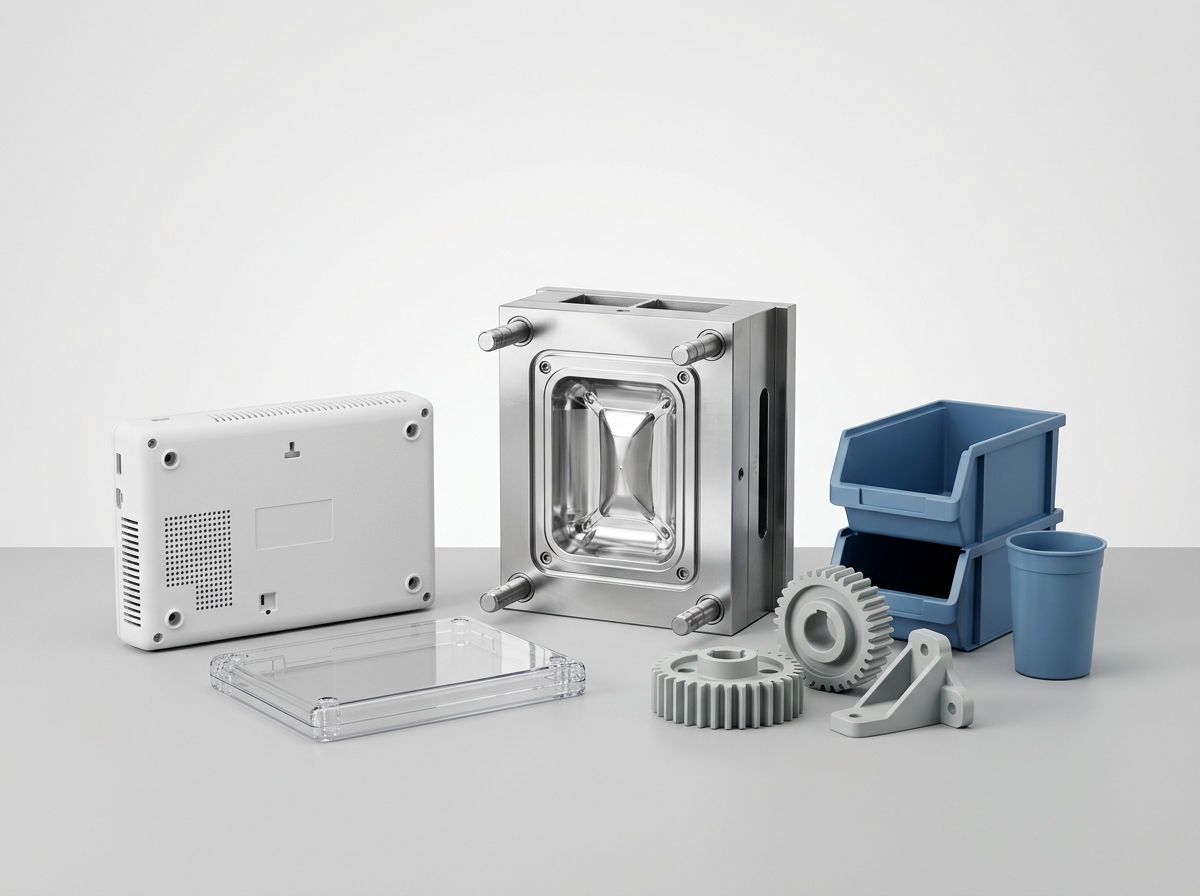 How to Evaluate Mold Design, Trial Runs, and Tolerance Control
Tooling quality determines whether a part can be produced repeatedly without constant correction.
One of the clearest signs of a strong custom plastic product manufacturer is how it handles mold development. The best suppliers ask for drawings, samples, target annual volume, assembly conditions, and cosmetic priorities before they quote tooling. That early review helps decide whether the part needs core pulling, side action, hot runner support, or special ejection geometry.
For dimensional evaluation, buyers should ask how the manufacturer measures critical features. In precision production, inspection may include calipers, micrometers, optical measuring systems, and first-article inspection records. Industry tolerance frameworks such as ISO 2768-1:1989 help set general dimensional expectations, while more specialized requirements may be defined by the part drawing itself. If a supplier cannot explain how it controls critical dimensions, that is a procurement warning sign.
| Evaluation point | Good sign | Risk signal | Buyer action |
|---|---|---|---|
| DFM review | Specific feedback on draft and ribs | Only price discussion | Request revision notes |
| Trial sample | Stable appearance and fit | Short shot or flash | Ask for root-cause analysis |
| Dimension control | Critical features measured every run | No measurement method | Request inspection plan |
| Change management | Revisions logged and approved | Informal verbal changes | Require written ECO process |
In well-run molding operations, cycle time can be reduced by improving cooling and gate design, but only if part quality remains stable. A part that is one second faster but warps during assembly is not an improvement. Buyers should therefore evaluate cycle time together with reject rate, fit, and functional tests. For many programs, the right metric is not the fastest press cycle, but the lowest total cost per acceptable part.
What to Ask a Plastic Manufacturer Before You Place an Order
Smart questions reveal whether the supplier understands your business risk.
Before awarding an OEM plastic manufacturing project, ask direct questions about capacity, quality, and support. A credible manufacturer should answer without evasiveness. If the answers are vague, the project may become expensive later. The right discussion should cover mold ownership, lead time, spare parts, pilot run size, and response time for engineering issues.
- Can you review my drawing and identify molding risks before quotation?
- What is your normal tooling lead time for a single-cavity and multi-cavity mold?
- How do you control appearance defects such as sink marks, weld lines, and flash?
- What inspection documents do you provide for first article and production batches?
- How do you handle engineering changes after the first trial?
These questions are especially important if you are sourcing for appliances, consumer electronics, or industrial products. In those markets, a mismatch between housing geometry and assembly structure can stop an entire production line. If the manufacturer also offers plastic mold accessories, that can be useful for lifecycle support because worn components can be replaced without rebuilding the entire tool.
Quality Standards and Real-World Data That Buyers Should Know
Quality is easier to manage when it is tied to a measurable standard.
Procurement teams often ask for “high quality,” but quality must be defined numerically. In injection molding, relevant checks often include dimensional accuracy, surface appearance, mechanical performance, and process capability. International standards help frame those expectations. For example, ASTM D638 is widely used for tensile properties of plastics, while ASTM D790 is used for flexural properties. These standards do not make the part good by themselves, but they do make the test method repeatable and auditable.
From a manufacturing perspective, one useful operational benchmark is first-pass yield. A plant that controls material drying, mold temperature, and packing pressure well should reduce rework and scrap relative to a poorly controlled line. While actual rates depend on part complexity, supplier discipline often matters more than machine age. Buyers should ask for actual trial data, not generic claims.
| Test or control item | Reference | What it tells the buyer | Why it matters |
|---|---|---|---|
| Tensile test | ASTM D638 | Strength and elongation | Shows load behavior |
| Flexural test | ASTM D790 | Bending resistance | Useful for shells and brackets |
| General tolerances | ISO 2768-1:1989 | Accepted dimensional range | Useful for drawing interpretation |
| Process documentation | Trial report, FAI | Repeatability evidence | Supports supplier qualification |
For technical buyers, another reference point is machine repeatability. On stable production lines, repeatable shot control and consistent cooling are more valuable than headline machine speed. That is why many buyers prefer suppliers that can show process sheets, not just machine photos.
Internal Coordination: Why One-Stop Mold and Product Supply Can Reduce Risk
One-stop sourcing can reduce interface risk when the supplier is truly integrated.
If your project includes mold making, sample approval, and mass production, consolidating responsibility can shorten the feedback loop. A supplier that handles both tooling and production can often solve problems faster because design, trial, and manufacturing teams share the same data. That is especially useful in launch programs, where a one-week delay may affect retailer timing or customer delivery commitments.
The benefit is not simply convenience. It is control. When tooling, process tuning, and final part output are separated across multiple vendors, responsibility for defects can become unclear. Integrated supply is often better for product launches, provided the manufacturer has disciplined documentation and a clear approval process.
- Confirm who owns mold design and revisions.
- Set acceptance criteria before tool cutting begins.
- Define who signs off on trial samples.
- Document packaging, labeling, and logistics requirements.
- Track spare parts and mold maintenance obligations.
If your buying strategy includes multiple product lines, you may also want a supplier that can handle plastic parts manufacturing and future expansion into related tooling families. That reduces the cost of onboarding new SKUs and helps standardize quality expectations across product categories.
Common Mistakes When Selecting a Plastic Manufacturer
The most expensive supplier is often the one that looks cheap at the beginning.
Buyers often choose based on the first quote, then pay later through redesigns, delays, and rejected lots. A low tooling price can hide weak engineering, poor communication, or inadequate inspection. Another common mistake is assuming that a supplier with broad product categories automatically has depth in your exact part type.
- Choosing without a drawing review or DFM discussion.
- Ignoring material drying, shrinkage, and warpage risks.
- Not defining cosmetic standards for visible surfaces.
- Accepting a sample without production-relevant validation.
- Overlooking spare parts and tool maintenance planning.
The better approach is to compare suppliers on launch readiness. Ask who will support the trial, who will respond to defects, and how quickly tooling modifications can be implemented. For export buyers, also ask whether the team is comfortable with English documentation, inspection communication, and shipment coordination.
How to Make the Final Choice with Confidence
The right supplier is the one that reduces your project uncertainty the most.
If two suppliers offer similar prices, choose the one that asks better questions. Good questions indicate process thinking. Good process thinking usually leads to fewer defects, less schedule risk, and more stable production. For a high-value product, that matters more than a small unit-cost difference.
Use this final decision logic: if your part is visually sensitive, prioritize cosmetic control and sample consistency; if it is structural, prioritize engineering support and material validation; if your launch is time-critical, prioritize response speed and document discipline. A dependable custom plastic product manufacturer should be able to align all three.
In the end, OEM plastic manufacturing is not just about making plastic. It is about making a part that fits the design intent, survives production, and arrives on schedule. The best plastic manufacturer is the one that can prove that outcome before the first mass-production order is placed.
FAQ
What is the most important factor when choosing a custom plastic product manufacturer?
The most important factor is whether the supplier can match its tooling and process capability to your part requirements. Price matters, but engineering fit, communication, and quality control matter more for long-term success.
How do I know if a plastic manufacturer is good for OEM plastic manufacturing?
A good OEM plastic manufacturing partner provides DFM feedback, trial data, inspection documents, and clear change control. They should be able to explain material choice, tooling design, and production risks in practical language.
Should I choose a supplier with the lowest tooling quote?
Not necessarily. The lowest quote can lead to higher hidden costs if the mold needs rework, if samples fail fit checks, or if production quality is unstable. Compare total project risk, not only initial price.
What documents should I prepare before asking for a quotation?
Prepare 2D drawings, 3D files, target material, annual volume, cosmetic requirements, assembly conditions, and any critical dimensions. Samples are helpful when the design is still being finalized.
Why is material selection so important for plastic products?
Because material choice affects strength, appearance, heat resistance, shrinkage, and cost. A wrong resin can cause warpage, poor fit, or early failure even if the mold is well made.
How do I evaluate quality before mass production?
Review the sample report, first-article inspection, and test method references such as ASTM D638 and ASTM D790. Ask how the supplier measures critical dimensions and controls process variation.
When is one-stop mold and product supply the best choice?
It works best when the project needs faster feedback, fewer handoff errors, and unified responsibility from mold development through production. It is especially useful for launch programs and multi-SKU product lines.
Post time: Aug-15-2026