
- Choose a plastic injection factory by process control, not by sales promises or lowest unit price.
- Global brand work depends on sample feedback speed, English documentation, and stable OEM plastic manufacturing workflows.
- For cosmetic and structural parts, ask for tolerance, material, and inspection evidence before you approve tooling.
- A strong supplier can support tooling, trial runs, production, and spare parts with one accountable team.
Choosing a reliable plastic injection factory for global brands means judging whether the supplier can consistently deliver plastic injection molding parts that meet appearance, fit, and durability targets under real production conditions. In practice, brands usually need dimensional capability, controlled tooling, and disciplined change management, not just machine capacity. International buyers often compare suppliers against recognized systems such as ISO 13485:2016 for controlled documentation habits in regulated industries, and against general manufacturing quality expectations in ISO 9001. For critical dimensions, many engineering teams also reference process capability targets such as Cpk 1.33 or higher in stable production, depending on the part and the customer’s risk tolerance. For molded plastic housings, that level of control matters because a 0.2 mm deviation can affect snap fits, sealing, and cosmetic alignment long before the part looks obviously defective.
What Global Brands Really Need From a Plastic Injection Factory
Global brands usually need a supplier that can protect launch timing, not only a factory that can quote fast.
The first decision mistake is to confuse equipment size with reliability. A plastic injection factory may own many machines, but if it cannot explain molding windows, gate design, shrinkage control, or post-mold inspection, the project risk stays high. For OEM plastic manufacturing, reliability is built through repeatable setup, process records, and rapid corrective action. That is especially important for consumer electronics, home appliances, industrial housings, and other parts where appearance and assembly both matter.
For example, a PC housing often needs impact resistance, clarity or semi-clarity, and stable dimensions across batch runs. In many engineering applications, polycarbonate tensile strength is commonly listed around 60 to 70 MPa, while its heat deflection temperature varies by grade and loading condition. These numbers matter because the material choice changes wall thickness, draft angle, and cooling strategy. If the factory cannot discuss such trade-offs clearly, it is less likely to manage production risk effectively.
Plastic Injection Molding Capability That Matters Most
Process capability matters more than machine count when you are selecting a plastic injection factory.
A factory’s mold design and molding process should be evaluated together. A strong supplier can read a 3D model, ask the right questions about material, and suggest changes that improve part release, reduce sink marks, or shorten cycle time. This is where a good plastic injection molding partner saves time at the source. In many projects, a small geometry adjustment can reduce cooling imbalance and improve cosmetic consistency across cavities.
Global buyers should also ask whether the factory supports mold trials, sample review, and production stabilization under one roof. That matters because the gap between T0 samples and mass production is often where defects appear. According to ISO 20457:2018, plastics molded parts can be classified and checked with defined tolerancing logic, which helps brands formalize acceptance criteria. The best suppliers do not wait for rejection; they design the inspection method into the project from the beginning.
| Evaluation Area | What to Ask | Why It Matters | Useful Numeric Benchmark |
|---|---|---|---|
| Tooling review | Can the factory suggest gate, vent, and cooling changes? | Reduces warpage and cosmetic defects | Draft angles often start around 1 to 2 degrees depending on surface texture |
| Dimensional control | What tolerance can be held on repeat runs? | Protects assembly fit and sealing | Many precision housings target ±0.05 mm to ±0.10 mm on key features |
| Cycle stability | How does the team manage process drift? | Prevents variation during long production runs | Cycle times may range from 20 to 60 seconds for medium-sized housings |
| Inspection system | What reports are issued with each batch? | Supports brand traceability and claims handling | FAI, IPQC, and final inspection should be documented for every lot |
How to Evaluate OEM Plastic Manufacturing Before You Place an Order
The best way to evaluate OEM plastic manufacturing is to test how the supplier thinks before you test how it produces.
Start with the RFQ response. A reliable plastic injection factory will not only quote price; it will ask about annual volume, appearance grade, material specification, mold life expectation, packaging, and testing standard. That behavior shows whether the supplier understands the full product lifecycle. If the reply is vague, delayed, or overpromising, the project will likely become difficult later.
Then check whether the factory can explain the difference between prototype intent and mass-production intent. A design that works in a sample room may fail in a 50,000-piece run if cooling, ejection, or clamp pressure is not controlled. For global brands, the supplier should also support documentation in English, including part drawings, issue logs, and revision control. Cross-border projects move faster when the same team handles tooling, sampling, and production feedback.
A practical assessment method is to ask for three things:
- A sample report with dimensional results and defect notes.
- A material certificate or traceable resin batch record.
- A corrective action example from a previous production issue.
If a factory cannot provide these without hesitation, its process discipline is probably weaker than its sales pitch.
| Supplier Signal | Strong Factory | Weak Factory | Risk to Brand |
|---|---|---|---|
| RFQ response | Asks about tolerance, resin, and annual volume | Only sends a unit price | Hidden tooling and quality risk |
| Sample review | Provides measured data and defect commentary | Sends samples with no report | Approval based on guesswork |
| Change control | Uses revision tracking and approval gates | Changes drawings informally | Version mismatch in mass production |
| Communication | Replies clearly in English and confirms next steps | Gives short, unclear answers | Delayed launch and misunderstanding |
Plastic Injection Factory Quality Checks That Global Buyers Should Require
Quality checks are the fastest way to separate a dependable factory from a risky one.
For plastic injection molding, quality should be layered across incoming material control, in-process inspection, and final audit. The supplier should define what is checked, how often it is checked, and what happens when a measurement drifts. For cosmetic parts, visual standards are just as important as dimension control, because sink marks, flash, weld lines, and gloss differences can damage brand perception immediately.
A credible factory will typically use structured inspection points such as first article inspection, patrol inspection, and final random sampling. Many buyers also request AQL-based acceptance rules for shipment lots. For example, an AQL plan can specify different thresholds for critical, major, and minor defects, which makes acceptance decisions transparent. If the supplier cannot describe its inspection logic, it is difficult to trust its claim of stable output.
For high-visibility housings, ask about surface finish standards, color consistency control, and mold maintenance frequency. Even a well-made mold will degrade if it is not cleaned, polished, and monitored. In global supply chains, spare parts and preventive maintenance matter because one worn core pin can stop a launch batch and create expensive delay. A strong factory keeps tool-life records and does not treat maintenance as an afterthought.
- Ask for incoming resin traceability by lot number.
- Request the inspection frequency for each critical feature.
- Verify whether the factory keeps mold maintenance logs.
- Confirm how nonconforming parts are quarantined and reviewed.
Why Design Support Is a Core Sign of a Reliable Plastic Injection Factory
Design support is one of the clearest indicators of whether a plastic injection factory can handle global-brand work.
Good design support shortens the path from concept to stable production. For plastic housings, that usually means advising on wall thickness, rib layout, draft angle, gate placement, and ejector pin marks. For example, many molded enclosures perform better when wall thickness stays uniform and ribs are designed to support stiffness without causing sink. The factory does not need to be the product designer, but it must understand how manufacturability affects cost, appearance, and yield.
This is also where one-stop mold and finished-part supply becomes valuable. When tooling and molding are handled by separate vendors, the brand may face longer debugging cycles and unclear responsibility. A factory that can manage both mold development and production reduces handoff loss and makes troubleshooting faster. That is especially useful for global brands launching multiple SKUs, because the same engineering team can reuse lessons across variants.
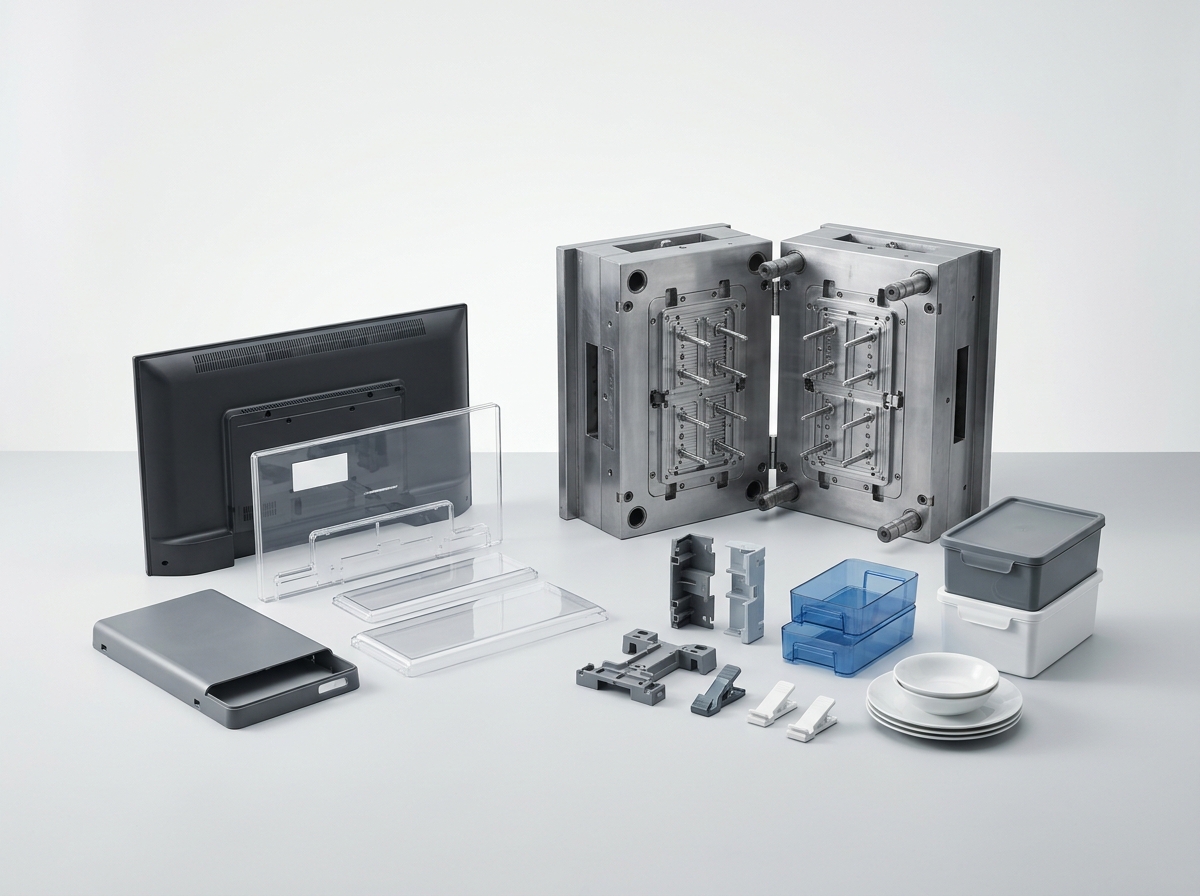
In one common project pattern, a consumer electronics customer needs a PC front shell with a tight snap fit and a premium visual finish. If the factory suggests a slight rib adjustment, a gate shift, and a controlled cooling change before tooling is cut, the project can avoid rework later. That kind of advice saves more money than a lower unit price ever will.
How to Compare Plastic Injection Molding Offers Without Getting Misled by Price
The lowest quote is often the most expensive choice once risk is included.
Price comparison must include tooling scope, sample count, mold steel grade, inspection documentation, packaging method, and after-sales support. A low initial quote may exclude engineering support or use a softer mold steel that increases maintenance costs later. Global brands should compare total cost of ownership, not just the per-piece number.
Consider the actual production economics. Industry sources such as the NIST Materials and Manufacturing Technology program emphasize process control as a major factor in repeatability, which directly affects scrap and rework. In many molding operations, improving process stability by a few percentage points can reduce hidden costs across labor, material, and delayed shipments. For a brand shipping millions of units, even a 1% scrap reduction can materially improve margins.
Also check whether the supplier is realistic about lead times. A factory that promises impossible schedules may be hiding unstable capacity or weak tool planning. A reliable partner gives a timeline that includes design review, steel cutting, trial runs, sample approval, and ramp-up. Predictable timing is often more valuable than a fast promise that cannot be met.
| Cost Factor | What It Includes | Hidden Risk if Ignored | Typical Decision Impact |
|---|---|---|---|
| Tool steel | Core, cavity, inserts, wear parts | Short mold life and unstable dimensions | Higher maintenance cost over time |
| Engineering support | DFM review and trial feedback | More samples and rework loops | Slower launch |
| Inspection | Measurement and batch records | Rejected shipments and claims | Better traceability |
| Packaging | Protection, labeling, carton spec | Transit scratches and mix-ups | Lower damage rate |
Best Use Cases for Global Brands Needing Plastic Injection Molding
The right plastic injection factory should match the product category, not just the material list.
For consumer electronics, the priority is usually visual consistency, snap-fit reliability, and clean parting lines. For home appliances, fit and structural strength matter more because the parts often work under heat, vibration, or repeated handling. For industrial equipment, long-term supply stability and spare-part continuity become critical. That is why many brands prefer suppliers with both mold and parts capability: it helps them scale without rebuilding the sourcing chain every time the product line expands.
Different products also change the evaluation lens. A transparent cover may need better surface control than a hidden internal bracket. A 3D-shaped decorative shell may require higher mold complexity and tighter sample review than a simple utility component. A factory that understands these distinctions will recommend the right production route instead of forcing every project into the same process.
In global sourcing, the strongest suppliers are usually the ones that ask about the end market. A part for a retail shelf display, a cordless appliance, and an industrial control box do not fail in the same way. Suppliers that understand this reality usually give better technical advice and fewer surprises during pilot production.
How to Audit a Plastic Injection Factory Before Signing
A factory audit should test systems, people, and documentation together.
First, review the engineering workflow. Can the team explain mold flow logic, sampling criteria, and issue escalation? Second, review production control. Are machine settings recorded, and are first-piece approvals required before the line runs? Third, review quality records. Are rejection causes tracked, and is there a corrective action process? These questions reveal whether the factory is truly reliable or simply busy.
Third-party benchmarks can help structure the audit. The ASTM D638 standard, for example, defines tensile test methods for plastics and is widely used to verify material behavior. When a factory understands standards like this, it can better align incoming material checks and product validation with engineering expectations. Likewise, for dimensional verification, buyers often rely on calibrated instruments and documented calibration systems rather than informal inspection.
A practical factory audit checklist is simple:
- Check whether the factory can show current drawings and revision history.
- Confirm tooling maintenance and spare-part handling.
- Ask how rejected parts are isolated and recorded.
- Review the last three production issue reports and their corrective actions.
Choosing a Reliable Plastic Injection Factory: Final Decision Framework
The most reliable factory is the one that lowers project uncertainty at every stage.
For global brands, the best plastic injection factory combines engineering support, controlled plastic injection molding, and disciplined OEM plastic manufacturing. It should communicate clearly, document changes, and prove that it can hold quality over time. If a supplier can explain its tooling strategy, sampling logic, inspection records, and production response to issues, it is much easier to trust than a factory that only talks about machine tonnage.
One useful way to make the final decision is to score each supplier across five areas: design support, sample quality, production stability, communication, and after-sales responsiveness. A supplier that performs well in all five usually creates fewer surprises in launch and ramp-up. A supplier that is excellent in only one area but weak in the others may still create delay, scrap, and brand risk.
For buyers who want a deeper view of sourcing options, it also helps to compare service scope across plastic injection molding solutions, injection molding services, plastic mold development, and custom plastic parts. If your project needs more than one SKU or a broader product platform, a supplier with integrated support can reduce coordination overhead and help keep release timing under control.
FAQ: Plastic Injection Factory Selection for Global Brands
What is the first thing to check in a plastic injection factory?
The first thing to check is whether the factory can explain process control, not just pricing. Look for DFM support, sample reports, and revision control.
How do I know if OEM plastic manufacturing is stable?
Stable OEM plastic manufacturing shows up in repeatable samples, documented inspections, and clear corrective actions when a defect appears.
What tolerance can a plastic injection factory usually hold?
It depends on part size, material, and geometry, but many precision housings target ±0.05 mm to ±0.10 mm on critical features when the mold and process are well controlled.
Why is design support important in plastic injection molding?
Design support reduces warpage, sink marks, and assembly issues before tooling is cut, which saves time and cost during launch.
Should I choose a factory with mold making and molding in one place?
Yes, in many projects one-stop capability reduces handoff loss, speeds debugging, and makes responsibility clearer during sample and mass production stages.
How can I compare two suppliers with similar prices?
Compare tooling scope, inspection depth, communication quality, and production stability. The cheaper quote is not better if it increases risk or rework.
What documents should a reliable factory provide?
At minimum, request drawings with revision control, sample reports, material traceability, inspection records, and a corrective action example.
Post time: Jul-28-2026