
- Prepare an RFQ that includes geometry, tolerance, resin, finish, volume, and delivery target.
- Ask the supplier to review design-for-manufacturing risks before paying for the mold.
- Separate tooling cost, sample approval, and unit price so you can compare suppliers fairly.
- Choose a China plastic manufacturer with export communication, trial support, and stable production control.
- Use written acceptance criteria for color, appearance, dimensions, and packaging.
Custom plastic injection molding from China works best when the buyer treats it as an engineering process, not a simple purchasing quote. If your part needs repeatable fit, stable appearance, and scalable unit cost, the supplier must convert your design intent into a manufacturable mold and a controlled production plan. In practice, that means sharing CAD files, target quantity, resin preferences, and acceptance standards early. Dimensional requirements should be realistic: ISO 20457:2018 defines general tolerances for molded parts, and many projects succeed faster when the buyer aligns inspection methods with measurable limits rather than vague wording. A well-run OEM plastic manufacturing project can shorten iterations, reduce scrap, and help you move from sample to mass production with fewer surprises.
How to request custom plastic injection molding services from China the right way
The best request is a complete engineering brief, not a one-line inquiry. Buyers often ask for a “price for plastic parts,” but a China plastic manufacturer can only quote accurately when the part definition is complete enough to estimate mold complexity, cavity count, cycle time, and post-processing.
At minimum, send a 3D CAD file in STEP or IGES format, a 2D drawing with critical dimensions, resin grade preference, surface finish, color, expected annual usage, and packaging requirements. If your product is an electronic enclosure, include assembly interfaces, screw bosses, snap-fit locations, wall thickness targets, and any sealing requirement. If your product is a consumer housing, include appearance zones and cosmetic defect limits. These details directly affect tooling design, gate placement, cooling layout, and the final quotation.
It also helps to state your commercial goal. A supplier needs to know whether you are validating a new product, replacing an existing vendor, or scaling an established SKU. Prototype-friendly projects can tolerate more iteration, while launch-critical programs need stable lead time and strict sign-off gates.
What a China plastic manufacturer needs before quoting OEM plastic manufacturing
Quotation accuracy depends on the quality of the input package. The more complete your RFQ, the easier it is for the supplier to separate one-time mold investment from recurring piece cost.
| RFQ item | Why it matters | Typical detail level |
|---|---|---|
| 3D model | Defines geometry, draft, undercuts, and moldability | STEP, IGES, or X-T |
| 2D drawing | Sets tolerance and inspection focus | Critical dimensions marked in mm |
| Material | Affects shrinkage, strength, and appearance | ABS, PC, PP, PA, POM |
| Annual volume | Determines cavity count and tooling strategy | Prototype, low-volume, mass production |
| Surface finish | Impacts texture, gloss, and polish cost | SPI finish, matte, gloss, paint-ready |
| Packaging | Influences shipping protection and labor | Bulk, tray, polybag, custom carton |
Volume planning is one of the most important pricing levers. A supplier may quote a simple single-cavity mold for a low-volume project, but the same part could justify a multi-cavity or family mold if annual demand is higher. More cavities usually raise tooling cost but lower unit price through better output per cycle.
As a practical example, a buyer requesting 5,000 parts per year should not expect the same tooling strategy as a buyer planning 500,000 parts per year. The first may prioritize lower upfront investment; the second may prioritize cycle time, automation, and long-term stability. This is why buyers should provide forecast ranges, not just one number.
How to compare custom plastic injection molding quotes from China
The cheapest quote is rarely the best quote. To compare suppliers fairly, split each offer into tooling, samples, engineering changes, unit price, and lead time.
| Quote element | What to check | Buyer risk if unclear |
|---|---|---|
| Mold cost | Steel grade, cavity count, hot runner or cold runner | Hidden revisions and quality drift |
| Sample cost | Trial shots, dimension reports, rework policy | Unexpected extra charges |
| Unit price | Material, labor, trimming, assembly, packaging | Artificially low start price |
| Lead time | Tooling weeks and production weeks | Missed launch window |
| Payment terms | Deposit, balance, milestone payments | Cash flow pressure |
For molded parts, tooling lead time is often the hidden schedule risk. If a supplier promises fast delivery without explaining steel procurement, DFM review, mold flow analysis, tool-making, trial, and dimensional correction, the schedule may be unrealistic. A credible China plastic manufacturer should explain the process step by step and define what happens if the first sample does not pass approval.
Buyers should also ask whether the quote includes design support. Strong suppliers often identify sink risk, weld-line exposure, gate marks, ejector pin visibility, and shrinkage-sensitive ribs before cutting steel. That early feedback can save weeks and prevent a costly retool.
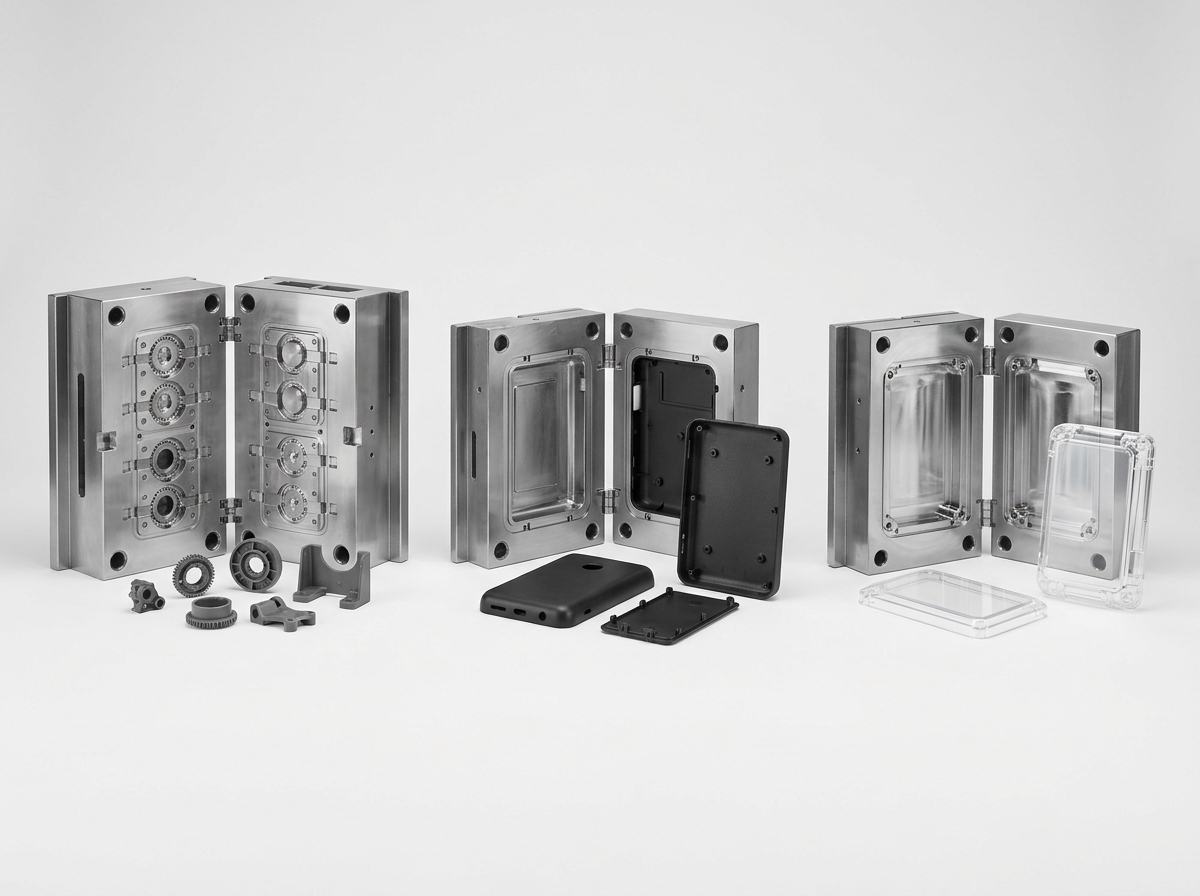
Which plastic materials are best for OEM plastic manufacturing projects
Material selection determines performance, appearance, and processing stability. For custom plastic injection molding, the wrong resin can create warpage, poor snap-fit behavior, brittle impact response, or cosmetic defects.
| Material | Key property | Common use case | Typical note |
|---|---|---|---|
| ABS | Good impact resistance and processability | Consumer housings | Easy to mold, good surface finish |
| PC | High impact resistance and transparency | Protective covers, lighting parts | Often used where clarity matters |
| PP | Low density and chemical resistance | Household and packaging parts | Good for cost-sensitive projects |
| PA | Strength and wear resistance | Functional clips, gears, brackets | Moisture conditioning matters |
| POM | Low friction and dimensional stability | Precision moving components | Good for repeated motion |
PC is a common choice for housings that need transparency and impact resistance. It is widely used in electronics and protective applications because it balances visual clarity with toughness. For parts that must hold shape under assembly load, PC can be a strong option when the design manages wall thickness and cooling well.
For outdoor or high-temperature use, buyers may need UV-stabilized or flame-retardant grades, depending on the application. The supplier should confirm whether the chosen resin supports your compliance target, whether that is UL-related performance, chemical resistance, or repeated assembly durability.
How to reduce tooling risk in custom plastic injection molding
Tooling risk falls sharply when design-for-manufacturing is handled before steel cutting. The most expensive mistakes usually come from geometry that looks fine in CAD but behaves poorly in the mold.
- Check draft angle, undercuts, and wall uniformity before quotation.
- Define critical dimensions and inspection methods in the drawing.
- Ask for a mold flow review if the part has thick-to-thin transitions.
- Confirm gate location and cosmetic zones before trial production.
- Approve samples in writing before mass production starts.
Industry practice commonly uses draft to help molded parts release cleanly from the tool. For many straight-pull features, even modest draft can improve demolding consistency and reduce surface damage. The exact draft depends on texture, resin, and geometry, so the supplier should recommend a part-specific value instead of giving a generic promise.
Another practical risk is shrinkage. Different polymers shrink differently, and even within the same resin family, wall thickness, fiber content, and cooling design change the final result. That is why sampling is not just a formality; it is the point where CAD assumptions meet real material behavior.
How quality control works in China plastic manufacturer projects
Quality control should begin with the first sample and continue through every production batch. Buyers often focus only on final inspection, but molded parts are process-sensitive, so control must include incoming material, trial-shot validation, in-process checks, and packaging verification.
For dimensional checks, suppliers commonly use calipers, micrometers, gauges, and coordinate measurement systems depending on tolerance tightness and part complexity. For appearance control, the buyer should define acceptable gate marks, sink marks, flow lines, color variation, and surface scratches with photos or samples. For functional parts, assembly tests may be more important than a static dimension report.
When projects involve tight fit or visible surfaces, ask the supplier how they document samples. A stable process should produce a report that links dimensions to the drawing revision, resin batch, and mold version. Without that traceability, repeat orders can become inconsistent even if the first run looked acceptable.
For buyers managing multiple SKUs, standardized inspection criteria matter even more. A supplier that serves household, electronics, and industrial parts should be able to apply different QC rules by product type rather than using one generic checklist for every job.
What the standards say about custom plastic injection molding tolerances and testing
Standards are the cleanest way to align buyer expectations with supplier capability. They do not replace engineering judgment, but they reduce ambiguity in quoting and acceptance.
The most relevant references for molded parts and process quality include ISO 20457:2018 for general tolerances of injection-molded parts and NIST guidance for traceable measurement practices. For material test methods, ASTM standards are widely used across plastics inspection and verification. Buyers should use these references to define how dimensions, material properties, and test results are measured rather than assuming every factory interprets tolerance the same way.
Dimensional requirements should be attached to a measurement method. For example, a tight feature callout without a gauge method can create disputes later. If the application is sensitive, ask the supplier to state the measuring instrument, the sample size, and the acceptance rule before approval.
This is especially important for export projects. A manufacturer working with global buyers should understand that technical compliance is not just about making the part; it is about proving the part matches the agreed specification.
When custom plastic injection molding should include assembly or one-stop sourcing
One-stop sourcing reduces coordination risk when your project includes more than a single molded part. If the final product needs inserts, fasteners, printed labels, secondary assembly, or packaging, one supplier can often simplify accountability.
In practical terms, a buyer launching a consumer enclosure may need not only the shell but also screws, decorative parts, inserts, and final carton packing. A single coordinator can reduce handoff errors and lower the chance of one vendor blaming another for a defect. This matters most when timing is tight and the product launch depends on synchronized delivery.
That said, one-stop sourcing is not automatically better. It works best when the supplier has clear process control and enough capacity for both molding and assembly. If quality risk is high, the buyer may prefer to keep molding, decoration, and final assembly under separate audits.
For some projects, especially seasonal or promotional goods, the biggest value is speed. A supplier that can move from DFM review to sample approval to packed shipment without multiple intermediaries can shorten the overall schedule and reduce project management overhead.
How to write a strong RFQ for OEM plastic manufacturing in China
A strong RFQ answers the supplier’s engineering questions before they are asked. That is the simplest way to get faster, more accurate quotes from a China plastic manufacturer.
- State the part function and end-use environment.
- Attach 3D files and 2D drawings with revision control.
- List material preference and acceptable alternatives.
- Identify critical dimensions and cosmetic surfaces.
- Provide annual volume, target launch date, and forecast growth.
- Define packaging, labeling, and shipping destination.
Buyers often improve response quality by adding reference photos of similar products, failure examples, and sample approval criteria. If the part must mate with another component, include the mating part or its dimensions. If the project has regulatory constraints, state them clearly so the manufacturer can propose an appropriate material and process path.
The RFQ should also ask three direct questions: Can the part be molded as designed? What changes would improve manufacturability? What is the realistic risk to lead time and appearance? These questions help separate an engineering partner from a generic price-only vendor.
Common mistakes when requesting custom plastic injection molding services from China
Most procurement problems come from incomplete specifications, not from molding itself. The same issue often appears in first-time sourcing: buyers request pricing before they define acceptance criteria.
- Sending only a product photo without CAD or drawing.
- Ignoring draft, wall thickness, and undercut risk.
- Comparing quotes without separating mold cost from piece price.
- Skipping written approval for samples and cosmetic limits.
- Choosing a supplier only by lowest tooling price.
Another frequent mistake is assuming all plastics behave similarly. They do not. A geometry that works in ABS may not work the same in PC or PA because shrinkage, stiffness, and moisture behavior differ. The supplier should confirm material compatibility before you freeze the design.
It is also risky to overlook communication quality. For export projects, a responsive English-language workflow can be as important as the machine itself because it speeds up clarification, sample review, and shipment coordination.
What a buyer should expect after submitting a custom plastic injection molding request
A professional supplier should respond with engineering questions, not just a number. A credible reply usually includes manufacturability feedback, clarifications about material and finish, estimated tooling structure, and a timeline for quotation and sample delivery.
If the supplier is strong, you should see evidence of process thinking: where the gate will likely be placed, whether a hot runner makes sense, how ejection will work, and how the part will be inspected. This is especially useful when the product has visible surfaces or functional snaps.
After the first review, the supplier may suggest minor changes to improve wall balance, reduce sink, or simplify molding. That feedback should be viewed as a strength, not as a refusal. In custom plastic injection molding, the best projects usually improve once the mold designer and buyer align on function, cost, and repeatability.
FAQ about custom plastic injection molding from China
What files should I send to a China plastic manufacturer?
Send a 3D CAD file, a 2D drawing, target material, annual quantity, surface finish request, and any critical dimensions or assembly notes. If you only have a sketch, ask whether the supplier can support design development first.
How do I know if my part is suitable for injection molding?
A part is usually suitable if it needs repeatability, stable volume production, and moderate per-unit cost after tooling. Complex geometry, hidden snap fits, and cosmetic housings often benefit from injection molding when the design is refined for manufacturability.
Why do injection molding quotes vary so much?
Quotes vary because mold steel, cavity count, resin, cosmetic standard, sampling policy, and lead time all affect cost. Two suppliers may price the same part differently if they use different tooling strategies or risk assumptions.
What is the best material for a plastic housing?
ABS is common for general housings, PC is strong for transparent or impact-sensitive covers, and blends may be used when heat or flame performance matters. The best material depends on appearance, stiffness, impact, and operating environment.
How many samples should I expect before mass production?
It depends on complexity, but many projects need at least one trial stage and one corrective stage before approval. Parts with tight fit or cosmetic demands may need more than one iteration.
How can I reduce risk when sourcing OEM plastic manufacturing overseas?
Use a complete RFQ, require sample approval in writing, confirm measurement methods, and choose a supplier that documents revisions and material batches. Clear communication reduces most cross-border sourcing issues.
Should I use one supplier for molding and assembly?
Use one supplier when coordination speed and fewer handoffs matter more than split accountability. For high-risk launches, separate audits may still be better if the product has strict quality or compliance needs.
Post time: Jul-29-2026