
- Tooling cost is driven by geometry, cavitation, steel selection, and surface finish, not only by mold size.
- Injection molding costs usually fall when wall thickness, undercuts, and cosmetic constraints are simplified early.
- Material selection matters: a resin that is easier to process can shorten cycle time and reduce rejects.
- Supplier selection should include DFM support, trial feedback, lead time, and post-launch stability, not just piece price.
Custom injection molding costs can be reduced by controlling design complexity, choosing the right resin, and matching tooling strategy to volume. In production environments, dimensional control is often tied to process capability and standards such as ISO 20457:2018, while mold validation for complex projects may follow guidance from the Society of Plastics Engineers. For procurement teams sourcing housings, covers, or industrial plastic parts, cost savings usually begin with engineering decisions rather than supplier negotiation. A well-run project can also reduce hidden costs such as scrap, rework, secondary assembly, and schedule delays.
For manufacturers that need a single partner across tooling and parts, internal coordination can also matter. A supplier with a dedicated plastic injection mold capability, a plastic shell mold focus for appliance and electronics housings, and a 3D mold development workflow can often shorten iteration cycles. That matters because every engineering revision after steel work begins can add both direct machining cost and indirect delay cost.
Why custom injection molding costs rise so quickly
Most cost overruns in custom injection molding start with design decisions made too late. The price of a molded part is not determined only by resin usage; it is shaped by tooling complexity, cycle time, part geometry, quality standards, and logistics. A part that looks simple in CAD may still require slides, lifters, tight venting, or advanced polishing to meet appearance and assembly requirements.
From a purchasing perspective, the first hidden cost is usually tool complexity. Each undercut, thin rib, deep boss, or nonstandard texture can increase machining time and maintenance burden. A second hidden cost is cycle time. A faster mold does not merely produce parts sooner; it reduces machine hours per unit, which can materially lower injection molding costs in high-volume programs.
| Cost Driver | Common Impact | Typical Cost Effect | How to Reduce It |
|---|---|---|---|
| Undercuts | Slides, lifters, side actions | Higher tool build and maintenance | Revise geometry or split the part |
| Wall thickness variation | Shrink, sink marks, warpage | More scrap and tuning time | Standardize wall sections |
| High cosmetic finish | Polishing, texture control | Longer lead time | Specify finish only where visible |
| Short production run | Amortization pressure | Higher unit cost | Align tool class with volume |
In most projects, the cheapest part is the one that can be molded consistently on the first try. That is why early DFM input is one of the most effective cost-control tools. It prevents expensive revisions after steel cutting and reduces the chance of trial-and-error tuning during sampling.
How design for manufacturability lowers plastic manufacturing costs
DFM is the fastest path to lower plastic manufacturing cost because it removes unnecessary complexity before production starts. A procurement team often focuses on quotation differences, but engineering simplification usually saves more than aggressive price negotiation. For custom injection molding, the most expensive part is often not the resin; it is the mold feature set required to make the design work.
A practical DFM review should check wall thickness, draft angle, rib design, gate location, ejection method, and assembly strategy. Thin walls can cause short shots or fill pressure issues. Thick walls can create sinks and longer cooling time. Poor draft can increase ejection force and surface damage. A part with unnecessary snap-fit features may need more tuning than a screw-assembled alternative, even if the latter adds a small assembly step.
| DFM Item | Recommended Range or Practice | Cost Risk if Ignored | Cost-Saving Action |
|---|---|---|---|
| Wall thickness | Keep uniform where possible | Warping and sink | Use consistent sections |
| Draft angle | Enough for clean release | Tool wear and scuffing | Increase draft on deep walls |
| Ribs | Avoid over-thick ribs | Sink marks | Use thinner ribs with proper spacing |
| Undercuts | Minimize where possible | Slides and lifters | Redesign or split component |
Design simplification is especially valuable in appliance, consumer electronics, and industrial enclosure projects. These products often demand a balance of appearance, fit, and strength, which makes it tempting to add extra features. In reality, many features can be consolidated. A living hinge may replace a separate clip. A rib network may replace a thicker wall. A two-part assembly may be more economical than a highly contoured one-piece shell.
For external coordination, suppliers with strong file response and engineering communication can reduce expensive misunderstandings. That is particularly relevant for export projects where specification changes, packaging requirements, and approval loops can extend timelines. If you are evaluating a partner, reviewing their about page can help you understand whether they position themselves as a toolmaker, a parts supplier, or a full project support team.
Which material choices reduce injection molding costs without sacrificing performance
Material choice influences both part performance and molding cost, so the cheapest resin is not always the lowest-cost solution. A resin with easier flow, lower shrink sensitivity, or better dimensional stability can reduce processing risk and cycle time. That matters in custom injection molding because mold design and process settings must work together.
Polycarbonate is a common choice for transparent or impact-resistant housings. In many applications, PC offers a glass transition temperature around 147 C and good toughness, which is why it is widely used for protective covers and electronics shells. For projects with optical clarity, impact resistance, and fit stability, PC can reduce downstream failure risk even if the resin price is higher than commodity alternatives. For reference, data sheets and material standards from manufacturers and organizations such as ASTM D638 are commonly used to characterize tensile behavior, while processing guidance is often compared against supplier technical data.
Higher resin price can still produce lower total cost if it shortens cycle time or prevents field failures. For example, a more stable engineering plastic may reduce warpage and improve first-pass yield, which directly lowers scrap and rework. In high-volume production, that can outweigh the difference in pellet price.
| Material Type | Typical Strength or Stability Trait | Processing Consideration | Cost-Control Implication |
|---|---|---|---|
| Polycarbonate | High impact resistance | Needs moisture control | Good for protective housings |
| ABS | Easy to mold | Balanced finish and stiffness | Often cost-effective for shells |
| PP | Low density | Lower density helps material usage | Good for budget-sensitive parts |
| PC/ABS | Balanced toughness and finish | Process window must be managed | Useful for consumer electronics |
For many enclosure projects, a PC-based blend can be the right compromise between appearance, impact resistance, and dimensional control. That is especially true when the part must withstand repeated assembly, transport, or light industrial use. The key is to match the resin to the functional load, not to over-specify the material.
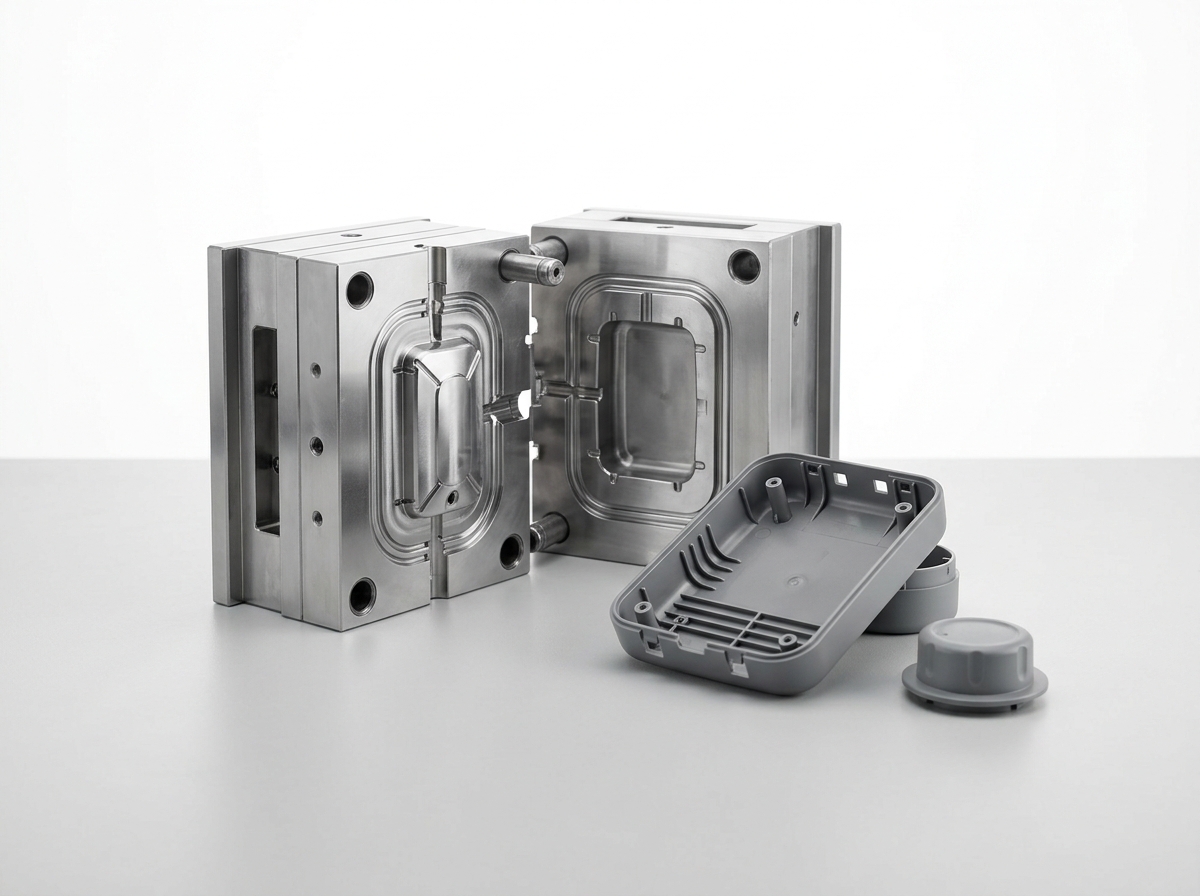 How tooling strategy affects custom injection molding project budgets
Tooling strategy is one of the biggest determinants of custom injection molding cost because it sets the ceiling for productivity and mold life. A single-cavity tool has a very different economics profile from a multi-cavity tool. Likewise, hardened steel costs more up front but can be justified when the annual volume or part wear rate is high.
Tool class selection should be based on real demand, not optimistic forecasts. A high-cavity mold can lower unit cost, but only if the demand can absorb the upfront investment. If the launch quantity is uncertain, a simpler tool may protect cash flow and reduce risk. This is especially important for OEM and ODM launches where product-market fit is still being validated.
| Tooling Option | Upfront Investment | Best Fit | Total Cost Logic |
|---|---|---|---|
| Prototype tool | Lower | Design validation | Minimizes risk before volume commitment |
| Single-cavity production tool | Moderate | Lower volume launches | Flexible and easier to modify |
| Multi-cavity tool | Higher | Stable high-volume demand | Lowers unit cost when demand is strong |
| Hardened steel tool | Highest | Long-life programs | Better durability over many cycles |
Mold lifespan and maintenance access also change the economics of custom injection molding. A tool that is difficult to clean, vent, or repair may look cheaper at quote stage but become expensive in production. Easier maintenance shortens downtime and reduces unexpected stoppages. That is one reason suppliers that also provide mold components support can be more economical over the full product life cycle.
In many programs, the most rational path is to start with a production-realistic pilot tool, then scale to a multi-cavity setup once the market proves stable. This staged approach reduces capital risk and makes it easier to validate dimensional control, cosmetic performance, and assembly fit.
What process parameters matter most for injection molding costs
Process settings matter because unstable molding increases scrap, cycle time, and operator intervention. Even a well-designed tool can become expensive if barrel temperatures, holding pressure, cooling time, or drying are poorly controlled. The goal is stable production with the lowest practical scrap rate and the shortest reliable cycle.
Industry references such as NIST calibration resources are widely used to support measurement confidence in production environments. That matters because cost reduction is not only about molding faster; it is about producing parts that consistently meet specification. If a part requires frequent sorting or rework, the apparent savings from low piece price disappear quickly.
Cycle time is one of the most important numbers in injection molding economics. A reduction of just a few seconds on a high-volume part can significantly lower annual machine time. In a 24/7 program, the savings compound across thousands or millions of shots. The actual result depends on part geometry and cooling efficiency, but the principle is constant: less cooling time usually means lower cost per part.
- Control resin drying to avoid splay, bubbles, and brittle parts.
- Optimize gate and vent design to improve fill balance.
- Minimize unnecessary hold time once dimensions stabilize.
- Use cooling channels that support uniform heat removal.
Stable process windows are often more valuable than aggressive speed targets. A process that runs slightly slower but produces fewer rejects is usually cheaper overall. That is why mature suppliers focus on process capability rather than simply advertising maximum machine speed.
How to choose a supplier that reduces total project cost
The right supplier lowers cost by preventing mistakes, not by cutting corners. In custom injection molding, supplier selection should include engineering support, sample turnaround, communication speed, and long-term production stability. A low quote from a vendor that cannot handle revisions or maintain consistency is rarely the cheapest option.
For cross-border projects, communication and document quality are major cost factors. Clear English responses, fast drawing review, and disciplined change control reduce the chance of late corrections. This is especially important for buyers working on consumer electronics, appliance housings, or industrial parts with multiple stakeholders.
A strong supplier should be able to explain where costs come from and where they can be removed. That includes cavity count, steel grade, gate strategy, finish requirements, and packaging assumptions. If a vendor can only offer a price but cannot explain the engineering basis, the buyer may face surprises later.
- Ask for a DFM review before mold build begins.
- Confirm part volume, not just initial order quantity.
- Define which surfaces are cosmetic and which are functional.
- Request a change-control process for revisions after approval.
- Compare total cost, including tooling, sampling, scrap, and lead time.
Projects that combine tooling and production under one workflow often reduce coordination cost. That is because one team owns the handoff from design to trial to mass production. For buyers planning future model expansions, this can also make it easier to reuse design knowledge across multiple SKUs.
How to reduce costs in custom injection molding projects without hurting quality
The best cost reduction strategy is to remove waste, not value. Buyers often assume that lower cost means lower quality, but in custom injection molding the opposite can be true. When design, material, and tooling are aligned, the part becomes easier to mold, easier to inspect, and easier to assemble. That lowers total cost while improving consistency.
For electronics housings, appliance covers, toys, and industrial components, the practical approach is to classify requirements into must-have and optional. If a feature does not improve function, compliance, or brand-critical appearance, it may be a candidate for simplification. That could mean replacing a high-polish hidden surface with a standard finish, or changing a complex assembly into a simpler one with the same user experience.
Cost control works best when procurement and engineering review the same data. A drawing, sample, expected annual volume, resin choice, and cosmetic standard should all be evaluated together. If one of those variables changes later, the cost model changes too.
| Decision Area | Ask Before Quoting | Cost Effect | Risk if Ignored |
|---|---|---|---|
| Volume | Annual and lifetime demand | Tool selection and amortization | Wrong mold class |
| Appearance | Visible or hidden surfaces | Finish and polishing cost | Overpaying for cosmetics |
| Assembly | Manual or automated assembly | Feature simplification | Unnecessary features |
| Supply chain | Local or export delivery | Logistics and packaging | Delay and damage costs |
In short, custom injection molding costs go down when the project is treated as an engineering system, not a single purchase order. That perspective helps teams reduce tooling complexity, shorten cycle time, and improve first-pass yield.
FAQ
What is the biggest cost driver in custom injection molding?
The biggest cost driver is usually tooling complexity combined with cycle time. Undercuts, tight cosmetics, and long cooling times can raise both upfront mold cost and unit cost.
How can I lower injection molding costs without changing the part function?
Start with DFM simplification. Standardize wall thickness, remove unnecessary undercuts, and limit premium finishes to visible areas only.
Is a cheaper resin always the best way to reduce plastic manufacturing cost?
No. A lower-priced resin can increase scrap, warpage, or failure risk, which may cost more overall than a better-processing material.
Does higher cavity count always reduce unit cost?
Not always. Multi-cavity tooling lowers unit cost only when demand is high enough to justify the added investment and maintenance complexity.
Why do prototype tools sometimes save money in the long run?
Prototype tools reduce the risk of expensive design mistakes. They let teams validate fit, appearance, and function before committing to production steel.
What should I ask a supplier before approving a mold?
Ask about DFM feedback, lead time, maintenance access, resin compatibility, and change control. These factors often determine the true project cost.
How do I know if my part is over-designed for injection molding?
If the drawing contains many slides, sharp transitions, thick sections, and cosmetic demands that do not affect function, the part is likely more expensive than necessary.
Post time: Sep-15-2026