
- Medical plastic molds should be sourced by process capability, documentation quality, and validation discipline, not only by unit price.
- Precision injection molding for medical parts depends on material behavior, mold design, and stable process windows.
- A strong China mold factory should provide DFM review, trial reports, inspection data, and sample approval before mass production.
- For regulated healthcare parts, traceability, clean handling, and consistent dimensional control matter as much as machining accuracy.
- The best supplier relationship is one that reduces rework, stabilizes launch timing, and protects long-term part consistency.
Ordering medical plastic molds from a China mold factory is a technical sourcing decision that usually succeeds only when the buyer evaluates measurable process control, not just price. In medical device manufacturing, dimensional accuracy is often judged against ISO standards such as ISO 20457:2018 for plastics molding equipment terminology, while machined tool components commonly rely on geometric tolerances like ISO 2768 and inspection practices aligned with metrology standards. For example, coordinate measurement systems are routinely validated against NIST CMM guidance, and the industry commonly expects injection molded parts to hold tight feature control in the low-hundred-micron range when the tooling, resin, and process are properly engineered. The real question is not whether a supplier can quote a mold, but whether it can prove repeatable output, documented trials, and dependable production support.
How to order medical plastic molds from China without losing control of quality
The right ordering process starts with technical clarity, not RFQ volume. Medical buyers often assume the fastest supplier is the best supplier, but in precision injection molding the fastest quote can hide the weakest process understanding. A serious request should include 2D drawings, 3D CAD files, resin grade, cosmetic requirements, mating interface details, expected annual output, and the critical-to-quality dimensions that cannot drift.
When those inputs are missing, the supplier will make assumptions about draft angle, wall thickness, gate location, shrinkage, and venting. That is where projects slip. A China mold factory that asks detailed engineering questions early is usually safer than one that only responds with a low price. Good suppliers also discuss whether the tool should be single-cavity, multi-cavity, hot runner, or cold runner, because those choices strongly affect cycle time, scrap risk, and dimensional stability.
For medical programs, the buyer should also ask how the supplier handles part approval, first article inspection, and revision control. Even if the final product is not a sterile implant, medical customers often expect controlled records, material traceability, and stable sample approval. That is especially important when the mold supports housings, handles, diagnostic accessories, fluid-contact components, or other parts where fit and cleanliness are visible to end users.
One practical way to reduce sourcing risk is to compare suppliers on process evidence. If a factory can show mold design review notes, trial shot records, tool steel certificates, and dimensional reports, it usually has a stronger engineering culture than a supplier that relies on sales language alone.
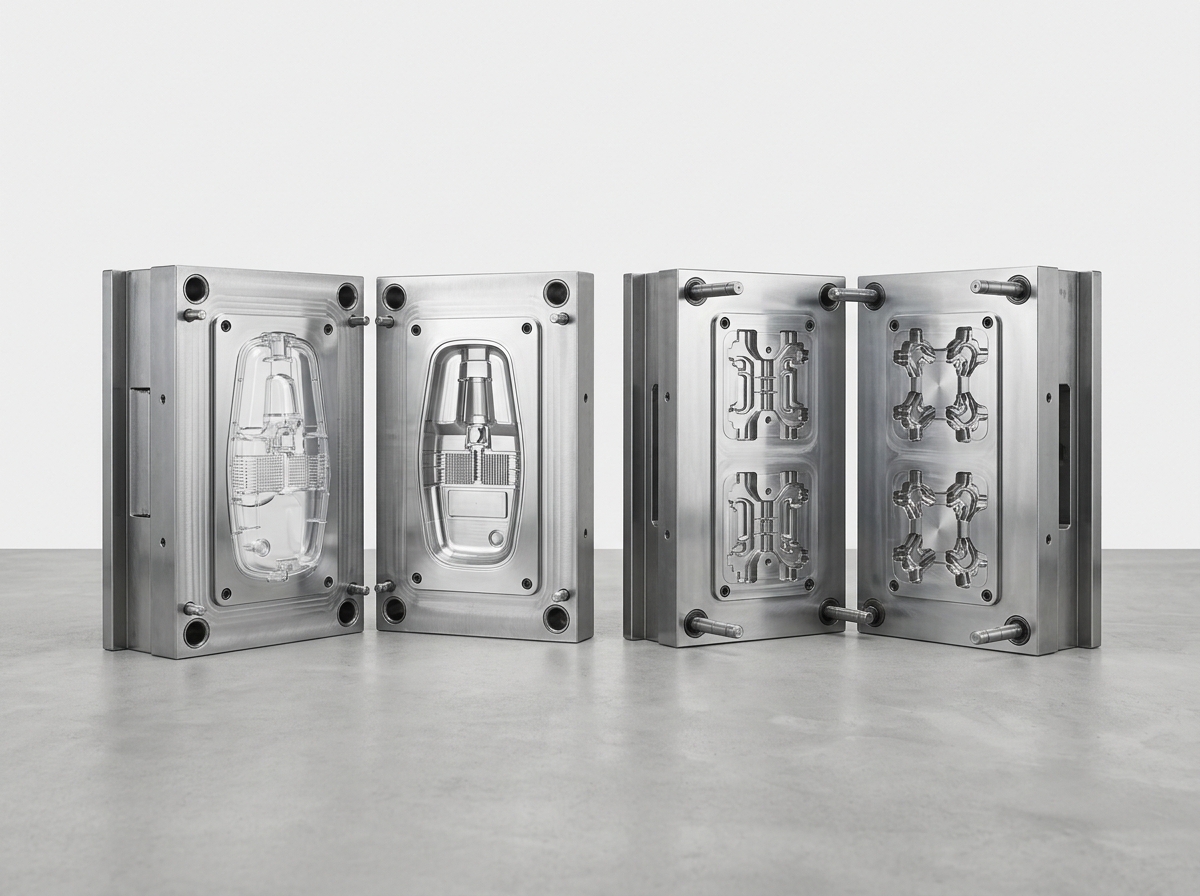
What makes precision injection molding for medical parts different?
Precision injection molding for medical parts is defined by repeatability, not just tight nominal dimensions. A molded part may measure correctly on one sample and still fail in production if it warps, flash forms, or drifts after the first few hundred shots. In medical applications, that is a serious issue because assembly tolerances are often stacked across multiple parts.
The process must control resin drying, melt temperature, injection speed, packing pressure, mold temperature, and cooling balance. For example, polycarbonate, a common transparent engineering resin used in medical housings and protective covers, has a tensile strength often reported around 60 to 70 MPa in standard material datasheets, while its heat deflection performance depends heavily on grade and test conditions. The material may be suitable, but only if the mold design accounts for gate marks, stress whitening, and shrink behavior.
Medical buyers also need to think about surface finish and visual consistency. Cosmetic defects that might be acceptable in industrial parts can be a rejection point in healthcare products because users associate visible sink marks, flow lines, or color streaks with poor quality. A strong mold supplier should therefore discuss texture, polishing level, and ejection strategy before cutting steel.
| Ordering Stage | What the Buyer Should Provide | What the Supplier Should Return | Typical Quantitative Check |
|---|---|---|---|
| RFQ | CAD, drawing, resin, volume, critical dimensions | DFM feedback, tool concept, lead time | Target tolerance, cavity count, cycle estimate |
| Design Review | Functional requirements and assembly constraints | Gate plan, cooling plan, parting line plan | Wall thickness, draft angle, shrink allowance |
| Trial Stage | Sample approval criteria | T1/T2 samples, inspection report, correction list | Dimensional deviation, flash, warpage |
| Mass Production | Release approval | Process window, maintenance plan, spare parts list | Shot life, cycle stability, reject rate |
In healthcare sourcing, the word precision should always mean measurable control. If a supplier cannot explain how it manages cavity-to-cavity variation, dimensional drift after 10,000 or 50,000 shots, or the inspection frequency used during trial production, then the buyer is still in the risk assessment phase. A competent factory will usually describe its control plan in the language of engineering, not persuasion.
How to evaluate a China mold factory for medical tooling
A reliable China mold factory should be judged by evidence of engineering discipline and production stability. The site visit, video audit, or document review should focus on how the shop develops tooling, not on how polished the office looks. You want to see whether the factory can handle tool design, machining, EDM, assembly, sampling, and corrective action with the same team structure and communication speed.
Three capabilities matter most. First, the factory should have design support that can challenge a drawing if the part is hard to mold. Second, it should have machining and inspection equipment capable of verifying fine features, insert fit, and complex geometries. Third, it should have trial-and-correction discipline, meaning that every sample run produces a documented learning loop instead of a verbal promise.
A practical indicator is whether the factory can talk clearly about steel selection, cooling layout, gate type, vent depth, and ejection method. Another is whether it can explain why a part may need a family mold, a hot runner, or a secondary operation. These are not sales topics; they are process control topics.
| Supplier Capability | Why It Matters for Medical Molds | Good Sign | Risk Signal |
|---|---|---|---|
| DFM review | Prevents costly molding defects | Written feedback before steel cut | Only sends a price quote |
| Moldflow awareness | Reduces short shot and warp risk | Explains gate and cooling decisions | No process simulation at all |
| Inspection discipline | Protects critical dimensions | Trial report with measured data | Only one hand sample |
| Change control | Maintains part consistency over time | Revision records and approval steps | Silent tool changes |
For buyers who also need broader sourcing support, it helps to compare mold capability with part-production capability. If the same supplier can support a tool build and then manage injection molds, plastic parts, and custom injection molding, the project often moves faster because tool adjustments and molding feedback stay inside one communication loop. That is especially useful when launch timing is tight.
Medical mold design choices that affect cost, quality, and lead time
Tool design decisions determine most of the downstream cost of medical plastic molds. Buyers often focus on the first mold price, but the real economics come from cycle time, scrap rate, maintenance needs, and how often the tool needs adjustment during the part’s life.
For example, a single-cavity tool may cost less to design and build, but a multi-cavity tool may lower per-part cost when volume rises. Hot runner systems can reduce sprue waste and improve consistency, but they add complexity and maintenance requirements. Similarly, hardened tool steel can improve wear resistance, but it may extend machining time and raise upfront cost. Those tradeoffs are normal; the key is to make them consciously.
Medical part geometry also drives mold complexity. Thin ribs, deep bosses, snap features, and optical surfaces require different venting and cooling strategies. The cleaner the parting line and the better the cooling balance, the lower the chance of distortion or flash. In practical terms, a well-designed mold may save more money over a year of production than a cheaper mold saves at quotation stage.
- Confirm the functional surfaces and non-negotiable dimensions first.
- Review draft, undercuts, and gate locations before tool approval.
- Match steel grade and surface treatment to the resin and shot count.
- Ask for sampling data, not only pictures of the finished tool.
- Build spare parts and maintenance expectations into the purchase order.
In many medical programs, the first engineering correction is cheaper than the first production recall. That is why buyers should ask how the factory structures iteration: how long it takes to modify inserts, how trial parts are measured, and whether the mold is optimized for manufacturing or just for initial sample approval.
Quantitative benchmarks that help you compare suppliers
Quantitative benchmarks make supplier comparison much easier than vague promises. Not every medical mold program needs the same target, but buyers should demand hard numbers wherever possible. For example, the IEC and ISO ecosystems routinely rely on defined measurement and conformity terms, while the NIST metrology environment emphasizes traceability and measurement uncertainty discipline. Even if your supplier is not in a regulated sterile device segment, those concepts still improve decision quality.
Below are useful comparison points for a typical precision tooling project. These are not universal promises; they are practical reference values that help buyers ask better questions and spot weak answers.
| Benchmark Area | Typical Reference Value | Why It Matters |
|---|---|---|
| Dimensional control | Low-hundred-micron range on critical features | Supports repeatable assembly fit |
| Machine positioning precision | Commonly evaluated in micron-level terms on modern CNC equipment | Influences cavity accuracy and insert fit |
| Material choice | Polycarbonate tensile strength often around 60 to 70 MPa | Useful for transparent, impact-resistant housings |
| Inspection traceability | First article + in-process checks + final report | Reduces escape risk |
On the equipment side, buyers should not over-focus on brand names. Instead, ask how the factory validates machining and inspection. If it can explain how CMM checks are done, how EDM wear is compensated, and how insert matching is controlled, it is probably equipped to handle medical tooling more reliably than a shop that only advertises machine tonnage. For metrology concepts and dimensional verification practices, the NIST CMM resource is a useful public reference.
Another useful benchmark is the tooling life strategy. Medical molds may be expected to support long runs, so buyers should ask how the supplier estimates wear points, replacement inserts, ejector pin life, and routine maintenance intervals. The answer is not a fixed industry constant, but a good supplier can describe its maintenance logic clearly and in measurable terms.
What documents should you request before placing an order?
Document control is one of the strongest signals of a serious medical mold supplier. If the paperwork is weak, the process is usually weak too. Before placing an order, request the following package so the project can be reviewed with engineering discipline rather than guesswork.
- 2D drawing with critical dimensions and tolerance notes.
- 3D CAD data in a common exchange format.
- Material specification, including resin grade and color code.
- DFM report or moldability comments.
- Tooling plan with cavity count, steel selection, and runner type.
- Trial sample report with measured dimensions.
- Change control and approval procedure for later revisions.
These documents do more than protect the buyer. They also help the supplier stay aligned when language, time zone, or project scope changes. In cross-border sourcing, clarity prevents more problems than any negotiation tactic.
If your project also involves packaging, assembly, or broader product development, it can be useful to coordinate with related manufacturing pages such as medical molds, home appliance molds, and about the factory. That helps procurement teams understand whether the same manufacturer can support different product families without losing process discipline.
Common mistakes when ordering medical plastic molds from China
Most mold problems come from incomplete requirements, not from machining alone. Buyers often assume the supplier will infer the missing details, but tooling is unforgiving. A small ambiguity in wall thickness, cosmetic grade, or functional fit can become a big issue after steel is cut.
The first mistake is asking for a quote before freezing the part definition. If the geometry is still changing, the mold price will also change. The second mistake is treating sample approval as the end of the project instead of the beginning of process stabilization. The third mistake is ignoring maintenance and spare parts, which can create avoidable downtime later. The fourth mistake is choosing a supplier only because it is the cheapest, even though medical programs usually need stronger documentation and more sampling iterations.
A fifth mistake is failing to define acceptance criteria for surface finish, color, gate witness, and assembly fit. In medical products, visual and tactile quality often influence user trust as much as pure dimensional accuracy. Finally, many buyers do not ask about communication speed. A factory that replies quickly during quotation but slowly during trial correction can become expensive very fast.
- Freeze design inputs before requesting final mold pricing.
- Separate sample approval from production approval.
- Write down surface, fit, and cosmetic standards.
- Plan spare parts and maintenance from the start.
- Score suppliers on evidence, not only enthusiasm.
FAQ about ordering high-precision medical plastic molds from China
What is the first thing to send to a China mold factory?
Send the 2D drawing, 3D CAD file, material requirement, expected annual volume, and the dimensions that matter most for assembly or safety. The more complete the input package, the better the DFM feedback and quotation accuracy.
How do I know whether a supplier can handle precision injection molding?
Ask for trial reports, inspection records, tool steel data, and a clear explanation of how they control cavity balance, cooling, and dimensional drift. Precision molding is proven by data, not by words.
Is it better to choose a single-cavity or multi-cavity mold?
It depends on volume, part complexity, and acceptable piece price. Single-cavity tools are often simpler to debug, while multi-cavity tools improve throughput when demand is stable enough to justify the added complexity.
What resin is common for transparent medical housings?
Polycarbonate is common because it combines impact resistance and transparency, but grade selection must match the application, sterilization method, and optical requirements. Resin choice should always be validated with the final product conditions.
How much detail should be in the sample approval process?
Enough to define what is acceptable, how it will be measured, and who signs off. Include dimensional limits, cosmetic criteria, and any assembly fit checks, otherwise sample approval becomes subjective.
Why do some molds fail after production starts?
Common causes include poor cooling balance, inadequate venting, wrong steel selection, weak maintenance planning, and undefined process windows. Many failures are preventable when the mold is designed for production rather than only for first samples.
Can one supplier support both molds and production parts?
Yes, and that can reduce communication loss if the supplier is genuinely strong in both toolmaking and molding. Integrated support is often helpful when you need design changes, pilot runs, and mass production under one workflow.
Post time: Jul-13-2026