
- Fast delivery in custom plastic parts manufacturing depends on design readiness, mold complexity, and material availability more than on price alone.
- Low-cost sourcing becomes practical when the supplier reduces engineering rework, tool revisions, and post-processing steps.
- Buyer risk drops when the supplier provides DFM feedback, trial reports, and production control from the same project team.
- For enclosure and functional parts, tolerance strategy and resin selection often matter more than raw machine speed.
- Reliable delivery is usually built through standardization, staged approvals, and clear specification control.
Custom plastic parts manufacturing is most affordable when the project is designed around manufacturability, not just the CAD model. In injection molding, a practical tolerance target often starts around +/-0.005 mm for precision features only when tooling, process control, and inspection support it, while most commercial plastic parts require looser part-specific tolerances defined by the design intent and the material behavior. According to ISO 20457, injection-molded parts should be designed with the mold process and material characteristics in mind, and NIST plastics resources highlight how shrinkage, cooling, and warpage affect final dimensions. If you are sourcing custom injection molding, plastic injection molds, or plastic housing molds, the real question is how to shorten lead time without sacrificing fit, finish, or repeatability.
Why custom plastic parts manufacturing becomes expensive or slow
The main cost drivers are engineering complexity, tooling iterations, and process instability.
Buyers often assume the mold price is the whole story, but total project cost is usually dominated by rework. A part with aggressive undercuts, thick-to-thin wall transitions, or weak draft angles can trigger extra slides, longer machining, and more trial cycles. Every revision adds time because the mold must be re-cut, re-polished, and re-validated before production can resume.
Lead time also expands when material choices are unclear. For example, polycarbonate is popular for transparent or impact-resistant enclosures because it combines high toughness with good dimensional stability, but it is more sensitive to processing conditions than simple commodity resins. For consumer electronics or protective housings, that matters because a faster quote is useless if the first shots warp, haze, or miss assembly checkpoints.
Fast delivery is therefore not a promise; it is a system. Suppliers that control quoting, DFM, tooling, trial, and packaging in one workflow usually shorten the calendar because they reduce handoff delays. That is especially important for buyers comparing OEM and ODM support against a fragmented sourcing model where engineering, mold making, and shipping are split across separate vendors.
How to get affordable custom plastic parts without losing quality
The cheapest successful project is usually the one that avoids unnecessary design and process complexity.
In practical purchasing terms, affordability starts with part simplification. Flat surfaces, consistent wall thickness, and sensible draft angles reduce tooling complexity and lower scrap risk. When the part is a shell, cover, or structural enclosure, the supplier should review snap fits, bosses, ribs, and gate positions before machining begins. This is why plastic shell molds are often more efficient than fully bespoke tool concepts for first-time buyers who need both speed and predictable unit economics.
A second cost lever is cavity strategy. A single-cavity mold is often faster to validate, but a multi-cavity tool can lower unit cost once demand is proven. The correct answer depends on forecast volume, acceptable piece price, and how much demand uncertainty remains. Buyers who choose the wrong cavity count either overpay for steel and setup or accept excessive per-part cost.
A third lever is resin selection. PC, ABS, PP, and PA each behave differently in shrinkage, stiffness, and surface finish. Choosing a resin that matches the application avoids later redesign. For example, PC is often used in device windows and protective covers, while PP is common in low-cost consumer goods where chemical resistance and low density matter more than gloss. That resin choice affects cooling time, gate design, and cycle stability, all of which influence delivery speed and cost.
| Decision factor | Cost impact | Speed impact | Typical buyer outcome |
|---|---|---|---|
| Part geometry simplification | Lower tooling hours | Fewer trial cycles | Shorter launch window |
| Proper cavity count | Better unit economics at volume | Higher output per cycle | Balanced price and delivery |
| Resin matched to application | Less scrap and rework | More stable molding | More predictable quality |
| Integrated DFM review | Fewer revisions | Faster pre-production | Lower total project risk |
What fast delivery really means in plastic manufacturing
Fast delivery means fewer handoffs, fewer trial loops, and better pre-production decisions.
Many buyers use the phrase fast delivery manufacturing to mean short lead time, but the industry reality is more specific. Delivery speed depends on three linked stages: design validation, tooling completion, and production readiness. If a drawing is incomplete, even a high-capacity factory will lose time asking for clarifications. If the mold is optimized for manufacturability, the same factory can move faster because the process path is clearer from the start.
In practical terms, a project becomes faster when the supplier can answer questions like wall thickness, gate location, parting line, surface texture, and inspection method in the first round of review. That is why experienced suppliers emphasize injection mold development rather than only machine capacity. The mold itself is the schedule driver.
For buyers in consumer electronics, household appliances, or industrial equipment, the fastest suppliers are usually the ones that can support both trial parts and final production documentation. Industry buyers often underestimate the time saved by a clean approval process. A stable first article means fewer downstream surprises in assembly, packaging, and logistics.
| Stage | Common delay source | How to shorten it | Buyer checkpoint |
|---|---|---|---|
| DFM review | Missing dimensions | Provide drawings, samples, and material targets | Approved engineering notes |
| Tooling | Geometry changes | Freeze critical features early | Signed mold layout |
| T1 trial | Gate or warpage issues | Use simulation and resin-specific process windows | Trial report with measurements |
| Production | Inconsistent inspection | Standardize sampling and packaging | Inspection plan and PPAP-style evidence |
Which materials and standards matter for custom plastic parts
Material selection and standards control whether a part is cheap, stable, and scalable.
If the product is a housing, cover, bracket, or functional insert, resin choice should be matched to mechanical and cosmetic requirements. PC is often selected for impact resistance and transparency. ABS is commonly used for general-purpose housings where toughness and appearance must be balanced. PP is attractive for cost-sensitive parts because it is lightweight and chemically resistant. PA is often chosen where wear resistance and strength are needed.
Standards are equally important. For injection-molded parts, ISO 20457 provides a framework for tolerancing molded parts, while ASTM D790 covers flexural properties of plastics and ASTM D638 covers tensile properties of plastics. These are not just lab references; they shape real procurement decisions because they help buyers compare strength, stiffness, and acceptable deformation across candidate resins.
In quality-sensitive projects, the supplier should not only quote material names but also specify grade, color masterbatch, surface requirement, and acceptance criteria. That becomes critical for products with visible surfaces, where even small inconsistencies can affect brand perception and retail returns.
| Material | Main advantage | Typical application | Why buyers choose it |
|---|---|---|---|
| PC | High impact resistance | Transparent covers, protective housings | Strength and clarity |
| ABS | Good balance of toughness and cost | Consumer device shells | Stable appearance and processability |
| PP | Low density and chemical resistance | Utility parts, lids, daily-use products | Cost control |
| PA | Wear resistance and strength | Industrial fittings, clips, load-bearing parts | Durability |
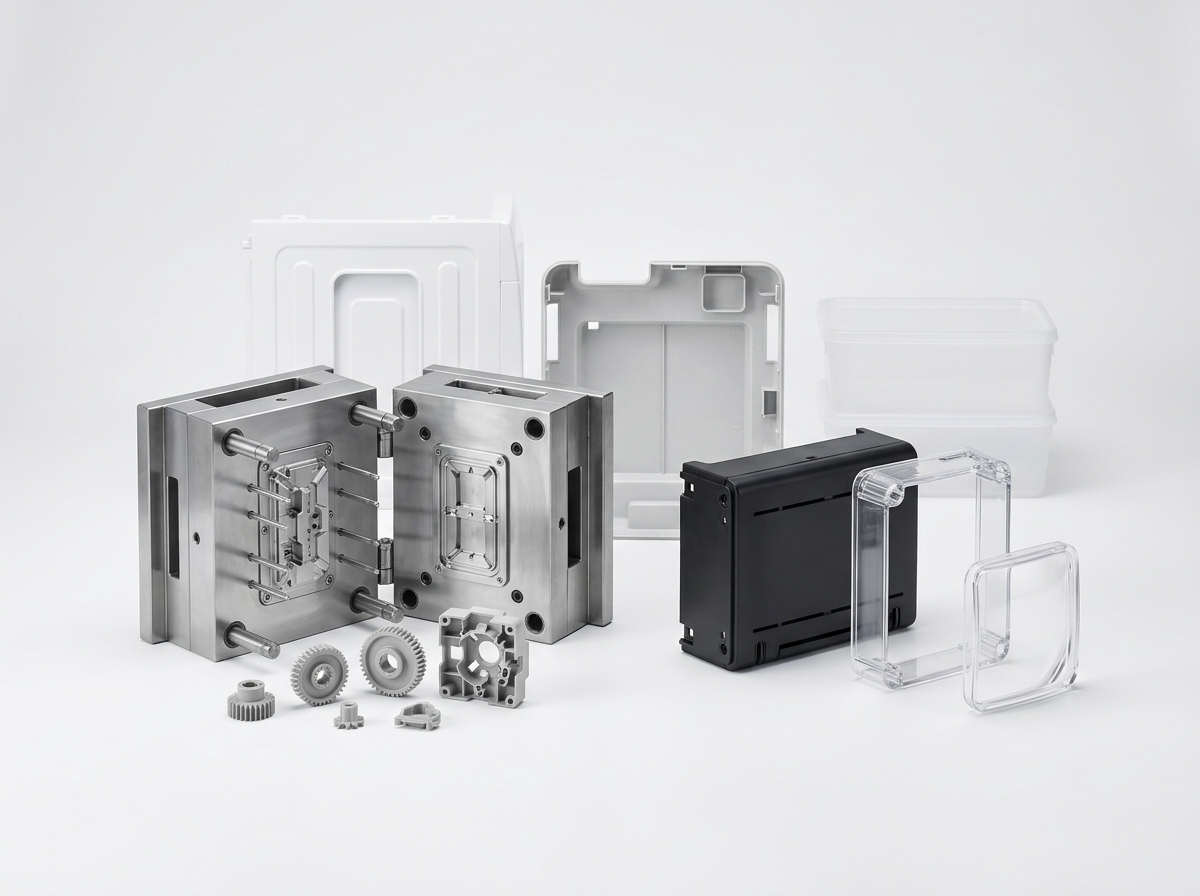
How one-stop mold and finished-part supply reduces total project risk
One-stop supply usually lowers risk because accountability stays in one chain.
When one supplier handles mold design, tooling, trial, production, and packaging, the buyer avoids blame shifting between vendors. If a dimension drifts or a gate mark appears, the same team can trace the issue faster. That matters because custom plastic parts are rarely perfect on the first shot, especially when tolerances are tight or the design includes thin walls, ribs, or cosmetic surfaces.
For projects where speed matters, one-stop service also improves communication. Instead of managing separate mold makers, mold trials, and part suppliers, the buyer has one schedule, one revision history, and one approval point. That is especially useful for cross-border procurement where English communication, file control, and shipping coordination affect the launch date as much as machine time.
Buyers sourcing plastic parts manufacturing or custom mold design should ask for a workflow that includes DFM notes, material confirmation, first-article measurement, and packaging standards. Without those steps, a low quote can become an expensive schedule slip.
What a fast and affordable supplier should show before you place an order
A credible supplier should prove process control before promising price or delivery.
Before ordering, request evidence of how the supplier handles project definition. The most useful materials are not marketing brochures but technical items: a DFM review, a mold layout, a trial report, an inspection summary, and an estimated production schedule. These documents show whether the team understands the part or is simply reacting to it.
It is also smart to ask how the supplier manages sampling and change control. If a mold needs a steel-safe adjustment, the process should be clear. If the part will require texture, welding, pad printing, or assembly, those operations need to be planned early because they affect both cost and delivery.
In many sourcing scenarios, a supplier that offers 3D mold making or complex-geometry support can help reduce redesign risk for parts with curves, asymmetry, or special visual features. That is valuable when the product must launch quickly but still look premium at first sale.
- Ask for DFM feedback before tooling starts.
- Confirm resin grade, color, and surface requirement in writing.
- Review critical dimensions and acceptance criteria.
- Check whether trial parts will be measured and documented.
- Verify packaging, labeling, and shipping timelines.
When custom plastic parts manufacturing is most cost-effective
Custom plastic parts are most cost-effective when demand, geometry, and supply chain are aligned.
Low-volume work is usually better served by simple tooling, limited cavity count, and minimal secondary processing. High-volume work benefits from optimized cycle time, automated inspection, and stable supply commitments. The break-even point depends on part geometry and annual usage, but the principle is consistent: as volume rises, tooling investment should be amortized over more pieces.
For parts used in appliances, consumer electronics, toys, footwear components, or industrial accessories, the buyer should compare not only unit price but also lifetime cost. A slightly more expensive mold can be the cheaper option if it reduces scrap, shortens cycle time, and improves yield. In industry practice, short cycle stability matters because a few seconds saved per shot can translate into meaningful monthly output gains across long production runs.
That is why plastic accessories and plastic mold parts are often sourced through suppliers that can support both production and replacement components. A stable parts ecosystem lowers downtime and helps the buyer keep launches, replenishment, and after-sales supply aligned.
Practical buyer checklist for fast delivery manufacturing
A short checklist can prevent most sourcing delays.
- Provide 2D drawings, 3D files, target resin, annual volume, and appearance requirements.
- Identify cosmetic surfaces, assembly interfaces, and dimensions that cannot move.
- Confirm whether the part needs transparency, impact resistance, or flame performance.
- Ask for lead time by stage: DFM, tooling, trial, production, and shipping.
- Request a measurement report for critical dimensions and sample approval.
- Define packaging and labeling rules before mass production begins.
Buyers who follow this sequence usually get faster quotations and fewer late-stage surprises. More importantly, they can compare suppliers on process maturity instead of only price. That is the difference between a cheap mold and a genuinely affordable program.
FAQ
How can I lower the cost of custom plastic parts manufacturing?
Reduce geometry complexity, standardize resin choice, avoid unnecessary cosmetic features, and ask for DFM review before tooling starts. These steps usually cut rework and shorten trial cycles.
What is the fastest way to get custom plastic parts delivered?
The fastest path is to provide complete drawings, clear material requirements, and signed-off critical dimensions so the supplier can move directly into mold layout and tooling.
Which material is best for fast-turnaround plastic parts?
There is no universal best resin, but PP, ABS, and PC are common choices because they are widely processed and available. The correct selection depends on strength, transparency, cost, and appearance needs.
Why does injection molding take longer than expected?
Lead time often grows because of design revisions, mold complexity, and trial failures. Unclear specifications usually delay more projects than machine capacity does.
How do I know if a supplier is reliable for fast delivery manufacturing?
Look for documented DFM support, trial reports, inspection records, and clear communication on schedule changes. Reliable suppliers explain problems early and show how they will control them.
Is one-stop mold and part supply better than using separate vendors?
For most buyers, yes. One supplier reduces handoff risk, simplifies communication, and makes it easier to hold one team accountable for timing and quality.
Can custom plastic parts be both low cost and high quality?
Yes, if the design is manufacturable, the resin is appropriate, and the process is controlled from prototype to production. Affordable does not mean minimal; it means optimized.
Post time: Jul-23-2026