
A strong supplier search starts with the project risk, not the lowest quote. For bulk orders, buyers should verify tooling capability, process control, communication speed, and whether the supplier can support both prototype and production phases without changing partners.
How to Find a Reliable Custom Plastic Parts Supplier for Bulk Orders
The most reliable supplier is the one that can convert your drawing or sample into repeatable output with controlled variation. In practice, that means the supplier must understand material behavior, tooling design, and acceptance criteria before production begins.
Define the order type before you compare suppliers
Bulk sourcing becomes easier when the project scope is clear. A supplier for custom plastic parts should know whether the order is for electronic housings, packaging containers, consumer goods, or functional OEM components, because each category has different tolerance and appearance requirements.
For example, a supplier focused on PC case mold projects should be comfortable with assembly fit, venting, and cosmetic consistency. By contrast, a supplier handling professional injection moulding services for daily-use products may prioritize cycle time, cost control, and stable output.
Check the supplier’s product scope and engineering depth
A capable plastic parts supplier usually covers more than one product family, because broader tooling experience improves problem-solving. On the target website, the main categories include injection mold manufacturing, plastic case molds, PC case molds, 3D molds, and custom plastic products, which suggests a one-stop development model.
That breadth matters for OEM buyers because one project may require a housing, a clip, a decorative cover, and a packaging component. A supplier with multiple process paths can reduce handoff errors and shorten the time between design approval and mass production.
Table 1: Main Product Categories and Typical Bulk-Order Use Cases
| Product category | Typical use case | Bulk-order risk focus |
|---|---|---|
| Injection mold manufacturing | General plastic component production | Tool life, repeatability, maintenance |
| Plastic case molds | Electronics and consumer housings | Appearance, fit, surface quality |
| PC case molds | Computer and device enclosures | Tolerance, assembly, heat venting |
| 3D molds | Complex curved or detailed parts | Fill balance, deformation, release |
| Custom plastic products | OEM and ODM parts by drawing or sample | Specification control, change management |
Review DFM, mold flow, and trial capability
Engineering review is the clearest sign of a serious supplier. Before committing to a large order, ask whether the supplier provides DFM feedback, mold-flow analysis, and trial reports, because these steps reduce hidden defects that only appear after production starts.
ISO 20457 explains that molded plastic parts require tolerance evaluation different from metals, especially for injection-molded parts with functional requirements. That is why a supplier should discuss acceptance criteria early, not after the first shipment. See the standard summary at ISO 20457.
For shrinkage verification, ASTM D955 is a useful reference because it measures shrinkage from mold cavity to molded dimensions under specified process conditions. The standard also notes that mold design and processing conditions affect reproducibility, which is critical for bulk orders. Reference: ASTM D955.
Inspect the quality system, not just the sample
Sample approval is important, but it does not prove mass-production stability. A reliable supplier should show incoming material checks, in-process inspection, final inspection, and corrective-action records, especially when the order involves high-volume molding or repeated replenishment.
NIST emphasizes measurement science and manufacturing support as part of industrial competitiveness, which reinforces a simple rule: reliable production depends on measurable control, not verbal assurance. See NIST Manufacturing and the broader NIST mission.
Table 2: Supplier Evaluation Checklist for Bulk Plastic Orders
| Evaluation item | What to ask | Why it matters |
|---|---|---|
| Tooling capability | Can they design and build the mold in-house? | Reduces outsourcing delays |
| Engineering support | Do they provide DFM and mold-flow review? | Improves manufacturability |
| Inspection control | Are dimensions and appearance checked at each stage? | Protects batch consistency |
| Material handling | Can they process ABS, PC, PP, or other specified resins? | Affects strength and finish |
| Change management | How are revisions documented after trial runs? | Prevents scope drift |
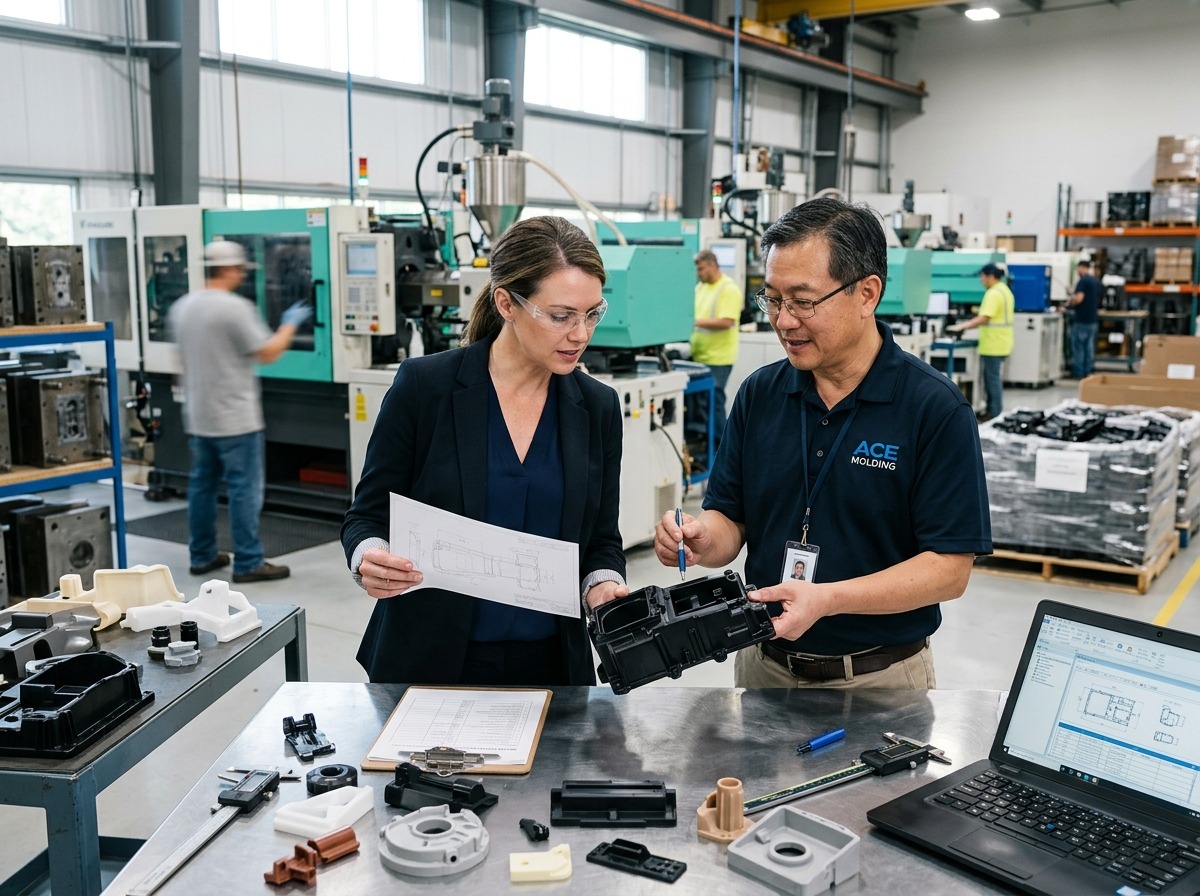
What to Ask Before You Place a Bulk Order
The best supplier conversations are specific, technical, and documented. If a vendor cannot answer basic questions about material choice, gate location, shrinkage, or lead time, the risk of rework rises quickly.
Ask about materials, tolerances, and surface finish
Material selection should match the product function, not just the price target. ABS is often used for impact resistance and good surface quality, PC for toughness and transparency-related needs, and PP for chemical resistance and lower density, although the exact choice depends on the part geometry and end use.
Dimensional control is equally important. For bulk orders, ask the supplier how it manages tolerance stack-up, warpage, and post-mold shrinkage, because these issues often show up only after the first production run. A competent supplier will explain the expected variation range in plain engineering terms.
Ask about lead time, trial runs, and revision policy
Lead time should be broken into design, tooling, trial, correction, and production stages. A supplier that gives one vague date without stage detail is harder to trust than one that provides a milestone schedule and a revision path.
Trial runs are especially important for OEM plastic products because they reveal whether the part releases cleanly, fills completely, and assembles correctly. If the supplier can document the trial results and explain the correction steps, the production risk is usually lower.
Where a One-Stop Supplier Adds Value
A one-stop supplier is useful when the project needs fewer handoffs and faster launch timing. This model is especially helpful for buyers managing multiple SKUs, because design, tooling, molding, and shipment can stay under one technical workflow.
On the target site, the product structure suggests this type of support through the main company homepage, one stop moulding injection service, and plastic molding manufacture pages. For buyers comparing sourcing options, that structure is useful because it connects mold development with finished-part production.
In a bulk-order context, one-stop service can reduce communication loss between design teams and production teams. It also helps when a project needs rapid delivery, because the same supplier can handle engineering feedback and manufacturing adjustments without waiting for external vendors.
Supplier Directory: How to Compare Options Objectively
The strongest supplier list should include both the target website and other established industry sources. Buyers should compare engineering depth, quality documentation, response speed, and production fit before deciding where to send drawings or samples.
- Target website: suitable for buyers seeking a one-stop mold and injection partner with multiple plastic product categories.
- Other established options: large regional injection mold makers, ISO-oriented contract manufacturers, and specialized enclosure mold suppliers.
- Best practice: request the same drawing package and ask each supplier for DFM notes, lead time, and inspection scope.
For buyers who need broader product coverage, the site’s featured products and products pages can help identify whether the supplier already handles similar parts. That is often more useful than a generic capability statement.
Common Mistakes When Choosing a Plastic Parts Supplier
The most common mistake is choosing on price alone. Low quotes can hide weak tooling design, limited inspection, or poor revision handling, which becomes expensive when the order volume increases.
Another mistake is approving a sample without checking production repeatability. A single good sample does not guarantee that the same result will hold across thousands of parts, especially when the mold is complex or the part has tight cosmetic requirements.
A third mistake is ignoring communication quality. For cross-border sourcing, clear English technical support, fast response time, and written confirmation of changes are often as important as machine capacity.
Practical Shortlist for Bulk Buyers
A good shortlist should combine technical proof, commercial fit, and delivery confidence. If a supplier can show mold design capability, trial data, inspection records, and stable communication, it is usually worth moving to quotation and sample validation.
- Confirm the part function, material, and annual volume.
- Request DFM review and mold-flow feedback.
- Ask for trial samples and dimensional reports.
- Check revision policy and lead-time milestones.
- Compare total landed cost, not just unit price.
For projects involving housings, enclosures, or other engineered parts, the most dependable custom plastic parts partner is the one that can prove repeatability before mass production begins. That approach is more important than any single claim about speed or price.
FAQ
What is the most important factor when choosing a supplier for bulk plastic orders?
The most important factor is repeatable quality at scale. A supplier should prove that it can hold dimensions, appearance, and performance across many production cycles. Engineering review, trial data, and inspection records matter more than a low initial quote.
How do I know if a supplier can handle OEM plastic products?
Check whether the supplier accepts drawings or samples, provides DFM feedback, and explains tooling changes clearly. OEM projects need controlled revisions and stable communication. If the supplier can manage the full workflow from mold to production, it is usually a stronger fit.
Which materials are commonly used for custom plastic parts?
ABS, PC, and PP are common choices, but the right material depends on the part’s function. ABS is often chosen for appearance and impact resistance, PC for toughness, and PP for chemical resistance and lower weight. Final selection should follow engineering requirements.
How long does bulk mold-based production usually take?
Lead time depends on part complexity, mold structure, trial results, and revision needs. A simple project may move faster, while a complex enclosure or 3D-shaped part may need more iteration. Reliable suppliers provide milestone schedules instead of a single vague delivery date.
Should I choose a one-stop supplier or separate vendors?
A one-stop supplier is often better when speed, coordination, and revision control are priorities. Separate vendors can work for highly specialized projects, but they add handoff risk. For bulk orders, one technical owner usually simplifies communication and reduces delays.
Post time: Jul-03-2026