
- Quality starts with design-for-manufacturability, not with final inspection.
- Critical dimensions, appearance criteria, and resin specifications must be written before tooling begins.
- Process stability is more important than a perfect sample from a single short run.
- Traceability, inspection records, and change control reduce hidden quality risk.
- A capable partner should support plastic injection molds, plastic housing molds, and 3D molds with the same documentation discipline.
Custom plastic parts quality depends on how well the project controls tolerance, material behavior, and production repeatability, especially for electronics, home appliances, and industrial components. For example, injection-molded plastic parts often need to hold tight assembly relationships, while some optical or enclosure applications may demand much tighter control than the default plastics test methods in ISO 20457:2018. A well-run program also compares resin data, tool design, and sampling results before mass production, because one out-of-spec gate or a warped rib can affect the entire assembly. That is why buyers looking for OEM and ODM plastic parts should judge both the mold maker and the process controls behind the part.
What Quality Really Means in Custom Plastic Parts Manufacturing
Quality in custom plastic parts manufacturing means the part meets functional, dimensional, visual, and commercial requirements every time it is produced.
For a buyer, that usually means the part fits the assembly, survives its use environment, and arrives with stable appearance across the full lot.
In electronic housings, for example, quality is not only about whether a sample looks good; it is also about whether the snaps, bosses, and wall thickness remain consistent under repeated molding cycles.
For industrial parts, the same quality standard may include load-bearing performance, chemical resistance, and stable supply over multiple production years.
This is where a supplier offering custom plastic parts should be evaluated as a manufacturing system, not a catalog of products.
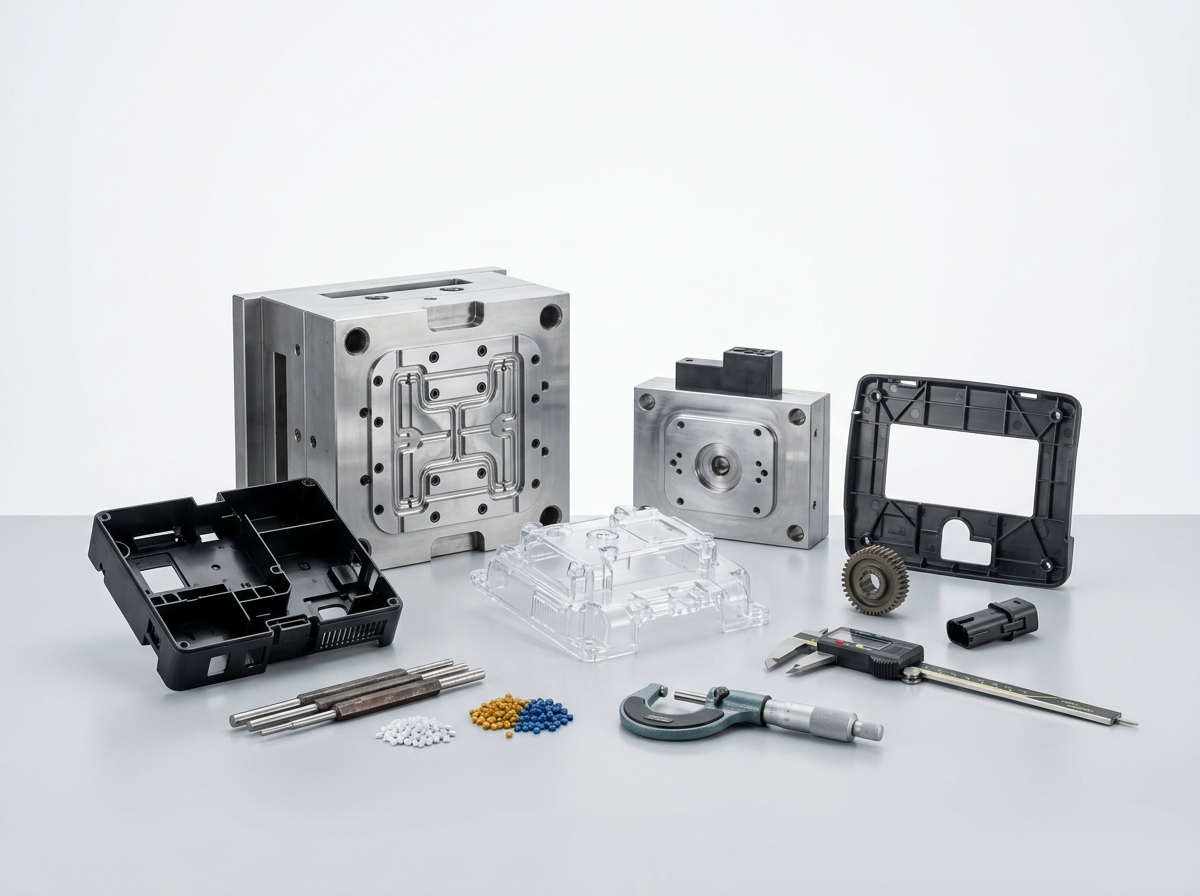 Start With DFM Before You Approve the Tool
Design for manufacturability is the fastest way to prevent quality loss before it becomes expensive.
DFM review checks whether wall thickness, draft angle, gate position, ribs, undercuts, and ejection strategy can produce a stable part without distortion or weak points.
For many molded parts, uniform wall design is critical because uneven cooling drives sink marks, warpage, and residual stress.
In real projects, this early review often matters more than later inspection because a bad geometry can keep generating defects even when the machine settings are optimized.
Buyers should ask the supplier to review not only the drawing but also the intended resin, the assembly method, and the cosmetic surface requirement.
That is especially important for plastic injection molds used for repeat production, where one design weakness can create a recurring defect across thousands of pieces.
| DFM Item | Why It Matters | Typical Risk If Ignored | Practical Control |
|---|---|---|---|
| Wall thickness | Controls cooling and shrinkage | Sink, warp, stress cracking | Keep sections as uniform as possible |
| Draft angle | Supports ejection | Drag marks, sticking, deformation | Build in release angle during design |
| Gate location | Influences flow and cosmetics | Weld lines, imbalance, weak zones | Simulate fill and gate balance |
| Boss and rib design | Improves strength without excess mass | Sink and local stress | Use proportional rib rules |
Choose the Right Material and Verify the Resin
Material selection is one of the biggest quality levers in plastic manufacturing because resin behavior defines both performance and process window.
PC, for example, is widely used for transparent or impact-sensitive enclosures because it combines toughness, transparency, and dimensional stability better than many general-purpose plastics.
However, the same material can fail a project if the resin grade, drying condition, or melt history is not controlled.
Moisture-sensitive resins such as PC and nylon can create splay, haze, hydrolysis, or reduced strength if drying is incorrect, so material handling should be treated as a quality step, not a warehouse task.
Buyers should request resin specification sheets, lot traceability, and confirmation of any regrind policy before production starts.
When a part needs cost control plus broad application flexibility, a supplier with plastic housing molds experience can usually balance appearance, stiffness, and molding yield more effectively than a general fabricator.
| Common Resin | Useful Property | Typical Application | Quality Watchpoint |
|---|---|---|---|
| PC | High impact resistance, transparency | Electronics housings, protective covers | Drying and haze control |
| ABS | Good surface finish, easy processing | Consumer products, appliance shells | Scratch and gloss consistency |
| PP | Chemical resistance, low density | Utility parts, living hinges | Warp and shrink control |
| PA | Strength and wear resistance | Industrial clips, moving parts | Moisture conditioning |
Use Process Control Instead of Relying on Final Inspection
Final inspection alone cannot guarantee quality in custom plastic parts manufacturing.
Process control is the real defense because molding defects often begin in the machine settings, melt condition, mold temperature, or cooling balance long before the part reaches inspection.
A practical production system monitors melt temperature, mold temperature, injection pressure, holding pressure, cooling time, and cycle stability.
When those variables drift, part-to-part variation rises even if the first samples looked acceptable.
That is why quality-minded suppliers often maintain process sheets and machine-specific windows for critical parts instead of depending on operator memory.
For buyers, the key question is simple: can the factory repeat the same part on the next shift, the next machine, and the next batch?
That question matters even more for OEM and ODM plastic parts, where product launches depend on consistent output across multiple runs.
| Process Variable | Why It Matters | What to Monitor | Quality Impact |
|---|---|---|---|
| Melt temperature | Controls flow and polymer health | Drift from target setpoint | Short shots, flash, degradation |
| Mold temperature | Affects surface and shrinkage | Stability across cavities | Warp, gloss variation |
| Holding pressure | Compensates shrinkage | Fill completion and packing curve | Sink marks, dimensional drift |
| Cooling time | Determines part stability | Cycle consistency | Deformation, ejection damage |
Why First Article Inspection and Trial Molding Matter
First article inspection is the bridge between design intent and mass production reality.
A single golden sample is not enough unless it is supported by measured data, approved material, and stable trial conditions.
During trial molding, buyers should compare critical dimensions, appearance, assembly fit, and any functional tests that simulate use.
For external-facing parts, color, gloss, gate witness, and weld line position may be just as important as dimensional accuracy.
For hidden structural parts, rib integrity, snap fit, and screw boss strength may be the deciding factors.
When a supplier provides plastic injection mold parts and trial reports together, it becomes much easier to isolate whether a failure comes from the mold, the resin, or the process window.
That is also where clear acceptance criteria save time: the team should know what is acceptable, what is borderline, and what requires rework.
Which Standards Help You Define Quality in Plastic Manufacturing?
Quality becomes easier to manage when it is tied to recognized standards instead of vague expectations.
For plastic part tolerancing, ISO 1101:2017 provides the framework for geometrical tolerances, while ISO 20457 supports dimensional test methods for molding specimens and molded parts.
For broader quality management, ISO 9001 remains the base system for process control, documentation, corrective action, and continuous improvement.
In the United States, the NIST manufacturing resources are useful for understanding measurement, traceability, and small-manufacturer quality practices.
These references do not replace project-specific tolerances, but they make supplier evaluation much more objective.
| Reference | Use Case | Buyer Benefit | What to Ask For |
|---|---|---|---|
| ISO 1101:2017 | Geometrical tolerancing | Clear fit and function rules | Critical feature callouts |
| ISO 20457 | Plastics test specimen methods | Comparable measurements | Test method alignment |
| ISO 9001 | Quality management system | Repeatable process control | Audit evidence and corrective actions |
| NIST resources | Measurement and manufacturing guidance | More reliable inspection discipline | Calibration and traceability records |
How to Evaluate a Supplier Before You Commit
The best supplier is the one that reduces project risk, not the one that promises the lowest unit price.
When buying custom plastic parts, evaluate the factory on engineering support, mold design competence, trial response speed, communication quality, and after-sales support.
A supplier with strong project management can often prevent expensive rework by identifying risks in the drawing stage or during sampling.
For export-oriented projects, document response time, English communication clarity, and shipping coordination can matter as much as machine tonnage.
That is why many buyers prefer a supplier that can handle 3D molds for complex geometry and also support a broader production program for future SKUs.
- Request DFM feedback before tool approval.
- Confirm resin grade, supplier, and drying requirements.
- Ask for cavity-by-cavity dimensional reports on first articles.
- Check the correction loop after the first trial, not only the first sample.
- Verify traceability for material lots, mold revisions, and change records.
Common Quality Failures and How to Prevent Them
Most plastic part failures repeat predictable patterns.
Sink marks usually come from thick sections or poor packing.
Warpage often comes from uneven cooling, asymmetric geometry, or residual stress.
Flash points to clamping, wear, or mold closure issues.
Short shots can indicate low injection pressure, poor venting, or material flow limits.
Surface defects such as splay, flow lines, and burn marks usually trace back to resin condition, gate design, or thermal control.
The fastest prevention method is to define each defect mode, assign an acceptance rule, and map the likely process cause before production begins.
This is especially important for high-visibility parts where a small cosmetic blemish can make the entire shipment unacceptable.
What Documentation Should a Good Factory Provide?
Documentation is one of the strongest indicators of real quality control.
A capable factory should be able to provide drawings, material certificates, inspection reports, trial records, change logs, and packaging instructions.
If the project is sensitive, buyers should also request control plans, gauge calibration evidence, and photos or videos from trial runs.
These records make disputes easier to solve and make quality easier to repeat in future orders.
For recurring programs, documentation also protects the buyer from quiet changes in resin, mold revision, or process parameters.
When a supplier can document its workflow clearly, the project is easier to scale from prototype to pilot and then to stable volume.
FAQ
What is the most important factor in custom plastic parts quality?
The most important factor is controlling the process from DFM through final inspection so the part remains stable across repeated production runs.
How do I check whether a plastic supplier is reliable?
Check whether the supplier can provide DFM feedback, trial reports, material traceability, and corrective-action records for previous projects.
Why does resin choice affect quality so much?
Resin choice affects shrinkage, impact resistance, surface finish, drying sensitivity, and long-term dimensional stability, so it directly shapes the final part quality.
What should be included in a first article inspection?
It should include critical dimensions, appearance checks, assembly fit, functional tests, and the approved material and process conditions used for sampling.
How do standards help in plastic manufacturing?
Standards such as ISO 1101:2017 and ISO 20457 make tolerances and measurement methods clearer, which reduces misunderstandings between buyer and supplier.
When should I choose injection molding over other methods?
Choose injection molding when the project needs repeatable, scalable production with controlled cost per part after tooling is justified.
How can I reduce quality risk in a new product launch?
Use DFM review, pilot sampling, clear acceptance criteria, and documented change control before releasing the part into full production.
Post time: Aug-21-2026