
- Low MOQ plastic products help startups reduce tooling risk and launch faster with smaller financial exposure.
- Custom plastic products are most valuable when design, function, and repeat production all need to be balanced.
- OEM plastic manufacturing works best when the supplier can manage molding, testing, and scaling without forcing a redesign.
- Buying fewer units first is not just a cost strategy; it is a product-learning strategy.
Low MOQ plastic products are especially useful for startups that need to turn a concept into a testable physical part without overcommitting to inventory or tooling. For precision-focused plastic injection molding, dimensional control often follows standards such as ISO 20457:2018, while mold design and process validation can be evaluated against recognized tooling practices. In consumer-facing applications, a startup may begin with a small pilot run of custom plastic products, then scale only after confirming fit, appearance, and user response. If the product is an enclosure, a bracket, or a protective shell, the right OEM plastic manufacturing partner can shorten the path from sample to mass production while keeping risk manageable.
Why Low MOQ Plastic Products Fit Startup Launch Strategies
Low MOQ plastic products fit startup launch strategies because they reduce the cost of learning before the market proves itself.
Most startups do not fail because the idea is weak; they fail because they scale too early. A first run of custom plastic products lets founders verify whether the part assembles correctly, survives real use, and looks acceptable in photos, demos, and retail packaging. That matters in categories where appearance and fit drive purchase decisions, such as consumer electronics, home appliances, and branded accessories.
From a procurement standpoint, low MOQ means a startup can order enough units to test sales channels, field feedback, or pilot installations without committing to a full-year forecast. This is particularly helpful when demand is uncertain, the SKU range may change, or the design still needs revision after user testing. In OEM plastic manufacturing, this approach also supports faster iteration because tooling adjustments can be made before the product reaches a rigid production schedule.
| Startup stage | Typical need | Why low MOQ helps | Decision risk |
|---|---|---|---|
| Concept validation | 20-200 pilot units | Tests geometry, fit, and reaction | High uncertainty |
| Pre-launch sampling | 200-1,000 units | Supports demos and channel trials | Moderate uncertainty |
| First commercial run | 1,000-5,000 units | Improves unit economics before scaling | Lower uncertainty |
| Repeat replenishment | 5,000+ units | Stabilizes pricing and delivery plans | Managed risk |
For product teams, the real advantage is not just order quantity; it is decision speed. A smaller first run gives founders time to refine packaging, revise wall thickness, strengthen snap-fits, or switch resin grades before a full-scale commitment.
How Custom Plastic Products Reduce Launch Risk and Speed Up Learning
Custom plastic products reduce launch risk because they expose design issues while the cost of fixing them is still manageable.
Every molded plastic part contains hidden assumptions: draft angle, shrinkage allowance, gate location, surface finish, and assembly clearance. If those assumptions are wrong, the part may still look good in CAD but fail in real assembly. A low MOQ run catches these issues early, especially when the supplier performs structured mold trial feedback, dimensional review, and practical manufacturability checks.
For startups, that feedback loop is often more valuable than the first shipment itself. A slightly loose clip, a weak hinge, or a warped panel can be identified and corrected before the brand scales into a larger order. In many cases, this is where a supplier with design support becomes more important than a supplier with only machine capacity. A team that can explain flow marks, sink marks, weld lines, and ejector-pin placement helps founders make better product decisions.
If the product needs a housing or shell, one practical route is to evaluate plastic injection mold solutions first, then decide whether the geometry should move into a more complex structure. Startups that need electronics protection may also compare plastic shell mold options to see how appearance, mounting points, and impact resistance can be balanced in one part. For differentiated product architecture, 3D mold development may be the better path when the design includes unusual curves or nonstandard surfaces.
| Common defect | Typical cause | Startup impact | Low MOQ benefit |
|---|---|---|---|
| Short shot | Poor flow or gate design | Functional failure | Small run exposes issue early |
| Warping | Uneven cooling or wall design | Assembly misfit | Revision before scale |
| Sink marks | Thick sections | Visible quality problem | Surface correction before launch |
| Flash | Poor clamping or tolerance stack | Brand perception damage | Tooling adjustment before volume |
In other words, low MOQ is a practical control system for startups, not just a purchasing tactic. It gives teams the evidence they need to decide whether to iterate, retool, or scale.
Which OEM Plastic Manufacturing Models Work Best for Startups
The best OEM plastic manufacturing model for a startup is the one that matches product complexity, cash flow, and launch timeline.
Not every startup needs the same level of tooling commitment. Some products can start with a simpler mold and a conservative resin choice, while others need high-precision tooling from the beginning. A startup selling a protective consumer device may prioritize appearance and impact resistance, while a small industrial brand may care more about mechanical strength and repeatability. The key is to choose a manufacturing route that aligns with the commercial stage of the product.
| Manufacturing model | Best for | Typical strength | Typical limitation |
|---|---|---|---|
| Prototype tooling | Early validation | Fast learning | Not optimized for long runs |
| Low MOQ production mold | First market entry | Balanced cost and quality | Higher unit cost than volume tooling |
| Bridge production | Between pilot and scale | Stable delivery | Needs careful demand planning |
| Full-volume tooling | Established demand | Lowest unit cost at scale | High upfront investment |
For startups, the bridge-production model is often the most practical. It allows a team to keep inventory lean while preparing for growth. If the product line is likely to expand, a supplier with broader category coverage becomes useful, because the same production partner can support multiple SKUs instead of forcing the startup to manage several vendors.
That is where a multi-category platform can help. A startup may begin with one housing, then later add a second shell, a connector cover, or an accessory part. When the supplier can handle custom plastic products across different categories, procurement becomes simpler and production planning becomes more stable.
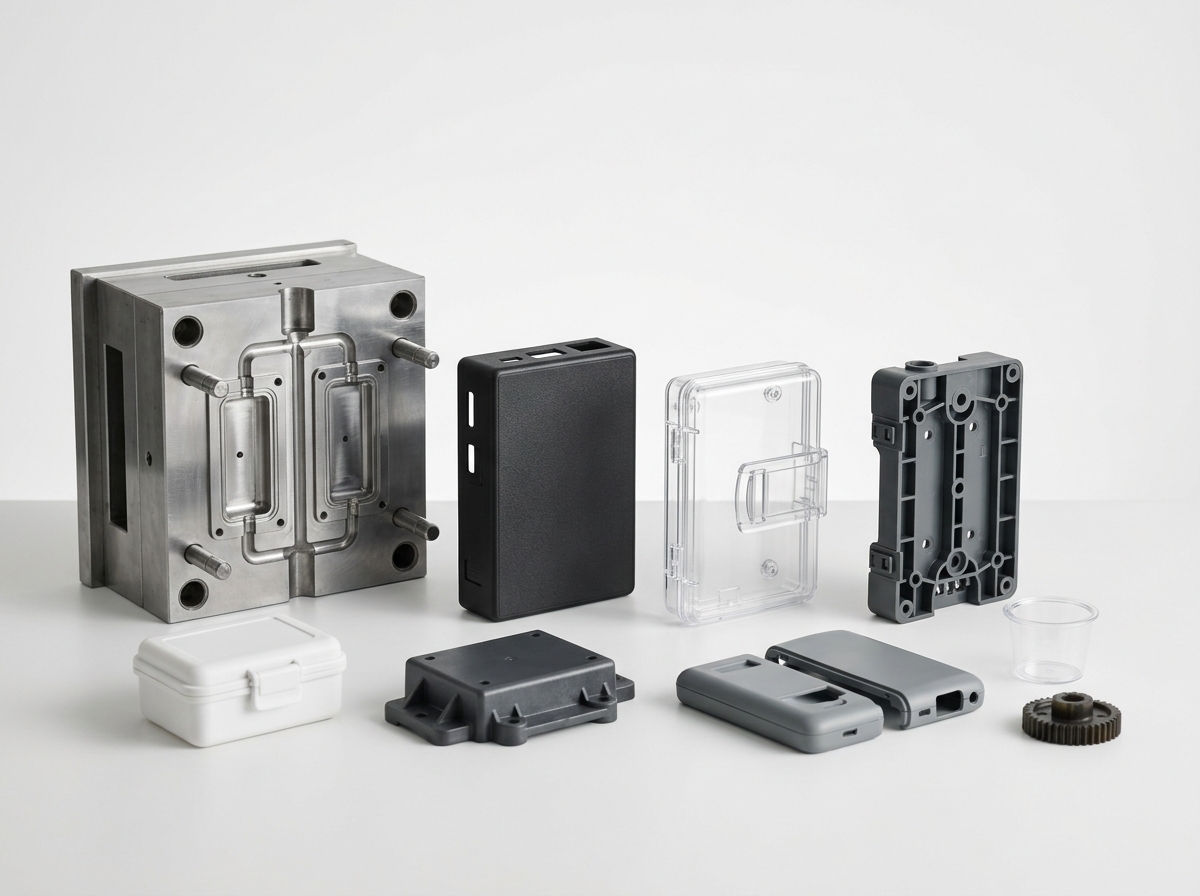 Why Material Choice Matters in Low MOQ Custom Plastic Products
Material choice matters in low MOQ custom plastic products because resin selection influences appearance, cost, durability, and manufacturability at the same time.
Startups often focus on shape first, but material often determines whether the part can survive shipping, survive use, and still look acceptable after repeated handling. For transparent or semi-transparent housings, polycarbonate is common because it combines impact resistance with dimensional stability. According to ASTM D638, tensile testing is commonly used to compare polymers, and polycarbonate grades can show tensile strength values in the tens of MPa range depending on formulation and processing. For many enclosure projects, that balance makes PC a strong option when visual quality and toughness both matter.
For a startup choosing between material grades, the question is not only strength. It is also about moldability, surface finish, shrinkage control, and whether the part needs flame resistance, UV stability, or food-contact compliance. In practical terms, a more forgiving material may reduce trial cost in a low MOQ run, even if the resin price is slightly higher.
Material decisions are also linked to industry standards. Thermoplastic properties can be checked through standardized test methods, while general plastics terminology and performance expectations are commonly documented by standards bodies such as ISO technical committee resources and public test references from NIST. The important point for startups is simple: the cheapest resin is not always the lowest-risk option.
| Material | Typical benefit | Common use case | Startup trade-off |
|---|---|---|---|
| PC | Impact resistance and clarity | Electronic housings | Needs process control |
| ABS | Good balance of cost and finish | Consumer products | Lower heat resistance than PC |
| PP | Lightweight and chemical resistance | Utility parts | Paint and bonding challenges |
| PA | Mechanical strength | Structural components | Moisture sensitivity |
If the startup’s product is an outer shell, a contact surface, or a visible cover, the supplier should explain how the chosen material will behave under molding temperature, cooling time, and real assembly load. That technical conversation is often what separates a low-quality sample from a launch-ready part.
How Precision, Tolerance, and Mold Design Affect Startup Success
Precision and tolerance determine whether a custom plastic product feels engineered or improvised.
In startup projects, many failures happen at the interface level. Screws do not align, clips do not engage, or two halves of a shell do not sit flush. Those are not cosmetic issues; they are system issues. A mold with a poor gate position or inconsistent cooling can create dimensional drift that becomes expensive once the product is in the hands of customers.
Precision expectations should be discussed early. For many injection-molded parts, the practical target may be around ±0.1 mm to ±0.2 mm for non-critical features, while tighter areas require more careful process control and often higher tooling quality. Exact capability depends on geometry, resin, and mold design. In regulated or engineering-heavy applications, the team should define which dimensions are critical-to-function and which are only visual.
That is why startup buyers should request drawings, samples, and production intent before approving a mold. A good supplier will review wall thickness, rib design, draft angles, and undercuts before cutting steel. If the product includes unusual surfaces or brand-driven aesthetics, the design team should consider 3D mold development to reduce the risk of cosmetic mismatch during scaling.
- Define critical dimensions before tooling starts.
- Review shrinkage assumptions for the selected resin.
- Ask for a trial report after the first mold test.
- Check assembly fit with real mating parts, not only drawings.
- Approve surface finish against a physical sample, not just a render.
Good dimensional control is not a luxury for startups; it is what prevents small problems from becoming expensive recalls or negative reviews.
How Startups Should Evaluate a Supplier for Low MOQ Plastic Products
Startup buyers should evaluate a supplier by design support, communication quality, and production stability, not only by price.
Low MOQ projects are sensitive to response speed. If a supplier cannot review drawings quickly, interpret design intent clearly, or explain risk in plain English, the project timeline can slip before tooling even begins. This is especially important for export-oriented startups, where file exchange, sample approval, and shipping coordination must stay organized across time zones.
A practical supplier review should include how the factory handles mold development, how often it reports progress, how it documents trial results, and whether it can support later volume growth. A team that can move from sample to production with minimal requalification saves the startup time and negotiation overhead.
| Supplier evaluation factor | What to ask | Why it matters | Red flag |
|---|---|---|---|
| Design support | Can you review DFM before tooling? | Prevents avoidable mold issues | No engineering feedback |
| Trial transparency | Will you share test data and photos? | Confirms process control | Only final samples are shown |
| Communication speed | How fast is response on revisions? | Protects launch schedule | Delayed replies |
| Scaling ability | Can you support larger orders later? | Supports growth without re-sourcing | Only small-batch focus |
Startups should also ask whether the supplier can support additional parts later. For example, a project that begins with one enclosure may later need internal brackets, accessory covers, or replacement parts. A supplier with broader manufacturing scope can make replenishment easier and reduce switching costs over time.
For teams comparing categories, plastic injection mold services and related part families are usually the most efficient place to start because the process is proven, scalable, and suitable for both pilot and mass production.
Real Startup Use Cases for Low MOQ OEM Plastic Manufacturing
Low MOQ OEM plastic manufacturing is most effective when the product must prove itself in the market before scale.
One common case is a consumer electronics startup launching a new protective shell. The team needs a small number of parts for influencer demos, retail testing, and internal assembly checks. Another case is a home-appliance brand testing a revised control panel cover with a small group of installers. A third case is an industrial startup validating a new bracket or protective cover before committing to a long contract run.
In each case, the startup benefits from the same pattern: small first run, structured feedback, design refinement, then scale. This sequence is especially useful when visual quality matters, because surface defects become obvious in retail photos and on social media. It is also useful when the product has multiple variants, since low MOQ allows the team to test different colors, textures, or dimensions without building too much inventory.
For products that need to combine function and appearance, a supplier with experience in plastic shell mold solutions can help the startup keep the exterior clean while preserving structural strength. For unusual geometry or brand-defining forms, 3D mold capability may create a more differentiated product identity.
According to startup and manufacturing guidance from public and trade sources, early-stage physical-product companies often reduce risk by validating fit and demand in small batches before scaling production. That logic is not unique to plastics, but plastics make it especially important because tooling, material behavior, and assembly tolerance are tightly connected.
What a Smart Low MOQ Buying Checklist Looks Like
A smart low MOQ buying checklist helps startups avoid hidden costs and redesign loops.
The first check is whether the product can be molded efficiently at the target quantity. The second is whether the supplier understands the target market, whether that is consumer electronics, household goods, toys, footwear parts, or industrial accessories. The third is whether the supplier can document the project well enough for future repeat orders.
- Confirm the first-order quantity and the next replenishment target.
- Identify the critical dimensions and appearance surfaces.
- Choose a resin based on use, not only price.
- Ask for tooling feedback before steel is cut.
- Verify that samples reflect production intent.
- Plan packaging and logistics before mass release.
Startups that follow this checklist tend to make better trade-offs. They do not overspend on unused inventory, and they do not underinvest in tooling quality. Instead, they use the first order as a learning stage that prepares them for reliable growth.
Conclusion: The Startup Advantage Is Control, Not Just Cost
Low MOQ custom plastic products help startups by creating control over risk, timing, and product learning.
When a young brand chooses the right OEM plastic manufacturing path, it can test the market with real parts, improve the design before scale, and avoid locking too much capital into inventory. That is especially valuable in industries where fit, appearance, and repeatability determine customer trust. The most successful startup buyers usually treat the supplier as a technical partner, not just a factory. They ask about tooling logic, material behavior, dimensional control, and future scale before placing the first order.
In practical terms, low MOQ is not a compromise; it is a disciplined way to move from concept to commercial product. For startups that want to launch faster and learn faster, that difference can define whether the product survives its first market test.
FAQ
What are low MOQ plastic products?
Low MOQ plastic products are custom-molded parts produced in smaller initial quantities so a startup can test demand, fit, and quality before scaling.
Why are custom plastic products useful for startups?
Custom plastic products let startups turn a design into a physical part that can be tested, shown to customers, and improved before full production.
Is OEM plastic manufacturing expensive for small orders?
Small orders usually have a higher unit price than large-volume production, but they can still be cost-effective because they reduce inventory risk and redesign losses.
Which products are best for low MOQ production?
Enclosures, shells, brackets, covers, accessories, and other parts with uncertain market demand are often the best candidates for low MOQ production.
How do I choose the right material for a startup plastic part?
Choose material based on function, appearance, impact resistance, heat resistance, and molding behavior rather than price alone.
What should I ask a supplier before ordering?
Ask about DFM support, mold trial reports, dimensional control, communication speed, and whether the supplier can scale later.
When should a startup move from low MOQ to mass production?
A startup should move to mass production after the design is validated, early sales are stable, and the product no longer requires major changes.
Post time: Aug-20-2026