
- High-precision mold manufacturing improves dimensional repeatability, which is critical for OEM assembly tolerance stacks.
- Better cavity balance, cooling design, and steel selection can reduce warpage, flash, and cosmetic defects in production.
- OEM buyers gain most when mold design, sampling, and production validation are managed as one workflow, not separate handoffs.
- For PC, ABS, and similar engineering plastics, precision tooling is often the difference between a passing first article and repeated rework.
- A supplier that supports design review, mold trial feedback, and long-term maintenance usually creates more value than a low-quote-only vendor.
Precision injection mold manufacturing is a strategic advantage for OEM programs because it improves repeatability, assembly fit, and launch readiness, especially in high-volume parts where tolerances can cascade across the product. In precision machining and mold validation, common metrology targets are often discussed in microns, and ISO 20457:2018 sets a formal framework for plastics-molded part tolerance assessment. For OEM teams that need stable delivery and fewer engineering changes, a precision mold is not only a tooling asset; it is a risk-control system that protects quality, schedule, and unit economics. See the tooling scope in injection molds, compare structural needs in plastic housings, and review capability fit for complex geometry in 3D molds.
Why precision injection mold manufacturing matters in OEM injection molding
Precision injection mold manufacturing matters most when the part must fit another part, seal against another surface, or look identical across thousands of units.
OEM projects usually fail quietly before they fail visibly. A housing may look acceptable in samples, yet small deviations in wall thickness, gate location, or ejector layout can create assembly stress, sink marks, or inconsistent snap-fit force in mass production. That is why precision injection mold work is valuable: it converts a design concept into a stable production process, not just a one-time sample.
In plastics manufacturing, tolerance management is often more important than nominal size. ISO 20457:2018 provides a tolerance framework for molded plastic parts, while ISO 286-1 remains a useful reference for fit thinking in engineering design. For OEM buyers, the lesson is simple: if the mold cannot hold the feature relationship, the line will pay for it later in rework, sorting, or customer returns.
Precision also supports multi-SKU strategies. For consumer electronics, appliances, and industrial accessories, many programs need the same product family to share a platform while differing in trim, openings, or mounting points. A well-built mold reduces variation across variants and makes platform reuse more practical.
| OEM challenge | What precision mold manufacturing changes | Typical impact on production | Validation reference |
|---|---|---|---|
| Assembly gap variation | Tighter cavity control and balanced cooling | More stable fit across batches | ISO 20457:2018 |
| Cosmetic defects | Improved venting, surface finish, and gate design | Lower reject rate in visible parts | Process capability testing |
| Warped housings | Better material flow and cooling symmetry | Less post-trim correction | Moldflow / trial sampling |
| Late launch changes | Early design-for-manufacture review | Fewer tool revisions | Pre-production review |
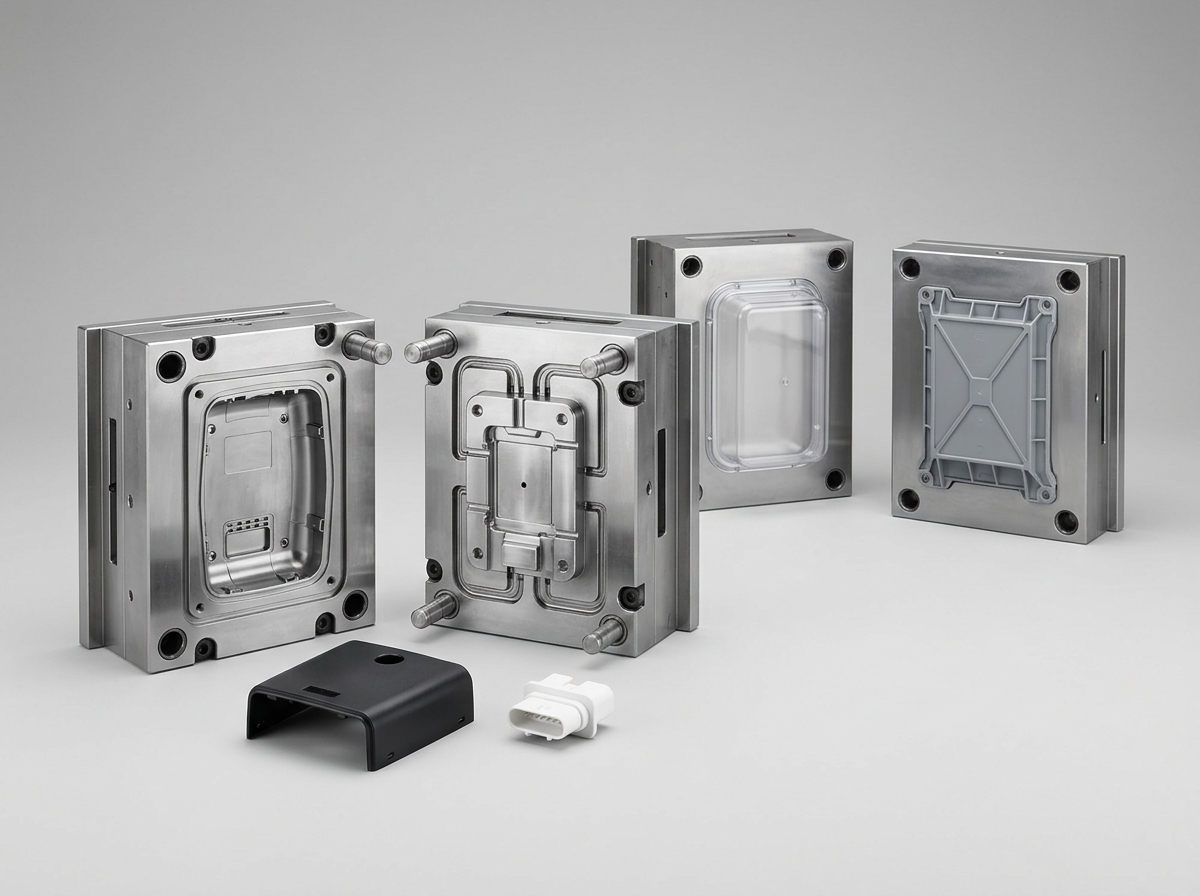 How OEM injection molding projects gain value from tighter mold tolerances
Tighter mold tolerances help OEM programs by reducing the total spread of part variation before the part reaches the assembly line.
In OEM injection molding, the mold is the first control point. If the steel cavity, core alignment, and runner balance are unstable, the molding machine can only compensate so much. Precision tooling reduces the amount of process noise that reaches the finished part. That is especially important for snap-fit enclosures, electrical insulation covers, connector-adjacent components, and transparent PC parts where distortion is easy to see.
Material behavior matters as much as steel precision. PC, for example, offers high impact resistance and optical clarity, but it is also sensitive to moisture, melt temperature, and residual stress. For this reason, precision injection mold manufacturing must account for gate placement, polish grade, wall uniformity, and ejection geometry. A mold that is technically accurate but thermally unstable can still produce unacceptable parts.
When an OEM asks for a lower unit cost, the right question is often not the tool price alone, but the cost of keeping the tool stable over the full program life. A more precise mold may reduce trial iterations, improve first-pass yield, and lower the frequency of corrective maintenance. That is why mature sourcing teams evaluate total cost of ownership rather than only tooling quotation.
| Tooling factor | Low-precision outcome | High-precision outcome | Why OEMs care |
|---|---|---|---|
| Parting line control | Flash and visual mismatch | Cleaner seam and better fit | Brand appearance |
| Cooling layout | Hot spots and warpage | More uniform shrinkage | Dimensional stability |
| Gate design | Stress marks and flow lines | More even fill behavior | Strength and cosmetics |
| Ejection system | Deformation during release | Cleaner part release | Lower scrap risk |
Precision injection mold design for electronics, appliances, and industrial OEM parts
Different OEM sectors benefit from precision injection mold manufacturing in different ways, but the core logic is the same: stable geometry produces stable assembly.
Electronics projects tend to care most about surface appearance, wall consistency, and snap-fit reliability. Appliance parts often prioritize size stability, screw boss strength, and long-term repeatability. Industrial parts usually add mechanical durability, chemical resistance, and supply continuity. In each case, the mold must translate product intent into a reproducible output that survives volume production.
For electronics housings, the focus is usually on aesthetics and fit. Small mismatches can create visible steps at the seam, poor button feel, or stress whitening around clips. For appliance components, the concern shifts toward load-bearing geometry and thermal cycling. For industrial enclosures and functional covers, the key is usually long-term dimensional stability under repeated use.
OEM programs also benefit from vendor-side design support. When a supplier can comment on draft angle, rib thickness, gate location, and cooling strategy before steel cutting, the project is more likely to reach stable production on schedule. This is why many sourcing teams value solution capability, not only machine capacity.
| OEM part category | Main precision requirement | Common defect risk | Priority check |
|---|---|---|---|
| Consumer electronics housing | Cosmetic alignment and clip fit | Flash, sink, mismatch | Appearance and assembly |
| Home appliance cover | Size stability and screw boss strength | Warp, cracking, stress marks | Load and heat resistance |
| Industrial enclosure | Structural rigidity and repeatability | Deformation and seal failure | Long-term reliability |
| Transparent PC part | Optical quality and stress control | Haze, flow lines, birefringence | Surface and clarity |
What to review before starting a custom mold manufacturing project
A custom mold manufacturing project succeeds faster when the buyer and supplier align on drawings, samples, material requirements, and volume targets before steel is cut.
The most expensive mold mistake is often not the wrong material or the wrong machine; it is an incomplete requirement definition. If the OEM only provides a concept sketch without defining tolerance priority, cosmetic class, expected annual volume, or mating conditions, the tool may be built for the wrong outcome. Good mold manufacturing begins with evidence, not assumptions.
A practical pre-project review should cover part function, resin choice, gate sensitivity, assembly method, and target cycle time. For example, a part with hidden internal ribs may need a different cooling strategy than a decorative shell. A transparent PC component usually demands better stress management than an opaque ABS cover. If the part is destined for export, documentation quality and engineering communication speed become part of the deliverable.
OEM sourcing teams should also evaluate whether the supplier can support trial adjustment and later maintenance. Many projects run smoothly at sampling but degrade after repeated use if spare components, polishing, and fit correction are not planned. This is where a one-stop mold and product supply model can reduce coordination gaps.
- Confirm the part function and the top three critical dimensions.
- Define material, surface finish, and assembly method early.
- Agree on sampling criteria before tool release.
- Review cooling, ejection, and gate strategy with the supplier.
- Plan spare parts and maintenance access for the full program life.
Quantitative standards and process data that help OEM buyers judge mold quality
OEM buyers should ask for measurable evidence because mold quality is easier to verify with numbers than with promises.
One of the most useful quality references is ISO 20457:2018, which addresses tolerances for molded plastic parts and gives procurement teams a common language for part acceptance. For environmental or material testing, ASTM D638 is widely used for tensile properties of plastics, while ASTM D790 is a standard method for flexural properties. These standards do not guarantee a good mold by themselves, but they help define what “good” should mean in production terms.
On the machine side, many modern injection molding systems support screw speeds and injection speeds that can be tuned for process stability, but the point for OEMs is not maximum speed. It is repeatability. A high-speed machine cannot compensate for poor venting or an unstable cooling circuit. Likewise, a highly polished cavity cannot fix a poor gate location in a thin-wall part.
Industry estimates often show that better first-pass yield and fewer tool revisions can materially reduce launch waste, but those gains depend on project complexity. In practice, the most reliable metrics are trial report quality, dimensional trend charts, and repeatability across consecutive shots. That is where precision injection mold manufacturing shows real value.
| Reference | What it measures | Why it matters to OEMs | Example use |
|---|---|---|---|
| ISO 20457:2018 | Tolerance framework for molded plastic parts | Defines acceptance language | Dimension control |
| ASTM D638 | Tensile properties of plastics | Confirms material performance | Strength comparison |
| ASTM D790 | Flexural properties of plastics | Useful for shell and bracket behavior | Load-bearing evaluation |
How a precision mold reduces risk across the OEM product lifecycle
A precision mold reduces risk because it lowers variation at the source, and source control is cheaper than end-of-line correction.
During the lifecycle of an OEM program, risk appears in different forms. In the early stage, it is engineering rework. In pilot production, it is unstable sampling. In mass production, it is scrap, downtime, and customer claims. A precision injection mold addresses all three by making the part more predictable from the first trial onward.
This matters most for parts with launch deadlines. If a project is tied to a retail season, a trade show, or a customer line-down replacement, there is little tolerance for repeated tool modification. A supplier that can interpret drawings quickly, communicate in English clearly, and manage export logistics efficiently offers more than convenience; it reduces schedule uncertainty.
OEMs should also look at maintainability. Even a precise mold will drift if wear surfaces are ignored. Inserts, ejector pins, guiding components, and wear plates need a defined service plan. The best suppliers usually document maintenance intervals and replacement parts so the mold remains predictable after many cycles.
- Shorter sampling loop because the mold behaves closer to target on the first trial.
- Lower sorting and trimming effort because flash and mismatch are reduced.
- Better launch predictability because engineering changes are fewer and smaller.
- Longer useful tool life when wear parts are tracked and replaced on schedule.
Choosing a mold manufacturing partner for OEM projects
The right mold manufacturing partner is the one that can convert design intent into stable production, not just the one with the lowest quote.
For OEM buyers, supplier selection should cover technical capability, communication quality, sample response speed, and long-term support. A supplier that can only machine steel but cannot explain root causes during trial may create hidden delays. By contrast, a supplier that can review drawings, suggest feature changes, and maintain the mold after delivery often reduces total project risk.
Capability also matters by product type. Complex curved surfaces may need better tool-path planning and surface finishing. Thin-wall housings may need better flow analysis. Multicomponent or family molds may need more careful balancing. If the supplier has experience across consumer electronics, appliances, toys, daily-use products, and industrial parts, they are more likely to recognize the trade-offs early.
When the purchasing team evaluates offers, the best comparison is usually not quote versus quote. It is proposal completeness versus project risk. That includes DFM feedback, trial data, cavity consistency, spare part planning, and post-shipment support. Those items often decide whether a mold becomes a stable production asset or a recurring problem.
| Supplier evaluation point | Strong answer looks like | Weak answer looks like | OEM impact |
|---|---|---|---|
| Design support | DFM review and risk notes | Only accepts drawings | Fewer redesign loops |
| Trial feedback | Dimension report and corrective plan | Only sends samples | Faster approval |
| Maintenance support | Spare parts and service plan | No after-sales detail | Lower downtime risk |
| Program communication | Clear English updates and schedule control | Unclear response timing | Better launch reliability |
Practical OEM checklist for precision injection mold manufacturing
A practical checklist helps OEM teams avoid the most common mistakes before tool fabrication begins.
The most useful checklist is short but specific. First, confirm the real product use case. Second, identify which dimensions are critical and which are cosmetic only. Third, choose the resin with the actual service environment in mind, not just the lowest cost material. Fourth, agree on the sample approval path so the factory knows what success looks like. Finally, ensure maintenance and spare parts are part of the commercial discussion.
For products using PC material, the checklist should include moisture control, wall balance, and stress-sensitive geometry. For decorative shells, it should include appearance criteria and gate mark tolerance. For structural parts, it should include load path, rib layout, and long-term dimensional stability. Precision injection mold manufacturing is most effective when these decisions are made before steel is hardened, not after the first failure.
- Confirm target volume, resin type, and cosmetic grade.
- Mark the three most critical dimensions on the drawing.
- Review draft angle, rib thickness, and gate position.
- Ask for trial data, not only sample parts.
- Define spare parts and maintenance intervals before delivery.
FAQ: precision injection mold, OEM injection molding, and mold manufacturing
What makes a precision injection mold different from a standard mold?
A precision injection mold is built with tighter control over cavity alignment, cooling symmetry, gate design, and wear resistance, which improves part repeatability and assembly fit.
Why do OEM projects need high-precision injection mold manufacturing?
OEM projects need high-precision injection mold manufacturing because even small variation can cause fit problems, cosmetic defects, or downstream scrap in mass production.
How early should OEM buyers involve the mold supplier?
OEM buyers should involve the mold supplier as early as the drawing and sample review stage, because early DFM feedback prevents expensive tool revisions later.
Which materials benefit most from precision mold manufacturing?
PC, ABS, and other engineering plastics benefit strongly because they are sensitive to flow, cooling, shrinkage, and surface stress.
What standards help verify mold-related part quality?
ISO 20457:2018 is useful for molded-part tolerances, while ASTM D638 and ASTM D790 help evaluate tensile and flexural performance of plastics.
How can OEMs reduce launch risk in mold projects?
OEMs can reduce launch risk by demanding DFM review, trial data, maintenance planning, and clear acceptance criteria before tool release.
Is the cheapest mold usually the best choice for OEM production?
No, the cheapest mold is often the most expensive choice over time if it causes repeated sampling, unstable quality, or early maintenance issues.
Post time: Sep-10-2026