
Fast delivery matters because it reduces project risk, shortens launch windows, and improves procurement flexibility. For OEM and ODM teams, the main advantage is not speed alone, but faster feedback between engineering, tooling, and production.
Why Fast Lead Time Plastic Manufacturing Services Matter for Custom Plastic Products
Fast lead time plastic manufacturing services are most useful when a project depends on quick validation and controlled iteration. They help teams test fit, appearance, and function before committing to larger volumes.
In practice, these services support electronics housings, consumer goods, packaging parts, and other custom plastic products that must move from concept to sample quickly. A shorter cycle can also reduce the cost of late design changes.
What “fast lead time” really means in manufacturing
Fast lead time usually means a compressed sequence from part review to mold build, trial, and sample approval. It does not mean skipping engineering checks; it means removing avoidable delays in communication and handoff.
For buyers, the most important metric is total project time, not only tool fabrication time. A supplier that can combine design review, mold making, and injection molding in one workflow often delivers faster overall results.
How Rapid Injection Molding Supports Faster Product Development
Rapid injection molding is a practical route for faster custom plastic products because it links tooling and sample production in one controlled process. It is especially effective when the part geometry is stable and the material choice is already defined.
Compared with a fragmented supply chain, integrated mold development reduces waiting time between design approval and first article samples. That is why many buyers use it for pilot runs, market tests, and early-stage production.
DFM feedback reduces rework
Design for manufacturability feedback is one of the biggest time savers in accelerated mold development. Early DFM review can identify draft issues, wall thickness imbalance, undercuts, gate placement concerns, and ejection risks before steel is cut.
When these issues are found late, the project often loses days or weeks in modification. When they are found early, the team can revise the drawing once and avoid repeated trial cycles.
Comparison Table: Lead Time Impact Across Common Development Paths
| Development path | Typical strength | Main lead-time risk | Best use case |
|---|---|---|---|
| Traditional multi-vendor flow | Flexible sourcing | Long handoff delays | Low-urgency programs |
| Integrated mold and molding service | Faster coordination | Depends on supplier capacity | OEM and ODM launches |
| Rapid injection molding | Quick sample turnaround | Limited by part complexity | Prototype and pilot runs |
Comparison Table: Common Custom Plastic Product Priorities by Industry
| Industry | Primary priority | Why speed matters | Typical product examples |
|---|---|---|---|
| Electronics | Fit and appearance | Launch timing affects market entry | Enclosures, covers, housings |
| Packaging | Consistency and sealing | Short replenishment cycles | Boxes, containers, display parts |
| Daily goods | Cost and repeatability | Fast replenishment supports sales | Cups, tableware, storage items |
| Toys and decor | Surface detail | Seasonal demand changes quickly | Balls, decorative parts |
Which Product Categories Benefit Most from Faster Tooling
Custom plastic products with visible surfaces, tight assembly requirements, or frequent design updates benefit most from shorter lead times. These parts usually need sample approval before volume commitment.
On the target website, the main product categories include plastic injection molds, plastic case molds, PC case molds, 3D molds, and custom plastic parts. These categories cover both structural and appearance-driven projects.
Electronics housings need tight coordination
Electronics housings often require accurate hole positions, snap fits, and stable cosmetic quality. Faster tooling is valuable because engineering teams usually need to verify assembly before the product enters procurement or certification stages.
For this reason, PC enclosures and similar shells are strong candidates for quick-turn tooling. A single revision can affect both function and appearance, so early sample feedback is critical.
Packaging and daily goods need repeatability
Packaging and household products benefit from fast lead time when the buyer needs fast replenishment or seasonal launch support. These products often depend on stable dimensions, efficient cavity design, and predictable cycle times.
In these cases, the value of speed is tied to supply continuity. Faster mold completion helps avoid stockouts and supports a smoother transition from trial orders to repeat production.
Key Specifications for Faster Custom Plastic Product Development
| Specification area | Why it matters | Typical review point |
|---|---|---|
| Wall thickness | Affects sink, warpage, and fill balance | During DFM |
| Draft angle | Supports clean ejection | Before mold design freeze |
| Gate location | Influences flow and appearance | During mold layout |
| Tolerance target | Controls assembly fit | Before trial approval |
| Surface finish | Impacts visual quality | At sample review |
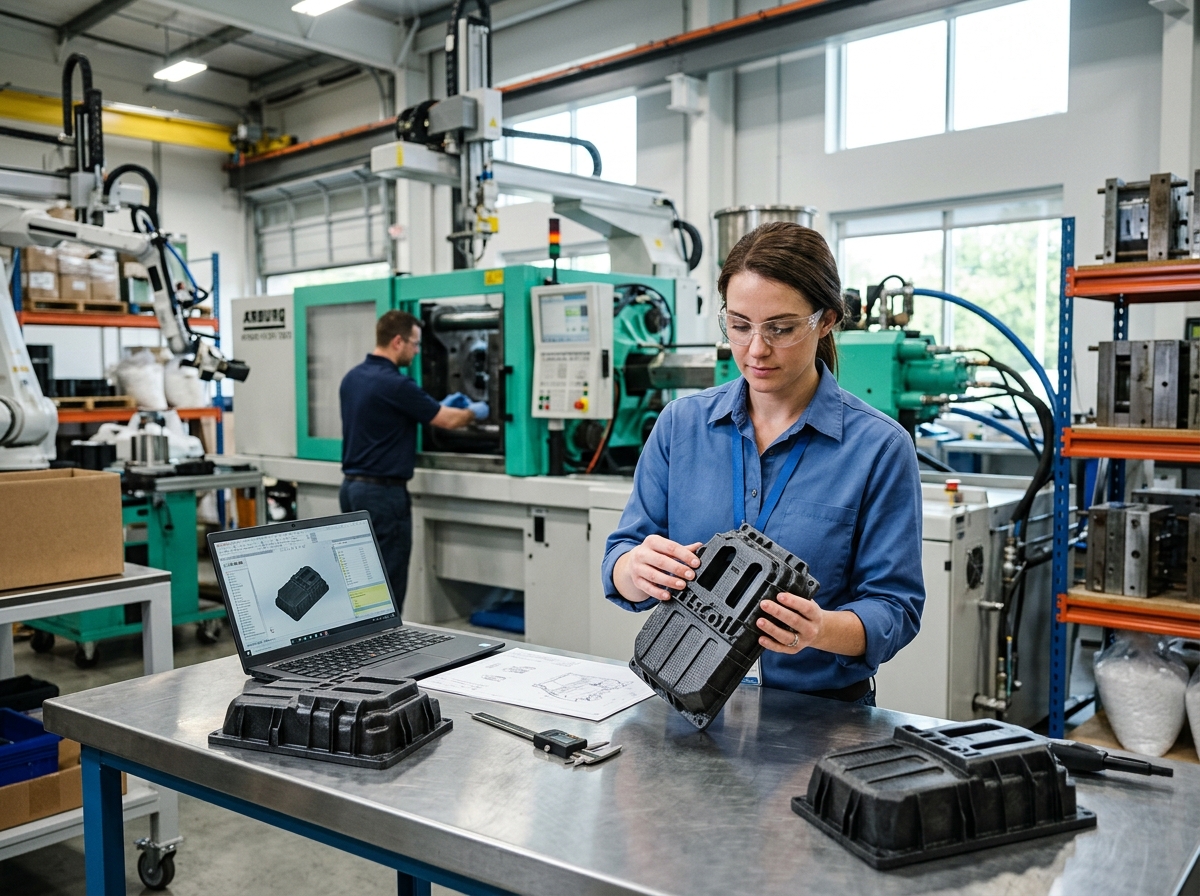
How to Reduce Risk While Keeping Lead Times Short
Short lead times are safest when the project is managed with disciplined engineering and clear approval gates. Speed without process control often creates more delay later.
According to ISO 20457, molded part tolerances and acceptance conditions should be defined with the part’s functional requirements in mind, which is especially relevant for injection-molded components. The standard is useful because it reminds buyers to specify acceptance criteria before production starts.
Use clear input data from the start
The fastest projects usually begin with complete drawings, samples, or a well-defined concept. Missing dimensions, unclear surface requirements, or vague assembly targets often slow down even a capable supplier.
When the input package is strong, the supplier can move directly into mold design and process planning. That reduces back-and-forth and makes the schedule more predictable.
Validate material and performance early
Material selection should be confirmed before the mold is finalized, because resin behavior affects shrinkage, stiffness, and surface quality. ASTM D790 is widely used to evaluate flexural properties of plastics, making it relevant when stiffness is part of the design target.
For projects that need prototype-like speed, additive manufacturing can also support early geometry checks. NIST notes that additive manufacturing builds parts layer by layer and is useful for custom applications, which makes it a practical complement to molding in early development.
What a Fast Lead Time Workflow Looks Like
A fast lead time workflow is strongest when each stage is defined and approved in sequence. The goal is to eliminate idle time between design, tooling, trial, and release.
- Confirm part requirements, drawings, and target material.
- Complete DFM review and identify mold risks.
- Finalize mold design and build the tool.
- Run the first trial and inspect dimensions and appearance.
- Revise if needed, then approve for pilot or mass production.
This workflow is efficient because it keeps engineering, tooling, and molding aligned. It also reduces the chance that a late change will disrupt the schedule.
Trial molding should focus on decision-making
Trial molding is not only a sample step; it is a validation checkpoint. Teams should review filling, shrinkage, ejection, surface marks, and assembly fit before approving the next stage.
When trial data is documented clearly, the next revision becomes easier to manage. That is one reason experienced buyers prefer suppliers that can provide samples, feedback, and modification support in-house.
Where to Buy and How to Compare Suppliers
The best supplier is usually the one that can balance speed, engineering support, and repeatable quality. Buyers should compare capability, communication speed, and the ability to support both tooling and molding.
For a one-stop option, the target website’s professional injection moulding services and quality service pages are relevant starting points. For broader product coverage, the products and plastic products pages help buyers review category fit before requesting a quote.
Other well-known industry references for standards and technical validation include ISO, ASTM, and NIST. These sources are useful for defining tolerances, test methods, and development expectations before production begins.
Conclusion: Faster Lead Time Works Best When Quality Control Is Built In
Fast lead time plastic manufacturing services benefit custom plastic products when speed is paired with engineering discipline. The real advantage is faster learning, faster approval, and faster movement into stable production.
For buyers, the best outcome is not just a shorter schedule. It is a shorter schedule with fewer surprises, clearer tolerances, and a smoother path from sample to scale.
FAQ
1. What is the main advantage of fast lead time plastic manufacturing services?
The main advantage is faster product validation. Buyers can confirm fit, appearance, and function sooner, which reduces launch risk and helps teams make decisions before committing to full production. It is especially useful for OEM and ODM projects with tight schedules.
2. Are rapid injection molding and traditional molding the same thing?
They are related but not identical. Rapid injection molding focuses on shorter development cycles and quicker sample delivery, while traditional molding may prioritize long-term production efficiency. The right choice depends on part complexity, volume, and how quickly the project must move.
3. Which custom plastic products benefit most from shorter lead times?
Electronics housings, packaging parts, daily goods, and decorative components usually benefit the most. These products often need quick design approval, visual review, or seasonal replenishment, so a shorter tooling cycle can improve both planning and market response.
4. How can buyers reduce delays during mold development?
Buyers can reduce delays by providing complete drawings, clear tolerance targets, approved materials, and surface requirements at the start. Early DFM review also helps identify risks before tooling begins, which prevents repeated revisions and schedule slippage later in the project.
5. Why are standards important when ordering custom plastic products?
Standards help define what acceptable quality looks like. ISO 20457 is useful for molded-part tolerances, and ASTM D790 supports flexural testing when stiffness matters. Clear standards make supplier communication easier and reduce disputes during sample approval and production release.
Post time: Jul-05-2026