
- Hot runner molds reduce runner scrap and can improve material utilization, but they increase tool complexity and maintenance requirements.
- Cold runner molds are simpler, cheaper to build, and easier to debug, but they add runner regrind, extra cycle time, and more post-processing.
- The right choice depends on annual volume, resin price, cavity count, cosmetic requirements, and how often the design will change.
- For procurement teams, the best metric is cost per acceptable part, not initial mold quotation.
For injection molds, the hot runner mold versus cold runner mold decision is not only a tooling question; it is a manufacturing strategy question. In precision production, even a seemingly small tolerance such as ±0.005 mm can affect assembly fit, sealing, and cosmetic quality, which is why tooling selection must align with the product’s end-use requirements. Standards and measurement discipline matter here: ISO 20457:2018 provides a framework for injection-molded test specimens, while NIST guidance on measurement traceability helps manufacturers keep inspection systems aligned with production reality. For buyers comparing custom injection molds, this means the correct runner system should support dimensional stability, repeatability, and predictable total cost. See also injection molds, PC plastic injection mold, and 3D mold solutions for typical part and tooling contexts.
Hot Runner Mold vs Cold Runner Mold: the Core Difference in Injection Molds
The core difference is where the molten resin solidifies and how much material remains outside the cavity after each shot.
In a hot runner mold, the resin stays molten inside heated manifolds and nozzles until it reaches the gate, so there is little or no runner waste. In a cold runner mold, the runner channel cools and solidifies with every cycle, and that runner must be separated, recycled, or scrapped after molding.
This distinction changes cycle time, material utilization, mold cost, and maintenance needs. It also changes how a factory handles color change, resin drying, gating strategy, and part quality. For example, a cosmetic consumer-electronics shell often benefits from gate control and balanced filling, while a lower-volume industrial component may prioritize fast tooling launch and simpler serviceability.
| Comparison item | Hot runner mold | Cold runner mold |
|---|---|---|
| Runner waste | Near zero for many systems | Runner added every cycle |
| Tooling complexity | Higher | Lower |
| Maintenance | Heater, thermocouple, nozzle upkeep | Mainly steel wear and gate cleanup |
| Color change | Slower and more sensitive | Usually easier |
| Best fit | High-volume, stable programs | Lower-volume or variable programs |
When a Hot Runner Mold Is Better for High-Volume Injection Molds
A hot runner mold is usually better when the program is high-volume, the resin is expensive, and part design is stable.
The reason is simple: eliminating the runner lowers material consumption and can shorten cycle time because the runner does not need to cool and eject. In multi-cavity production, that savings compounds quickly. If a program runs millions of parts, the cumulative material loss from a cold runner can become substantial, especially with engineering resins or filled compounds.
Hot runner systems are widely used in consumer electronics, appliance housings, and packaged components where cosmetics and repeatability matter. They also support balanced fill across multiple cavities, which can improve part-to-part consistency if the manifold design is well engineered. For product teams buying custom plastic parts, that consistency can reduce inspection burden and downstream assembly issues. A practical sourcing approach is to pair the tooling discussion with a stable product plan, such as plastic shell mold, appliance injection mold, or custom plastic parts.
Hot runner molds also fit designs that need multiple gates, edge gates, or valve gating to control knit lines and visible gate marks. In cosmetic parts, this can be a decisive advantage because the gate location often influences sanding, painting, and final appearance. However, the system requires disciplined process control because heater imbalance or degraded thermal management can cause drool, stringing, color streaks, or local overpacking.
| High-volume decision factor | Why hot runner helps | Procurement impact |
|---|---|---|
| Annual output | Runner waste spreads over large volume | Lower cost per good part |
| Resin price | Less scrap material | Faster ROI on tooling premium |
| Cavity count | Better balance in multi-cavity tools | More stable production |
| Cosmetics | Smaller or hidden gate options | Better surface quality |
When a Cold Runner Mold Is the Better Procurement Choice
A cold runner mold is often the better choice when the project is short-run, highly iterative, or budget-sensitive.
Cold runner tooling is mechanically simpler, which typically lowers the initial mold price and reduces the number of components that can fail. That matters when the buyer is validating a new product, expecting frequent geometry changes, or launching a limited production run. It is also useful when color changes are frequent because the runner system can be purged and adjusted with less concern about residual melt in heated channels.
Another practical benefit is easier troubleshooting. Because the thermal system is simpler, a cold runner mold can be faster to debug during trial shots. For many OEM and ODM projects, this can shorten the time from drawing to first article approval. A sourcing team that wants flexibility may prefer a cold runner approach for OEM and ODM mold projects or for parts that are still in design freeze review.
Cold runner systems are also common when the part volume is moderate and material cost is not the dominant expense. If labor and tooling simplicity matter more than resin yield, the total project economics may favor the cold runner mold even if the per-part material utilization is lower.
- Choose cold runner when the design is still changing.
- Choose cold runner when budget and lead time are the biggest constraints.
- Choose cold runner when color changes are frequent.
- Choose cold runner when maintenance resources are limited.
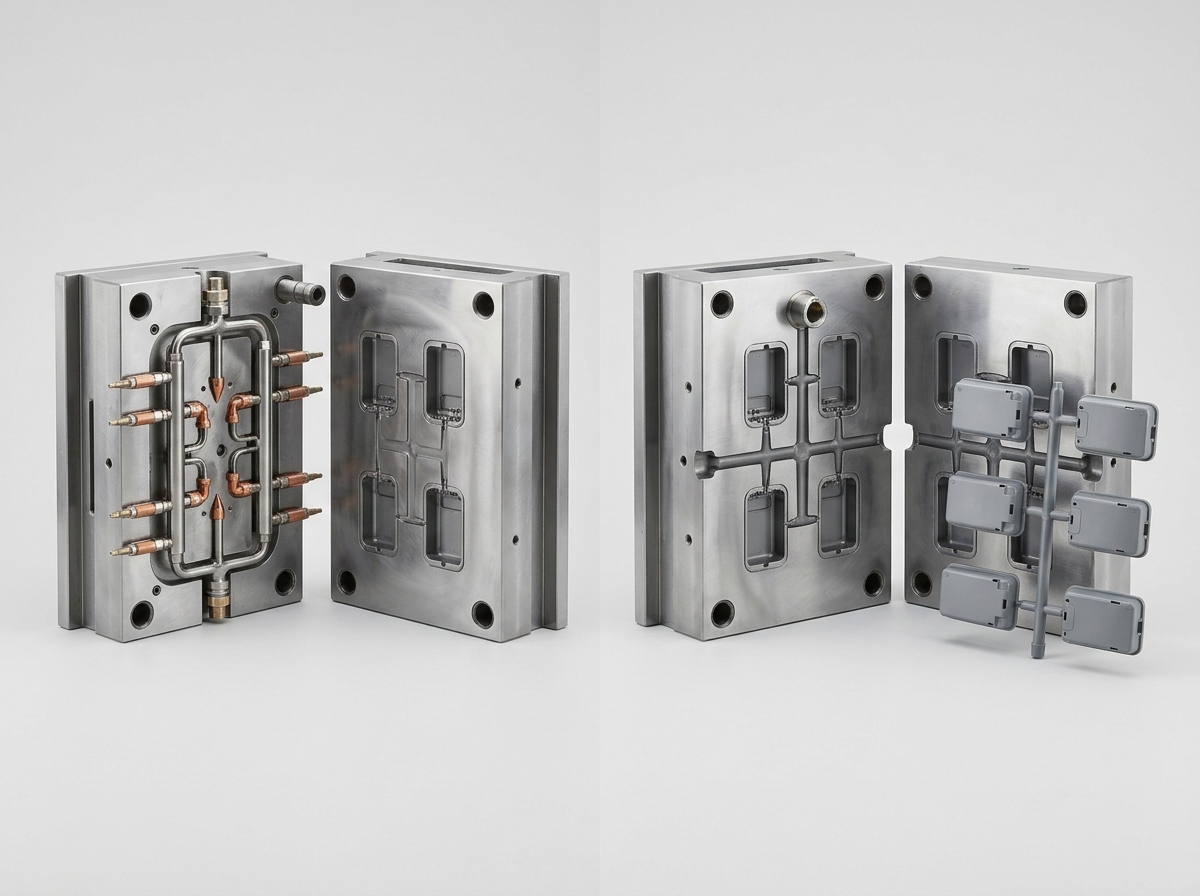 Quantitative Comparison for Injection Molds: Cost, Cycle Time, and Waste
The right runner system should be evaluated by measurable outcomes, not by tool price alone.
Below is a practical comparison framework that procurement teams can use during RFQ review. The numbers vary by part geometry and resin, but the categories are stable across most injection molds. For example, injection molding quality systems often work around dimensional control plans derived from the part drawing and inspection method, while the mold itself must be designed to support consistent filling and cooling. ISO 20457:2018 is useful as a reference point for molded test specimen practices, and NIST’s Manufacturing Extension Partnership also emphasizes process measurement and traceability in production systems.
| Metric | Hot runner mold | Cold runner mold | Why it matters |
|---|---|---|---|
| Runner material | Minimal or none | One runner per shot | Material utilization |
| Cycle time | Usually lower | Usually higher | Output per hour |
| Tool price | Higher | Lower | CAPEX decision |
| Maintenance complexity | Higher | Lower | Downtime risk |
| Color switching | Harder | Easier | Changeover speed |
A useful rule is to compare cost per good part at a realistic annual run rate. If a cold runner mold adds even a modest runner volume on every cycle, the economics worsen as production rises. In contrast, the hot runner mold can make more sense as volume increases because the fixed tooling premium is diluted over a larger output base. That is why many buyers of high-volume injection molds eventually move toward hot runners after a successful pilot run.
Material choice also affects the decision. Filled engineering resins, flame-retardant compounds, and transparent grades such as polycarbonate may require tighter thermal control and more careful gate design. For PC components, cosmetic risk and dimensional stability often justify the added complexity of a hot runner mold if the part is destined for a high-volume shell or protective cover application.
Technical Trade-Offs: Gate Quality, Shear, and Part Appearance
The runner system changes the thermal and flow history of the melt, and that directly affects part quality.
In a hot runner mold, the melt is kept near processing temperature all the way to the gate, which can reduce pressure loss and support shorter filling paths. That is useful for thin-wall parts or multi-cavity tools. However, if the temperature profile is poorly controlled, resin degradation, drool, or gate stringing can appear. In contrast, a cold runner mold has a predictable solidifying runner but imposes extra pressure loss and can create more material handling steps after molding.
Surface quality is also affected by the gate type and runner design. The gate should be positioned to minimize weld lines in visible areas and to control flow orientation. This matters in electronic housings, appliance trims, and consumer-facing parts where cosmetic consistency directly influences acceptance. For parts with complex curvature or a differentiated silhouette, a more specialized tooling strategy may be needed, which is why projects involving 3D mold solutions often require a runner discussion early in design review.
Another issue is regrind. Runner reuse is common in cold runner molding, but the allowable regrind ratio depends on resin, part performance, and color requirements. Overuse of regrind can affect mechanical properties or appearance, so buyers should define a material control plan before production begins.
Standards and Measurement: What Buyers Should Ask Before Ordering Injection Molds
Buyers should ask how the supplier verifies dimensional control, thermal balance, and trial-shot repeatability.
Measurement systems matter because a tooling decision is only good if the result can be validated. ISO 20457:2018 gives a recognized framework for injection-molded test specimens, and ASTM D638 specifies tensile testing for plastics, which helps teams compare molded material behavior under controlled conditions. The U.S. National Institute of Standards and Technology maintains measurement resources that reinforce traceability and calibration discipline, which is essential when a project depends on tight tolerances and repeatable assembly fits.
For procurement, the practical questions are straightforward: How is cavity balance checked? How is mold temperature monitored? What is the first-shot sampling plan? What is the acceptable Cpk target for critical dimensions? What are the gate vestige limits on visible surfaces? These questions often reveal whether the supplier is prepared for a stable launch or only for a single prototype round.
| Validation topic | What to ask | Why it matters |
|---|---|---|
| Dimensional inspection | Gauge R&R, CMM, GO/NO-GO tools | Confirms tolerance capability |
| Material testing | ASTM D638 or part-specific test plan | Verifies resin performance |
| Process traceability | Temperature, pressure, cycle logs | Supports repeatability |
| Tool qualification | T1, T2, and approved sample criteria | Controls launch risk |
For buyers of custom injection molds, this is where supplier maturity matters more than a low quotation. A good mold maker can explain why a hot runner mold or cold runner mold is best for the specific part, not just quote a generic option. That is especially important for structural housings and multi-piece assemblies where the tooling must support downstream fit and finish.
Real-World Selection Guide for Injection Molds
The best runner system is the one that matches the product lifecycle, not the one that sounds more advanced.
Use the following selection guide when comparing suppliers and issuing an RFQ. It helps turn a vague tooling discussion into a procurement decision with measurable criteria.
- Estimate annual volume and peak monthly demand.
- Identify resin cost, dryness requirements, and regrind limits.
- Define cosmetic, structural, and dimensional critical-to-quality features.
- Decide how often the design may change after launch.
- Compare cost per good part, not only mold quotation.
If the answer is stable design, high output, and expensive resin, the hot runner mold usually deserves serious consideration. If the answer is uncertain design, lower output, or frequent color changes, the cold runner mold is often the safer starting point.
In supply-chain terms, the choice also depends on lead time and service capability. A hot runner mold can be highly productive, but it may require better spare-part support, more disciplined maintenance, and faster troubleshooting expertise. A cold runner mold is easier to service, which can matter for factories that need local maintenance simplicity or shorter training cycles.
Decision Table: Which Option Is Better for Your Project?
The right answer depends on where your project sits on the volume-versus-flexibility curve.
| Project condition | Better option | Reason |
|---|---|---|
| High annual volume | Hot runner mold | Lower waste and better cost per part |
| Prototype or pilot run | Cold runner mold | Lower tooling risk and easier changes |
| Frequent color changes | Cold runner mold | Easier purging and transition |
| Cosmetic consumer shell | Hot runner mold | Better gate control and finish |
| Budget-limited launch | Cold runner mold | Lower initial investment |
| Long-life platform product | Hot runner mold | Better lifecycle economics |
For most buyers, the practical answer is not binary. A portfolio strategy often works best: use cold runner molds for early validation, then switch to hot runner molds for scaled programs once demand and design stability are proven. This staged approach reduces launch risk while preserving the option to optimize production economics later.
That is also why a supplier with both design support and manufacturing experience can be useful. A team that understands injection molds across multiple part categories can help align runner design with product function, cosmetic standards, and production volume.
FAQ: Hot Runner Mold vs Cold Runner Mold
1. Which is cheaper to make, a hot runner mold or a cold runner mold?
A cold runner mold is usually cheaper to build because it has fewer heated components and less control hardware.
2. Which mold produces less waste?
A hot runner mold usually produces less waste because it eliminates or greatly reduces runner scrap.
3. Which option is better for high-volume production?
A hot runner mold is generally better for high-volume injection molds because it lowers material waste and can reduce cycle time.
4. Which option is easier to maintain?
A cold runner mold is usually easier to maintain because it does not rely on heaters, manifolds, and thermal control to the same extent.
5. Which mold is better for frequent color changes?
A cold runner mold is usually easier for frequent color changes because the runner system is simpler to purge.
6. Which mold is better for cosmetic parts?
A hot runner mold often works better for cosmetic parts because it offers more flexible gate placement and can reduce visible runner handling.
7. How should I choose between the two for an OEM project?
Choose based on annual volume, resin cost, part complexity, change frequency, and cost per good part rather than mold price alone.
In summary, the better option depends on your business model as much as on the part geometry. If your priority is launch flexibility, lower upfront cost, and simple maintenance, the cold runner mold is often the best fit. If your priority is stable high-volume output, lower scrap, and better lifecycle economics, the hot runner mold usually becomes the stronger choice. For buyers comparing injection molds, the smartest path is to ask for both tooling concepts, then evaluate them against production volume, quality targets, and total cost of ownership.
Post time: Sep-15-2026