
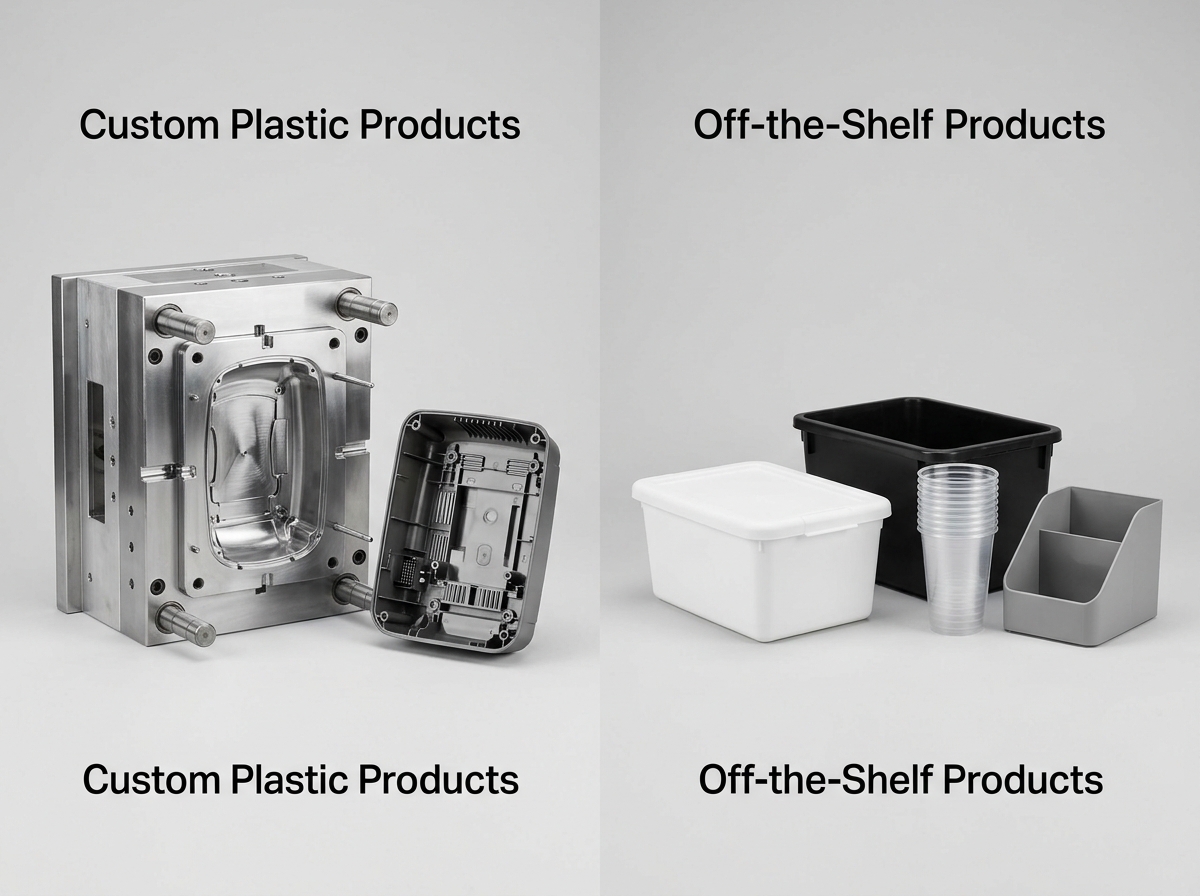
- Custom plastic products reduce design compromise, but they usually require tooling investment and longer launch cycles.
- Standard plastic products lower initial cost and procurement time, but they rarely optimize fit, branding, or assembly efficiency.
- OEM plastic manufacturing is most valuable when part geometry, tolerance stack-up, and volume justify a dedicated mold.
- For repeated production, the economics often shift toward custom parts after the first tooling cost is absorbed.
- Material choice, especially PC for impact and clarity, can matter as much as the custom-versus-standard decision itself.
Custom plastic products and standard plastic products are both used in high-volume manufacturing, but they solve different purchasing problems, and the right choice often depends on whether your part must be engineered to a product or simply sourced to a catalog. In injection molding, dimensional control is commonly evaluated using standards such as ISO 20457:2018, while mold performance and part consistency are closely tied to process control under NIST calibration and measurement practices. For buyers in electronics, appliances, and industrial equipment, a custom plastic housing can reduce assembly friction, improve brand fit, and support tolerances in the hundredths of a millimeter range when the tool and process are properly controlled.
Custom Plastic Products vs Standard Plastic Products: The Core Decision
The core decision is whether you need a product that fits your design or a design that fits an existing product.
Custom plastic products are built from your drawing, sample, or functional requirement, which means you can define wall thickness, ribs, snap-fits, bosses, surface texture, logo placement, and color control. Standard plastic products are already designed, molded, and stocked for broad use, so they are faster to buy but harder to adapt. In OEM plastic manufacturing, custom tooling becomes economically attractive when the part is repeated, protected by design, or tightly linked to the final product architecture.
Many procurement teams underestimate the hidden cost of using a standard part. A catalog part may look cheaper on paper, but if it creates extra fasteners, manual labor, cosmetic mismatch, or assembly rework, the total landed cost can rise quickly. For that reason, the right comparison is not unit price only; it is part cost, assembly cost, defect risk, and time-to-market.
| Decision Factor | Custom Plastic Products | Standard Plastic Products |
|---|---|---|
| Upfront tooling cost | High, often thousands to tens of thousands of USD depending on complexity | Usually none or minimal |
| Lead time | Typically longer due to design, tooling, and validation | Short, often immediate from stock |
| Design fit | Matched to product requirements | Generic fit, limited adaptation |
| Brand identity | High, supports unique appearance and function | Low to moderate |
| Change flexibility | High before tooling freeze, lower after mold release | Low, because the item is fixed |
Why Custom Plastic Products Often Win in OEM Plastic Manufacturing
Custom plastic products are usually the better answer when the part must solve a real engineering problem.
That problem may be fit, protection, sealing, load bearing, appearance, or assembly speed. In consumer electronics, for example, a plastic enclosure may need controlled clip force, clean parting lines, and stable geometry across repeated production. In appliances, the same housing may need to survive thermal cycling and maintain alignment with metal frames, screws, and gaskets. In industrial equipment, the part may need to carry labels, cable routing features, and impact resistance under daily handling.
OEM plastic manufacturing adds value because it converts a concept into a repeatable production system. That system includes mold design, gate location, venting, cooling balance, resin selection, trial runs, and final approval. When the supplier handles both the mold and the part, the feedback loop is usually shorter, which can reduce iteration time before mass production.
For clear or impact-resistant parts, PC injection molding is often selected because polycarbonate combines optical clarity with toughness. Common PC grades used in industry can achieve tensile strength around 60 to 70 MPa and heat deflection temperatures that vary by grade, which is why the material is widely used for transparent covers, shields, and housings. Material choice should always be validated against the final operating environment, not just the brochure data.
In practice, custom parts also improve design consolidation. One well-designed molded component can replace several off-the-shelf parts plus the labor needed to assemble them. That is where custom work often creates the largest value.
When Standard Plastic Products Are the Smarter Procurement Choice
Standard plastic products are the better choice when the part is simple, widely used, and not central to product differentiation.
If you need trays, simple caps, spacers, clips, or generic covers, a standard item can save time and reduce project risk. This is especially useful for maintenance, pilot builds, temporary fixtures, and low-volume internal use. Buyers often choose catalog parts when they need to move fast, validate a concept, or avoid tooling investment before demand is proven.
Standard products are also useful when your volume is too low to justify dedicated tooling. In many programs, the first purchase is a standard part, then the team upgrades to a custom part after market feedback confirms demand. That approach lowers early financial exposure, but it can also limit product optimization.
The trade-off is that standard parts rarely match all functional needs. A generic enclosure may have unused space, poor cable routing, weak mounting points, or surface details that conflict with your brand. If the part touches the customer directly, those compromises can show up in perceived quality.
| Use Case | Standard Part Advantage | Custom Part Advantage |
|---|---|---|
| Maintenance spares | Fast replacement | Better fit to legacy equipment |
| Prototype validation | Low cost and quick sourcing | Closer to final product behavior |
| High-visibility consumer product | Lower initial spend | Better branding and surface control |
| Simple utility component | Efficient procurement | Usually unnecessary |
How Injection Mold Design Changes the Total Cost of Ownership
Injection mold design is the main reason custom plastic products can become cheaper over time.
A well-designed mold reduces cycle time, stabilizes dimensions, and lowers scrap. The cycle time in injection molding is often driven by cooling, and cooling can account for the majority of the cycle in many parts. Even a small reduction in cooling time can materially improve output over a long production run. For example, if a part runs 30 seconds per cycle and the mold is optimized to 26 seconds, output rises by about 15.4 percent before any other change is made.
That is why experienced buyers do not ask only, “How much does the part cost?” They also ask, “How many parts per hour can the mold support, and what is the expected stability at scale?” In many projects, the mold pays for itself through lower unit cost, lower assembly labor, and fewer quality escapes.
Design also affects part quality. Rib thickness, draft angle, gate position, and venting all influence whether the part warps, sinks, traps air, or shows visible weld lines. When the part is a cosmetic housing, these details are not optional. They are the difference between a part that passes and one that is rejected.
For buyers comparing custom plastic products with standard plastic products, the most useful metric is not the catalog price. It is cost per acceptable finished unit across the full product lifecycle.
| Economic Metric | Custom Tooling Path | Standard Product Path |
|---|---|---|
| First-unit cost | Higher due to tooling amortization | Lower |
| Unit cost at volume | Usually lower after tooling is absorbed | Often stable but less optimized |
| Assembly labor | Can be reduced by design integration | Often unchanged or higher |
| Scrap exposure | Depends on process control and mold quality | Lower process risk if already proven, but limited fit control |
 Material Choice, Tolerance, and Surface Quality Matter More Than Buyers Expect
Material selection often determines whether a custom plastic product succeeds in the field.
Polycarbonate is widely used for clear housings because it offers impact resistance and dimensional stability, while ABS is common for cost-sensitive housings that need a balance of toughness and processability. For higher heat resistance, engineering resins may be required, but those decisions should be validated against real operating temperature, chemical exposure, and assembly stress. A part that looks good on day one may still fail if the resin is not matched to the use case.
Tolerance is equally important. ISO 20457 provides a framework for general dimensional tolerancing for injection-molded parts, but actual capability depends on geometry, resin shrinkage, tooling quality, and process discipline. In a controlled production environment, critical dimensions may be held within tight ranges such as ±0.05 mm or better on selected features, but only when the part design supports that level of control. Buyers should avoid assuming that all plastic parts can hold metal-like tolerances everywhere.
Surface quality also shapes the buying decision. For visible consumer products, gloss, texture, sink marks, and flow lines can determine whether a product looks premium or cheap. For hidden industrial parts, the priority may shift to strength and repeatability. That is why the same OEM plastic manufacturing process can serve very different outcomes depending on design intent.
For quality-sensitive programs, a practical rule is simple: define critical-to-function dimensions, critical-to-appearance surfaces, and acceptable cosmetic limits before tool steel is cut.
| Property | Typical Buyer Concern | Why It Matters |
|---|---|---|
| Dimensional tolerance | Fit and assembly | Prevents gap, interference, and rework |
| Surface finish | Brand appearance | Influences perceived quality |
| Impact resistance | Drop or handling damage | Reduces field failures |
| Thermal stability | Heat exposure | Protects geometry and function |
How to Choose Between Custom Plastic Products and Standard Plastic Products
The best choice becomes clear when you evaluate the purchase through a product-development lens.
Use custom plastic products if the part must fit a unique assembly, support branding, reduce labor, or protect intellectual property. Use standard plastic products if the geometry is generic, the volume is low, or the item is only needed temporarily. If your procurement team is unsure, start with a decision matrix instead of a price quote.
- Define the function of the part in the final product.
- List critical dimensions, materials, and surface requirements.
- Estimate annual volume and target unit cost.
- Compare tooling cost against labor and scrap savings.
- Check whether the part is available off the shelf with acceptable performance.
- Confirm lead time, communication speed, and change-control ability with the supplier.
That final step is important because supplier capability matters as much as the part itself. If the supplier can support design review, trial feedback, documentation, and stable production, the project risk drops. If not, even a good design can become difficult to launch.
When buyers need a broader view of available manufacturing paths, pages such as plastic injection mold solutions and plastic housing mold options are useful starting points for understanding how tooling strategy affects part economics.
Real-World Scenarios Where Custom Plastic Manufacturing Pays Off
Custom plastic manufacturing pays off fastest when the part sits on the critical path of the product.
In consumer electronics, a custom shell can integrate screw posts, snap-fit hooks, and cable exits, which reduces manual assembly and part count. In home appliances, a custom cover can improve airflow and fit around internal brackets, while still matching the color and texture of the product line. In industrial equipment, a custom component can be designed for long-term supply stability, which matters when a machine platform must be supported for years.
For many buyers, the strongest commercial argument is not technical elegance; it is operational simplicity. A single custom molded part can replace multiple sourced items, reduce incoming inspection complexity, and improve consistency across SKUs. That is especially valuable for brands that manage multiple models or export programs.
One practical example is a transparent protective cover. A standard off-the-shelf cover may fit loosely and require extra clips or adhesive. A custom PC part can be designed with the right latch geometry, wall thickness, and optical requirement, which improves both assembly and appearance. The result is often a cleaner product and a lower total assembly burden.
Common Mistakes Buyers Make When Comparing Custom and Standard Parts
The biggest mistake is comparing only the purchase price.
Another common mistake is approving a standard product too early, before checking whether it creates hidden assembly cost. Buyers also often freeze a custom design without confirming the tolerance chain, which can lead to expensive rework after the tool is built. A third mistake is choosing the wrong resin because the material is familiar rather than because it fits the application.
- Do not ignore tooling amortization when evaluating custom plastic products.
- Do not assume a catalog part will reduce total project cost.
- Do not skip sample validation, especially for cosmetic or load-bearing parts.
- Do not treat material selection as a secondary step.
- Do not overlook supplier communication speed and file response quality.
If the product will be sold internationally, the supplier’s ability to manage drawings, revisions, and logistics also matters. A responsive OEM plastic manufacturing partner can reduce delays that are caused not by molding itself, but by file miscommunication and late engineering changes.
What to Ask a Supplier Before You Order Custom Plastic Products
The right supplier questions help prevent expensive surprises.
Ask whether the supplier can review your drawing, suggest design changes for moldability, and explain which dimensions are critical to function. Ask what resin grades are recommended, what surface finish is feasible, and how many trial rounds are included. Ask how the supplier handles mold maintenance, spare parts, and production revalidation. Those questions reveal whether the supplier is only a maker or also a process partner.
- Can you support design-for-manufacturing feedback before tooling starts?
- What tolerances can you hold on critical dimensions?
- What is the expected cycle time for the part?
- Which resin grade do you recommend and why?
- How do you handle sample approval and mass-production transition?
For buyers comparing suppliers across products and categories, a clear manufacturing portfolio can simplify sourcing. For example, a dedicated OEM plastic parts page often helps procurement teams understand whether the supplier is equipped for custom development, repeat production, and long-term support.
Conclusion: The Best Choice Depends on Product Risk, Volume, and Differentiation
Custom plastic products are usually the better choice when the part affects fit, appearance, assembly, or long-term product value.
Standard plastic products are usually the better choice when the part is generic, urgent, and not central to the product’s competitive edge. OEM plastic manufacturing becomes most valuable when you want to reduce assembly complexity, improve brand consistency, and create a stable repeatable part at scale. If you are still unsure, compare total lifecycle cost instead of unit price alone, because that is where the real difference usually appears.
For technical validation, buyers should anchor decisions in measurable requirements, not assumptions. Standards like ASTM D638 for tensile properties and ISO 527-1 for tensile testing help define how materials are verified, while process consistency should be judged against the part’s actual use conditions. That is the most reliable way to choose between custom plastic products and standard plastic products.
FAQ
1. Are custom plastic products always more expensive than standard plastic products?
Custom plastic products usually cost more at the start because of tooling, engineering, and validation, but they can become cheaper over the full lifecycle if they reduce assembly labor, scrap, or part count.
2. When should a buyer choose OEM plastic manufacturing?
OEM plastic manufacturing makes sense when the part is tied to a specific product, requires controlled geometry, or needs repeated production with stable quality.
3. What products are best suited to custom molding?
Housings, covers, clips, bezels, structural supports, and parts with branding or tight fit requirements are often good candidates for custom molding.
4. What are the biggest risks of using standard plastic products?
The biggest risks are poor fit, extra assembly work, limited branding, and hidden total cost if the part does not match the product architecture.
5. How do I know if a custom mold is worth the investment?
A custom mold is usually worth it when annual volume is meaningful, the part is repeated, and the design savings outweigh the tooling cost over time.
6. Which material is common for transparent housings?
Polycarbonate is a common choice because it combines transparency with impact resistance and good dimensional stability.
7. What should I check before approving a supplier?
Check design support, tolerance capability, sample approval process, resin recommendations, lead time, and communication speed.
Post time: Aug-27-2026