
- 3D printing is strongest for prototypes, short runs, and design validation.
- Custom plastic product manufacturing is usually better for repeatability, finish quality, and lower unit cost at scale.
- For consumer products, electronics, and appliance housings, tooling-based production is often the more reliable long-term option.
- Material choice, tolerance stack-up, and surface requirements matter as much as the process itself.
- A hybrid workflow often delivers the fastest path from concept to production.
Custom plastic product manufacturing and 3D printing solve different parts of the same problem: turning a design into a usable plastic part. In industrial practice, the decision often comes down to repeatability, tolerance control, and economics. For example, ISO 20457:2018 defines a framework for plastic moulded parts tolerance grades, while ISO 20457:2018 helps manufacturers align dimensional expectations with function and tooling capability. In real projects, a part that must hold tight assembly fit, cosmetic consistency, and stable supply across thousands of units usually favors tooling-based production, while a part that must be revised weekly favors additive manufacturing. If you are evaluating custom plastic products, the most important question is not which process is newer, but which process best matches the part’s lifecycle, use case, and volume plan.
Custom Plastic Product Manufacturing vs 3D Printing: the Search Intent Behind the Question
This comparison is really about choosing the lowest-risk manufacturing path for a specific product stage.
Most buyers asking this question are not comparing technologies in the abstract. They are trying to decide whether to prototype with additive manufacturing, tool for injection molding, or combine both in one launch plan. That usually means they care about cost per part, lead time, cosmetic quality, and whether the part will still work after the first production ramp.
For companies sourcing from a custom plastic product manufacturer, the real decision often includes supplier communication, engineering support, and how quickly design feedback can be converted into a manufacturable part.
How Custom Plastic Product Manufacturing Works in Practice
Custom plastic product manufacturing is the better fit when the part must be produced consistently, not just successfully once.
In most production programs, the workflow starts with part design review, moldability analysis, material selection, tooling, trial shots, and then pilot or full production. Injection molding is especially effective for housings, covers, brackets, clips, and other parts that require repeated geometry with stable appearance. That is why many OEM and ODM buyers prefer a tooling-based route for appliances, consumer electronics, industrial enclosures, and other high-repeat applications.
Tool-based manufacturing is also where design-for-manufacture matters most. Small details such as wall thickness, rib placement, draft angle, gate position, and ejection strategy can determine whether a part runs smoothly or creates sink marks, warpage, and assembly issues.
For buyers comparing suppliers, browsing a structured plastic injection mold category is often more useful than reading a generic company profile because it shows how the supplier organizes tooling capability by part type and application.
How 3D Printing Fits into Plastic Manufacturing
3D printing is the better fit when speed of iteration matters more than per-part economics.
Additive manufacturing builds parts layer by layer, which removes the upfront tooling step and allows fast design changes. That is extremely helpful for early prototypes, fit checks, ergonomic tests, and visual validation. A design team can change geometry overnight and print a revised sample the next day, which is difficult to match with mold-based production.
However, 3D printing has practical limits. Layer lines, anisotropic strength, support removal, and post-processing can affect fit and finish. Surface quality and repeatability are often sufficient for prototypes, but not always ideal for customer-facing production parts, especially when the product must look identical across a large batch.
For teams evaluating product development pathways, a dedicated 3D printing services page can help clarify which applications are best served by additive methods before investing in tooling.
Key Technical Differences That Actually Change the Decision
The most important differences are not marketing claims; they are process constraints.
Injection molding can achieve much better unit economics at scale because the mold cost is spread over larger volumes. 3D printing removes tooling cost but raises per-unit cost and often extends post-processing time. The larger the annual demand, the more likely tooling becomes the better financial decision.
| Factor | Custom Plastic Product Manufacturing | 3D Printing |
|---|---|---|
| Best volume range | Medium to high volume | Low volume to one-off |
| Typical setup | Tooling, process tuning, production validation | Digital file preparation and print setup |
| Unit cost trend | Decreases strongly with volume | Often stays relatively high per part |
| Design change speed | Slower after tooling is cut | Very fast |
| Surface finish | Typically better for cosmetic parts | Usually needs post-processing |
| Repeatability | High when the process is stable | Good for prototypes, variable for production |
That table explains why many companies prototype with 3D printing and then transition to molding once geometry is frozen.
Quantitative Benchmarks Buyers Should Use
Numbers matter because they reduce guesswork.
ISO 20457:2018 provides a tolerance-graded framework for injection-molded plastic parts, which is useful when engineering a housing, snap-fit, or precision cover. In practice, many product teams also reference ISO 286 fits for mating features and evaluate molding capability against actual part geometry rather than relying on a single generic tolerance.
For additive manufacturing, ASTM F2792 defines additive manufacturing terminology, and ASTM F2792 remains a widely cited reference point for process language and classification. That matters because teams often mix up prototyping methods, material systems, and production suitability.
In production environments, a common benchmark for CNC and tooling verification is surface and dimensional inspection against defined coordinate criteria. When companies need metrology consistency, NIST resources on measurement traceability and dimensional calibration help explain why repeatability is more than a shop-floor promise.
| Benchmark | Typical Value or Reference | Why It Matters |
|---|---|---|
| ISO tolerance framework | ISO 20457:2018 | Sets expectation for molded part dimensional classes |
| Additive terminology standard | ASTM F2792 | Clarifies process definitions and communication |
| Common prototype iteration cycle | 1 to 7 days according to industry estimates | Useful for early concept changes |
| Mold-based production cycle time | Seconds to minutes per part, depending on size and material | Drives throughput and cost per unit |
Even where exact cycle times vary, the direction is clear: once tooling is ready, injection molding usually supports much faster part-by-part output than additive manufacturing.
When 3D Printing Is Better for Custom Plastic Products
3D printing is better when uncertainty is still high.
If the design is still changing, a mold can become a sunk cost. That is why additive manufacturing is often used for proof-of-concept parts, fit checks with mating components, and stakeholder reviews. It also suits highly complex geometry, internal channels, and low-volume customization where the part count will never justify a mold.
Typical use cases include:
- Early-stage product development with multiple design revisions
- Fixtures, jigs, and test components
- Short-run specialty parts with unstable demand
- Complex shapes that are not economically feasible to tool
For example, a medical accessory or electronics enclosure prototype may need several geometry changes before the final release. In that case, 3D printing can save weeks compared with repeated mold rework.
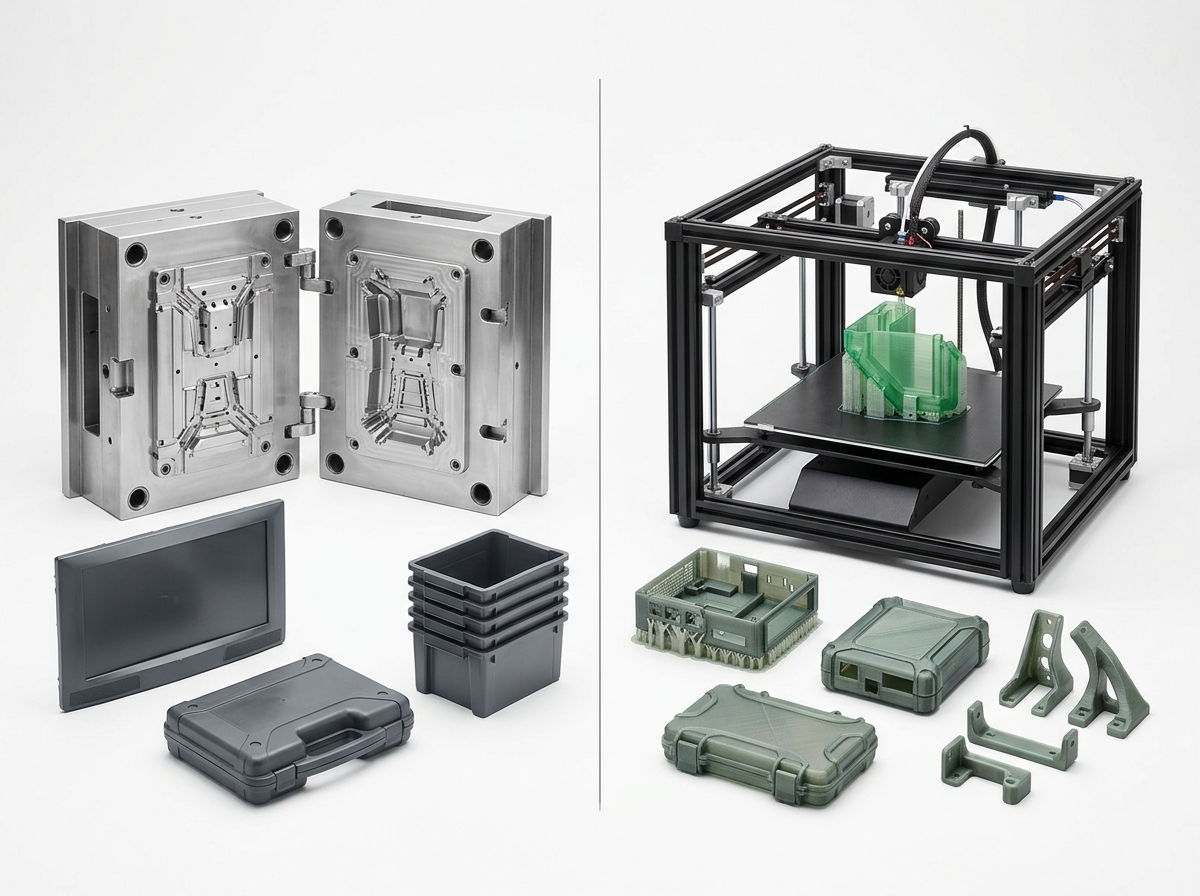
When Custom Plastic Product Manufacturing Is Better
Tooling-based manufacturing is better when the part is a production commitment.
If the product must ship in consistent batches, survive customer handling, and look the same across multiple production lots, custom plastic product manufacturing is usually the safer choice. Injection molding is especially strong for external housings, snap-fit assemblies, appliance panels, packaging components, and consumer-facing plastic parts where the finish is part of the brand promise.
A common example is a PC material enclosure. Polycarbonate is often selected when impact resistance, clarity, and dimensional stability matter. That makes it useful for electronic covers, protective parts, and other housings that need both appearance and functional strength. In many product categories, material choice is as important as process choice.
If a project requires one-stop support from tooling through production, a supplier with an integrated plastic injection mold offering can reduce handoff risk and shorten the path from sample to shipment.
Cost Structure: Why the Cheapest Prototype Is Not Always the Cheapest Product
The lowest prototype cost rarely equals the lowest total project cost.
3D printing avoids tooling expense, which makes it attractive at the start. But if a product needs 5,000, 20,000, or 100,000 units, the per-part cost, finishing time, and consistency limits can make additive manufacturing more expensive overall. Injection molding has the opposite profile: higher upfront cost, lower unit cost, and better output stability.
| Cost Element | 3D Printing | Custom Plastic Product Manufacturing |
|---|---|---|
| Upfront tooling | Low | High |
| Per-part cost at low volume | Moderate to high | Usually high until volume grows |
| Per-part cost at scale | Often still high | Usually low |
| Post-processing | Common | Lower for well-designed molds |
| Scrap risk | Higher when supports or warpage occur | Lower once process is stable |
For procurement teams, the right calculation is total landed cost, not just sample cost. That includes labor, rework, shipping, quality checks, and the business cost of delays.
Product-Type Fit: Which Process Works Best by Application
Different product categories favor different processes because their functional priorities are different.
| Product Type | Better Process | Main Reason |
|---|---|---|
| Consumer electronics housings | Custom plastic product manufacturing | Cosmetic consistency and snap-fit accuracy |
| Appliance covers and panels | Custom plastic product manufacturing | Volume stability and appearance control |
| Industrial prototypes | 3D printing | Fast iteration and design validation |
| Short-run specialty accessories | 3D printing | Low demand and rapid customization |
| High-volume consumer parts | Custom plastic product manufacturing | Lower cost per unit at scale |
This is why many buyers in electronics, home appliances, and industrial equipment start with printed samples, then move to tooling for production approval.
How to Decide: A Practical Selection Checklist
The right choice becomes obvious when you answer a few operational questions.
- How many parts will you need in the first 6 to 12 months?
- Will the geometry still change after the first sample?
- Is surface finish customer-facing or hidden inside the assembly?
- Does the part need stable fit with screws, clips, or seals?
- Is the material requirement driven by impact, heat, clarity, or chemical resistance?
- Do you need one supplier to manage both tooling and production?
If the answers point to high volume, stable geometry, and visible finish requirements, custom plastic product manufacturing is usually the better path. If the answers point to design uncertainty and urgent iteration, 3D printing is the safer first step.
Where One-Stop Mold and Production Support Adds Value
Integrated support reduces friction in cross-functional projects.
When one supplier handles design review, tooling, sampling, and production coordination, there are fewer translation errors between engineering intent and manufacturing reality. That is particularly useful for export-oriented procurement, where English communication, file turnaround, and delivery scheduling must stay aligned across time zones.
For buyers comparing sourcing options, looking at a plastic parts category can reveal whether the supplier is organized around samples, production parts, or both. That matters because the best prototype vendor is not always the best mass-production partner.
The Most Common Mistakes Buyers Make
Most project failures come from choosing the process before defining the requirement.
- Choosing 3D printing for a part that needs thousands of identical units
- Cutting a mold before the design is stable
- Ignoring tolerance stack-up in snap-fit assemblies
- Picking a material based on price alone
- Overlooking post-processing and inspection cost
- Assuming prototype appearance predicts production appearance
These mistakes are avoidable when the sourcing strategy is tied to product stage, not just to the lowest quote.
Decision Summary: Which Is Better?
Custom plastic product manufacturing is better for volume, repeatability, and long-term commercial supply.
3D printing is better for iteration, complexity, and low-volume validation.
If you are building a product that will move beyond samples into market-ready supply, injection molding and related tooling methods usually provide better dimensional stability, better finish, and lower unit cost. If you are still refining geometry, testing fit, or exploring multiple versions, 3D printing is usually the faster and lower-risk choice. In many professional programs, the strongest strategy is a hybrid one: print first, tool later.
For a broader sourcing view, buyers can also review plastic injection mold solutions alongside additive prototyping capabilities to build a realistic launch plan.
FAQ
Is 3D printing cheaper than custom plastic product manufacturing?
It is usually cheaper only for very low quantities, early prototypes, or highly customized parts. Once volume increases, tooling-based production normally lowers the unit cost.
Which process gives better surface finish?
Custom plastic product manufacturing usually gives better finish consistency, especially for consumer-facing housings and cosmetic parts.
Which is faster for the first sample?
3D printing is usually faster for the first physical sample because it removes tooling lead time.
Can 3D printing replace injection molding?
Only in some low-volume or specialty applications. For most repeat production parts, injection molding remains more suitable.
What materials are common in custom plastic product manufacturing?
Common choices include ABS, PP, PC, PA, and POM, selected according to impact, heat, stiffness, and appearance needs.
When should I switch from 3D printing to molding?
Switch when the design is stable, demand is clearer, and unit economics matter more than revision speed.
What is the biggest risk in choosing the wrong process?
The biggest risk is not technical failure alone; it is wasting time and money on a process that does not match the product stage.
Post time: Jul-22-2026