
- Choose CNC machining for prototypes, bridge production, and frequent design revisions.
- Choose custom injection molding for stable designs, repeat orders, and higher annual volumes.
- For plastic parts, tolerances, cosmetic requirements, and material behavior often matter more than raw machine capability.
- Total cost must include tooling, setup, scrap risk, inspection, and logistics, not only unit price.
- Supplier engineering support can be as important as the process itself for housings, covers, and functional components.
Custom injection molding vs CNC machining is one of the most common sourcing decisions for plastic parts, especially when buyers need a balance of accuracy, appearance, and unit cost. For dimensional reference, plastics molding tolerances are commonly assessed against ISO 20457:2018, while CNC verification often follows geometric and coordinate-measurement practices such as ISO 230-1:2012 for machine tool testing. If your project involves housings, snap-fits, or high-repeat production, a capable injection mold partner matters; if you need one-off validation parts or fast design iteration, a CNC machining workflow can shorten the path from drawing to sample. The real decision is usually about risk control, not just manufacturing preference.
What custom injection molding vs CNC machining means for plastic parts
Custom injection molding creates parts by forcing molten polymer into a shaped cavity, while CNC machining removes material from a solid plastic block or sheet.
That single process difference changes almost every commercial factor: cost structure, lead time, repeatability, design flexibility, and cosmetic quality.
In sourcing terms, injection molding is a tooling-led model, while CNC machining is a material-led model.
For buyers, that means injection molding pays off when the design is stable and quantity is high, while CNC machining is stronger when the design is still moving.
| Criterion | Custom Injection Molding | CNC Machining |
|---|---|---|
| Typical best use | Stable, repeatable production | Prototypes and low volume |
| Lead time driver | Mold design and fabrication | Programming and setup |
| Per-part cost at scale | Usually lower | Usually higher |
| Design change flexibility | Lower after tooling | Higher |
| Common material forms | Thermoplastic pellets | Solid stock, plate, rod |
For plastic parts, the best process depends on whether the part is judged by unit cost or by engineering speed.
Custom injection molding vs CNC machining: the cost model that buyers should use
Unit price alone does not tell you which process is cheaper.
Injection molding typically has higher upfront tooling cost but lower marginal cost per part, while CNC machining has little or no tooling cost but more expensive machine time per unit.
This is why the breakeven point changes with cavity count, part size, material, and cosmetic requirements.
As a practical example, a simple plastic housing can become economical in injection molding once volume rises enough to spread mold cost across thousands of parts, but the same design may still be smarter to machine if the client expects geometry changes after first samples.
| Cost element | Injection Molding | CNC Machining |
|---|---|---|
| Upfront tooling | High | Low |
| Per-part labor | Low after setup | Higher |
| Scrap impact | Can rise during launch | Lower in prototype phase |
| Engineering change cost | Potentially high | Usually lower |
| Best volume band | Medium to high | Low to medium |
In procurement, the cheapest part is often the one with the fewest downstream surprises.
Tolerance, surface finish, and material behavior in plastic parts
Tolerance capability is one of the biggest differences in custom injection molding vs CNC machining.
CNC machining can produce very tight features on rigid plastics, but molded parts may be better when the design is optimized for the process rather than copied directly from a machined prototype.
Plastic is not metal, so thermal expansion, shrinkage, gate location, weld lines, and residual stress all affect final dimensions.
For molded plastics, the design and measurement conversation often starts with ISO 20457:2018, which provides general tolerancing guidance for molded parts.
For machine tool performance and verification context, CNC processes are commonly discussed with standards such as ISO 230-1:2012.
| Attribute | Molding tendency | CNC tendency | Commercial impact |
|---|---|---|---|
| Dimensional consistency | High after stabilization | High from first part | Important for mating features |
| Surface finish | Depends on mold polish | Depends on toolpath and stock | Visible on consumer goods |
| Internal stress | Can be process-dependent | Usually lower | May affect warpage |
| Fine details | Excellent in volume production | Excellent for sharp edits | Critical for branding and fit |
For PC plastic parts, the question is often not whether the material can be molded, but whether the design controls shrinkage and appearance well enough for end use.
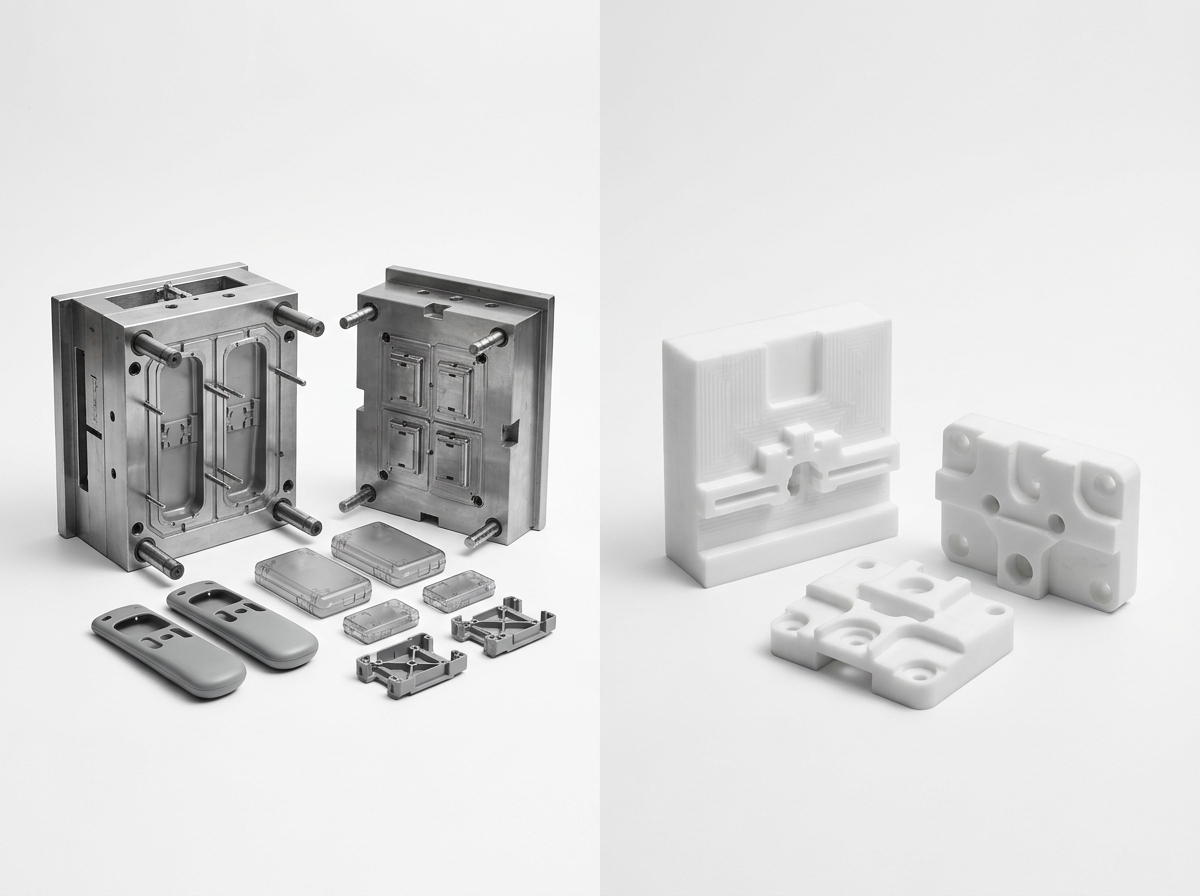 Why PC material changes the custom injection molding vs CNC machining decision
Polycarbonate is often selected for transparent, impact-resistant, and dimensionally stable housings.
That makes PC common in electronics, guards, and protective covers where clarity and toughness matter together.
However, PC also increases process sensitivity because drying, melt control, and stress management must be handled carefully to avoid haze, splay, or brittle areas.
This is where experienced mold engineering can outperform a purely dimensional machining approach, because the final part must be manufacturable, not just accurate.
For buyers evaluating a housing program, an engineered plastic shell mold can be better than CNC machining if the target is repeatable production and clean appearance.
If the design is still under review or the product team is testing multiple versions, CNC machining remains valuable because the part can be updated without reworking the mold.
- Use PC when impact resistance and clarity matter.
- Use CNC for early-stage fit checks and design validation.
- Use molding when cosmetic consistency and repeat volume matter.
The material itself does not decide the process; the program stage does.
When injection molding is better for plastic parts
Injection molding is usually better when the part design is frozen and the production plan is clear.
It is especially strong for consumer electronics housings, appliance covers, and industrial enclosures with repeated demand.
Once the mold is validated, cycle times are typically measured in seconds rather than minutes, which is a major advantage in high-volume supply chains.
That is why many buyers prefer a dedicated 3D mold approach for complex curved surfaces or differentiated product styling, especially when visual identity matters.
In practical terms, molding is often the better path when the part must balance aesthetics, assembly, and structural strength across large batches.
- Stable geometry with low expected revision risk.
- Annual demand high enough to absorb tooling cost.
- Need for consistent cosmetic finish across many parts.
- Need for automated or semi-automated production.
For OEM and ODM programs, this is usually the route that supports long-term supply continuity.
When CNC machining is better for plastic parts
CNC machining is usually better when speed of iteration matters more than per-part cost.
It is the preferred route for first articles, validation samples, engineering experiments, and urgent bridge supply.
Because there is no mold cavity to build, buyers can move from CAD to physical part much faster.
This is valuable when the purchasing team still expects geometry updates, fit changes, or material substitution.
CNC also works well for rigid plastics where the part needs precise holes, pockets, or mating interfaces and the quantity is not high enough to justify tooling.
For low-volume sourcing, a CNC machining route can reduce financial exposure while preserving design freedom.
- Prototype parts with uncertain geometry.
- Functional samples for fit and assembly tests.
- Short-run industrial components.
- Emergency replacement parts.
If the design is still negotiating with engineering, CNC is often the safer commercial decision.
How to compare quality risk in custom injection molding vs CNC machining
Quality risk should be evaluated by failure mode, not by process reputation.
Injection molding can introduce gate marks, sink, weld lines, flash, and warpage, while CNC machining can introduce tool marks, burrs, and stress from clamping or cutting.
The best supplier reduces those risks before production begins through DFM review, material selection, and inspection planning.
For plastic shell programs, this is where supplier capability becomes a differentiator, because the part often has to look clean and assemble reliably at the same time.
| Risk | Injection Molding | CNC Machining | Prevention method |
|---|---|---|---|
| Dimensional drift | Possible during mold tuning | Usually stable per setup | First article inspection |
| Cosmetic defects | Gate, sink, weld line, flash | Tool marks, burrs | Process review and finishing |
| Material stress | Can be process-related | Can be cutting-related | Cooling and cutting control |
| Assembly mismatch | Possible if shrinkage is misread | Possible if CAD datum is wrong | DFM and tolerance stack-up |
For buyers, the most expensive quality failure is often not scrap; it is delay in launch or rework after tools are already approved.
Choosing a supplier for custom plastic parts
The right supplier should help you choose the process, not force one process onto every project.
That is especially important for overseas buyers who need English communication, drawing feedback, trial reports, and export logistics coordination.
A strong manufacturer should be able to review design intent, estimate moldability, and explain whether injection molding or CNC machining is more appropriate before quoting.
If you are sourcing a broad product line, it also helps to work with a partner that can support home appliance mold programs, consumer housing tooling, and production follow-up in one workflow.
For industrial customers, that reduces supplier switching cost and makes replenishment easier to manage.
- Ask for DFM feedback before price comparison.
- Confirm material grade, shrinkage assumptions, and cosmetic level.
- Request sample inspection data, not only photos.
- Check whether the supplier can support both prototype and volume stages.
For project purchasing, engineering support is part of the product.
What procurement teams should ask before deciding
The best decision comes from asking the right commercial questions early.
These questions reveal whether the part belongs in a mold or on a CNC machine.
- What is the annual demand and expected repeat order level?
- Will the geometry change after the first sample round?
- Does the part require high cosmetic consistency?
- Is the design optimized for molding shrinkage and draft?
- Are tolerances critical at clip, snap, or sealing features?
If the answers point to stable volume and repeatability, custom injection molding usually wins.
If the answers point to uncertainty, fast iteration, or low quantity, CNC machining is usually the better commercial tool.
Practical decision matrix for plastic parts
The simplest way to choose is to match the process to the project stage.
Prototype and low-risk validation usually favor CNC machining.
Stable, repeat-volume production usually favors custom injection molding.
Complex decorative housings with repeat demand often favor molded tooling, especially when appearance and assembly both matter.
When the part is a PC housing, appliance shell, or consumer enclosure, the final answer often depends on whether the project team values speed or scale.
| Project stage | Recommended process | Reason | Typical buyer concern |
|---|---|---|---|
| Concept validation | CNC machining | Fast changes | Will the design fit? |
| Pre-production trial | Either, based on volume | Risk balancing | Is the design frozen? |
| Mass production | Injection molding | Lower unit cost | Can supply remain stable? |
| Replacement supply | Injection molding or CNC | Depends on volume and timing | How urgent is replenishment? |
That matrix is why procurement teams should compare not only price, but also lifecycle fit.
Bottom line on custom injection molding vs CNC machining
Custom injection molding vs CNC machining is not a battle between good and bad manufacturing methods.
It is a decision about risk, timing, and scale.
Injection molding is usually better for stable plastic parts with repeat demand, especially housings, covers, and functional consumer components.
CNC machining is usually better for prototypes, low-volume parts, and designs that are still evolving.
If you need one supplier to support engineering review, mold development, and batch production, a partner with both capabilities can reduce communication loss and shorten sourcing cycles.
For many buyers, the best outcome is not choosing the cheapest process on paper, but choosing the process that produces the most reliable part at the lowest total delivered cost.
FAQ
Is injection molding cheaper than CNC machining for plastic parts?
Yes, injection molding is usually cheaper per part at higher volumes because tooling cost is spread across many units, while CNC machining has higher per-part labor and machine time.
Is CNC machining more accurate than injection molding?
Often yes for first samples and low-volume parts, because CNC machining does not depend on mold shrinkage or cavity tuning, but molded parts can be highly consistent once the process is stabilized.
Which is better for plastic prototypes?
CNC machining is usually better for prototypes because it is faster to start and easier to revise after the first test fit.
Which is better for plastic housings?
Injection molding is usually better for plastic housings when the geometry is stable and the project needs repeatable appearance and lower unit cost.
Can polycarbonate parts be injection molded?
Yes, polycarbonate is widely used in molded transparent or impact-resistant plastic parts, but drying and process control are important to protect clarity and toughness.
What standards matter when comparing plastic part quality?
For molded plastics, ISO 20457:2018 is a key reference for tolerancing, while machine tool verification for CNC context is commonly linked to ISO 230-1:2012.
When should a buyer request both quotes?
Always, when the part could move from prototype to production. Dual quoting helps you compare total cost, not just initial lead time.
Post time: Aug-28-2026