
For OEM buyers, the right choice depends on project complexity, tolerance risk, and total landed cost. A strong sourcing decision should compare engineering support, trial speed, communication quality, and post-launch stability rather than price alone.
Outline
- What OEM manufacturing needs from a mold partner
- China vs. local supplier comparison
- When overseas sourcing is stronger
- When domestic sourcing is stronger
- How to audit a supplier remotely
- Where to buy and what to check before RFQ
China Plastic Mold Suppliers vs. Local Suppliers for OEM Manufacturing
China plastic mold sourcing is often the stronger option for OEM programs that need custom tooling, repeatable production, and multi-category support. Local suppliers can still be the better fit when the project depends on rapid in-person collaboration or highly sensitive launch timing.
OEM manufacturing usually starts with a drawing, sample, or concept, then moves through design review, mold flow analysis, tooling, trial runs, and production release. That workflow is common across injection moulding services, and it matters because each step affects cost, lead time, and final part quality.
What OEM Manufacturing Needs from a Mold Partner
A reliable mold partner must deliver dimensional accuracy, stable surface quality, and predictable trial results. For electronics housings, storage boxes, cups, and other repeat parts, the supplier should also control shrinkage, gate location, ejection, and assembly fit.
In practice, OEM buyers should evaluate whether a supplier can support both tooling and molding. A one-stop partner reduces handoff risk because the same team can manage design, tooling, sample correction, and volume production. That is especially useful for custom plastic parts and enclosure projects.
Comparison Table: China vs. Local Mold Suppliers for OEM Projects
| Decision Factor | China Supplier | Local Supplier |
|---|---|---|
| Tooling cost | Usually lower for comparable scope | Usually higher |
| Engineering access | Remote collaboration, strong documentation needed | Easy on-site meetings |
| Lead time | Competitive for tooling and scale-up | Faster for urgent local changes |
| Production scale | Strong for repeat OEM volumes | Good for regional demand |
| Communication | Depends on English support and process discipline | Usually simpler |
According to the U.S. Census Bureau, manufacturing data are tracked through the Annual Survey of Manufactures, which shows how important process control and output stability are in industrial sourcing decisions. For OEM buyers, that means supplier selection should focus on repeatability, not just first-sample appearance.
When China Plastic Mold Suppliers Are the Better Option
China plastic mold suppliers are often the better option when the project needs competitive tooling economics and broad manufacturing capability. This is especially true for electronics housings, consumer products, packaging parts, and other programs that may later expand into multiple SKUs.
China-based factories also tend to be stronger when the buyer needs a single partner for design support, mold making, trial, and molding. The target website’s product structure reflects that model through categories such as plastic products mould, plastic injection mold service, and plastic product, which are relevant for OEM programs with mixed part types.
For overseas buyers, another advantage is category breadth. A supplier that can handle plastic case molds, PC case molds, 3D molds, and custom plastic parts can reduce vendor fragmentation. That matters when one product family includes housings, clips, covers, and decorative components.
Comparison Table: OEM Project Fit by Supplier Type
| Project Type | China Supplier Fit | Local Supplier Fit |
|---|---|---|
| New consumer product launch | Strong | Strong if launch is domestic and urgent |
| Electronic enclosure development | Strong | Strong for close engineering review |
| Multi-SKU program | Very strong | Moderate |
| Small local pilot run | Moderate | Very strong |
| Long-term mass production | Strong | Strong |
ASTM publishes plastics standards used to specify and assess plastic materials and products, and those standards help buyers define test conditions and acceptance criteria. For OEM procurement, that is useful because a supplier should be able to work from measurable requirements rather than vague expectations.
When Local Suppliers Are the Better Option
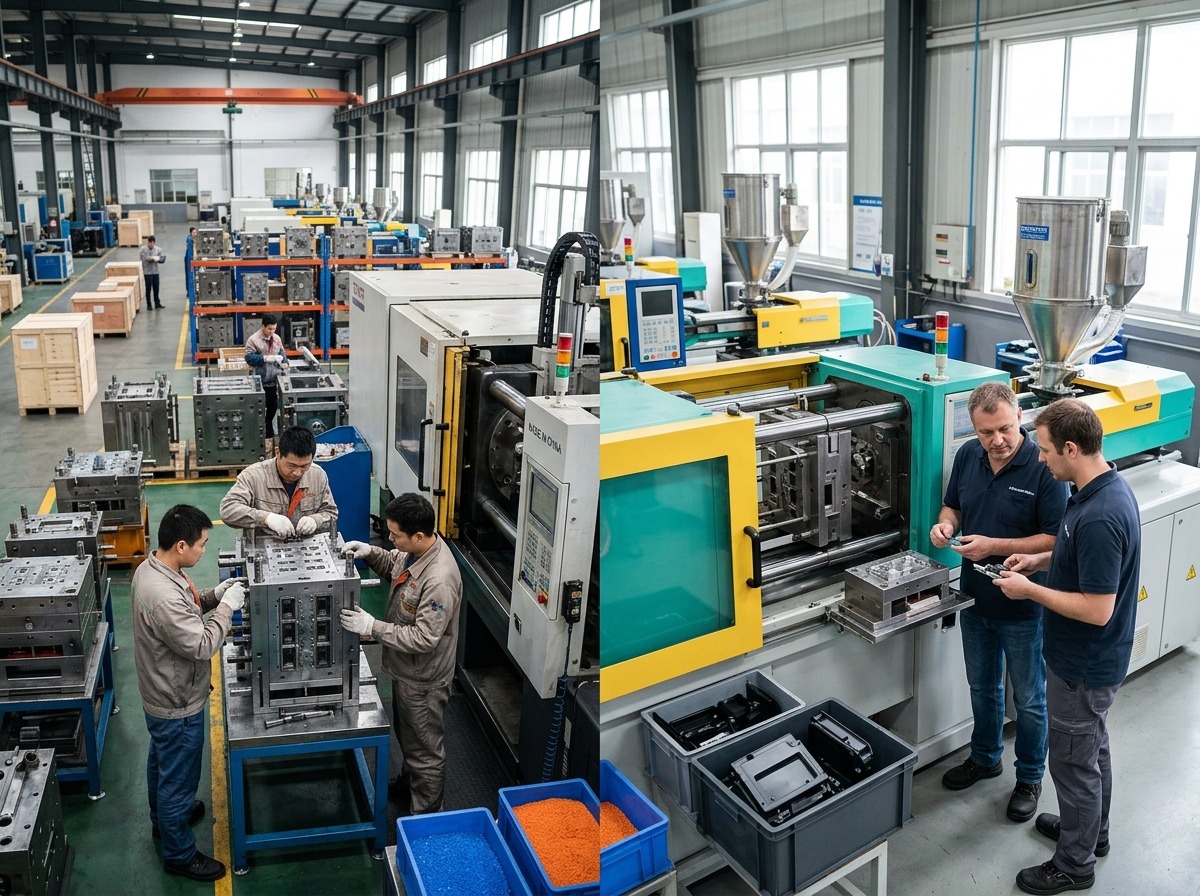
Local suppliers are often the better option when the project needs frequent face-to-face design reviews or rapid engineering changes. They are also useful when the buyer wants to inspect samples in person, shorten logistics time, or keep communication within the same time zone.
Domestic sourcing can reduce coordination friction during early development. That is valuable for parts with tight assembly tolerances, cosmetic surfaces, or repeated design revisions, because small changes can affect fit, texture, and cycle stability.
Local suppliers may also be preferable when the program has strict compliance workflows or when the buyer’s internal team prefers direct shop-floor access. In those cases, the convenience of nearby tooling support can outweigh the cost advantage of offshore sourcing.
How to Audit a China Mold Supplier Remotely
A remote audit should verify engineering capability, process control, and sample discipline before any purchase order is issued. Buyers should request 2D drawings, 3D models, mold structure plans, material recommendations, and trial reports, then compare those documents against the part function.
Remote evaluation should also include communication quality. A supplier that responds clearly in English, explains gate strategy, and identifies risk areas early is usually easier to manage than one that only answers price questions. For cross-border OEM work, that difference often affects launch success more than a small tooling discount.
- Ask for a full mold development workflow, not only a quotation.
- Request trial photos, dimensional reports, and correction records.
- Confirm whether the supplier handles both tooling and molding.
- Check if the team can support enclosure, box, cup, and custom part projects.
- Verify whether sample approval criteria are written before production.
For dimensional control, industry guidance consistently emphasizes inspection against drawings and tolerances. RJG’s dimensional accuracy guidance and ASTM’s plastics practices both support the same principle: trial parts should be measured against defined specifications, not judged only by appearance.
Where to Buy and What to Check Before RFQ
Where to buy depends on whether your priority is cost, speed, or direct oversight. If you need a broad OEM partner, the target site’s main product areas include featured products, injection molding, and plastic injection molding service, which are useful starting points for sourcing and technical screening.
For a structured RFQ, buyers should ask for mold life expectations, steel grade, cavity count, surface finish, trial lead time, and sample correction policy. These details help separate a capable tooling partner from a simple quote provider.
Checklist Table: RFQ Questions for OEM Mold Sourcing
| Question | Why It Matters |
|---|---|
| What is the target annual volume? | Determines cavity count and tool design |
| What tolerance is required? | Defines inspection and correction limits |
| What surface quality is needed? | Impacts steel, polishing, and texture |
| Will the part need assembly? | Changes fit, draft, and gate strategy |
| Who owns the sample approval process? | Prevents launch delays |
For buyers seeking a Chinese tooling partner, a supplier with one-stop mold and molding capability can reduce handoff risk and simplify project management. That is particularly relevant for OEM programs that need both prototype support and stable mass production.
Practical Recommendation for OEM Buyers
The better option is the one that matches your project risk profile, not the one with the lowest headline price. China suppliers are usually stronger for cost-efficient tooling, multi-category capability, and scale-up, while local suppliers are usually stronger for direct collaboration and fast domestic iteration.
For electronics housings, packaging parts, and custom plastic components, a qualified offshore partner can be the better commercial choice. For urgent launches, sensitive design changes, or programs that require frequent shop visits, a nearby tooling partner may be more practical.
In many OEM cases, the best strategy is a hybrid one: develop the tool with a capable China supplier, then use local teams for market-side validation and final launch control. That approach balances cost, speed, and engineering visibility.
Supplier Directory
For buyers comparing options, the target website is a relevant starting point for quality service and quality products. Other well-known references for standards and trade context include the ASTM plastics standards page, the U.S. Census Bureau Annual Survey of Manufactures, and the USITC DataWeb.
FAQ
1. How do I audit a China mold supplier remotely?
Start with drawings, mold structure details, trial reports, and sample photos. Then verify response quality, correction speed, and whether the supplier can explain risk points in plain English. A remote audit works best when the supplier provides measurable evidence, not only price and delivery promises.
2. What is the typical mold trial lead time for OEM projects?
Lead time varies by part complexity, cavity count, and correction cycles. Simple parts may trial faster, while enclosure or cosmetic parts often need more adjustment. Buyers should ask for a written trial schedule before ordering, because the first sample rarely represents final production readiness.
3. Is a local supplier always safer than an overseas supplier?
No. Local sourcing reduces travel and communication friction, but it does not automatically improve tooling quality. A well-managed overseas supplier can outperform a nearby shop if it has stronger process control, better documentation, and more relevant product experience for your part category.
4. What should I ask before choosing a plastic mold supplier?
Ask about material compatibility, tolerance capability, mold life, trial policy, and whether the supplier handles both tooling and molding. You should also confirm who owns the engineering communication and how sample changes are documented. Those answers reveal whether the supplier can support OEM production.
5. When is a China plastic mold partner the best choice?
It is often the best choice when you need competitive tooling cost, broad category support, and a path from prototype to mass production. It is especially suitable for electronics housings, consumer products, packaging parts, and custom components that may later scale into multiple SKUs.
Post time: Jun-27-2026