
- Aluminum molds typically reduce lead time and are easier to machine, making them useful for rapid validation and lower-volume custom injection molding.
- Steel molds generally offer longer tool life, better wear resistance, and stronger repeatability for large production runs.
- The real decision is not material alone; it is part geometry, resin choice, cosmetic standard, cycle count, and total cost per good part.
- For products with high visual requirements, such as consumer electronics housings, mold design quality can matter as much as mold material.
- Standards and tolerance control, including ISO-based dimensional verification, help define whether aluminum or steel is the safer manufacturing path.
Aluminum mold versus steel mold is one of the most important decisions in custom injection molding, because it directly affects lead time, tooling cost, dimensional stability, and part consistency. In precision manufacturing, tolerances are often verified using metrology methods aligned with ISO 230-1:2022 for positioning accuracy concepts in machine tools, while injection molded parts may be judged against drawing tolerances and process capability targets; in practical production, many buyers target stable part variation in the low-hundredths of a millimeter when fit and assembly are critical. For a broader manufacturing context, ISO 230-1:2022, NIST Standard Reference Materials, and ASTM standards are useful reference points when evaluating measurement discipline, material behavior, and test consistency. If you are sourcing a custom tool, compare plastic injection molds, plastic shell mold solutions, and 3D mold capabilities before deciding whether aluminum or steel gives you the better business outcome.
Aluminum Mold vs Steel Mold: What the Searcher Really Wants to Know
The real question behind aluminum mold vs steel mold is not which material is “better” in theory, but which one reduces risk in your specific project. Buyers usually want to know how fast the tool can be built, how many parts it can produce, whether the mold can hold cosmetic quality, and how much the total project will cost once maintenance and scrap are included. In custom manufacturing, the material choice must align with the resin family, the annual volume, the expected lifecycle, and the part’s tolerance stack-up.
Aluminum molds are often selected when validation speed matters. Steel molds are often selected when lifecycle durability matters. That sounds simple, but the best answer depends on whether the part is a short-run consumer housing, a long-life industrial component, or a high-gloss enclosure where cosmetic defects are unacceptable.
| Decision Factor | Aluminum Mold | Steel Mold |
|---|---|---|
| Typical use case | Prototype, bridge tooling, short-run custom injection molding | High-volume production, abrasive resins, long-life programs |
| Lead time | Usually shorter due to faster machining | Usually longer due to harder material and more finishing |
| Tool life | Lower than steel, suitable for modest cycle counts | Higher, often preferred for long production lifecycles |
| Cosmetic stability | Good, but more sensitive to wear over time | Excellent for long-term surface consistency |
| Upfront tooling cost | Generally lower | Generally higher |
Aluminum Mold for Custom Injection Molding: Where It Makes the Most Sense
Aluminum mold tooling is strongest when speed, iteration, and cost control matter more than extreme tool longevity. Because aluminum is easier to machine than tool steel, it can shorten development cycles and support quicker design changes during early-stage custom manufacturing. That is why aluminum is often chosen for pilot runs, sales samples, functional validation parts, and bridge production before steel investment is justified.
For products such as consumer electronics housings, light-duty appliance covers, or industrial demonstration parts, an aluminum mold can be enough to prove geometry, assembly fit, and surface finish. In practical sourcing terms, this is especially useful when the buyer needs to confirm undercut behavior, wall thickness balance, snap-fit strength, and draft angle performance before committing to a full-volume steel tool.
There is also a financial logic behind aluminum. Lower initial tooling cost can reduce launch risk, especially when demand is uncertain. In custom injection molding, that matters when the forecast is still moving, the product is seasonal, or the buyer expects engineering revisions after the first trial shots.
| Aluminum Mold Strength | Practical Benefit | Typical Buyer Scenario |
|---|---|---|
| Fast machining | Shorter tooling lead time | New product launch with tight schedule |
| Lower hardness than steel | Easier modification and polishing | Design still under review |
| Lower upfront cost | Better cash flow control | Prototype or bridge tooling budget |
| Good thermal conductivity | Faster heat transfer during molding | Short-run production with fast iteration |
For buyers in electronics and appliance markets, the aluminum mold is often a strategic step rather than a final answer. It lets teams test whether the custom injection molding concept is manufacturable before scaling the tool into a more durable platform.
Steel Mold for Custom Manufacturing: Why It Dominates High-Volume Programs
Steel mold tooling is the standard choice when the project needs long life, high wear resistance, and stable part quality over many cycles. That makes steel especially valuable in custom injection molding programs for industrial parts, consumer product families, and supply agreements where the same mold may need to run for years.
The biggest advantage of steel is durability. Harder tool materials resist abrasion from filled polymers, glass-reinforced compounds, and repeated opening and closing cycles. This matters because wear changes cavity geometry, gate conditions, and surface quality over time. In other words, steel protects your dimensional consistency and reduces the chance that early parts and late parts look or measure differently.
For complex plastic shell mold applications, especially in consumer electronics, steel often gives the manufacturer more confidence in long-term surface consistency, fine texture replication, and reliable shut-off performance. When the part has visible Class A surfaces or demanding snap-fit geometry, steel becomes the safer choice for production stability.
| Steel Mold Advantage | Why It Matters | Best Fit |
|---|---|---|
| High wear resistance | Stable cavity geometry over time | High-volume runs |
| Better long-term repeatability | Less variation in dimensions and finish | Precision housings |
| Supports abrasive resins | Reduces premature tool wear | Glass-filled or mineral-filled polymers |
| Long lifecycle economics | Lower cost per part over many cycles | Multi-year supply programs |
When a buyer plans recurring orders, steel often becomes the better total-cost decision even if the initial tool price is higher. That is the basic logic of custom manufacturing economics: the cheapest tool is not always the cheapest program.
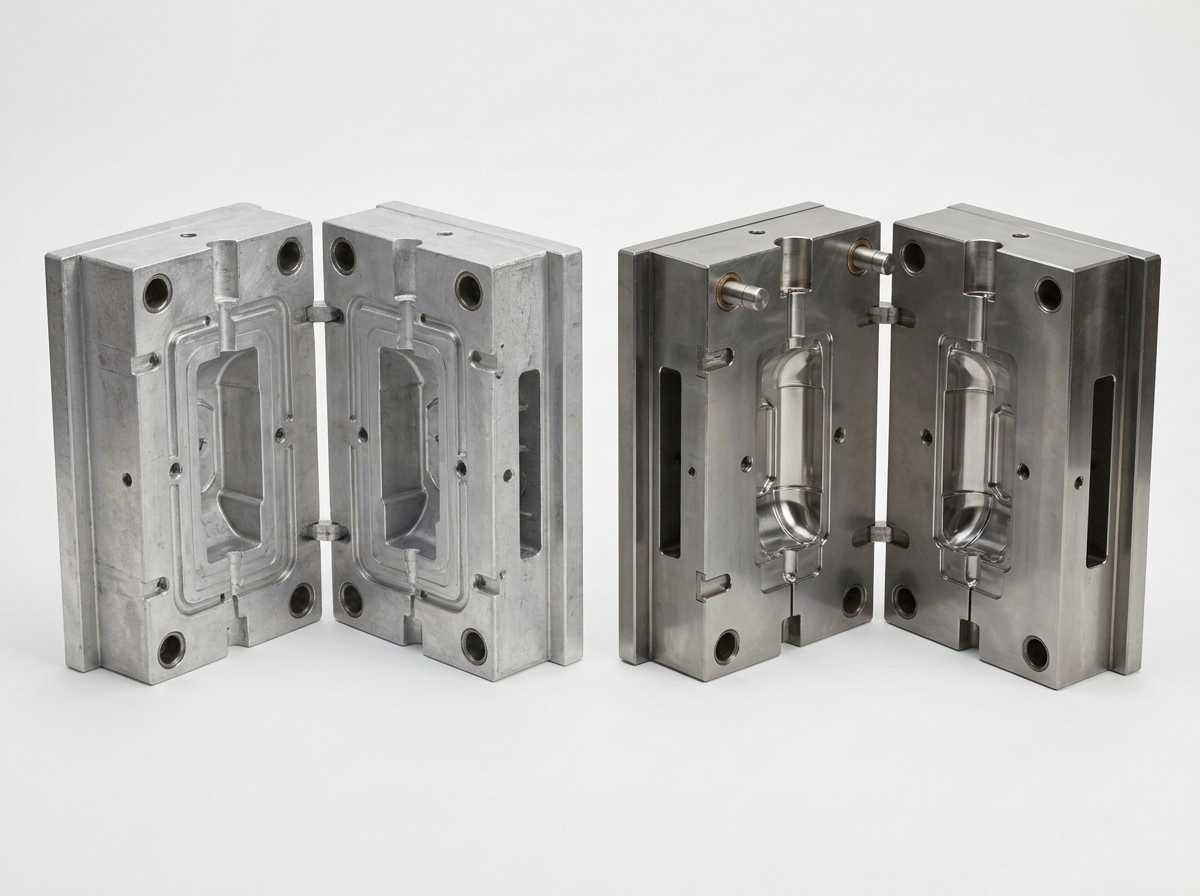 2How Resin Choice Changes the Aluminum Mold vs Steel Mold Decision
Material selection should always be evaluated alongside resin selection. Filled and abrasive polymers put more stress on mold surfaces, ejector systems, and gate areas than unfilled commodity resins. If the project uses glass-filled nylon, mineral-filled compounds, or engineering thermoplastics with demanding processing windows, steel usually offers a stronger reliability margin.
For example, polycarbonate is widely used in transparent and impact-resistant housings because it combines optical clarity with toughness. In custom injection molding, that is why PC often appears in device covers, protective components, and precision-fit shell designs. But if the resin is highly abrasive or the tool needs to maintain polish and dimension over a long campaign, steel is often the safer base material.
The practical rule is simple: the more aggressive the resin, the more the mold material matters. An aluminum mold can still work in some cases, but maintenance frequency and wear monitoring become more important.
- Unfilled resins: aluminum may be adequate for short runs.
- Filled engineering resins: steel is usually preferred.
- High-gloss cosmetic parts: steel often delivers more stable finish retention.
- Transparent PC parts: surface finish control becomes a priority regardless of mold material.
Dimensional Accuracy, Tolerance Control, and Mold Material
Dimensional accuracy is not determined by mold material alone, but mold material affects how long precision remains stable. A well-designed aluminum mold can produce accurate parts early in its life, but steel generally holds that precision for longer under repeated production stress.
In practical custom injection molding, buyers often care about fit-up, snap retention, and cosmetic gap control. A part that is off by a small amount can still fail in assembly if the tolerances stack in the wrong direction. That is why mold makers often evaluate shut-off areas, cooling balance, and ejector layout before deciding whether aluminum or steel is the better foundation.
One useful benchmark comes from machine-tool verification thinking: precision is only valuable when it is repeatable. According to ISO 230-1:2022, machine performance is evaluated through measurable positional behavior rather than assumption. For mold buyers, that mindset translates into a demand for repeatable cavity filling, stable shrink control, and consistent inspection results across the production window.
| Quality Risk | Aluminum Mold Impact | Steel Mold Impact |
|---|---|---|
| Wear on cavity surfaces | Higher over time | Lower over time |
| Dimension drift | More likely in long runs | Less likely in long runs |
| Polish retention | Good initially, then more maintenance-sensitive | More stable across cycles |
| Inspection consistency | Best for shorter campaigns | Best for long campaigns |
Lead Time, Cycle Time, and Total Cost per Good Part
Lead time and cycle time are not the same thing, but both influence the aluminum mold versus steel mold decision. Lead time is how quickly the tool is delivered. Cycle time is how fast the mold produces each part once it is in production. Aluminum usually helps on lead time because it is faster to machine and easier to adjust. Steel usually helps on total program economics because it lasts longer and reduces replacement frequency.
Cycle time is affected by more than mold material. Cooling design, part thickness, gate placement, resin type, and ejection strategy all shape production speed. Still, the thermal properties of aluminum can help reduce heat buildup and make early-process tuning easier, while steel tends to provide more durable process stability when the mold is expected to run continuously.
For procurement teams, the key metric is cost per good part, not cost per mold alone. A lower-cost aluminum mold can become more expensive if it wears out too early or needs more maintenance. A higher-cost steel mold can be more economical if the production volume is large enough to spread the tooling cost across many thousands of acceptable parts.
| Economic Metric | Aluminum Mold | Steel Mold |
|---|---|---|
| Upfront investment | Lower | Higher |
| Maintenance burden | Moderate to higher for long runs | Lower relative burden for long runs |
| Cost per part at low volume | Often favorable | Often less favorable |
| Cost per part at high volume | Can rise due to wear limits | Usually improves significantly |
If your program is still in validation, aluminum is often the safer economic move. If your program has stable demand and a clear multi-year forecast, steel usually wins on lifecycle value.
Choosing the Right Mold for Custom Injection Molding Projects
The best way to choose between aluminum mold and steel mold is to evaluate the project in stages. First, identify the part’s function, cosmetic level, and annual demand. Then map those requirements to tooling life, resin behavior, and inspection targets. This approach helps custom manufacturing buyers avoid overbuying steel for a low-volume project or underbuying aluminum for a long-life production program.
A practical sourcing conversation should always include the following questions: How many cycles do you expect? What is the acceptable dimensional drift before the part fails? Is the resin filled or unfilled? Does the product need a Class A surface? Will the design still change? These questions are more useful than asking which mold material is universally superior.
- Define the annual volume and total lifecycle demand.
- Confirm resin type, especially if the polymer is filled or abrasive.
- Set the cosmetic and dimensional acceptance criteria before tool build.
- Estimate how many design changes may still happen.
- Compare cost per good part, not just mold price.
When Aluminum Mold Is the Better Choice
Aluminum mold is the better choice when speed, flexibility, and lower upfront cost matter most. That is often true for prototypes, market validation runs, pilot production, and projects where demand is uncertain. It is also useful when the part design may still change after first samples or when the buyer wants to test assembly fit before committing to long-term production.
In custom injection molding, aluminum is especially useful for products with moderate complexity, reasonable surface demands, and a clear need to reach the market quickly. If the project is a consumer device housing, a short-run industrial cover, or a temporary launch platform, aluminum is often the most practical path.
When Steel Mold Is the Better Choice
Steel mold is the better choice when volume, wear resistance, and long-term repeatability are the main priorities. If the part will be produced continuously, if the resin is abrasive, or if cosmetic stability must remain consistent over many cycles, steel usually offers the lower-risk solution.
Steel also makes sense for supply chains that need reliable replenishment. When a mold is expected to support a product line for years, the extra tooling investment can protect service levels, reduce downtime, and keep dimensional drift under control. For many custom manufacturing buyers, that stability is worth more than the initial savings of aluminum.
Practical Comparison for Custom Manufacturing Buyers
For most sourcing teams, the decision becomes clear when they compare launch timing, demand certainty, and tool life. Aluminum is a tactical choice for speed and flexibility. Steel is a strategic choice for endurance and repeatability. Both are valid, but they serve different business problems.
| Project Condition | Preferred Mold Type | Reason |
|---|---|---|
| Prototype or pilot run | Aluminum mold | Faster build and easier design iteration |
| Short production window | Aluminum mold | Lower initial cost and quicker delivery |
| Large recurring demand | Steel mold | Better lifecycle durability |
| Abrasive resin | Steel mold | Better wear resistance |
| High cosmetic standard | Steel mold | More stable finish retention over time |
FAQ
1. Is aluminum mold cheaper than steel mold?
Yes, aluminum mold tooling is usually cheaper upfront than steel mold tooling because it is faster to machine and easier to modify. The total program cost, however, depends on cycle count, maintenance, and part acceptance rate.
2. Which mold lasts longer in custom injection molding?
Steel mold generally lasts longer because it has better wear resistance and maintains cavity geometry over more cycles. That makes it more suitable for high-volume custom manufacturing.
3. Can aluminum mold produce production-quality parts?
Yes, aluminum mold can produce production-quality parts, especially for prototypes, pilot runs, and shorter production campaigns. The key is to match the mold life to the expected demand.
4. Which mold is better for PC parts?
For polycarbonate parts, the choice depends on volume and cosmetic requirements. Aluminum mold can be suitable for short runs, while steel mold is usually better for long-term surface stability and repeatability.
5. Is steel mold always better for custom injection molding?
No. Steel mold is not always the best answer. If the project is early-stage, low-volume, or likely to change, aluminum mold can be the smarter commercial choice.
6. How do I decide between aluminum and steel mold for an OEM project?
Start with annual volume, resin type, cosmetic standard, and how many design revisions are still expected. Then compare cost per good part instead of comparing mold price alone.
7. What should I ask a mold supplier before ordering?
Ask about expected tool life, maintenance plan, dimensional control strategy, lead time, and whether they can support both mold development and production ramp-up. If you need broader sourcing support, review about the supplier’s engineering support, custom plastic parts capability, and mold components and spare parts.
Post time: Sep-16-2026