
- ABS plastic is generally preferred for structural housings, cosmetic parts, and parts requiring better stiffness and finish.
- PP plastic is generally preferred for low-cost, lightweight, chemically resistant parts and hinge features.
- Injection molding success depends on shrinkage control, draft design, gate strategy, and the final service environment.
- Material choice should be validated against standards, test data, and end-use conditions, not only resin price.
- For OEM and ODM projects, tool design and process window matter as much as the resin itself.
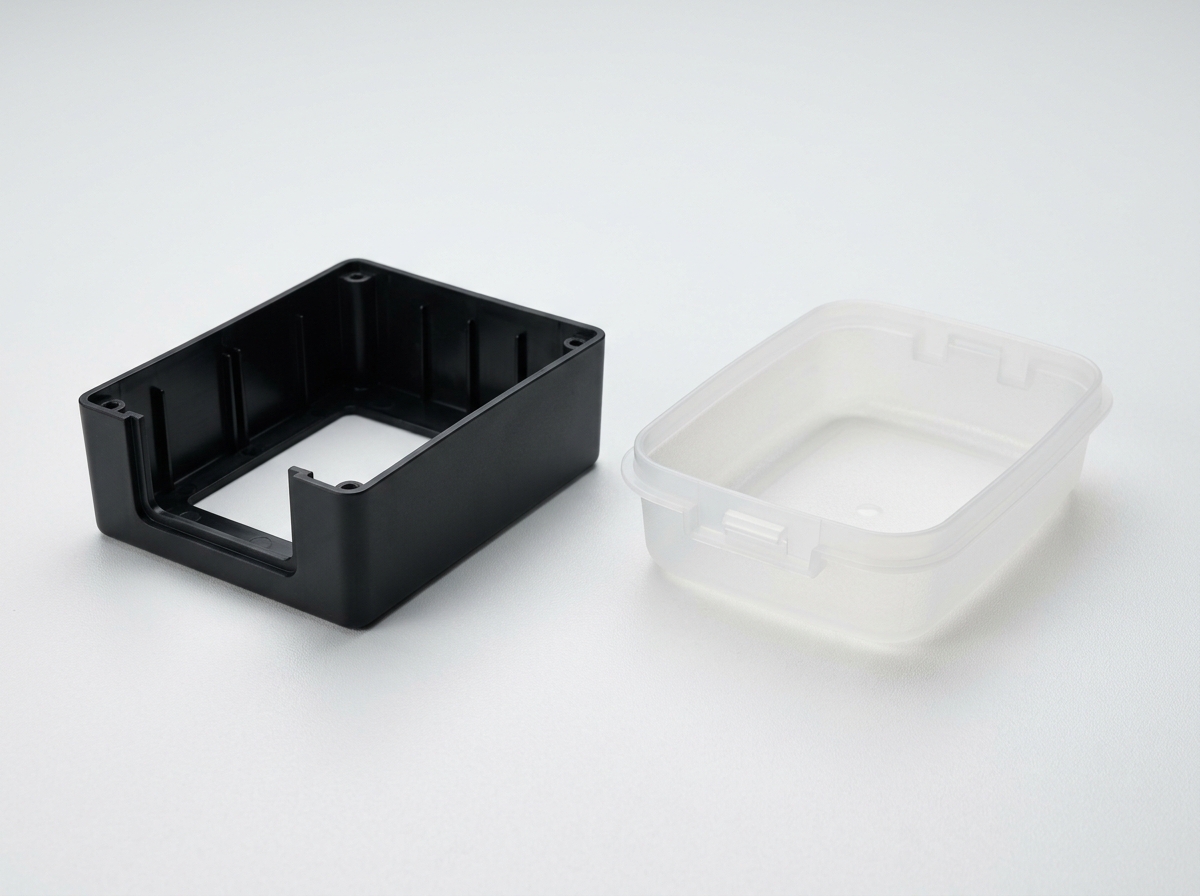
ABS plastic and PP plastic are both widely used in injection molding, but they solve different production problems. ABS is an amorphous thermoplastic known for rigidity, impact strength, and a cleaner surface finish, while PP is a semi-crystalline thermoplastic valued for low density, chemical resistance, and excellent fatigue performance. For dimensional context, ASTM D4895 specifies polypropylene resin density at 0.895 to 0.905 g/cm3, and common ABS grades typically have higher density and lower shrink behavior variability than PP, which is why ABS is often selected for appearance-critical housings and plastic injection molds for consumer electronics, while PP often fits utility parts, caps, and plastic household products molds.
ABS Plastic vs PP Plastic: The Core Difference for Injection Molding Applications
The main difference is that ABS favors rigidity and surface quality, while PP favors flexibility, chemical resistance, and lower part weight. This single distinction drives nearly every molding decision, from wall thickness to cooling time.
ABS, or acrylonitrile butadiene styrene, is widely used for enclosures, instrument panels, appliance covers, and consumer product shells because it balances stiffness and impact resistance. PP, or polypropylene, is common in food containers, automotive trims, laboratory consumables, closures, and hinge-based parts because it tolerates repeated flexing and many chemicals better than ABS.
For buyers, the real question is not which resin is “better” in general. The better resin is the one that matches your loading conditions, appearance target, assembly tolerance, and annual volume. In many projects, the wrong resin creates hidden costs such as sink marks, warpage, brittle snap-fits, long cycle times, or field failures.
ABS Plastic Injection Molding: Where It Wins and Where It Fails
ABS plastic is the more reliable choice when visual quality and structural consistency matter. It is commonly used for front covers, switch housings, device shells, brackets, and medium-load components that need a clean painted or textured finish.
ABS is especially useful when the product must look premium after molding. It generally accepts painting, electroplating, printing, and texturing better than PP, which is one reason it is used in electronics and home appliance shells. If your product team needs a part that can survive handling, show fewer flow-related appearance defects, and keep a sharp edge definition, ABS is often the safer resin.
That said, ABS also has limitations. Its chemical resistance is weaker than PP in many solvent and detergent environments, and its moisture and heat exposure limits can be lower than more engineered polymers. In long-term outdoor or high-chemical applications, ABS may need UV stabilization or a different resin altogether.
| ABS molding factor | Typical behavior | Practical impact |
|---|---|---|
| Surface finish | Good to excellent | Suitable for visible consumer parts |
| Dimensional stability | Good | Useful for housings and assembly parts |
| Impact resistance | Good | Handles drops better than brittle plastics |
| Chemical resistance | Moderate | Less suitable for aggressive cleaners or solvents |
| Shrinkage control | More manageable than PP | Better for tight cosmetic tooling |
PP Plastic Injection Molding: When Lower Cost and Flexibility Matter
PP plastic is the stronger choice when the part must bend, resist chemicals, or hit aggressive cost targets. Its low density helps reduce part weight, and its fatigue resistance makes it ideal for living hinges and repetitive flex features.
One reason PP is so common in packaging and utility parts is that it can be processed efficiently at high volume. ASTM D4101 is a standard specification for polypropylene plastic molding and extrusion materials, and common PP grades are available in a broad melt flow index range to match thin-wall, structural, or hinge applications. In practical procurement terms, PP is often selected when the part will be touched, squeezed, snapped, or exposed to household chemicals.
PP does bring processing challenges. It has higher shrinkage than ABS, and that means the mold design must compensate carefully for warpage and draft. If the tool, gate location, and cooling layout are not properly engineered, PP parts can show distortion, ovality, or uneven dimensions after ejection.
| PP molding factor | Typical behavior | Practical impact |
|---|---|---|
| Density | 0.895 to 0.905 g/cm3 | Lightweight parts and lower material mass |
| Fatigue resistance | Very good | Excellent for living hinges |
| Chemical resistance | Good | Works well in detergent and fluid-contact parts |
| Surface finish | Moderate | Less ideal for premium cosmetic parts |
| Shrinkage | Higher than ABS | Needs stronger mold compensation |
ABS vs PP Plastic in Injection Molding: A Decision Table for Buyers
The most useful comparison is the one that connects material behavior to real purchasing outcomes. If you are sourcing an OEM or ODM part, these differences directly affect tooling cost, cycle time, rework risk, and the amount of engineering support needed before mass production.
| Decision factor | ABS plastic | PP plastic | Best use case |
|---|---|---|---|
| Appearance | Better | Good but less premium | Visible consumer housings |
| Rigidity | Higher | Lower | Structural shells and frames |
| Impact behavior | Good | Moderate to good | Drop-prone consumer products |
| Flex fatigue | Lower | Higher | Living hinges and snap features |
| Chemical resistance | Moderate | Better | Detergent, fluid, or lab parts |
| Dimensional control | Easier | More shrink-sensitive | Tight assembly parts |
| Weight | Higher | Lower | Lightweight products |
| Typical cost pressure | Medium | Lower | High-volume utility parts |
For many buyers, this table answers the immediate sourcing question, but a better answer comes from the product use case. A cosmetic ABS housing for a smart appliance is a different project from a PP detergent cap for a mass-market household item. The first needs surface consistency and dimensional precision. The second needs chemical resistance, easy mold release, and cost discipline.
Injection Molding Process Factors That Change the ABS vs PP Result
The same resin can perform very differently depending on mold design and process control. This is why resin selection should always be tied to part geometry, tool steel, gate strategy, and cooling layout.
For reference, ISO 20457:2018 defines general tolerances for molded plastics by nominal size range, which is why a 50 mm housing boss and a 500 mm panel cannot be treated the same way. In real production, those tolerances must be matched to shrinkage behavior, mold temperature, and expected assembly fit.
ABS usually gives molders a broader cosmetic process window because it is less shrink-sensitive than PP. PP usually needs more attention to cooling symmetry and gate placement, especially on large flat parts. If the design includes long ribs, side walls, or snap-fit structures, the process window can narrow quickly.
- Use balanced gating when the part has long flow paths.
- Design drafts generously for PP when deep walls or ejection risk are involved.
- Control cooling uniformity to reduce warpage in both materials.
- Validate shrinkage with trial shots, not only CAD assumptions.
For tooling teams, this is where a qualified plastic injection molds supplier becomes important. The material decision affects venting, gate type, runner layout, and hold pressure tuning, so resin selection should be aligned with DFM feedback before the tool is frozen.
 Performance Standards and Test Methods Buyers Should Ask For
The best material choice is the one that can be verified by test data under a known standard. Without that, an ABS vs PP decision is just a preference, not an engineering decision.
For tensile and flexural behavior, buyers often request test results based on ASTM D638 and ASTM D790. For impact resistance, ASTM D256 is commonly used for Izod testing. For polypropylene resin classification, ASTM D4101 provides the material specification framework. These standards matter because they let different suppliers speak the same technical language.
In one practical sourcing workflow, a buyer should ask for tensile strength, flexural modulus, Izod impact, heat deflection temperature, density, and shrinkage data in the same datasheet comparison. That makes it easier to decide whether ABS or PP is suitable for the product rather than relying on resin family stereotypes.
| Test item | Common standard | Why it matters |
|---|---|---|
| Tensile properties | ASTM D638 | Strength and elongation comparison |
| Flexural properties | ASTM D790 | Stiffness and bending response |
| Impact resistance | ASTM D256 | Drop and shock performance |
| Polypropylene material spec | ASTM D4101 | Grade selection and compliance |
| General molded part tolerance | ISO 20457:2018 | Fit and dimensional planning |
When suppliers cannot link material claims to a recognized standard, procurement risk rises. That risk shows up later as assembly rework, complaints about fit, or unexpected failures during drop, heat, or chemical exposure testing.
How to Choose ABS Plastic or PP Plastic for Real Injection Molding Projects
The best material choice starts with the end-use environment and ends with the manufacturing plan. A good resin decision considers mechanical load, appearance, tolerance, chemical exposure, and volume target together.
In consumer electronics, ABS is usually favored for outer shells because it supports crisp edges, better textures, and a more premium feel. In household utilities, PP often makes more sense because the part may need chemical resistance, living hinge function, or lower per-part mass. For industrial accessories, the choice often comes down to whether the part is a visible housing or a functional connector.
- Define the load case: static load, impact, flexing, or repeated opening and closing.
- Define the environment: heat, humidity, detergent, oil, UV, or cleaning chemicals.
- Define the visual target: textured, painted, glossy, or hidden.
- Define the tolerance target: loose fit, normal fit, or precision assembly.
- Confirm the annual volume and target cycle time before locking the resin.
For projects that need both mold development and end-product delivery, a one-stop supplier can reduce coordination losses between design review, sampling, and production ramp-up. That is especially useful for household product molds and plastic household products where the part count is high and the design may need quick iteration.
Where ABS Plastic and PP Plastic Are Not Interchangeable
ABS and PP should not be treated as direct substitutes in every application. The material choice changes how the part behaves in the field, and those differences can be critical.
ABS should not be the default choice for parts that need hinge flexing, repeated bending, or long-term chemical contact. PP should not be the default choice for parts that need a crisp premium finish, tight snap-fit retention, or very stable cosmetic edges without extra design compensation.
- Choose ABS when the part is visible, structural, and assembly-sensitive.
- Choose PP when the part must flex, resist chemicals, or stay lightweight.
- Re-test the design if the wall thickness changes, because both resins react differently.
- Do not assume the mold can be reused unchanged if the resin changes.
In practice, many part failures are not resin failures but design mismatches. A PP part designed like an ABS part may warp or shrink unpredictably. An ABS part designed like a PP hinge part may crack or lose function after repeated use.
ABS vs PP Plastic Cost, Cycle Time, and Production Risk
Material cost is only one piece of total cost. Tooling complexity, scrap risk, cycle time, and post-processing can easily outweigh the resin price gap.
PP often helps reduce part weight and can support efficient production for simple geometries, which is useful in high-volume commodity parts. ABS often reduces appearance-related rework because it better supports premium finish requirements, which can lower sorting and customer complaint costs. In other words, the “cheaper” resin is not always cheaper at plant level.
For sourcing teams, it is smarter to compare total landed part cost, not pellet cost alone. That means factoring in mold complexity, part scrap, assembly fit, and any surface finishing step after molding.
| Cost driver | ABS plastic | PP plastic | Buyer takeaway |
|---|---|---|---|
| Raw material cost | Usually higher | Usually lower | PP often wins on resin price |
| Scrap risk from appearance | Lower | Higher on large flat parts | ABS can reduce cosmetic rejection |
| Post-processing need | Painting and finishing common | Less finishing typical | Application dependent |
| Tooling sensitivity | Moderate | Higher shrink compensation needed | PP may need more engineering effort |
If your program includes rapid product expansion or multiple SKUs, it can also help to work with a supplier that offers 3D mold solutions for complex geometry validation and custom plastic injection molds for stable mass production.
Practical Recommendation for ABS Plastic vs PP Plastic
ABS is better when you need rigidity, appearance quality, and easier dimensional control. PP is better when you need chemical resistance, fatigue performance, lower weight, and lower material cost.
If your project is a consumer electronics shell, appliance panel, or cosmetic cover, ABS is usually the first material to evaluate. If your project is a cap, utility container, hinge feature, or fluid-contact part, PP is usually the better starting point. If the part has both appearance and flex requirements, the design may need a hybrid solution, a material change, or a structural redesign rather than a simple ABS vs PP decision.
For procurement teams, the most effective workflow is to request a DFM review, compare resin datasheets under the same standards, and validate the part through a trial mold sample before committing to mass production. That process reduces technical risk and improves the chance that the final product meets both cost and performance targets.
FAQ
1. Is ABS stronger than PP for injection molding?
ABS is usually stiffer and better for rigid housings, while PP is usually better for flexibility and hinge performance. “Stronger” depends on whether you mean stiffness, impact resistance, or fatigue life.
2. Which plastic is better for outdoor use, ABS or PP?
PP often performs better in chemical resistance and fatigue, but outdoor use also depends on UV exposure. ABS usually needs UV stabilization if used outdoors for long periods.
3. Is PP cheaper than ABS for injection molding?
PP is generally lower in resin cost, but total part cost depends on shrinkage control, tooling complexity, scrap rate, and finishing requirements.
4. Which material is better for cosmetic parts?
ABS is usually better for cosmetic parts because it supports a more premium surface finish and better texture reproduction.
5. Can ABS and PP use the same mold?
Not always. The tool may need changes in gate design, cooling, shrink compensation, and ejection strategy because the two materials behave differently during molding.
6. Which material is better for living hinges?
PP is the standard choice for living hinges because it has much better fatigue performance than ABS.
7. What should I ask a molding supplier before choosing ABS or PP?
Ask for material datasheets, test standards, shrinkage data, DFM feedback, gate recommendations, and sample validation results based on your real part geometry.
Post time: Aug-26-2026