
- Injection mold production matters most when a product must be repeated thousands or millions of times with stable size and finish.
- Overseas buyers often need more than tooling: they need design support, trial reports, communication discipline, and export-ready documentation.
- OEM mold manufacturing reduces hidden costs by lowering rework, shortening launch delays, and improving part consistency.
- The best supplier choice depends on product type, tolerance target, material choice, and the buyer’s production schedule.
- For complex housings, PC materials, and multi-SKU programs, a mold partner with engineering feedback usually outperforms a pure price-only vendor.
Injection mold production is the foundation of scalable plastic part manufacturing, and for overseas factories it directly affects launch speed, assembly fit, and final product quality. In precision tooling, even small dimensional drift can matter: ISO 20457:2018 defines tolerances for molded parts by tolerance grade and basic size, which is why buyers often specify functional dimensions instead of vague appearance goals. When an order involves electronics housings, home appliance covers, or industrial enclosures, the injection mold manufacturer becomes part engineer, part project manager, and part risk controller. For buyers comparing injection mold production, plastic injection mold, and OEM mold manufacturing, the real question is not only who can make the tool, but who can make it stable for production and export.
Why Overseas Buyers Rely on Injection Mold Production Services
The core reason overseas factories outsource injection mold production is that tooling quality determines whether a design can move from prototype to repeatable output without constant correction.
Many buyers start with a CAD file or sample, but the actual mold must handle gate location, cooling, venting, shrinkage, ejection, and assembly tolerance. That is why a competent injection mold manufacturer is valuable before the first cavity is cut. According to ISO 20457:2018, molded part tolerances should be selected based on part function and process capability, not on wishful thinking. In real procurement, that means a housing for a consumer device may need tight snap-fit control, while a utility product may prioritize cycle time and surface finish instead.
Overseas teams also face communication and timing risk. If a supplier cannot handle English documentation, trial summaries, corrective action notes, and shipping coordination, the project often slows down long before mass production starts. This is one reason OEM mold manufacturing is typically chosen by buyers with repeat orders, brand launches, or multi-region supply chains.
Injection Mold Manufacturer vs General Machine Shop
A true injection mold manufacturer does more than machine steel; it manages the entire tool lifecycle from design review to trial validation and maintenance.
A general machine shop may produce components accurately, but tooling requires a different mindset. Mold steel selection, core and cavity balance, cooling layout, runner design, and part ejection all affect the final shot stability. For example, NIST notes that manufacturing variation management depends on measurement discipline and process control, which is why tooling suppliers need metrology capability, not only cutting ability. When an overseas buyer asks for a sample correction, the supplier must understand whether the issue comes from mold geometry, resin behavior, or process settings.
| Capability | General Machining Vendor | Injection Mold Manufacturer |
|---|---|---|
| Design for manufacturability review | Limited | Standard practice |
| Mold flow and shrinkage consideration | Often missing | Expected in project review |
| Trial correction loop | Component-only | Tool plus process feedback |
| Spare part support | Case by case | Common service item |
| Export documentation | Variable | Usually required for overseas orders |
For buyers managing product launches, that difference can decide whether a project lands on schedule or misses a retail window.
OEM Mold Manufacturing for Electronics, Appliances, and Industrial Parts
OEM mold manufacturing is most valuable when the part is not generic and must match a specific product architecture.
Plastic housings for electronics and home appliances usually need strong appearance consistency, clean parting lines, and reliable assembly features. Industrial equipment parts often need long-term structural reliability and stable supply rather than only cosmetic quality. The same mold strategy does not fit every sector. PC materials, for example, are widely used in transparent or impact-resistant housing applications because they combine clarity with toughness and dimensional stability. That makes them suitable for many electronic covers, protective shells, and appliance windows.
| Product Type | Main Requirement | Typical Material Focus | Common Mold Priority |
|---|---|---|---|
| Consumer electronics housing | Fit, snap strength, appearance | PC, ABS, PC-ABS | Surface finish and dimensional control |
| Home appliance shell | Assembly tolerance, cosmetic consistency | ABS, PC, PP blends | Large-area stability and gate balance |
| Industrial enclosure | Durability, long supply life | PC, PA, reinforced grades | Strength and repeatability |
| Daily-use consumer goods | Cost and fast cycle time | PP, ABS | Cycle optimization |
When buyers compare plastic housing mold and home appliance mold, they are really comparing different risk profiles: cosmetic risk, structural risk, or delivery risk.
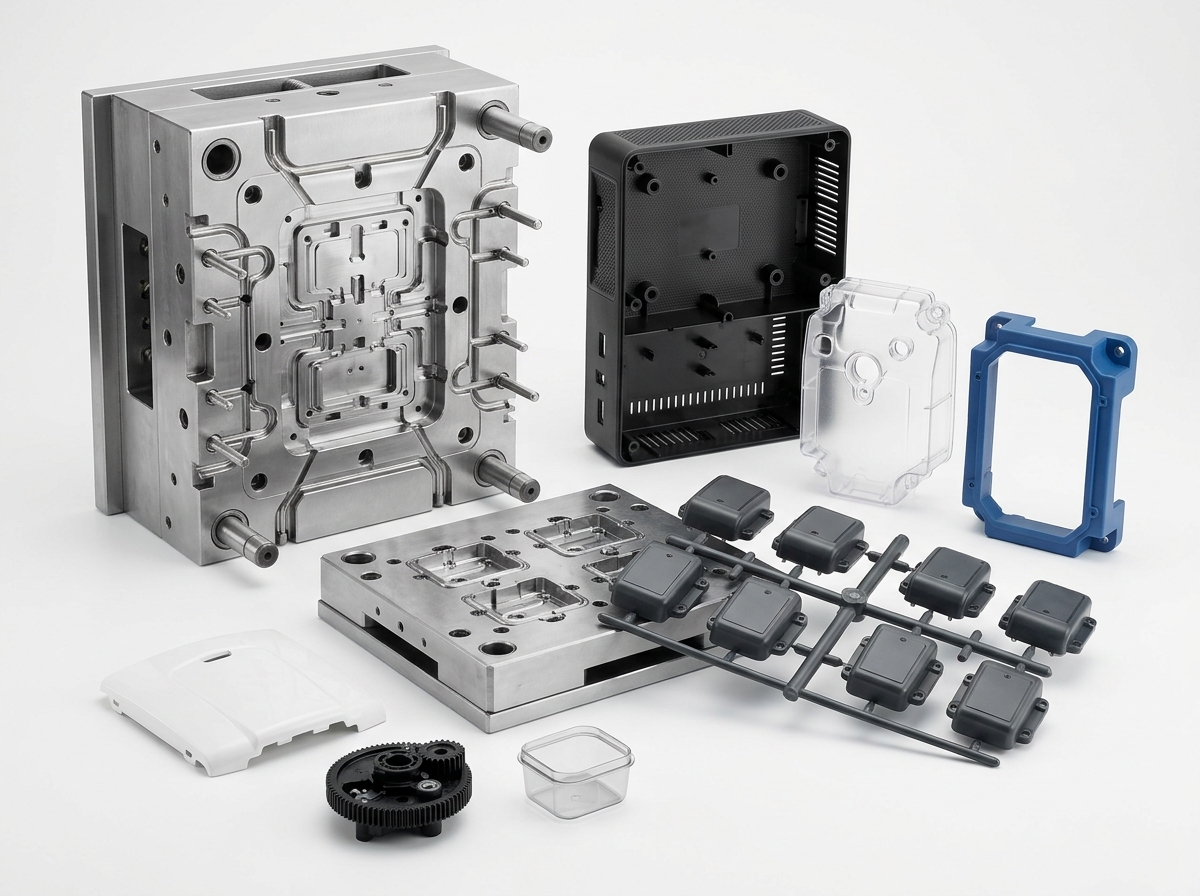 Why Material Choice Changes Mold Design
Material selection changes the mold design because plastics shrink, flow, and cool differently.
PC is often used in enclosure-like parts because it can support high impact resistance and clearer surfaces, but it also demands careful processing control. That is why the same cavity design may not perform equally across resins. A supplier that understands injection mold production should ask early questions about wall thickness, rib design, draft angle, and heat exposure in the final product.
Material behavior also affects gate placement and cooling time. A thin wall may fill quickly but distort under stress, while a thicker wall may trap heat and lengthen cycle time. For overseas factories, this is not an academic issue: every second added to cycle time multiplies across volume. In mass production, a 2-second cycle change across 500,000 parts can materially affect machine loading and labor scheduling, according to basic production planning logic used in the plastics industry.
| Material | Key Advantage | Typical Design Concern | Tooling Implication |
|---|---|---|---|
| PC | Impact resistance and clarity | Stress marks and shrink behavior | Cooling and polish control |
| ABS | Good surface and processability | Heat resistance limits | Balanced filling and ejection |
| PP | Low cost and flexibility | Higher shrinkage | Dimensional compensation |
| PA | Mechanical strength | Moisture sensitivity | Material conditioning awareness |
Buyers who start with the material in mind usually get better first trials and fewer late-stage design surprises.
How Injection Mold Production Reduces Project Risk
Injection mold production reduces risk because it makes product performance measurable before mass launch.
The best tooling projects use a structured flow: design review, moldability assessment, steel selection, machining, trial shot, sample correction, and release for production. This process is especially important when the buyer is overseas and cannot inspect every step on-site. Many factories underestimate this point and focus only on the steel cost. In reality, the largest hidden cost is usually rework caused by unclear requirements or weak trial feedback.
- Confirm part function, assembly position, and cosmetic standards.
- Review wall thickness, rib layout, and draft angles before cutting steel.
- Choose mold steel and cavity layout based on expected life and material type.
- Run trials and compare measured samples against the drawing.
- Lock process settings and issue a controlled production plan.
For export buyers, a supplier that can document each step creates a stronger audit trail. That matters when internal procurement teams need evidence for quality approval or when a product must move between factories in different countries.
Standardization, Tolerances, and Why They Matter in Export Projects
Standardization matters because overseas factories need consistent parts that can be assembled across batches, shifts, and sometimes continents.
ISO 20457:2018 is useful here because it gives a framework for dimensional tolerancing in injection-molded parts. Buyers do not need to quote the full standard in every purchase order, but they should understand that a molded dimension is only meaningful when measured against a defined tolerance zone. That is especially true for snap fits, cosmetic gaps, screw bosses, and mating surfaces.
Another practical benchmark comes from metrology. NIST emphasizes traceable measurement and controlled calibration in manufacturing quality systems. In tooling work, that means sample reports, CMM measurements, and gauge records are not paperwork; they are proof that the mold is capable of repeatable output.
| Quality Check | Why It Matters | Typical Evidence | Decision Impact |
|---|---|---|---|
| Dimensional inspection | Fit and assembly | CMM report | Tool release |
| Surface evaluation | Appearance consistency | Visual standard sample | Cosmetic approval |
| Trial shot comparison | Process stability | Sample approval sheet | Mass production sign-off |
| Steel condition check | Tool life | Maintenance log | Long-term support |
For procurement teams, this is how injection mold production turns from a promise into a measurable supplier capability.
When a One-Stop Mold Partner Makes Sense
A one-stop mold partner makes sense when speed, coordination, and supply continuity matter more than splitting the job among multiple vendors.
Overseas buyers often need more than a mold: they need sample parts, revision support, spare components, and sometimes finished plastic parts later. When all these tasks sit under one supplier, communication becomes simpler and responsibility is clearer. This is especially helpful for new product development, where design changes are still happening and time pressure is high.
The value is not only convenience. It is also lower transaction cost. Fewer handoffs usually mean fewer translation errors, fewer file mismatches, and less delay in trial scheduling. For product families with multiple SKUs, a supplier experienced in OEM mold manufacturing can also help standardize runner systems, inserts, and maintenance parts.
If you are comparing vendors, a practical question is this: can the supplier explain how the mold will be supported after delivery, not only how it will be built?
How to Evaluate an Injection Mold Manufacturer Before You Order
The strongest supplier is the one that can prove process control, not the one that talks most confidently.
Before awarding an injection mold production project, buyers should review engineering responsiveness, trial capability, documentation habits, and service continuity. Requesting only a price quote often leads to incomplete comparison, because low tooling cost can hide slow corrections or weak after-sales support. A serious buyer should ask for mold structure explanation, steel recommendation, sample timeline, and maintenance plan.
- Check whether the supplier asks for drawings, samples, and material targets before quoting.
- Confirm whether the team can provide DFM feedback in English.
- Ask how trial issues are recorded and corrected.
- Review whether spare parts and maintenance items are available.
- Compare lead time against project milestones, not only against cost.
For buyers looking at custom mold and mold parts, that checklist often reveals whether a supplier is prepared for production reality or only for the first quotation.
Common Mistakes Overseas Buyers Make
Most sourcing failures happen because the buyer assumes the mold is a one-time purchase instead of a production system.
The most common mistake is underdefining product requirements. If the drawing does not identify critical dimensions, appearance standards, or material properties, the mold may still be manufactured, but it may not be ready for scale production. Another mistake is choosing a supplier only by price and ignoring communication speed, trial process, and maintenance support.
- Buying on lowest price without checking engineering depth.
- Leaving tolerance targets vague instead of functional.
- Ignoring material shrinkage and surface requirement alignment.
- Assuming fast delivery automatically means stable production.
- Failing to plan spare parts and future tool maintenance.
These errors can be expensive because they show up after the tooling is already built, when change becomes slower and more costly.
Why Overseas Factories Need Injection Mold Production Services Now
Overseas factories need injection mold production services because global manufacturing now rewards speed, repeatability, and design-to-production coordination.
New product cycles are shorter, SKU counts are higher, and buyers expect faster sampling with fewer iterations. In that environment, a capable injection mold manufacturer does more than cut cavities; it shortens the distance between idea and shipment. For products such as electronics housings, appliance covers, and industrial enclosures, that distance often determines whether a launch is profitable.
For procurement teams, the best answer is rarely to search for the cheapest mold. It is to search for the supplier who can align design, tolerance, process, and export communication into one controlled workflow.
FAQ
What is injection mold production in simple terms?
Injection mold production is the process of building the tooling that shapes molten plastic into repeatable parts. It is the core step that allows one design to be mass-produced with consistent quality.
Why do overseas factories prefer OEM mold manufacturing?
Overseas factories prefer OEM mold manufacturing because it supports custom parts, coordinated communication, and production-ready tooling for brand-specific products.
What should I ask an injection mold manufacturer before placing an order?
Ask about DFM feedback, trial process, tolerance capability, material experience, spare parts, and expected lead time. These questions reveal real production readiness.
Is PC a good material for plastic housings?
Yes, PC is often suitable for housings that need transparency, impact resistance, and dimensional stability, especially in electronics and protective applications.
How does mold quality affect mass production cost?
Better mold quality usually reduces rework, stabilizes cycle time, and lowers scrap risk, which improves unit economics over the full production run.
What is the biggest mistake buyers make when sourcing molds overseas?
The biggest mistake is focusing only on price and ignoring engineering support, trial correction speed, and post-delivery maintenance.
When does one-stop mold service make the most sense?
It makes the most sense when the project needs faster sampling, clearer responsibility, and long-term support across multiple product revisions or SKUs.
For buyers evaluating a new project, injection mold production is not just a manufacturing step; it is the mechanism that turns a design into a stable supply chain. When the supplier understands standards like ISO 20457:2018, follows traceable measurement practices, and supports export communication, the tooling becomes an asset rather than a bottleneck. That is why overseas factories keep relying on experienced injection mold manufacturers for OEM mold manufacturing, especially in competitive categories where launch timing and consistency decide the final outcome.
Authoritative references: ISO 20457:2018, NIST, ASTM International, IEC.
Post time: Sep-02-2026