
- OEM plastic injection molding is best for repeatable, high-volume, and brand-sensitive e-commerce SKUs.
- Good mold planning reduces rework, improves fit and finish, and shortens the path from sample to mass production.
- Technical choices such as resin grade, wall thickness, and tolerance stack-up directly affect returns, cosmetic defects, and shipping damage.
- For sellers, the real value is not only custom plastic products, but faster launch timing, fewer quality surprises, and lower landed cost.
OEM plastic injection molding is one of the most practical ways to build e-commerce products that must look consistent, assemble cleanly, and survive shipping, and the need is especially strong when a part must hold a tolerance such as ±0.005 mm in precision tooling contexts, as referenced in ISO 230-1:2022. For online sellers, the challenge is rarely the idea itself; it is turning that idea into custom plastic products that can be repeated thousands of times with stable quality. That is why many procurement teams compare plastic injection molds, custom plastic parts, and plastic housings before they commit to a launch plan.
Why OEM Plastic Injection Molding Fits E-Commerce Business Models
OEM plastic injection molding fits e-commerce because the channel depends on repeatability, not one-off craftsmanship.
When a product is sold through marketplaces or a direct-to-consumer store, every unit must match the photos, the dimensions, and the buyer’s expectations. A small deviation in a clip, snap-fit, or screw boss can cause assembly problems, while visible sink marks or flow lines can trigger negative reviews. That is why plastic injection molding is often chosen for items such as electronic enclosures, accessory shells, storage components, and consumer device housings.
According to ASTM D790, flexural testing is commonly used to evaluate the stiffness of plastics in real use conditions, while ASTM D638 is widely used for tensile properties. Those standards matter because many e-commerce products are not judged only by appearance; they are judged by how well they resist bending, cracking, or fatigue during shipping and end use.
| Business Need | Why OEM Plastic Injection Molding Helps | Typical Manufacturing Control Point | Common E-Commerce Risk Reduced |
|---|---|---|---|
| High SKU repeatability | Same mold produces consistent geometry | Mold cavity balance and cooling | Variation between batches |
| Better packaging efficiency | Lightweight parts reduce volumetric cost | Wall thickness and rib design | High freight cost |
| Brand presentation | Stable surface finish and color matching | Material selection and texture | Negative reviews from cosmetic defects |
| Launch speed | Samples can be iterated before mass production | DFM review and tooling trial | Delayed product launch |
What E-Commerce Sellers Actually Need From a Plastic Injection Molding Supplier
E-commerce sellers need a supplier that can manage engineering, sampling, and production as one process.
The best OEM plastic injection molding suppliers do more than make parts. They review drawings, suggest resin alternatives, identify thin-wall risks, and prepare tooling with production in mind. This is especially important for custom plastic products that must fit other components such as PCBs, batteries, fasteners, or imported hardware.
For sellers managing a portfolio of SKUs, the value of one-stop supply is practical rather than theoretical. A supplier that can support OEM and ODM services, 3D molds, and household product molds can reduce communication gaps, shorten sample loops, and make future product expansion easier. That matters when a store owner needs one engineering team to support several product lines.
In practical sourcing terms, the supplier should also support English communication, file review, lead-time control, and export packaging. Those process details often decide whether a launch arrives on time or misses the selling season.
Which Product Types Benefit Most From Custom Plastic Products
Products with repeated geometry and visible surfaces benefit the most from OEM plastic injection molding.
Consumer electronics accessories, small appliances, home goods, toys, footwear components, and industrial add-on parts all have different priorities, but they share one need: reliable scale-up. For example, an electronics shell may need tighter assembly clearances, while a toy housing may need stronger visual appeal and color consistency. A household item may prioritize cost per unit, while an industrial cover may prioritize long-term durability.
PC material is often selected for transparent or impact-resistant housings because it combines good dimensional stability with useful toughness. In the context of e-commerce, that is valuable when a product must look premium on the shelf and still survive transport. For more complex geometry, houseware molds and plastic mold parts can help brands build families of compatible components.
| Product Category | Primary Priority | Common Material Choice | Why Injection Molding Works | Typical Buyer Concern |
|---|---|---|---|---|
| Consumer electronics housings | Fit, finish, and snap strength | PC, ABS, PC-ABS | Precise geometry and repeatability | Returns from poor assembly |
| Household products | Cost and fast turnover | PP, ABS | Low unit cost at scale | Margin pressure |
| Toys and leisure goods | Appearance and safety | ABS, PP | High-volume color stability | Cosmetic defects |
| Industrial accessories | Strength and continuity of supply | PA, PC | Stable production over time | Downtime from supplier issues |
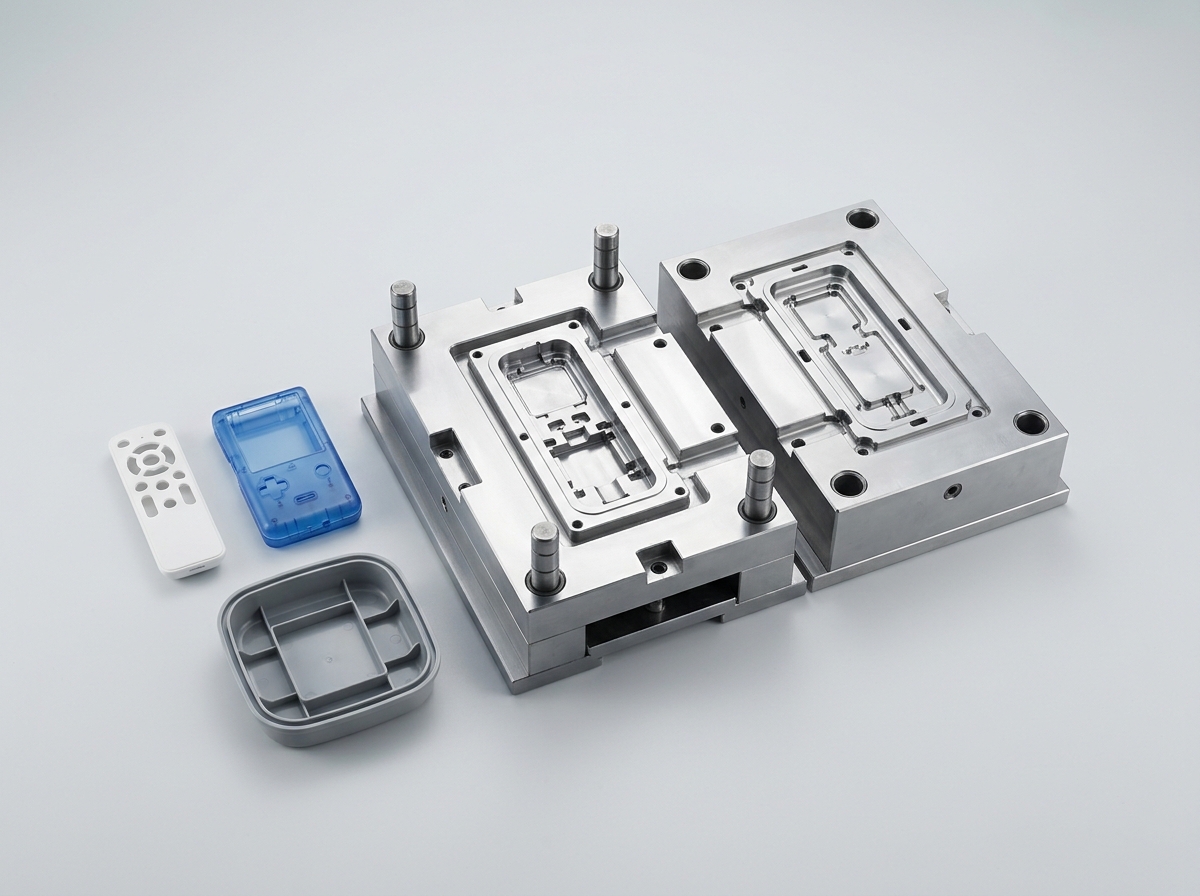
How OEM Plastic Injection Molding Improves Cost, Speed, and Quality
OEM plastic injection molding improves e-commerce economics because it spreads tooling cost across many units while keeping each unit consistent.
Injection molding is especially effective when the same part must be produced thousands or tens of thousands of times. Once the mold is validated, cycle time becomes a major cost lever. A typical thermoplastic injection cycle may range from about 15 to 60 seconds depending on part size, wall thickness, and cooling demand, which means the production line can move quickly once the process is stable. That speed is one reason sellers use mold-based production instead of repeated manual fabrication.
Quality control is equally important. Plastic parts are not only measured for dimensions; they are also checked for warpage, weld lines, gate marks, flash, and color shift. In many programs, a supplier will also monitor shrinkage and fit using functional gauges rather than relying only on nominal dimensions. For sellers, this lowers the chance that a part looks acceptable in photos but fails in real assembly.
The NIST plastics resources are useful because they reinforce a simple point: polymer processing is highly sensitive to process conditions, and small changes in temperature, pressure, or cooling can affect final part quality. That sensitivity is exactly why OEM plastic injection molding works best when design, tooling, and process control are aligned from the start.
How to Evaluate a Plastic Injection Molding Factory for E-Commerce Orders
A good plastic injection molding factory is judged by process discipline, not just machine count.
For e-commerce, the right supplier should show how it handles DFM, sample approval, mold maintenance, and production traceability. If the supplier cannot explain gate location, draft angle, or ejector pin strategy, the risk of late-stage rework is high. Buyers should also ask whether the factory supports injection molds for complex parts, precision molds for tighter assemblies, and plastic moulding products for finished goods.
- Ask for a DFM review before tooling starts.
- Confirm material options and substitution rules.
- Request sample criteria for appearance and function.
- Check mold steel, cavity count, and maintenance plan.
- Review lead times for first article, trial, and mass production.
| Supplier Checkpoint | What Good Looks Like | Why It Matters for E-Commerce | Typical Failure if Ignored |
|---|---|---|---|
| DFM support | Clear feedback on wall thickness and draft | Reduces redesigns | Tooling changes after sampling |
| Sampling process | Defined approval criteria | Prevents ambiguous sign-off | Quality disputes |
| Production stability | Repeatable settings and records | Supports replenishment | Batch inconsistency |
| Communication speed | Fast response on files and changes | Helps seasonal launches | Missed sales window |
Common Design Mistakes in Custom Plastic Products
Most custom plastic product failures come from design choices that ignore molding reality.
The most common mistake is making walls too thick in some areas and too thin in others. Uneven wall thickness can trap heat, increase sink marks, and create warpage. Another frequent issue is underestimating draft angle, which makes part release harder and can damage cosmetic surfaces. Sellers also sometimes select a resin based only on price, without considering impact strength, UV resistance, or food-contact requirements.
For transparent or semi-transparent parts, PC can provide useful toughness, but the product still needs proper gate placement and polishing strategy to preserve visual quality. For snap-fit parts, the design must account for strain limits and repeated assembly. For housings, screw boss design should balance strength and material flow. These are not theoretical concerns; they are the main reasons many first samples fail.
The best way to avoid these issues is to treat tooling as a manufacturing engineering project, not just a fabrication order. That is where OEM plastic injection molding creates value beyond simple part production.
What Data-Driven Buyers Should Compare Before Ordering OEM Plastic Injection Molding
Data-driven buyers should compare tolerance need, resin choice, lifecycle volume, and tooling strategy before placing an order.
The right comparison starts with usage. If a part must be decorative, structural, or weather-resistant, each requirement affects both resin and mold design. ASTM material testing standards help separate guesswork from facts. For example, ASTM D256 is commonly used for impact resistance, which is relevant for items that may be dropped during shipping or daily use. For heat performance, sellers may also ask for heat deflection data and long-term aging behavior from the material supplier.
Volume also matters. A single-cavity mold may fit early-stage validation, but a multi-cavity tool can reduce unit cost when demand is proven. The trade-off is tooling investment versus per-part economics. That decision should be linked to the product’s sales forecast rather than made on machine preference alone.
| Decision Factor | Low-Volume Launch | Growth Phase | High-Volume SKU |
|---|---|---|---|
| Cavity count | 1 | 2 to 4 | 4 to 8 or more |
| Tooling strategy | Flexible, easy to revise | Balanced cost and speed | Lowest unit cost focus |
| Material priority | Testability | Performance stability | Price-performance ratio |
| Quality focus | Prototype function | Cosmetic consistency | Long-run process control |
Why One-Stop Mold and Part Supply Matters for Cross-Border Sellers
One-stop mold and part supply reduces coordination cost, which is often invisible until a project gets delayed.
When the same supplier manages mold making, trial runs, and part production, the buyer has fewer handoffs and fewer opportunities for miscommunication. That becomes especially valuable for cross-border sellers who need export packaging, file review, and timeline coordination across time zones. It also helps when a product family grows from one SKU into several variants, because the same tooling partner already understands the design logic.
That is why many buyers prefer a supplier that can support custom injection mold work and finished custom plastic products from the same project file. In practice, that integrated approach can improve response time, reduce duplicated engineering effort, and simplify future revisions.
Practical Conclusion for E-Commerce Buyers
OEM plastic injection molding is worth it when a seller needs a product that is repeatable, scalable, and commercially defensible.
If the SKU must survive shipping, maintain a strong appearance, and stay profitable as volume rises, plastic injection molding is usually the most efficient path. The key is choosing a supplier that can handle engineering review, tooling, sample approval, and production discipline as one workflow. For e-commerce sellers, the best outcome is not just a mold; it is a stable supply system for custom plastic products that can support growth.
FAQ
Why do e-commerce sellers prefer OEM plastic injection molding over simple fabrication?
They prefer it because injection molding offers repeatability, lower unit cost at volume, and more stable cosmetic quality than ad hoc fabrication methods.
What products are best suited for plastic injection molding?
Products with repeated geometry, snap-fits, housings, covers, and consumer-facing surfaces are usually strong candidates.
How does OEM plastic injection molding help reduce returns?
It helps reduce returns by improving fit, consistency, and surface quality, which lowers assembly issues and cosmetic complaints.
What should buyers ask before approving a mold?
Buyers should ask about DFM feedback, resin choice, gate design, draft angle, cavity count, and the sample approval process.
Is PC always the best resin for housings?
No. PC is strong for impact resistance and clarity, but the right resin depends on cost, heat exposure, appearance, and function.
Why does cycle time matter for e-commerce sellers?
Cycle time affects production speed and unit cost, so faster stable cycles can improve replenishment and margin control.
What makes a supplier better for cross-border projects?
Fast English communication, disciplined file handling, stable lead times, and one-stop mold-to-production support usually matter most.
Post time: Aug-03-2026