
- Durability depends on the service environment, not only on tensile strength or price.
- For many long-life housings, PC is favored for impact resistance and dimensional stability.
- For moving parts, POM often delivers better wear performance than commodity plastics.
- For heat and chemical exposure, PPS, PEEK, and some glass-filled grades can outperform standard engineering plastics.
- Material selection should always be validated with testing, design review, and production-process compatibility.
Plastic materials are not equally durable, and the right choice depends on the part’s load case, temperature, humidity, and service life target. For example, ISO 527-1 defines tensile testing for plastics, while ASTM D256 is widely used to evaluate impact resistance; these standards help compare engineering plastics objectively instead of relying on marketing claims. In real purchasing decisions for durable plastic products, buyers often compare plastic injection mold solutions, plastic shell mold options, and 3D mold development to balance strength, appearance, and cost across the full product life cycle.
Which Plastic Material Offers the Best Durability for Long-Term Use?
The best durable plastic depends on whether the part must resist impact, wear, heat, chemicals, or creep over years of use. A housing for consumer electronics may need impact toughness and dimensional stability, while a gear, bushing, or slider may need low friction and abrasion resistance. In practice, PC is often selected for long-life housings, POM for moving components, and high-performance materials such as PPS or PEEK for harsher environments.
From a manufacturing perspective, durability is also tied to process stability. A well-designed plastic injection mold can reduce variation in wall thickness, sink marks, and weld-line weakness, which directly affects part life. For buyers comparing OEM custom parts and supplier capability, the key question is not only which resin is strongest, but which resin can be molded consistently at scale.
Engineering plastics vs commodity plastics: the durability gap
Engineering plastics generally outperform commodity plastics when long-term mechanical stability matters. Polypropylene and polyethylene may be cost-effective, but they usually cannot match the stiffness, heat resistance, or wear behavior of engineering grades under sustained load. In contrast, PC, POM, PA, PBT, PPS, and PEEK are designed for structural performance, tighter tolerances, and longer service life.
| Material | Main durability advantage | Typical service strength focus | Common long-term use case |
|---|---|---|---|
| PC | Impact resistance | Toughness and clarity | Protective housings, covers |
| POM | Wear and low friction | Sliding stability | Gears, latches, mechanisms |
| PA66 | Fatigue resistance | Strength after repeated load | Clips, structural brackets |
| PBT | Dimensional stability | Electrical and thermal balance | Connectors, enclosures |
| PPS | Heat and chemical resistance | High-temperature reliability | Industrial and automotive parts |
| PEEK | Extreme performance | Heat, wear, and chemicals | Medical, aerospace, precision parts |
For buyers, the practical takeaway is simple: commodity plastics are often sufficient for short service life or low-stress products, but engineering plastics become the safer choice when replacements are expensive, downtime is unacceptable, or the part is mission-critical.
PC, POM, PA, PBT, PPS, and PEEK: how to choose the most durable plastic
PC is often the best all-around answer for durable plastic products that need impact strength and visual quality. It is widely used for transparent covers, protective windows, and housings that must survive drops and repeated handling. A key advantage is that PC combines toughness with good dimensional stability, making it attractive for consumer electronics and appliance housings.
POM is usually the better choice for wear-prone moving parts. Its low coefficient of friction and good fatigue behavior make it suitable for gears, cams, slides, and locking components. If a product fails because of repeated motion rather than a single impact, POM often outlasts more brittle alternatives.
PA grades are strong candidates when repeated mechanical loading is the main concern. Nylon families offer good toughness and fatigue resistance, but moisture absorption can change dimensions and stiffness. That means PA can be durable in real use, but only if the design accounts for humidity and tolerances.
PBT offers a good balance of strength, electrical performance, and dimensional stability. It is often used in connectors and electrical housings where long-term shape retention matters. Compared with lower-end plastics, PBT is much better suited to parts that must hold assembly tolerances over time.
PPS and PEEK are the premium durability options for severe environments. They are more expensive, but they remain attractive where heat, chemicals, or continuous load would shorten the life of standard engineering plastics. In industrial applications, they are often selected not because they are cheapest, but because they reduce failure risk.
| Material | Relative durability profile | Strength point | Risk to manage | Best-fit scenario |
|---|---|---|---|---|
| PC | High impact durability | Drop resistance | Scratch sensitivity | Transparent protective parts |
| POM | High wear durability | Low friction | Bonding difficulty | Mechanisms and sliding parts |
| PA66 | High fatigue durability | Repeated loading | Moisture uptake | Clips and structural components |
| PBT | High dimensional durability | Shape retention | Hydrolysis in harsh conditions | Electrical housings |
| PPS | High thermal durability | Heat and chemicals | Higher cost | Industrial duty parts |
| PEEK | Very high durability | Extreme environments | Material cost | Critical long-life components |
For sourcing teams, the best filter is application stress, not resin popularity. A part that sees repeated flexing, heat cycling, or solvent exposure should be validated with the actual operating profile, not a brochure specification.
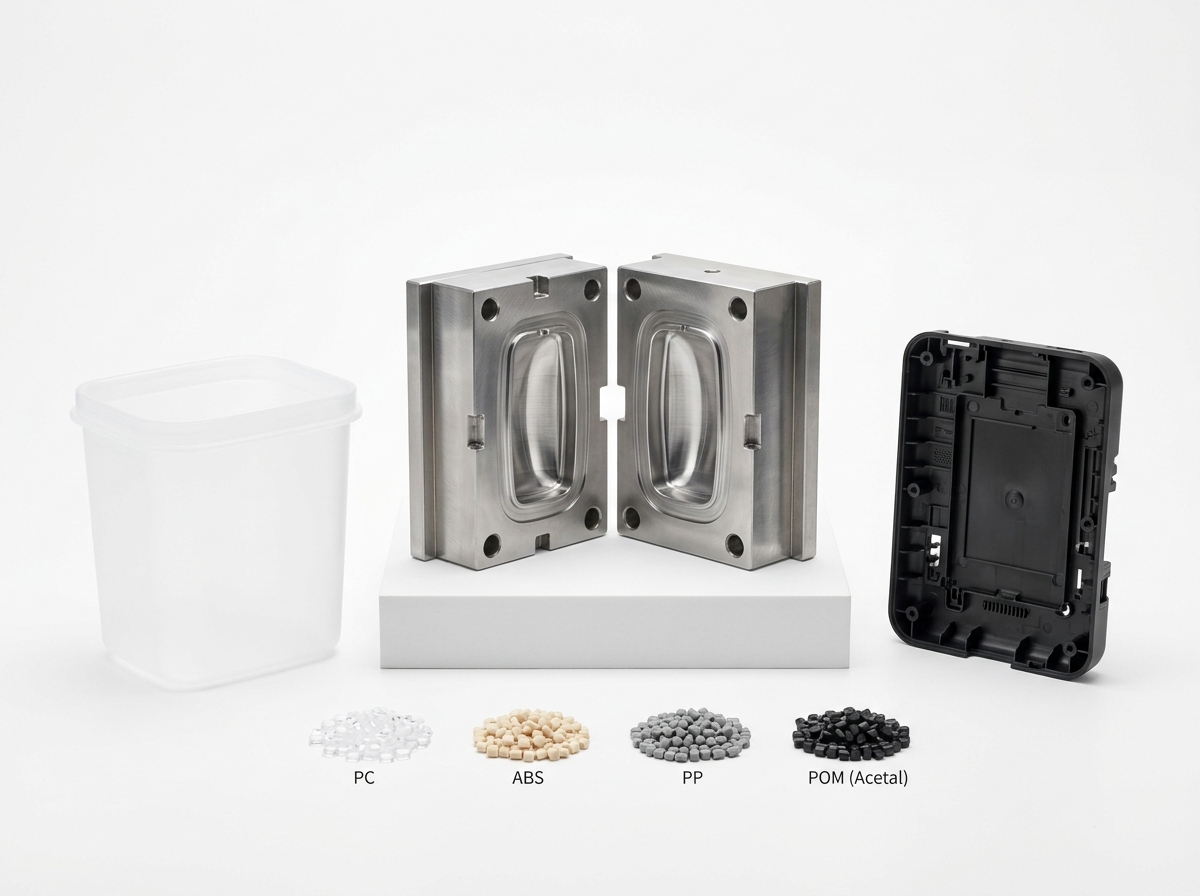 What standards and test methods matter for durable plastic products?
Durability claims should be verified against standard test methods. ISO 527-1 covers tensile properties of plastics, ASTM D256 covers impact resistance, ASTM D570 measures water absorption, and ASTM D648 is used for heat deflection temperature. These tests do not replace real-life qualification, but they create a common language for comparing materials.
The most useful standard-based data points for buyers are tensile strength, impact resistance, water uptake, heat deflection temperature, and creep behavior under load. If a supplier cannot explain how the material performs under these tests, the risk of field failure rises sharply.
For precision-oriented projects, consistency matters as much as raw strength. NIST has long emphasized measurement traceability in manufacturing, and that principle applies directly to plastic part durability: if dimensional drift is not controlled, even a strong material can become a weak product after assembly.
Relevant references include ISO 527-1, ASTM D256, ASTM D570, and ASTM D648. For manufacturing traceability principles, see NIST.
Durability in real products: what buyers should verify before ordering
Long-term durability is a system outcome, not a material label. Even a premium resin can fail early if the wall thickness is poor, the gate design creates weld-line weakness, or the cooling path induces residual stress. This is why buyers of durable plastic products should ask for design-for-manufacture feedback before tooling begins.
- Confirm the actual load case: impact, bending, wear, heat, UV, or chemical exposure.
- Ask for the target service life in cycles, years, or operating hours.
- Request standard test data, including tensile, impact, and heat resistance results.
- Review wall thickness, rib design, and expected shrinkage behavior.
- Validate whether the chosen resin is stable under humidity, sunlight, or detergents.
In many cases, a buyer thinks they need the strongest plastic, but the better decision is the one that minimizes total cost of ownership. That may mean choosing a slightly more expensive resin that reduces breakage, warranty claims, and replacement downtime.
How injection molding affects the durability of engineering plastics
Injection molding quality can make or break long-term performance. The same resin can perform very differently depending on mold design, melt temperature, packing pressure, cooling balance, and moisture control. For example, overly aggressive processing can degrade polymers, while insufficient drying can weaken hydrolysis-sensitive materials.
For durable housings and structural parts, mold balance, gate location, and cooling uniformity are critical. This is especially true in products served by plastic shell mold projects and durable housing mold solutions, where surface appearance and internal integrity must both remain stable over time.
As a practical benchmark, ISO 20457 provides a framework for precision mold manufacturing, and that matters because mold accuracy influences part repeatability. When assembly tolerances are tight, small process variations can become functional failures after repeated use.
In long-life applications, buyers should also evaluate whether a supplier can support prototype validation and ramp-up to mass production. That reduces the chance of discovering durability issues only after tooling is complete.
Case-based material selection: the best choice by application
The right durable plastic changes by use case. A transparent protective cover, a gear, and an outdoor connector each demand different failure resistance.
| Application | Most suitable material | Why it lasts longer | Main design caution |
|---|---|---|---|
| Electronic protective cover | PC | Impact resistance and clarity | Scratch control |
| Small gear or slider | POM | Wear resistance and low friction | Dimensional control |
| Structural clip | PA66 | Fatigue resistance | Moisture absorption |
| Electrical connector housing | PBT | Dimensional stability | Heat and humidity exposure |
| Industrial hot-zone part | PPS | Heat and chemical resistance | Higher tooling and material cost |
| Critical precision component | PEEK | Extreme durability envelope | Very high material cost |
For consumer products, PC often wins because it gives a strong combination of toughness and appearance. For industrial systems, PPS or PEEK may be justified if downtime is more expensive than resin cost. For moving assemblies, POM is often the hidden champion because wear failure is usually the real end-of-life trigger.
If the project requires multi-SKU development or fast design changeover, working with a supplier experienced in custom plastic parts and multi-SKU production support can reduce iteration time and improve long-term consistency across the product line.
Common mistakes buyers make when choosing durable plastics
The most common mistake is optimizing for one property and ignoring the rest. A plastic with excellent tensile strength may still fail if it creeps under load, absorbs moisture, or cracks under impact.
- Choosing the cheapest material without validating life-cycle stress.
- Ignoring humidity, UV, detergent, or solvent exposure.
- Using a strong resin in a poorly designed mold.
- Assuming high stiffness means high impact resistance.
- Skipping prototype testing before mass production.
A second mistake is not separating short-term performance from long-term performance. A material can pass a basic hand test yet fail after 500 thermal cycles, 10,000 actuations, or a year of outdoor exposure. For durable plastic products, the qualification plan should match the real service environment.
FAQ: Which plastic material is most durable for long-term use?
1. Is PC the most durable plastic overall?
PC is one of the best all-around durable plastics for impact resistance and clarity, but it is not always the best for wear, chemical exposure, or high heat.
2. Is POM better than PC for long-term use?
POM is often better for moving parts and wear resistance, while PC is usually better for impact-prone housings and transparent parts.
3. What plastic lasts longest in high heat?
PPS and PEEK are typically stronger candidates for high-heat environments than standard engineering plastics, although the exact choice depends on load and chemical exposure.
4. Which engineering plastic is best for outdoor durability?
PC, certain UV-stabilized PA grades, and selected high-performance materials can work outdoors, but UV exposure and moisture must be tested explicitly.
5. What is the most cost-effective durable plastic?
The most cost-effective option is usually the one that meets service requirements with the lowest total cost of ownership, often PC, POM, or PBT depending on the application.
6. How do I verify a supplier’s durability claims?
Ask for ISO or ASTM test data, prototype samples, material traceability, and a clear explanation of how the part was validated for its end-use environment.
7. Should I choose a custom mold or a standard mold for durable parts?
Custom molds are usually better when geometry, fit, or performance requirements are specific, while standard tooling may be acceptable for simpler, lower-risk products.
For buyers sourcing long-life components, the best decision is to align material, mold design, and qualification testing before production begins. That approach reduces failures, stabilizes quality, and makes durable plastic products far more predictable in real use.
Post time: Aug-31-2026