
Choosing a China mold factory for complex plastic parts is mainly about technical fit, not just price. The right supplier should show clear experience with tight-tolerance housings, multi-feature components, and repeatable mass production.
What Makes a China Mold Factory Suitable for Complex Plastic Parts?
A suitable plastic mold supplier must control geometry, shrinkage, and assembly risk from the start. Complex parts often fail because the tooling plan is weak, not because the material is wrong.
For reference, ISO 20457 covers tolerances and acceptance conditions for molded plastic parts, while ASTM D955 measures shrinkage from mold dimensions and ASTM D3641 supports consistent specimen preparation for injection molding tests. These standards matter because they help buyers compare suppliers using measurable criteria rather than vague claims.
In practice, the best factories usually offer design review, mold flow thinking, trial support, and post-trial correction. They also understand that complex parts need stable gate placement, venting, cooling balance, and ejection planning.
How to Shortlist the Best China Mold Factory
The fastest way to shortlist a China mold factory is to score it across five technical checks. This method reduces risk before you send drawings or samples.
- Design capability: Can the team review ribs, bosses, undercuts, and wall thickness?
- Process control: Can they explain mold flow, shrinkage, and trial parameters clearly?
- Part complexity: Have they handled housings, 3D surfaces, and functional assemblies?
- Quality evidence: Do they show inspection reports, trial records, or sample photos?
- Communication: Can they support English technical discussion and fast feedback?
A simple scoring card helps buyers compare suppliers objectively. For example, a factory that can explain tolerance strategy and trial correction steps is usually safer than one that only quotes tooling cost.
Comparison Table: Practical Factory Evaluation Scorecard
| Evaluation Area | What to Check | Why It Matters |
|---|---|---|
| Engineering review | DFM, parting line, draft, undercuts | Reduces mold redesign risk |
| Trial capability | T1/T2 correction process | Improves first-pass fit and finish |
| Measurement control | CMM, gauges, inspection records | Supports repeatable dimensions |
| Production support | Injection molding and ramp-up | Helps move from sample to volume |
Which Factory Types Usually Perform Best?
The best factories for complex plastic parts are usually not the cheapest ones. They are the suppliers that combine mold making, molding, and engineering support in one workflow.
For electronics housings, a factory with strong PC case mold experience is often a better fit than a general-purpose toolmaker. For broader enclosure work, buyers should also review plastic case mold capability and the supplier’s trial discipline.
For projects that need both tooling and molding, our injection molding services can be relevant because the same team can manage design, trial, and production transfer. When a project includes multiple product lines, a factory with plastic products experience is often easier to coordinate.
Comparison Table: Best-Fit Factory Type by Part Complexity
| Part Type | Best Factory Strength | Typical Risk |
|---|---|---|
| Electronic enclosure | Precision case mold engineering | Warping and poor fit |
| 3D-shaped component | Advanced surface and slider design | Poor release and visible seams |
| Custom structural part | DFM and trial correction | Assembly mismatch |
| Consumer plastic item | Stable molding and cycle control | Inconsistent appearance |
Why One-Stop Mold and Molding Services Matter
One-stop service is often the safest choice for custom plastic parts because it reduces handoff errors. When design, tooling, trial, and molding sit under one roof, the supplier can correct problems faster.
This matters especially for OEM and ODM programs. A project may start from a drawing, then move to a sample, then require several adjustments before mass production. A fragmented supply chain often slows that process and increases communication loss.
Industry estimates suggest that projects with a single accountable supplier can reduce trial coordination time by 15% to 30% compared with split sourcing, although the exact result depends on part complexity and approval speed. That is an estimate, not a universal rule, but it reflects common procurement experience.
For buyers comparing suppliers, one-stop support is especially useful when the part includes cosmetic surfaces, assembly clips, or hidden functional features. These details are often easier to stabilize when the same engineering team owns the full workflow.
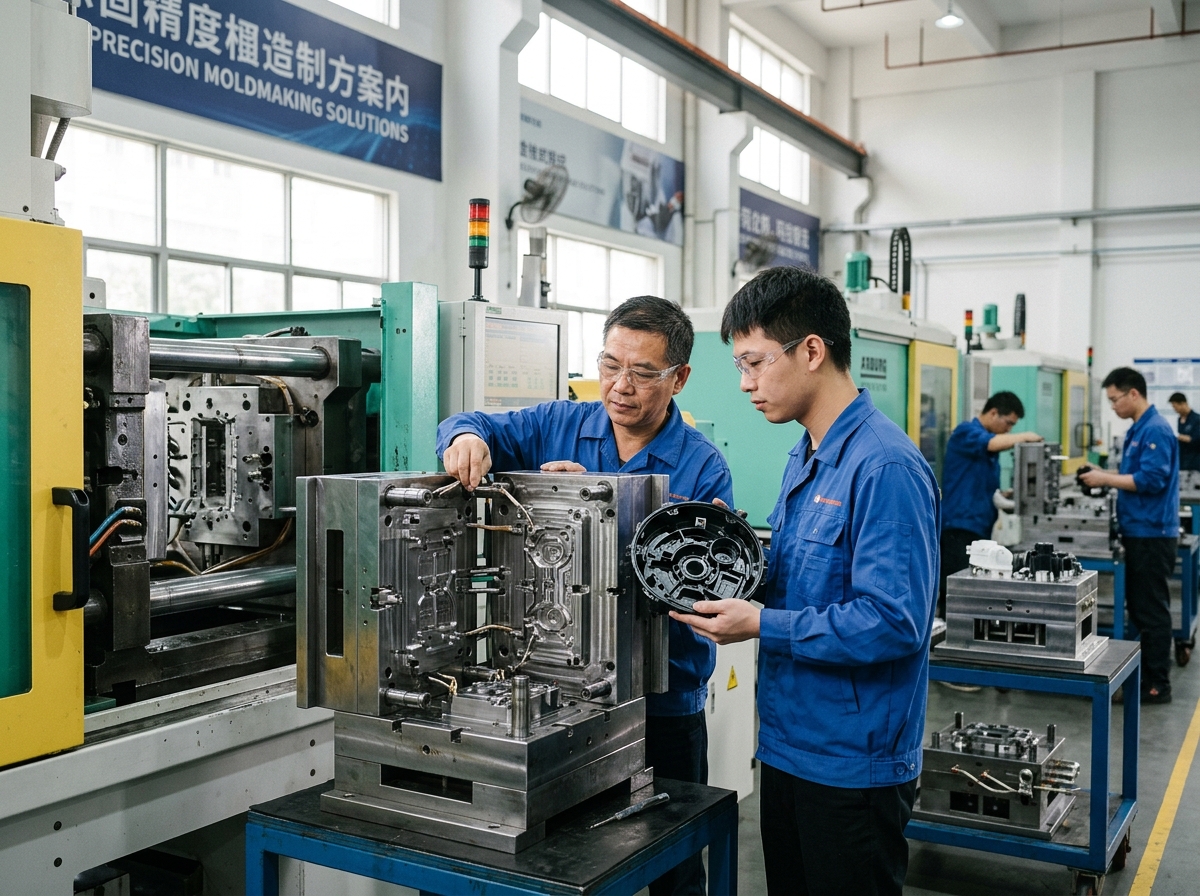
What Complex Parts Need During Trial and Validation
Trial validation is the point where a mold proves whether it can make usable parts. For complex plastic parts, the trial stage is usually more important than the quotation stage.
During trial, the factory should check filling, shrinkage, ejection, surface finish, and assembly fit. ASTM D955 is useful here because shrinkage data helps confirm whether the cavity design matches the final part dimensions.
For a practical example, a housing project with multiple snap-fits may need more than one trial to stabilize clip force and cosmetic quality. In similar anonymous B2B projects, a well-managed DFM review and trial loop has reduced rework by one or two correction rounds, according to industry estimates.
Buyers should ask for trial photos, dimensional reports, and a clear list of corrections after each run. That evidence is more valuable than a general promise of “high precision.”
Where to Buy and What to Compare
The most reliable purchasing approach is to compare factories by capability, not by headline claims. Buyers can start with the target website’s main categories, then benchmark them against other established mold suppliers in the market.
On the target site, useful starting points include the homepage, the injection molding service page, and the PC case mold page. These pages help buyers understand whether the supplier is better suited to housings, custom parts, or broader molding projects.
For broader supplier comparison, buyers often also review established global mold makers and injection molding firms that publish engineering references, inspection methods, and industry-specific case studies. The key is to compare documented capability, not just website design.
Comparison Table: Supplier Selection Questions Before RFQ
| Question | Good Answer Looks Like | Red Flag |
|---|---|---|
| Can you handle complex geometry? | Specific examples and tooling methods | Only generic claims |
| How do you manage shrinkage? | Material-based explanation and trial data | No process detail |
| Do you support custom plastic parts? | Drawing, sample, and concept support | Only standard catalog work |
| What happens after T1? | Correction plan and inspection report | No structured follow-up |
Which China Mold Factories Are Best for Complex Plastic Parts?
The best China mold factory is the one that can prove engineering control, not the one that only offers the lowest quote. For complex plastic parts, the strongest candidates are usually factories with case-mold experience, one-stop molding support, and documented trial correction capability.
In this category, suppliers with focused plastic mold, enclosure mold, and custom plastic parts experience are usually more reliable than general traders. A factory that can move from drawing review to trial and then to stable production is the safest choice for B2B buyers.
If the project is an electronics housing, a precision enclosure supplier is often the right fit. If the project is a multi-feature custom component, then a one-stop mold and molding partner is usually better. If the project is still in concept form, a supplier with design support and fast prototyping is the most practical option.
FAQ
1. Is it safe to buy complex molds from China?
Yes, it can be safe when the supplier shows engineering depth, inspection control, and clear trial records. The main risk is not geography; it is weak process control. Buyers should verify DFM support, dimensional reporting, and correction workflow before placing an order.
2. What files should I send to a China mold factory?
A 3D file, 2D drawing, sample photos, material preference, and target tolerance are the most useful inputs. If the part is still conceptual, a sketch with key dimensions can still start the discussion. Clear input usually shortens quotation and design review time.
3. How many trials are normal for complex plastic parts?
Many complex projects need at least one correction cycle, and some need two or more. The number depends on geometry, material shrinkage, cosmetic requirements, and assembly tolerance. A good factory will explain why a correction is needed instead of treating it as a surprise.
4. What is the biggest mistake buyers make when choosing a mold supplier?
The biggest mistake is choosing only by price. Low tooling cost can hide weak venting, poor cooling, or limited trial support. Those issues often create higher total cost later because they increase rework, delay launch, and reduce production stability.
5. Who should request a one-stop mold and molding service?
OEM and ODM teams, product developers, and sourcing managers usually benefit most. It is especially useful when the project needs fast sample approval, repeated adjustments, or a smooth move into mass production. One accountable supplier can simplify communication and reduce handoff risk.
Request a quote: If you are comparing suppliers for a complex housing, custom structural part, or multi-feature plastic component, prepare your drawing, target quantity, material, and tolerance notes before sending an RFQ. That will help you evaluate factories more accurately and shorten the sourcing cycle.
Post time: Jul-08-2026